

Let’s get one thing straight: social selling isn't about spamming prospects' inboxes with generic pitches. If that’s your strategy, you’re doing it wrong.
Instead, think of it as the modern way to find, connect with, and build genuine trust with potential customers on social platforms before you ever ask for the sale.
What Is Social Selling in Simple Terms

Let's cut through the buzzwords with an analogy.
Picture a huge industry conference. The old-school salesperson is the one speed-walking the floor, shoving a business card into every hand they see and launching into a canned pitch. It's interruptive, impersonal, and—let's be honest—mostly ineffective.
Now, imagine someone else at that same conference. They're spending their time actually listening to conversations, joining a small group here and there to offer a genuinely helpful thought, and connecting with people over shared challenges. They become a familiar, trusted face. When a real business need comes up, who are you going to talk to?
That second person gets it. That's the heart of social selling.
From Interrupting to Engaging
At its core, social selling is the art of using platforms like LinkedIn to listen for buying signals, share things that are actually useful, and have real conversations. It completely flips the script from a numbers game of outbound cold calls to a value-driven, inbound approach.
Instead of hammering a list of names, you’re building a network of people who already see you as a credible expert in your field. This is absolutely critical because B2B buyers today do most of their homework online long before they ever want to talk to a salesperson. They’re smart, they’re busy, and they have zero patience for aggressive, outdated tactics.
Social selling isn’t a replacement for sales; it’s the powerful front-end that meets buyers where they already are. It’s the digital version of building a relationship over coffee instead of shouting at someone through a megaphone.
This whole approach is about playing the long game. It’s a system built on:
- Listening to what your audience is struggling with.
- Sharing content that solves their problems, not just promotes your product.
- Engaging like a real person in comments and discussions.
- Building professional authority and trust, one interaction at a time.
By the time you slide into their DMs or hop on a call, the heavy lifting is done. They already know who you are and what you stand for, making the "sale" feel like the next logical step in a conversation you were already having.
A Quick Comparison
Let's put the two methods side-by-side. The difference in approach—and results—is night and day.
Social Selling vs Traditional Selling at a Glance
| Attribute | Social Selling | Traditional Selling |
|---|---|---|
| Primary Goal | Build relationships and trust | Close a transaction quickly |
| Approach | Inbound and value-driven | Outbound and volume-driven |
| Communication | Two-way dialogue | One-way pitch |
| Focus | Helping and educating | Persuading and pushing |
| Key Channel | Social networks (e.g., LinkedIn) | Cold calls, mass emails |
| Timing | Long-term, continuous effort | Short-term, campaign-based |
| Outcome | Warm, qualified leads | Low conversion rates |
Ultimately, one is about farming—cultivating relationships over time. The other is about hunting—chasing down the next kill. Understanding this is the first real step toward building a sales pipeline that actually works in today’s world.
Why Social Selling Is Critical for B2B Revenue
Let's be honest: the B2B buying game has completely changed. Your prospects aren't waiting by the phone for a cold call anymore. They're scrolling through LinkedIn, joining communities, and reading posts from experts.
By the time they're ready to talk to a salesperson, they've already done 70% of their research and have a pretty strong opinion about who they want to work with. If you're not part of that conversation, you're already behind.
This is where social selling stops being a "nice-to-have" and becomes a must-have. It’s about meeting your buyers where they already are—on platforms like LinkedIn—and showing up with genuine value instead of a pushy sales pitch.
By building a real presence, your team can engage prospects long before they're "in-market," establishing the trust and authority that makes you the obvious choice when the time is right.
Driving Tangible Business Outcomes
A smart social selling strategy isn't about chasing vanity metrics like likes and followers. It's about focusing on the specific activities that actually fuel your sales pipeline and drive real revenue.
The whole point is to flip the script—stop pushing your product and start pulling in high-intent buyers who already see you as a trusted advisor.
When you get this right, you'll see a massive impact across your entire sales funnel:
- Shorter Sales Cycles: Trust is the ultimate accelerator. When prospects already know and respect you, they move through the buying process faster because you've already done the heavy lifting of educating them.
- Increased Win Rates: Reps who build relationships on social media are seen as credible experts, not just another vendor trying to make a sale. That gives them a massive competitive advantage.
- Higher Average Deal Size: When you have a foundation of trust, you can have more strategic, honest conversations. This often uncovers bigger problems you can solve, leading to larger opportunities.
This isn't just theory; the numbers back it up. Salespeople who actively use social selling are consistently running circles around their peers.
A staggering 78% of salespeople who leverage social selling crush their peers who don't. And the top performers? They exceed their quotas 23% more often. They aren't spending all day on it either—many dedicate less than 10% of their time but see huge returns because their engagement is targeted and valuable.
From Cold Outreach to Warm Demand
At the end of the day, social selling is the missing link between marketing's big-picture awareness campaigns and sales' boots-on-the-ground closing efforts.
It warms up the entire market by consistently delivering value. So when your team finally does reach out, they're not met with a cold shoulder. They're greeted with recognition, respect, and often, genuine curiosity.
This approach is the engine of modern B2B demand generation strategies, creating a predictable flow of inbound opportunities from your dream customers. Instead of chasing leads, you attract them by becoming an indispensable resource in their professional lives. This doesn't just fill the pipeline; it fills it with better, more qualified deals that are ready to close.
The Four Pillars of an Effective Social Selling Strategy
Moving from theory to action means you need a system. A killer social selling program isn't about random likes and comments; it’s built on a repeatable framework that turns your LinkedIn presence from a passive profile into a pipeline-generating machine.
This whole process rests on four core pillars. Get these right, and you'll see a direct impact on your bottom line.
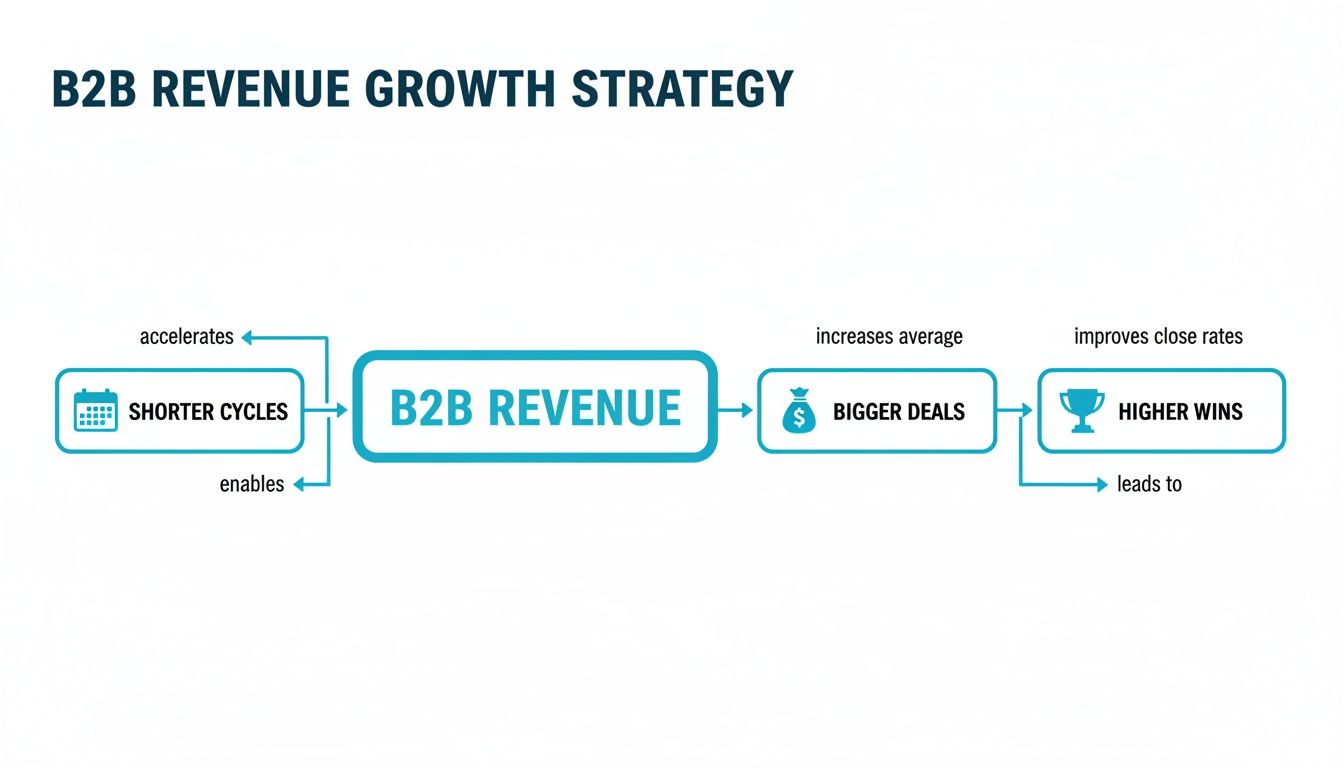
As you can see, a structured strategy isn't just about looking busy. It shortens sales cycles, leads to bigger deals, and flat-out improves your win rates because you're building trust from day one.
Pillar 1: Build a Buyer-Focused Brand
Let's get one thing straight: your LinkedIn profile is not your resume. It’s a resource hub for your ideal customer. Anyone who lands on your page should immediately understand the answer to one simple question: "What's in it for me?"
This requires a mental shift—stop talking about your accomplishments and start focusing on your buyer’s pain points. Your headline, banner, and summary should all scream, "I understand your problem, and I can help."
- Headline: Ditch "Sales Director at Company X." Try something like, "Helping SaaS Founders Fix Their Leaky Revenue Funnel."
- About Section: Don't just list your skills. Tell a story that shows you've been in their shoes and know the way out.
- Featured Content: Pin your best stuff. Showcase case studies, articles, or videos that give your prospects an immediate "aha!" moment.
A strong professional brand is a magnet. It pulls in high-intent prospects before you ever have to send a single message.
Pillar 2: Identify and Connect Strategically
Next up, you have to find the right people. This is not about spamming connection requests to anyone with a pulse. It’s about precision. Your goal is to build a curated network of ideal customers and industry influencers.
Use tools like LinkedIn Sales Navigator to zero in on specific roles, companies, and even trigger events—like a new funding round or a recent job change. Before you hit "connect," go engage with their content. A thoughtful comment on their latest post is infinitely more powerful than a cold, generic invite.
Pillar 3: Engage With Authentic Insights
This is where most people crash and burn. They connect, then immediately slide into the DMs with a sales pitch. Wrong move. The whole point of engagement is to build credibility and trust by consistently sharing valuable insights, not product features.
Social selling has become a powerhouse, generating 45% more opportunities for salespeople who embrace it. And the proof is in the numbers: 78% of salespeople using social selling consistently outperform their peers who are still stuck on traditional cold outreach.
Share a mix of your own thoughts, interesting industry news, and commentary on other people's content. By consistently joining conversations and offering a unique perspective, you position yourself as an expert. The key here is consistency. You have to show up regularly to stay top-of-mind. For some practical tips, check out our guide on how to write engaging LinkedIn posts that actually start conversations.
Pillar 4: Nurture Relationships to Build Pipeline
The final pillar is where your public activity turns into real business. After you’ve built some familiarity through comments, shares, and thoughtful engagement, you’ve finally earned the right to take the conversation private.
Even then, the transition from a public comment to a direct message should still lead with value. Reference a shared interest, ask an insightful question about their latest post, and only then—when the moment feels right—propose a quick chat to explore how you might solve a specific problem for them. This value-first approach is exactly how a connection becomes a qualified sales opportunity.
How to Measure Social Selling Success
Sooner or later, every leader asks the million-dollar question: "How do we know any of this is actually working?"
When it comes to social selling, the answer isn't in vanity metrics. Likes and follower counts feel good, but they don't pay the bills. Real measurement means looking at two different types of numbers: the ones that predict future cash, and the ones that prove it's already hit the bank.
Think of it like driving a car on a long road trip. Leading indicators are what you see through the windshield—your speed, the fuel gauge, the map telling you where you're headed. They’re the daily activities that tell you if you're on the right track.
Lagging indicators are what you see in the rearview mirror—the miles you've already covered, the destinations you've passed. They are the results, like booked meetings and closed deals, that confirm the journey was a success.
You need both to prove ROI and steer the ship.
Leading Indicators That Predict Success
Leading indicators are all about the inputs. They measure the day-to-day grind and tell you whether your team's actions are building the momentum needed to create a healthy pipeline. If these numbers are trending up, revenue is almost guaranteed to follow.
Here’s what to watch:
- Connection Acceptance Rate: Out of all the connection requests you send to ideal prospects, how many actually accept? A solid rate—think over 20-30%—is a great sign that your team's profiles are sharp and their outreach messages are hitting the mark.
- Profile Views from Target Accounts: Are the right eyeballs landing on your team’s LinkedIn profiles? When decision-makers from your dream client list start checking you out, you know your content is cutting through the noise.
- Inbound Connection Requests from ICPs: This is the holy grail. When your ideal prospects start reaching out to you, it means your team has successfully positioned themselves as go-to experts in your niche.
- Positive Reply Rates to DMs: How many of your direct messages turn into a real, two-way conversation? This separates valuable outreach from the spammy pitches that everyone hates and ignores.
Lagging Indicators That Prove Value
While leading indicators give you a glimpse into the future, lagging indicators are the hard proof. These are the bottom-line results that tie social selling directly to revenue. This is what you show the board.
The most important lagging metrics are:
- Social-Sourced Meetings Booked: Simple and powerful. How many qualified sales meetings were booked that started with a conversation on a social platform?
- Pipeline Influence: This is a big one. How many deals sitting in your pipeline had a key social media touchpoint? It shows how social selling helps move deals forward, even if it wasn't the very first interaction.
- Conversion Rate from Social Leads: Of all the opportunities that came from social selling, what percentage actually turned into paying customers?
- Sales Cycle Length for Social Leads: How long does it take to close a deal that started on social versus one from another channel? Often, the trust built online first makes for a much shorter sales cycle.
Tracking both sets of KPIs shifts the entire conversation. You stop asking, "Are we getting enough likes?" and start asking, "How is our LinkedIn presence directly fueling pipeline and revenue?" This is what separates a professional, predictable growth engine from just posting and praying.
Common Mistakes That Undermine Social Selling Efforts

It’s one thing to understand the principles of social selling. It’s another thing entirely to execute it well. This is where most teams trip up. Even with the best intentions, a few common blunders can completely sabotage your efforts, turning a powerful strategy into a huge waste of time and energy.
Steering clear of these potholes is the secret to building a real, sustainable pipeline.
The most common—and most damaging—mistake is pitching way too early. Think about it: you connect with someone on LinkedIn, and their first message is a sales pitch. It’s the digital equivalent of asking for marriage on a first date. It’s awkward, off-putting, and it instantly torches any trust you might have been building.
Treating Social Media Like a Billboard
Here’s another big one: treating your profile like a static ad. Your LinkedIn page isn’t just a digital résumé; it should be a living, breathing resource for your ideal customer. When all you do is post promotional fluff and company announcements, you’re shouting from a soapbox instead of starting a conversation.
This one-way broadcast completely misses the point of what is social selling—it’s about relationships, not just reach.
- What not to do: Your feed is a highlight reel of product features, company awards, and press releases. Your profile summary reads like a corporate memo.
- What to do instead: Share valuable articles from others in your industry. Offer your own unique take on emerging trends. Ask thoughtful questions that get people talking. Your profile should be a beacon for your customer, speaking directly to their biggest headaches.
That small shift turns your page from a boring brochure into a must-visit destination for the people you want to work with.
Sending Generic and Impersonal Outreach
Yes, automation can be a lifesaver, but leaning on it too heavily with generic, copy-paste messages is a fast track to the ignore bin. Prospects can smell a canned, impersonal message a mile away. These messages scream, "I haven't spent 30 seconds learning about you or your company."
The biggest mistake in social selling today is treating social media like a storefront rather than a conversation. Consumers don’t want to be sold to. They want to participate.
Real connection demands personalization. Mention a post they recently shared, bring up a mutual connection, or reference a specific challenge their company is facing. A tiny bit of homework shows you’re genuinely interested and earns you the right to a conversation. Without it, you’re just another notification they’re trying to swipe away.
Building Your Social Selling Roadmap
Alright, for any leader ready to turn these ideas into real pipeline, you need a plan. Getting a social selling program off the ground isn't as simple as telling your team to post more on LinkedIn. It’s a serious strategic decision that boils down to one question: do you build this machine yourself, or do you bring in an expert partner?
Trying to build it in-house is a heavy lift. It requires more than just a memo from the top; you need genuine executive buy-in, sales and marketing teams that are actually in sync, and the right tech to even see if what you're doing is working. This path gives you total control, but it almost always comes with a brutal learning curve and painfully slow results at the start.
On the other hand, partnering with a specialist agency like Growlancer is an investment in speed and expertise. It’s about skipping the rookie mistakes and plugging directly into a proven system for creating content, running targeted outreach, and driving professional conversations. This approach is built from the ground up to deliver predictable meetings, faster.
Choosing Your Path Forward
The right choice between building and buying really depends on your company's resources, internal know-how, and how quickly you need to see results.
- Build In-House If: You have a dedicated leader who can own the entire program, a strong content engine already humming along, and the patience to get through the inevitable trial-and-error phase.
- Partner with Specialists If: You need qualified meetings hitting the calendar now, you don’t have the internal bandwidth to create high-quality executive content consistently, and you want to implement a battle-tested playbook from day one.
The opportunity here is massive. With social media users projected to hit 5.42 billion by 2025 and ad spending going through the roof, your buyers are already living on these platforms. A strategic presence isn't optional anymore.
The best path forward is the one that gets your team consistently showing up where your buyers spend their time. Whether you build the capability internally or accelerate results with a partner, the goal is the same: to make social selling a core pillar of your revenue engine.
Ultimately, you need a well-thought-out strategy. Our guide on how to use LinkedIn for business lays out the foundational steps for making your presence count on the world's most critical B2B platform. No matter which path you take, a structured approach is the only way to unlock a predictable pipeline.
A Few Common Questions We Hear
When leaders first start exploring social selling, the same few questions always pop up. Here are some straight answers based on our experience.
How Much Time Does This Actually Take?
This isn't about spending hours doom-scrolling. It’s about focused, consistent effort. We find that 20-30 minutes a day is the sweet spot.
That time should be spent on high-value activities: sharing insights, jumping into relevant conversations, and sending thoughtful DMs. Quality over quantity, always.
Which Platform Should We Focus On for B2B?
For B2B, it's not even a debate: LinkedIn is where the game is played.
Your buyers are there. Your partners are there. Your competitors are there. It's the only platform built from the ground up for professional conversations, giving you the context and targeting you need to find the right people.
Will This Even Work for Our Industry?
Yes. If your customers are on social media (and they are), it can work. The strategy for a high-tech SaaS company will look different from a specialized manufacturing firm, but the core idea is the same: build trust by being helpful.
The real question isn't if social selling works for your industry. It's how you adapt it to the way your specific buyers think and operate. You have to meet them on their turf.
What's the Difference Between Social Selling and Social Media Marketing?
It's simple, really.
Think of social media marketing as a one-to-many broadcast. It’s your company's megaphone, building brand awareness and talking to the market as a whole. Marketing casts a wide net.
Social selling is the opposite. It’s a one-to-one conversation. It’s about building genuine relationships with specific people that eventually turn into real sales opportunities. Social selling is how you reel in the right fish.
Ready to build a predictable B2B pipeline without the guesswork? Growlancer combines expert strategy, authority content, and targeted outreach to deliver qualified meetings for your leadership team. Schedule your discovery call today.