

Let's be honest, not every lead is created equal. Some are just kicking the tires, while others are ready to sign on the dotted line. The trick is knowing who's who, and that’s where the Sales Qualified Lead (SQL) comes in.
An SQL is a prospect who’s moved past the window-shopping phase and has shown clear, immediate buying intent. Think of it this way: a casual browser looks at houses online. An SQL has their mortgage pre-approved, knows their budget, and is booking viewings for this weekend. They’re ready to make an offer.
Focusing your sales team's expensive time on these high-intent leads is the difference between spinning your wheels and closing deals.
What Is a Sales Qualified Lead

Let’s cut through the jargon. A Sales Qualified Lead isn’t just someone who downloaded your latest ebook. They're a prospect who has been properly vetted—first by marketing, then by sales—and checks all the right boxes.
They have a real problem that your solution can fix, the authority to actually make a purchasing decision, and a timeline that suggests they’re looking to act soon. This is the critical transition from someone just learning about their problem to someone actively hunting for the right solution.
A Sales Qualified Lead is a prospect who's been thoroughly vetted by marketing and then handed off to sales because they've shown clear buying intent, making them prime candidates for direct engagement. Unlike Marketing Qualified Leads (MQLs), SQLs have ticked all the boxes: they match your Ideal Customer Profile (ICP), have budget, authority, need, and timeline (BANT criteria), and have actively signaled readiness, like requesting a demo. You can get more great insights on defining SQLs from the team at Productive Shop.
Core Characteristics of an SQL
The real power in understanding what is sales qualified lead comes from recognizing their key traits. These aren't just "interested" people; they're prospects who have met a specific set of criteria that screams "high probability of becoming a customer."
This formal qualification process is what separates an SQL from every other name in your CRM.
For any B2B leader, this step is absolutely vital. It ensures your sales reps aren't wasting their time on lukewarm leads. Instead, they're pouring their energy into conversations with prospects who are already halfway across the finish line, which means shorter sales cycles and more accurate revenue forecasts.
At-a-Glance Sales Qualified Lead Characteristics
To make it even clearer, here’s a quick rundown of the essential attributes that define a lead as sales-ready. Think of this as your SQL cheat sheet.
| Attribute | Description | Example Signal |
|---|---|---|
| Clear Buying Intent | The lead has moved beyond research and is actively evaluating solutions. | Requesting a personalized demo or a price quote. |
| Verified Need | A specific pain point or business challenge has been identified that your solution can solve. | Asking detailed questions about how a feature addresses their specific problem. |
| Budget Confirmed | The prospect has access to or influence over the financial resources to make a purchase. | Discussing pricing tiers and confirming their budget aligns with your solution's cost. |
| Authority to Purchase | The individual is a decision-maker or a strong influencer within the buying committee. | They hold a relevant job title (e.g., VP of Operations, Director of IT). |
Spotting these signals is how your team can confidently identify a lead who isn't just a fan of your content, but a future customer waiting to be engaged.
The Critical Handoff from MQL to SQL
This is where most sales funnels spring a leak.
The jump from a lead showing some mild interest (a Marketing Qualified Lead, or MQL) to being genuinely ready to talk turkey (a Sales Qualified Lead) is more than just semantics. It’s about timing, efficiency, and not wasting your sales team's precious time.
Get this handoff right, and you’ll see your team’s productivity and your revenue climb.
Think of it like a relay race. Marketing runs the first leg, warming up the lead and building some initial trust. The MQL is the baton. If marketing passes it off too soon, sales fumbles it. They end up chasing someone who’s just not ready, and everyone gets frustrated.
But pass it too late? The lead gets bored and walks right off the track. A sloppy handoff creates friction between your teams and, worse, leaves money on the table.
Spotting the "Ready Now" Signals
So, how do you know when to pass the baton? You need to spot the behavioral triggers that show a lead is shifting from just browsing to seriously considering a purchase. This is the moment an MQL starts to look like a real SQL.
An MQL might download a whitepaper about general industry trends. That’s nice, but it’s passive. An SQL takes actions that scream, "I have a problem, and I'm looking for a solution right now."
These are your green lights for the handoff:
- Requesting a Demo: This is the big one. They want to see your product in action because they’re actively picturing themselves using it.
- Visiting the Pricing Page: Someone checking your pricing page more than once isn't just curious. They're trying to figure out if it fits their budget.
- Using an ROI Calculator: When a lead starts calculating their potential return on investment, they've moved way past features. They're thinking about the business impact.
- Asking Specific, Pointed Questions: If a lead reaches out to ask how your solution solves their specific problem, they're way beyond the initial research phase.
"The biggest mistake I see is companies relaxing the moment a lead is marked as 'sales qualified.' It’s almost like they think the finish line has been crossed, when in reality the relationship is still fragile… Buyers don’t walk away because the product isn’t good; they walk away because the trust they were starting to feel disappears." – Stefan Komlos, Community and Brand Strategist.
That quote from Stefan hits the nail on the head. A clunky transition can completely shatter the trust your marketing team worked so hard to build.
For any B2B founder or sales leader, nailing this internal process isn't just an operational nicety—it's a financial necessity. A smooth handoff guarantees your sales team is only spending their energy on opportunities with a real shot at closing. It’s how you turn a promising pipeline into actual, signed deals.
Mastering the BANT+ Qualification Framework
So, you've seen some buying signals. Great. But how do you really know if a lead is ready for a proper sales conversation?
You need a solid, repeatable system. Something that cuts through the noise and makes sure your sales team is asking the right questions, every single time. No more guesswork.
For years, the go-to framework has been BANT: Budget, Authority, Need, and Timeline. It’s a classic for a reason—it’s a quick and dirty way to see if a prospect has the basic ingredients to actually buy something. Think of it as the foundational checklist for defining what is a sales qualified lead.
But let's be real, the B2B world isn't that simple anymore. A lead can tick all the BANT boxes and still be a total nightmare customer down the line. That’s why the sharpest teams have evolved to BANT+. This isn't just a minor tweak; it adds two critical layers to the whole qualification game.
Going Deeper with BANT+
The BANT+ model takes that classic framework and injects it with two modern essentials: Fit and Engagement. This approach is about finding leads who not only can buy but should buy from you.
Here’s how it all breaks down, with some discovery questions you can steal and use today:
- Budget: Can they actually afford what you're selling? You have to get this out of the way early. Otherwise, you're just wasting everyone's time on a deal that's dead before it even starts.
- Try asking: "Just to make sure we're on the same page, what's the kind of budget you've set aside for tackling this problem?"
- Authority: Are you talking to the person who signs the checks, or just someone who can get you in the room? B2B decisions are rarely made by one person. You need to map out the final decision-maker and find your internal champion who will fight for the deal.
- Try asking: "Besides yourself, who else on the team will be part of the conversation as we look at a new solution like this?"
- Need: Is their problem painful enough to make them pull out their credit card? A mild interest won't get you a signature. You need to dig until you find a real, pressing business challenge.
- Try asking: "What specific challenges are you trying to fix, and what happens if you do nothing about them for the next six months?"
- Timeline: How soon do they need a fix? A prospect who needs a solution this quarter is obviously a higher priority than someone just budgeting for next year.
- Try asking: "In a perfect world, what's your timeline for getting a new solution up and running?"
The 'Plus' Factors: Where the Real Magic Happens
These last two bits are what separate a decent SQL from a fantastic one.
Fit (+F) is all about how neatly the lead fits into your Ideal Customer Profile (ICP). Are they in the right industry? The right company size? Selling to a bad-fit customer is a recipe for disaster—it almost always leads to high churn rates and a burned-out customer success team.
Engagement (+E) is a measure of their interest level. Have they been binging your content? Did they download that in-depth case study or play with your ROI calculator? High engagement is a massive tell. It shows they're not just kicking tires; they're actively trying to solve their problem.
This flowchart lays it out perfectly. It shows how a lead can evolve from a curious MQL into either a nurtured contact or—if they’re engaged and ready—a sales-qualified lead.
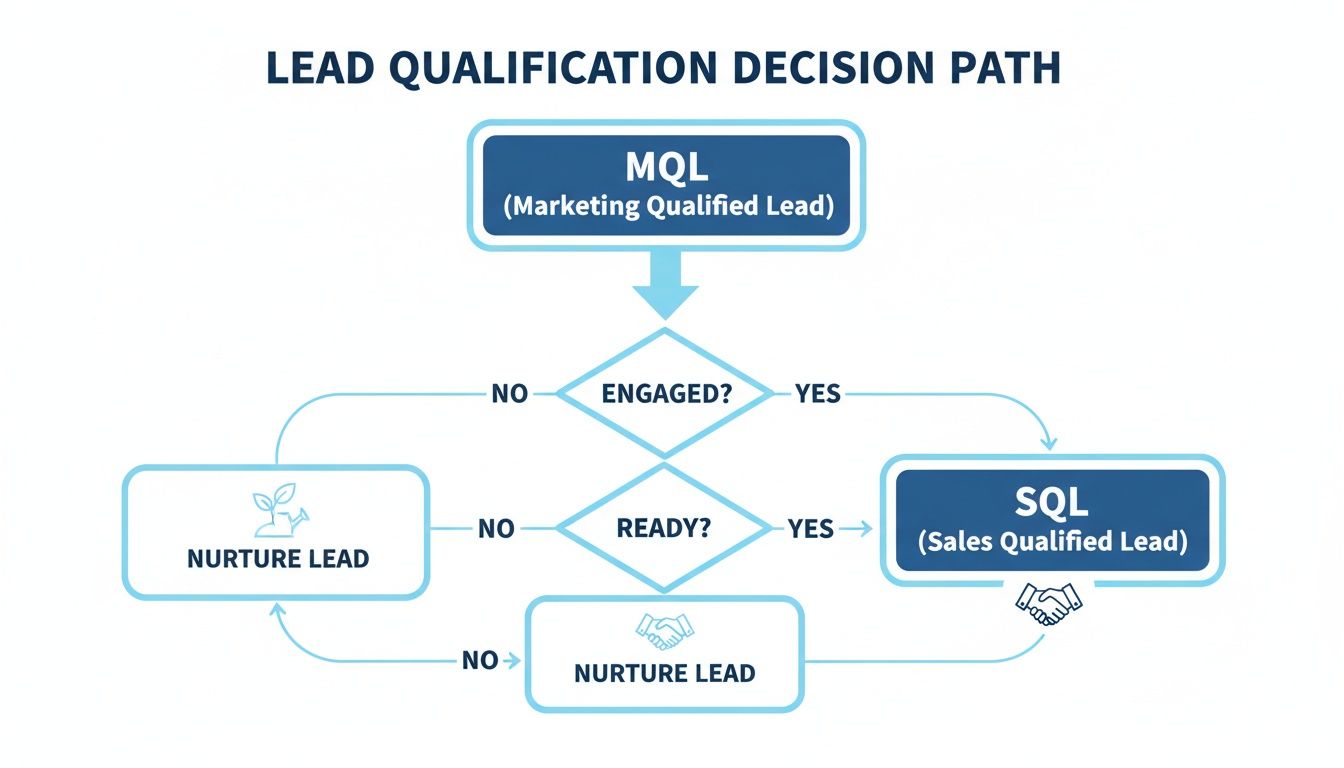
The key takeaway here is that not every MQL is ready for a sales call right away. Some need more time in the oven, and that’s what a good nurturing process is for. By building your process around BANT+, you give your sales team a clear roadmap to focus only on the deals that have a real shot at closing. That’s how you drive efficiency and, ultimately, more revenue.
How to Automate Lead Scoring and Find SQLs Faster
Let’s be real—manually keeping tabs on every single person who interacts with your brand is a fast track to burnout. It just doesn't scale. As your pipeline grows, you absolutely need a system to automatically tell the difference between the window shoppers and the ready-to-buy prospects.
This is exactly where automated lead scoring steps in. Think of it as a built-in priority filter for your sales team.

Imagine it’s a video game. Every time a prospect takes a specific action or fits a certain profile, they earn points. The higher their score, the more “leveled up” they are and the closer they get to being sales-ready. This system works by combining two key types of data to get a full picture.
First, you have explicit scoring, which is all about who they are. This is the concrete data they give you—things like their job title, company size, and industry. A "VP of Sales" at a 500-person tech company is going to rack up way more points than an "Intern" at a tiny agency, simply because they’re a much better fit for your ideal customer.
Implicit Scoring: The Behavioral Clues
Next up is implicit scoring, which is all about what they do. This is where you track their digital body language. Did they just download a surface-level ebook, or did they spend ten solid minutes on your pricing page before requesting a demo? Every action gets assigned a point value based on how much buying intent it signals.
Here’s a quick rundown of how this plays out in the real world:
- Prospect A lands on your blog and downloads a broad industry report. (+15 points)
- She works at one of your target companies and holds the right job title. (+35 points)
- Bingo. She just hit your MQL threshold of 50 points. Marketing now knows she’s a legitimate contender.
- A week later, she’s back. This time, she visits your pricing page and watches a detailed case study video. (+50 points)
- Her score jumps to 100, cruising past the SQL threshold. An alert is immediately fired off to the sales team to get in touch, stat.
This isn’t about guesswork; it’s about math. Your sales reps can stop wasting their time on lukewarm leads and focus only on the ones who have proven they’re interested and a good fit.
The numbers don't lie. A 2022 Gartner study found that while a mere 13% of leads ever become SQLs, they end up accounting for a massive 45% of all closed-won deals. The same study, which you can read more about over at Close, also showed that properly scored leads can qualify up to 40% faster, dramatically shortening your sales cycle.
Sample Lead Scoring Model for a B2B SaaS Company
To make this crystal clear, here’s a sample table showing how a B2B SaaS company might assign points. It’s a mix of who the lead is (demographics/firmographics) and what they're doing (behavioral).
| Action or Attribute | Category | Points Awarded | Example |
|---|---|---|---|
| Job Title: C-Suite/VP | Demographic | +25 | CEO, VP of Marketing |
| Job Title: Director/Manager | Demographic | +15 | Director of Operations |
| Company Size: 500+ Employees | Firmographic | +20 | Enterprise-level company |
| Company Size: 50-499 Employees | Firmographic | +10 | Mid-market company |
| Industry: Target Industry (e.g., Tech) | Firmographic | +15 | Software or IT services |
| Requested a Demo | High-Intent Behavior | +50 | Filled out the "Request Demo" form |
| Visited Pricing Page | High-Intent Behavior | +25 | Spent time evaluating costs |
| Downloaded Case Study | Mid-Intent Behavior | +15 | Looking for social proof and results |
| Attended a Webinar | Mid-Intent Behavior | +10 | Engaged with in-depth content |
| Downloaded Ebook | Low-Intent Behavior | +5 | Top-of-funnel educational content |
This kind of model is the engine that drives an efficient sales process. It takes the ambiguity out of lead qualification and tells your team exactly where to focus their energy for the biggest impact.
By automating your lead scoring, you flip the switch from a reactive to a proactive sales motion. Your reps no longer have to dig through a messy CRM for gold; the system serves up the hottest, most qualified leads on a silver platter, ready for a real conversation.
A well-calibrated scoring model is one of the most powerful assets you have for defining a true sales qualified lead and making sure your team is firing on all cylinders. For a deeper dive into setting up your own system, check out our complete guide on how to qualify sales leads. This approach is a direct line to better productivity, helping your team close more deals with far less effort.
Decoding SQL Buying Signals on LinkedIn
All the theory in the world is great, but the real skill is spotting a sales-qualified lead out in the wild. For anyone in B2B, there's no better hunting ground than LinkedIn. Forget thinking of it as just a digital resume—it's a live feed of professional intent, if you know how to read it.

A simple profile view? That's just noise. Real buying signals are active, not passive. They're the digital breadcrumbs people leave when they’re genuinely trying to solve a business problem. Learning to pick up on these signals is a superpower for any sales team today.
These high-intent actions are your green light to engage. They give you a warm, relevant way into a conversation that actually feels helpful, not like another cold pitch clogging up their inbox. Your job is to connect the dots between what they're doing publicly and the solution you're sitting on.
High-Intent Signals to Watch For
The whole game is about spotting behaviors that show someone is moving from being aware of their problem to actively looking for a solution. Think of yourself as a digital detective, piecing together clues that point straight to buying intent.
Trust me, these signals are worth a hundred generic connection requests.
- Asking for help in groups: You see a manager in an industry group post, "Has anyone found a good way to streamline project handoffs?" That isn't just a question; it's a direct cry for help and a perfect opening for you.
- Engaging with your competitors: A decision-maker at a target company likes or comments on a competitor’s case study. What are they doing? They're shopping around, actively researching and comparing their options.
- Posting about needing a solution: An executive shares an article and adds a comment like, "We really need to find a better way to manage our Q4 data." That's a public announcement of need.
When you spot these digital cues, you can start timely, personalized conversations. Instead of a bland pitch, you can lead with value, referencing their specific activity to show you've done your homework and get their immediate challenges.
Turning Signals into Conversations
Once you've identified a signal, your outreach has to be tailored. A generic "I saw you liked a post" won't cut it. You have to add value and connect their action to a potential fix. For a deep dive on this, our complete playbook on how to generate leads on LinkedIn breaks it all down.
For example, if someone asks that question in a group, you can drop a helpful, non-salesy comment and then follow up with a private message.
Here’s a script that works:
"Hey [Name], I saw your question in the [Group Name] about streamlining project handoffs. It's a super common challenge. We actually put together a short guide on a framework that helps teams cut down on revision cycles. Happy to share it if you think it'd be useful—no strings attached."
This approach instantly positions you as a helpful expert, not just another salesperson. It builds trust and opens the door for a real conversation about their needs, turning their casual LinkedIn activity into a genuine sales opportunity.
Building Your Predictable SQL Pipeline
Knowing the theory behind what is a sales qualified lead is one thing. Actually getting them consistently is another ballgame entirely. A reliable flow of SQLs doesn't just happen because you want it to. It's the direct result of a system built to attract, warm up, and engage the right people until they're genuinely ready for a sales call.
Think of this system as your predictable SQL pipeline. It’s an engine that takes fuzzy market data and turns it into tangible, revenue-driving opportunities. You’re swapping guesswork for a clear, repeatable process that drops qualified leads on your sales team’s doorstep, month in and month out.
It all starts with getting crystal clear on your Ideal Customer Profile (ICP). And no, I don't just mean industry and company size. I’m talking about a deep-seated understanding of their pains, their goals, and the specific triggers that make them look for a solution right now. Once you know exactly who you're hunting for, every other step gets a hell of a lot easier.
The Three Pillars of a Modern SQL Engine
With a razor-sharp ICP as your foundation, the pipeline itself stands on three core pillars. Each one supports the next, creating a smooth journey from a total stranger to a sales-ready lead.
-
Market Identification: This is where you pinpoint the perfect-fit prospects who match your ICP. You’re essentially building a high-quality list of target accounts and the key decision-makers within them. This step ensures you're only focusing your energy on people who can and should buy from you.
-
Authority Content: Next, you use value-first content on platforms like LinkedIn to warm up those accounts. You establish your team as the go-to experts, building credibility and educating prospects on the problem you solve long before you ever ask for a meeting.
-
Intelligent Outreach: Finally, you engage these warmed-up prospects with outreach that's actually personal and relevant. The goal here isn't to pitch. It’s to start conversations, filter for intent, and pre-qualify leads so that any meeting you book is with someone who's already a strong potential SQL.
By locking these three pieces together, you get a cohesive system where marketing and sales are perfectly in sync. This is the secret to building a robust and predictable sales pipeline that consistently delivers high-quality, sales-qualified leads.
This integrated approach is how you turn the abstract idea of an SQL into a concrete business outcome. To see how this whole process gets structured from start to finish, check out our detailed guide on how to build a sales pipeline that actually closes deals.
A Few Lingering Questions About SQLs
Even when you think you've got it all dialed in, a few questions always seem to pop up as you get your sales and marketing machine humming. Let's tackle some of the most common ones I hear about Sales Qualified Leads.
What’s a "Good" MQL to SQL Conversion Rate?
You're in a good spot if you're converting somewhere between 10% and 30% of your MQLs into SQLs. Honestly, the top-tier B2B outfits are consistently hitting that upper range.
If you’re seeing numbers below 10%, that’s a red flag. It usually points to a disconnect between what marketing thinks is a good lead and what sales knows is a good lead. It could also mean your Ideal Customer Profile (ICP) is fuzzy or your nurturing sequence just isn't hitting the right notes.
Who’s in Charge of Defining an SQL?
This is a team sport, plain and simple. It absolutely has to be a joint effort between your sales and marketing heads.
Marketing comes to the table with data, showing which behaviors and actions signal real buying intent. Sales brings the ground truth—the reality of which leads actually turn into paying customers. This collaboration gets formalized in a Service Level Agreement (SLA), making sure everyone’s rowing in the same direction and chasing the same finish line.
Can a Lead Skip the MQL Stage and Go Straight to SQL?
You bet. It happens all the time, especially with those high-intent inbound leads. Think about someone who lands on your site and immediately fills out a "Request a Demo" form.
They aren't just dipping their toes in the water; they’re ready to dive in. These leads are screaming, "I want to talk to someone now!" so they bypass the whole marketing nurture game. The same goes for sharp outbound prospecting—when you find a perfect-fit company and connect directly with the right person, you’ve just created an SQL from scratch.
Tired of the lead-gen rollercoaster and ready for a predictable pipeline of sales-qualified meetings? Growlancer’s done-for-you system uses authority-building content and smart outreach to put you in front of your ideal buyers, consistently. Book a call and see exactly how it works.