

Let's get one thing straight. An Ideal Customer Profile (ICP) isn't about a person. It's a crystal-clear picture of the perfect company that gets maximum value from what you sell—and in return, gives maximum value back to you.
Think of it as a strategic blueprint. It details the firmographic, technographic, and even behavioral traits of the accounts that are destined to become your best, most loyal partners. This profile is your North Star for every single sales and marketing move you make.
Why an Ideal Customer Profile Is Your B2B Game Changer

Picture your business as a complex, high-security lock. Your ICP is the master key.
Sure, you could try jamming hundreds of random, poorly cut keys into the lock, hoping one eventually turns. It’s a frustrating, expensive, and wildly inefficient way to operate. This is exactly what sales and marketing feels like without a defined ICP—a constant guessing game that burns cash and morale.
Now, imagine you’re a master locksmith. You don’t guess. You study the lock’s precise mechanisms, understand its unique tumblers, and craft a single, perfect key designed to open it effortlessly on the first try. That’s the power of a real ICP. It shifts your strategy from a scattergun blast to a surgical strike, focusing all your energy on the accounts you were truly built to serve.
The True Cost of a Poorly Defined ICP
Flying blind without a clear ICP isn't just inefficient; it's a direct hit to your bottom line. When your sales and marketing teams aren't on the same page about who they're targeting, chaos ensues.
- Wasted Marketing Spend: You pour money into campaigns that attract leads who were never going to buy. They're just not the right fit.
- Sales Team Burnout: Your reps waste countless hours chasing dead-end accounts, getting shut down, and struggling to make quota. It's soul-crushing.
- High Customer Churn: Even if you manage to close a bad-fit customer, they’ll likely be unhappy, drain your support resources, and leave as soon as they can.
An ICP is more than a document. It’s a strategic filter for every go-to-market decision you make. It lines up your product roadmap, your marketing copy, and your sales outreach to attract and keep your absolute best customers.
The Data-Backed Impact on Growth
The numbers don't lie—a solid ICP is directly tied to predictable revenue.
Recent research shows that over 78% of B2B businesses see better lead quality after putting an ICP in place. Better still, companies that actually use their ICP are 67% more likely to smash their sales quotas.
Getting this focus right is the foundation of getting your sales and marketing teams to work together instead of against each other. It’s the difference between struggling and scaling. To dig deeper into this, check out our guide on sales and marketing alignment best practices.
The Building Blocks of a Powerful Ideal Customer Profile
Talking about an "Ideal Customer Profile" can feel a bit fuzzy, right? It only gets real when you break it down into solid, data-driven pieces. These are the building blocks that turn a vague guess into a sharp, lethal tool for your sales and marketing teams.
Think of it like building a custom race car. You can't just throw parts together. Every component has a specific job, and they only give you that raw power when they work in perfect harmony.
A killer ICP is never just one thing. It's a mix of hard numbers and real-world observations that paints a crystal-clear picture of the companies you were born to help. We can slice these attributes into four key categories, each answering a crucial question about your perfect-fit customer.
Firmographics: Who Are They?
This is the ground floor. Firmographics are the basic, easily verifiable facts about a company. It’s where most people start because it gives you a clean, quantitative way to chop up the market. It’s the "who" and "where" of your targeting.
These are your first-pass filters. They help you shrink the entire ocean of businesses down to a manageable pond of real prospects.
- Industry: Which specific verticals are getting the most value from what you do? (e.g., FinTech, B2B SaaS, Healthcare)
- Company Size: Where’s the sweet spot for employee count? (e.g., 50-250 employees)
- Annual Revenue: Is there a revenue number that screams "they have the problem and the budget"? (e.g., $10M – $50M ARR)
- Geography: Where are your best customers clustered? Specific countries, regions, or cities? (e.g., North America, Western Europe)
Technographics: What Tools Do They Use?
Now we’re getting interesting. Technographics dive into a company's tech stack. This is gold. The software a company pays for tells you about their priorities, their budget, and how ready they are for your solution. It helps you understand how they actually work.
For example, if you sell a sales-to-marketing integration tool, knowing a prospect uses HubSpot and Salesforce isn't just a fun fact—it's a massive buying signal. You’ve moved beyond basic company size and into a real, strategic fit.
An ICP without technographics is like a map without roads. It shows you the city but gives you no clue how to navigate it. Their tech stack reveals their internal headaches, workflows, and easy wins for you to pitch.
Behavioral Data: How Do They Act?
This is where your ICP starts breathing. Behavioral data is all about the actions and patterns that show a company is actively looking for help. It’s about timing and intent. It’s the difference between a cold knock on the door and showing up right when they’re looking for a locksmith.
These are the signals that turn a cold pitch into a "funny you should mention that" conversation.
- Content Engagement: Are they binge-watching your webinars, downloading your guides, or lurking on your pricing page?
- Hiring Trends: Are they suddenly hiring a ton of SDRs? That’s a sign they’re investing in the exact area you support.
- Funding Events: Did they just close a Series B or C? That cash is meant for growth, and growth often means new tools.
- Online Activity: Are their decision-makers complaining about a specific problem on LinkedIn? That’s your cue.
Environmental Factors: What External Pressures Do They Face?
Last, you have to look outside the company's four walls. Environmental factors are the big, external forces pushing them around—market shifts, new laws, global trends. This stuff creates urgency. It gives you the "why now?" for the sale.
Think about new regulations like GDPR forcing companies to scramble for compliance software. Or the sudden shift to remote work creating a massive appetite for collaboration tools. When you understand the world they live in, you're not just selling a product. You're selling a strategic answer to the chaos.
A Step-by-Step Guide to Building Your Data-Driven ICP
Anyone can dream up a theoretical “ideal customer.” It’s easy. Building one that actually makes you money? That’s a whole different ball game. It requires a disciplined, data-driven process.
This isn't about throwing ideas at a whiteboard and hoping something sticks. It’s about methodically uncovering the DNA of your absolute best-fit accounts so you can go out and find more of them. The goal is to move from a vague idea of "who we sell to" into a sharp, actionable blueprint.
Let's walk through a clear, four-step process. This isn't academic theory—it's how you combine your own internal data, team insights, and a dose of market reality to forge an ICP that actually works.
Step 1: Identify Your Best Customers
Forget market reports for a second. Your most valuable data is already sitting in your CRM. The first move is always to look backward to find the patterns that will light the way forward.
Start by pulling a list of your top 10-20 customers.
But "best" isn't just about the biggest check. A truly ideal customer is a combination of a few key things:
- High Lifetime Value (LTV): They don’t just buy once. They stick around, upgrade, and expand their use of your service over time.
- High Satisfaction: These are your champions. They give you great feedback, agree to case studies, and don't flood your support team with tickets.
- Low Churn Risk: They’re deeply embedded with your solution. The thought of them leaving keeps no one up at night.
- Profitability: The cost to get them in the door and keep them happy is low compared to the revenue they bring in.
Once you have this golden list, it's time to put on your detective hat. Dig into their shared traits—the firmographics, the tech they use, their behaviors. You're hunting for the common threads that tie all these star accounts together.
The whole point here is simple but critical: turn that list of logos into a rich dataset. Every single commonality you find is another clue telling you what a perfect customer really looks like for your business.
Step 2: Uncover Insights From Your Team
Your data tells you the what. Your team tells you the why.
Your people on the front lines—sales, customer success, even product—have insights that no spreadsheet can give you. Their qualitative knowledge is pure gold for adding real-world context to your ICP.
Set up structured interviews with a few key people from each department. Don't just ask them, "Who's our ideal customer?" That's too broad. Get specific.
Questions for Your Sales Team:
- What's the one pain point that always comes up on the first call with a great prospect?
- Which competitors do we consistently beat, and what's our secret weapon against them?
- Is there a specific trigger event that makes someone start looking for a solution like ours? A new hire? A funding round?
Questions for Customer Success:
- Which customers got up and running the fastest? What did they all have in common?
- What features do our happiest, most successful customers use the most?
- Who are the actual day-to-day users inside these companies? What are their job titles?
These conversations will pull out the nuances that raw data always misses. This is how you add a layer of human intelligence to your profile.
Step 3: Enrich Your Profile With External Data
Okay, so now you have a strong hypothesis about who you should be targeting, built from your own successes and team knowledge. The next step is to see if it holds up in the real world.
This is where you validate and enrich your profile with external data. You need to make sure your ICP isn't just a reflection of your past, but a reliable map for your future.
Tools like LinkedIn Sales Navigator, Crunchbase, and other industry databases are your best friends here. Use them to cross-reference the attributes of your best customers against the wider market.
For example, if your internal data points to "Series B SaaS companies using HubSpot," jump into these tools and see how many actually exist. This step grounds your profile in reality and confirms your target market is big enough to be worth chasing.
This is all about layering different types of data to get a complete picture.
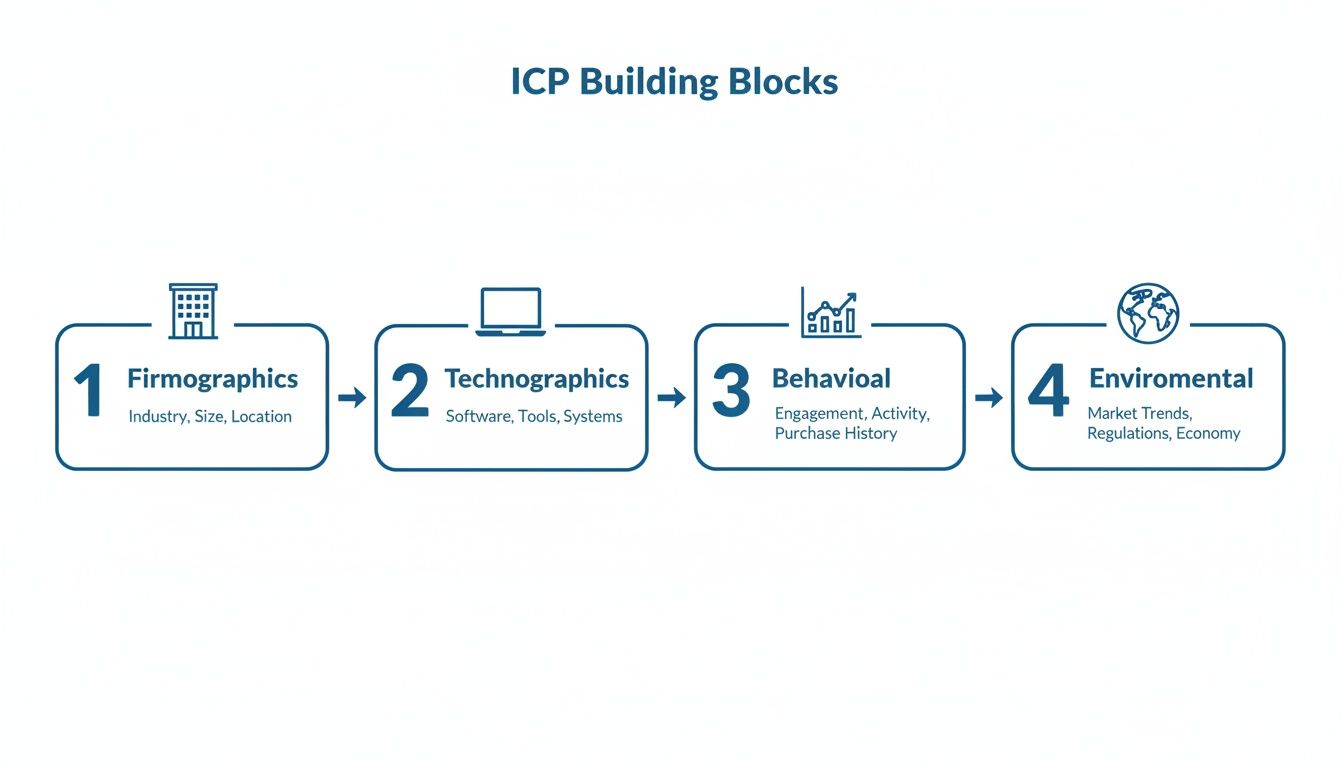
Think of it like building a complete profile. You start with the basic facts (firmographics) and then add the tools they use, the actions they take, and the market pressures they face.
Step 4: Document Your Findings in a Template
The last step is the most important: get it all down on paper. An ICP that lives in someone's head or a forgotten spreadsheet is completely useless. It has to be a simple, accessible tool your entire go-to-market team can grab and use every single day.
Your final ICP document should be a clean, one-page summary of everything you've learned. Here’s a simple way to structure it:
| Attribute Category | Specific Detail | Why It Matters |
|---|---|---|
| Industry | B2B SaaS, FinTech | These niches feel the pain we solve most acutely. |
| Company Size | 50-200 Employees | Big enough to have a budget, small enough that we can close deals fast. |
| Revenue | $5M – $50M ARR | Shows they can afford us and are actively growing. |
| Technology Used | HubSpot, Salesforce | Signals they have a mature sales/marketing function and we can integrate easily. |
| Key Pain Point | Can't generate a predictable pipeline from LinkedIn. | This is the exact problem we are the best in the world at solving. |
This simple document becomes your company's North Star. It's what guides your marketing campaigns, your sales outreach, and even your product roadmap. It ensures every single person is aligned on attracting and winning more of your absolute best customers.
How to Validate Your ICP and Avoid Common Mistakes
Getting your Ideal Customer Profile on paper is a massive first step. But let’s be real—it’s not the finish line. Right now, what you have is a very powerful, data-backed hypothesis. To turn it into a tool that actually prints money, you have to pit it against the real world.
Think of it like a new recipe you’ve put together. You’ve got all the best ingredients (your data) and followed the steps perfectly (your analysis), but you have no idea if it’s any good until you actually cook it and have a taste. Validation is that taste test. It confirms you’re on the right track before you serve this new dish to the entire company.
Testing Your ICP Hypothesis
Validation isn’t about launching some huge, company-wide blitz. Far from it. It’s about running small, controlled experiments to prove (or disprove) your theory quickly and with almost zero risk.
The goal is simple: find out if targeting this laser-focused profile gets you better results than your old, spray-and-pray approach.
The best way to do this is with a small, focused campaign aimed squarely at a sample of companies that are a perfect match for your new ICP.
- Build a Test List: Pull together a clean, tight list of 50-100 companies that tick every single box of your new profile.
- Run a Targeted Campaign: Get a multi-channel campaign going—think LinkedIn ads, super-personalized email sequences, and direct sales outreach. Your messaging should speak directly to the pain points you uncovered when building the ICP.
- Measure Everything: Track your metrics like a hawk. You’re looking for undeniable signals that this specific audience is actually listening.
What you're really trying to answer is: "Does focusing on this exact profile make our sales and marketing more effective?" Your test campaign data will give you a straight, unbiased answer.
Key Metrics for Validation
When you’re looking at the results, you have to ignore the vanity metrics. We’re interested in engagement and conversion data that shows a real connection is being made.
- Email Open & Reply Rates: Are these numbers blowing your old baseline out of the water? A high reply rate, especially with positive or curious responses, is a fantastic sign.
- LinkedIn Connection & Reply Rates: Is your outreach actually cutting through the noise with this group?
- Meeting Booked Rate: This is the ultimate proof. Are you turning those initial chats into qualified sales meetings? This is a critical part of figuring out how to qualify sales leads with your new profile.
- Sales Cycle Velocity: This one's a bit harder to see in a short test, but keep an eye on it. Are these leads moving from first touch to qualified opportunity faster than usual?
If your metrics are way up compared to your old benchmarks, congrats—your ICP is solid. If not, it’s a clear signal to go back to the drawing board before you roll it out everywhere.
Common ICP Mistakes to Avoid
Even with the best data, it’s surprisingly easy to mess this up. Knowing the common tripwires can save you from wasting months on a profile that’s completely off the mark.
The "Too Broad" Profile:
Saying your ICP is "tech companies in North America" isn't an ICP. That’s a target market. A truly powerful profile should feel a little restrictive. It needs to be just as clear about who you don't serve as who you do.
Ignoring Your Customer-Facing Teams:
Your CRM data tells you what happened, but your sales and customer success teams can tell you why. Ignoring their on-the-ground insights is a rookie mistake. They hear the real objections, know the buying triggers, and understand the customer pain points in a way data alone never will.
Treating It as a One-and-Done Project:
Markets change. Your product evolves. Your customers’ needs shift. An ICP isn’t a stone tablet you chisel once and worship forever. It’s a living document that needs a check-up every quarter and a serious overhaul at least once a year to stay sharp.
Activating Your ICP to Generate Predictable Pipeline
So you've built your Ideal Customer Profile. That’s a huge step, but let’s be honest—it’s not the finish line. The real money isn't in having an ICP document; it's in what you do with it. An unused profile is just a pretty PDF collecting digital dust.
To make it a true engine for growth, you have to activate it. This is where your theory hits the pavement. Activating your ICP means turning those documented traits into real-world sales and marketing actions that pull in your perfect-fit customers. It's how you build a pipeline you can actually count on.
The difference this makes is staggering. When you stop spraying and praying, the numbers speak for themselves. While a measly 5% of non-ideal leads might convert to an opportunity, a massive 20% of ICP-aligned leads move forward. That’s a 4X lift right there.
And it gets better. For those ideal accounts, win rates go up, deal sizes get bigger, and sales cycles get shorter. It’s the fastest path to better revenue. For more on this, check out the data on the revenue impact of targeting from Tenbound.
Crafting Authority Content That Attracts Your ICP
Your ICP is a content goldmine. Seriously. Every single pain point, goal, and frustration you wrote down is a topic your ideal customer is Googling at this very moment. When you create content that speaks directly to those problems, you stop chasing and start attracting.
This isn’t about pumping out generic blog posts. It’s about creating authority content—stuff so sharp and relevant that your ideal customer sees you as the only person who truly gets them.
- Solve Their Exact Problems: If your ICP struggles with "unpredictable leads from LinkedIn," don't just write about "LinkedIn marketing." Write a step-by-step guide to building a predictable pipeline on LinkedIn. Get specific.
- Speak Their Language: Use the same acronyms, slang, and technical terms they use every day. This builds instant trust and shows you belong in their world.
- Showcase Their Peers: Create case studies featuring customers who are a mirror image of your ICP. Nothing sells better than showing someone that your solution works for "people like them."
This kind of content acts like a magnet, pulling in high-quality inbound leads who have already qualified themselves by searching for the very problem you solve.
Your ICP tells you precisely what keeps your ideal customer up at night. Your content should be the answer they find when they start searching for a solution at 2 AM.
Executing Targeted Outreach That Converts
Great content will bring people to you, but a sharp ICP also transforms your outbound game. It lets you ditch the cringe-worthy, high-volume spam and switch to a hyper-personalized approach that actually gets replies. This is the core of a modern outbound lead gen strategy that doesn’t burn your reputation.
This is where tools like LinkedIn Sales Navigator become your secret weapon. You can plug your ICP attributes directly into the search filters to build incredibly precise prospect lists.
From ICP Attribute to Sales Navigator Filter:
| Your ICP Attribute | LinkedIn Sales Navigator Filter |
|---|---|
| Industry: B2B SaaS | "Industry" > Computer Software |
| Company Size: 50-200 Employees | "Company headcound" > 51-200 |
| Key Persona: VP of Sales | "Title" > Vice President of Sales |
| Geography: North America | "Geography" > United States, Canada |
Once you have this razor-sharp list, your ICP gives you the ammunition for outreach that cuts through the noise. You’re not just sending another pitch; you're starting a relevant conversation.
Personalizing Your Message
Forget the generic templates. Now you can write a message that references a specific, well-known challenge for that exact profile.
Example Personalized Message:
Subject: predictable pipeline for a VP of Sales?
"Hi [First Name],
Saw you're heading up sales at [Company Name]. I talk to a lot of VPs of Sales at Series B SaaS companies, and they all say the biggest headache is moving from founder-led selling to a scalable, predictable pipeline.
We build the systems that fix that for companies just like yours. Is this on your radar for Q3?
Cheers,
[Your Name]"
This message works because it isn't about you—it's about them. It shows you know their role, their company stage, and their most likely pain points. That level of personalization is only possible when a crystal-clear ICP is driving your every move. When your content and your outreach are perfectly aligned, you create a powerful system for filling your pipeline with nothing but your absolute best customers.
A Few Common Questions We Hear About ICPs
Once you get your hands dirty building and using your Ideal Customer Profile, a few practical questions always pop up. It's one thing to create the profile, but knowing how to manage and scale it is a whole different ball game.
Think of this as a quick FAQ section where we tackle the most common hurdles we see B2B leaders run into when they start putting their ICP to work.
How Often Should I Update My Ideal Customer Profile?
Your ICP isn't a "set it and forget it" document. It's alive. Your market shifts, your product gets better, and your customers change. Your profile has to keep up, or it becomes useless.
We tell our clients to give their ICP a light once-over every quarter. A full-blown teardown and rebuild? Plan on that at least once a year. But some things should make you stop what you're doing and reassess immediately.
Keep an eye out for these triggers:
- A major product pivot or a killer new feature that opens doors to a new audience.
- Big shifts in your industry, like new regulations or a competitor making a bold move.
- Your win rates start to tank, or the leads coming in feel… off. That's a huge red flag for misalignment.
Keeping your ICP fresh ensures your entire go-to-market strategy stays sharp and pointed at the best possible accounts.
Can My Company Have More Than One Ideal Customer Profile?
Yes, and honestly, most growing businesses should. It’s pretty common to have a few different ICPs, especially if you have multiple products, serve completely different industries, or sell to companies of different sizes.
For example, a SaaS company we know has one ICP for scrappy, mid-market tech startups and a totally separate one for massive, slow-moving financial institutions. The problems they solve, the way they buy, and who signs the checks are worlds apart.
The rule of thumb is this: each ICP must be distinct enough to demand its own strategy. If you can’t build a tailored marketing message and sales outreach plan around it, it’s not a separate ICP.
What Is the Difference Between an ICP and a Target Market?
It all comes down to precision. A target market is a shotgun blast; an ICP is a sniper rifle.
Your target market is the broad, general group of companies you could sell to. Think "U.S.-based software companies with 100-500 employees." It’s a good starting point, but it's way too wide for effective, personalized outreach.
Your Ideal Customer Profile zooms in on the absolute perfect company within that market. It’s the small handful of accounts that get a ridiculous amount of value from what you do and, in turn, are the most valuable for you to work with. It adds layers like the tech they use, their buying behaviors, and their company culture to find the bullseye.
Ready to stop guessing and start targeting the customers you were built to serve? Growlancer builds predictable B2B sales pipelines by combining expert strategy, authority content, and targeted outreach. See how we can fill your calendar with meetings with your ideal customers at https://growlancer.ai.