

At its core, a solid go-to-market strategy has just three parts: You Map the market to get crystal clear on your Ideal Customer Profile (ICP). You Build authority by creating content that actually solves their problems. Then, you Engage them with sharp, personalized outreach.
That's the whole game. This framework gets your entire company marching toward one single goal: building a predictable pipeline.
Why Your Current GTM Strategy Is Failing
Let's be honest. If your B2B playbook is still leaning on mass cold calls and generic digital ads, you're probably getting crushed.
The B2B world has changed. Buying cycles are longer and way more complicated, often looping in 6 to 10 decision-makers for a single deal. These people are smart. They have unlimited access to information and are absolutely sick of lazy, interruptive sales pitches. They don't want to be sold to; they want to learn from credible experts who understand their world.
This isn't a small shift. It's why a relationship-driven GTM strategy is no longer a "nice-to-have." It’s a matter of survival. Without it, even the most groundbreaking B2B companies are going to spin their wheels.
The Modern GTM Imperative
A GTM strategy that works today is built on a different foundation. It’s less about brute-force selling and more about systematically building trust and authority within a very specific market niche.
The goal isn't to chase vanity metrics like clicks and impressions. It's to build a reliable machine that generates qualified meetings and revenue you can measure.
This requires a truly coordinated effort, especially from the top down. When founders and department heads are all on the same page, the company projects a unified, authoritative voice. This is where most strategies fall apart—not from a lack of effort, but from a total lack of internal alignment. You can dig deeper into this in our guide on sales and marketing alignment best practices.
A go-to-market plan provides the structure necessary for success. Without it, crucial things can slip through the cracks, meaning you’ll miss opportunities and make costly mistakes.
This simple visual breaks down the core pillars of an effective GTM system.
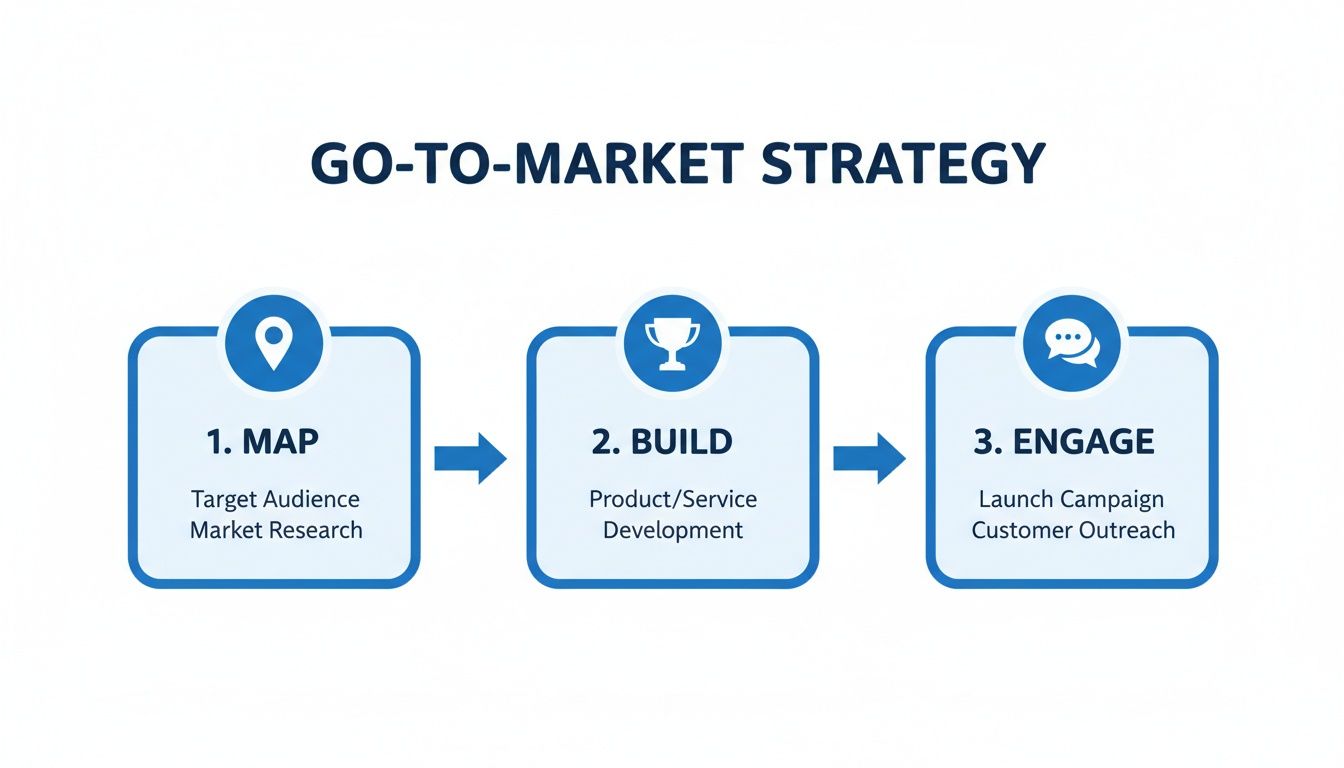
It really drives home the point: a winning strategy moves logically from deep market understanding, to building credibility, and finally, to direct engagement that actually provides value.
Map Your Market and Pinpoint Your ICP

Before you write a single line of copy or send one outreach message, you need to know exactly who you're selling to. Let's be blunt: a fuzzy idea of your customer is a guaranteed way to kill your go-to-market strategy before it even starts.
This isn't some box-ticking exercise. It's the bedrock for every single decision you'll make from here on out.
We start big and then zoom in. First, you map your Total Addressable Market (TAM)—the entire universe of companies that could theoretically buy from you. From there, you carve out your Serviceable Available Market (SAM), which is the slice you can realistically reach with your current setup.
Finally, you zero in on your Serviceable Obtainable Market (SOM). This is the piece of the pie you can actually win. This is your battlefield. Getting this right stops you from wasting time and money trying to boil the ocean.
Moving Beyond Basic Demographics
Knowing your target's industry and company size is table stakes. That’s not enough. A GTM strategy that actually works is built on a much, much deeper understanding. The real goal is to create a data-rich Ideal Customer Profile (ICP) that feels less like a document and more like a blueprint for a real business.
An ICP isn't some fluffy persona. It's a laser-focused definition of the exact company that gets the most value from your solution—and, in turn, provides the most value back to you. For a deep dive, check out our guide on what an ideal customer profile is and how to nail it.
To build this blueprint, start by looking at your best customers right now. Who are they?
- Firmographics: What's their revenue, employee count, and location?
- Technographics: What tech stack are they running? Any complementary or competing tools?
- Behavioral Data: How did they find you? What was their buying journey like? How long did it take to close them?
- Outcomes: What specific, measurable wins did they get after working with you?
Looking at this data reveals the patterns. It turns your targeting from a guessing game into a repeatable, data-driven process. You’ll quickly spot the common threads that tie your best clients together.
To illustrate, let's look at the difference between a useless, vague persona and an ICP that actually helps you sell.
From Vague Persona to Actionable ICP
| Attribute | Generic Persona (Vague) | Actionable ICP (Specific) |
|---|---|---|
| Industry | Tech companies | B2B SaaS (MarTech) |
| Size | Mid-sized | 50-200 employees, $10M-$50M ARR |
| Location | North America | US-based, remote-first or hybrid model |
| Tech Stack | Uses CRM | Uses HubSpot Marketing & Sales Hubs; integrated with Slack |
| Pain Point | Needs more leads | Struggling with low lead-to-MQL conversion rates (<2%) from content |
| Trigger | Looking to grow | Just hired a new Head of Demand Gen; recently raised a Series A/B round |
See the difference? One is a guess. The other is a weapon. The specific ICP tells your sales and marketing teams exactly who to find and what to say.
Uncovering Real Pain Points and Triggers
Data tells you the "what," but you need conversations to get the "why." Once you've analyzed the numbers, it's time to actually talk to your best customers. Seriously, just five to ten good interviews can give you more game-changing insights than a spreadsheet ever will.
And in these calls, you’re not selling. You’re a detective. You’re listening for the human story behind the business problem.
Here are the golden questions to ask:
- Before us, what was the single biggest bottleneck in your day-to-day related to [the problem you solve]?
- What was the "enough is enough" moment that made you start actively looking for a fix?
- When you were comparing options, what were the top 2-3 things that really mattered?
- How do you and your team actually learn about new tools? Blogs, podcasts, webinars, peer recommendations?
The answers here are pure gold. They tell you which pain points to hammer home in your messaging, what buying signals to look for in your outreach, and which channels will actually get you in front of the right people. This is how you turn a profile on paper into a targeting machine that fuels your entire GTM plan.
Craft Your Positioning and Value Proposition
Alright, you know exactly who you're selling to. That’s a huge win, but it’s only half the battle.
Now you have to figure out how to talk about your product so your ideal customer actually cares. Without sharp positioning, even a world-class solution gets lost in the noise and ends up sounding like everyone else.
This is where you plant your flag. You’re not just another option; you're the only logical choice for the specific problem your ICP faces. To do that, you need to get forensic with your competitive analysis.
Find Your Differentiated Space
First things first: map out your competitors. I don't just mean a quick list of logos. I mean who does your ideal customer think are the alternatives when they're looking for a solution?
Go deep on each one. Look at them through your customer's eyes:
- Their Core Message: What's the one big promise they're making?
- Their Target Audience: Who are they talking to? Is it your exact ICP, or are they aiming a little broader or more niche?
- Their Perceived Strengths: What do customers rave about? Scour reviews on sites like G2 or Capterra for the real story.
- Their Glaring Weaknesses: Where are the cracks? These gaps are pure gold for you.
Let’s say you’re a project management tool. You might find Competitor A is beloved by freelancers for its simple UI, but it completely lacks the security features enterprises demand. Competitor B is an enterprise beast but takes six months and a team of consultants to implement.
Boom. There’s your opening: the enterprise-ready project management tool that’s actually easy to implement. That's a position you can own.
This isn’t about trashing the competition. It’s about finding the unclaimed ground where your unique strengths solve a problem they can’t.
Articulate a Value Proposition That Resonates
Once you've found your spot, you need to put it into words that connect instantly. A value prop isn't some fluffy tagline. It’s a dead-simple statement explaining the tangible outcome a customer gets from using your stuff.
A rock-solid value proposition has to answer three questions for the customer:
- What specific pain do you solve for me?
- What specific results will I get?
- Why should I pick you over everyone else?
This becomes the DNA of all your messaging. Every ad, every email, every sales call should echo this core promise.
Your value proposition is the ultimate tiebreaker in a crowded market. It’s not about what your product does; it's about what your customer can achieve because of it.
Take a B2B SaaS company that automates financial reporting. A weak value prop is: "We provide automated financial reporting software." True, but snoozefest. Nobody's buying that.
A strong one? "We help CFOs at mid-market tech companies cut their month-end closing time by 50%, eliminating manual errors and freeing up their team for strategic analysis."
See the difference? It’s specific, outcome-driven, and speaks directly to the person with the problem.
Build Your Messaging Pillars
Your value proposition is your North Star. To keep everyone in your company pointing in the same direction, you need messaging pillars. These are the 3-4 core themes that prove your value prop is true.
Think of them as the talking points your sales, marketing, and customer success teams can use to tell the same compelling story over and over.
Let's stick with our financial reporting software example:
| Pillar | Core Message |
|---|---|
| Speed & Efficiency | Ditch the manual data entry. Consolidate financials in minutes, not days. |
| Accuracy & Confidence | Stop worrying about spreadsheet errors. Get compliant, trustworthy numbers every time. |
| Strategic Insight | Turn your finance team from number-crunchers into strategic advisors with real-time dashboards. |
These pillars become your content engine. A blog post might go deep on strategic insight. A LinkedIn ad could hammer the speed angle. A sales deck will hit all three.
This framework ensures that no matter how a prospect finds you, they get a consistent, powerful message. It's how you go from being a "nice-to-have" tool to a "must-have" solution.
Build Your LinkedIn-First Distribution Engine

You’ve got your ICP locked in and a value prop that cuts through the noise. Now for the hard part: getting it in front of the right people.
A brilliant go-to-market strategy with zero distribution is like a world-class race car with no gas—it looks impressive, but it’s going nowhere. This is where you build the engine that actually drives pipeline.
For high-value B2B SaaS or services, one platform has become the undeniable center of gravity: LinkedIn. It’s where your buyers hang out, where your competitors are trying to win, and where your future advocates are learning.
Ignoring LinkedIn isn’t just a missed opportunity; it's a strategic mistake. It's the modern town square for business, and showing up there consistently is non-negotiable.
Why Go All-In on LinkedIn?
Let's be clear: LinkedIn is not a digital resume folder anymore. It’s a powerful content and conversation platform where decision-makers go to get smarter about their jobs and vet potential partners. That makes it an incredibly efficient place to build authority and start conversations.
The entire platform is built for the kind of value-first, relationship-driven selling that actually works today. Your ICP is already on there talking about the exact problems you solve. Your job is simply to join the conversation—not as a pushy salesperson, but as a trusted expert.
This is how you plant the seeds for inbound leads.
The money follows the attention. By 2025, LinkedIn is projected to capture a massive 39% share of all B2B ad budgets, making it the top channel spend. When you consider that B2B buying cycles can stretch to 320 days for deals sourced on LinkedIn, it’s clear that staying top-of-mind with precision targeting isn't just nice to have; it's essential.
Position Your Executives as Thought Leaders
Your company page is a brochure. Your people are the real sales tool. Buyers connect with people, not logos.
The sharpest GTM strategies I’ve seen leverage the entire executive team. They position each leader as the go-to expert in their specific domain—the CEO on industry vision, the Head of Sales on revenue tactics, the Head of Product on innovation.
Your leadership team shouldn't just have profiles; they need to build a genuine presence. This means creating and distributing valuable content from their personal accounts, consistently.
Here's what this accomplishes:
- Builds Trust at Scale: One expert is interesting. A whole team of them sharing insights? That builds massive credibility for your entire company.
- Humanizes Your Brand: It puts a face to the name, showing the personality and expertise behind the business. It makes you approachable.
- Pulls in Inbound Leads: When your execs own the conversation in your niche, your ideal customers start coming to them. This flips the script entirely and dramatically shortens the sales cycle.
A team of recognized experts is your most powerful marketing asset. When your leadership team owns the conversation in your niche, your company owns the market.
This isn’t about posting on a whim. You need a documented content system where each executive has clear content pillars that align with their expertise and your company’s value prop.
Master the Content Formats That Work
The LinkedIn algorithm is a machine, and you need to feed it what it wants. While the specifics are always changing, the core principle is simple: LinkedIn rewards content that keeps users on the platform and sparks real conversation.
Your content mix should lean heavily on the formats that are proven to drive engagement right now:
- Conversational Text Posts: Short, punchy posts that share an opinion, ask a provocative question, or tell a quick story are gold. They feel personal and practically beg for comments.
- Carousels (PDFs): These are visual goldmines. They let you break down complex ideas into simple, shareable slides. Think of them as mini-presentations perfect for educational content.
- Simple Videos: Forget the high-production studio shoots. A quick, authentic video filmed on a phone sharing a tip or a behind-the-scenes look often outperforms polished corporate content.
More than anything, consistency is king. A steady rhythm of valuable content, posted a few times a week from each executive, builds incredible momentum. It trains the algorithm to show your posts to more of the right people.
If you want to go deeper on this, we've got a full playbook on how to use LinkedIn for business that unpacks these tactics. A smart GTM strategy combines this organic authority-building with targeted paid ads to make sure you’re always in front of your ICP, no matter where they are in their buying journey.
Execute Your Targeted Outreach Motion

Writing great content builds authority, but let's be real—thought leadership doesn't pay the bills. Targeted outreach is what turns that credibility into actual conversations and fills your pipeline.
This is where your GTM strategy gets personal. It’s the shift from broadcasting one-to-many to engaging one-to-one.
We're not talking about blasting a cold list with generic templates. That game is over. Today's outreach is a multi-touch system designed to feel timely, personal, and genuinely helpful. Precision over volume. Always.
Identify Your Perfect-Fit Prospects on LinkedIn
You’ve defined your Ideal Customer Profile (ICP). Now you need to find those exact people. LinkedIn Sales Navigator is your hunting ground.
Don’t just filter by job title and industry. That’s amateur hour. You need to get surgical with your search to build hyper-targeted lists.
- Recent Activity: Look for people who have posted in the last 30 days, been mentioned in the news, or recently changed jobs. These are golden opportunities for a relevant opening line.
- Shared Connections: A warm intro beats a cold message every single time. Filter by 2nd-degree connections and see who you know that can open a door for you.
- Group Membership: Are your prospects in niche industry groups? This tells you they're actively engaged and looking for solutions.
This isn't just about finding people who fit your ICP. It’s about finding the ones showing buying signals right now.
Craft Outreach That Commands Attention
Generic connection requests are digital junk mail. To break through the noise, your outreach has to be about them. It has to prove you’ve done your homework in the first ten seconds.
The secret is using "triggers"—specific, timely events that make your message impossible to ignore.
Here’s what that looks like in the wild:
"Hi [Name], saw your company just announced its expansion into the APAC region—congrats on the growth. My team at [Your Company] helps B2B SaaS firms scale demand gen in new markets, especially with the compliance headaches there. Worth a quick chat?"
See the difference? It’s not about you. It's about their world, their recent win, and a potential problem on their horizon. It’s a world away from the lazy "I'd love to connect" message that everyone ignores.
The difference between spam and valuable outreach is research. A single, well-researched message to the right person is worth more than a thousand generic blasts to the wrong ones.
Deploy a Multi-Touch, Multi-Channel Sequence
Relying on a single LinkedIn message is setting yourself up to fail. Decision-makers are buried in requests. A smart GTM strategy uses a planned sequence of touches across different channels to stay on their radar without being a pest.
This isn’t about just sending more messages. It’s about creating a series of light, value-added interactions that build familiarity and trust.
A simple—but brutally effective—sequence might look like this:
- Engage: Drop a thoughtful comment or like on a prospect's recent LinkedIn post.
- Connect: Send a personalized connection request a day later, mentioning their post or another trigger.
- Message: Once they accept, follow up with a concise message that connects their challenges to your solution.
- Email: A few days later, hit their inbox with a different angle or a genuinely useful piece of content.
This methodical approach respects their time, shows you’re persistent, and dramatically increases your chances of getting a reply.
The data backs this up. Over 89% of B2B marketers use LinkedIn for lead generation, and 62% say it generates more leads for them than any other social platform. With 40% of its active users logging in daily, it's the non-negotiable battleground for B2B pipeline. You can dig into more industry statistics about LinkedIn's power for lead generation. This is exactly why a sharp, targeted outreach motion is a cornerstone of any GTM strategy that actually works.
How to Actually Measure if Your GTM Plan is Working
A plan without numbers is just a wish list.
If you really want to know if your go-to-market strategy is pulling its weight, you have to look past the fluffy stuff like likes and shares. We're talking about KPIs that actually move the needle on revenue. Tracking the right data is what turns your GTM from a guessing game into a predictable pipeline machine.
You need a dashboard that shows you the whole picture, from top to bottom. It should mix the early-stage activity metrics with the bottom-line results. This is how you see what’s working now and what’s going to make you money later.
Don't Confuse Motion with Progress: Leading vs. Lagging KPIs
Your metrics need to tell a story. Think of it in two parts: leading indicators are the early signs that you’re on the right track, and lagging indicators are the final results that prove you got there.
-
Leading KPIs (The Stuff You Can Control Now): These are the numbers you should be looking at every single week. I'm talking about outbound message reply rates, positive response rates, and the big one: the number of qualified meetings booked. These metrics tell you instantly if your targeting and messaging are hitting the mark.
-
Lagging KPIs (The Results of Your Hard Work): These are the outcomes that show up later. They measure the real business impact—things like pipeline generated, average sales cycle length, customer acquisition cost (CAC), and, of course, closed-won revenue.
Why track both? Because focusing only on revenue is like driving while only looking in the rearview mirror. If you see that your meeting bookings (leading) have tanked this week, you can jump in and fix your outreach right away. You don't have to wait three months to see the painful dip in revenue (lagging).
A GTM strategy lives or dies by its ability to generate predictable pipeline. If your daily grind isn’t leading to qualified meetings that actually go somewhere, you’re just making noise.
The magic is connecting these dots in your CRM or analytics tools. For example, we've seen from digging into over 20 million outreach attempts that simple actions like profile visits can get your reply rates up to 11.87%. That's a powerful leading indicator. Little data points like that, which you can find in deep dives on the latest LinkedIn algorithm trends, help you tweak your tactics for bigger wins down the line.
Building a solid GTM dashboard isn't just a "nice-to-have." It's the final, crucial piece of the puzzle that proves your strategy is delivering real, measurable returns.
Your Go-to-Market Questions, Answered
Once you've got a plan on paper, the real questions start popping up. How long does this actually take? What are the landmines to avoid? Who needs to be involved?
Let's cut through the noise. Here are the straight answers to the questions I hear most often from B2B leaders trying to turn a GTM doc into a real pipeline.
How Long Until We Actually See Results?
This isn't a "wait six months and see" kind of deal. You shouldn't have to.
When you run a focused, LinkedIn-first GTM play that combines sharp authority content with smart, personalized outreach, you should see the first green shoots fast. I'm talking about the first qualified meetings hitting the calendar within 14 to 21 days.
That early traction is your signal that the engine is turning. From there, the real pipeline impact—the kind that shows up in your revenue numbers—starts to build. You can expect a measurable return within the first one to three months as your content gains momentum and you dial in your outreach based on what the market is telling you.
What's the Single Biggest GTM Mistake People Make?
Easy. It's getting the Ideal Customer Profile (ICP) wrong. Or, more commonly, not getting specific enough. Too many companies run with a vague, fluffy persona that's completely useless for writing copy or building a target list.
It’s the original sin of go-to-market. It leads to bland content nobody cares about, outreach that gets ignored (or marked as spam), and a massive bonfire of time, money, and morale. A winning GTM is built on an almost obsessive-level understanding of a very specific customer.
If your ICP is shaky, the entire strategy is built on quicksand. Period.
Do We Really Need the Whole Leadership Team on Board?
One hundred percent. A modern B2B GTM, especially one built around a personal platform like LinkedIn, is a team sport. Trying to have a single marketer or salesperson carry the flag just doesn't work anymore.
Think about the power of a coordinated front.
When your CEO is talking vision, your CRO is sharing real-world sales insights, and your CTO is breaking down tech trends, you create a force multiplier. It builds credibility across the entire buying committee, from the person using your product to the exec signing the check.
This isn't about vanity. It's about accelerating trust, which is the fastest way to shorten a sales cycle.