

Let's get one thing straight: a sales pipeline isn't just a fancy to-do list for your sales team. It’s the lifeblood of your business. Managing it properly is the difference between hoping for revenue and actually predicting it.
Sales pipeline management is how you systematically guide potential customers from that first "hello" all the way to a signed contract. It’s an active process—a way to see, track, and nudge every single opportunity forward until it becomes a win. This is how you build a machine for scalable, predictable growth.
What Is Sales Pipeline Management, Really?
Think of your sales process like an assembly line in a factory. Raw materials (your leads) get fed in one end. They move through different stations (your sales stages), and out the other end comes a finished product (a closed deal).

Sales pipeline management is the job of the factory supervisor. You’re not just watching the boxes go by; you’re making sure the line runs smoothly, spotting bottlenecks before they cause a pile-up, and making sure the output is consistent and high-quality.
It’s about giving your whole team a crystal-clear picture of every deal in play. Without it, you're flying blind, making decisions based on gut feelings instead of hard data. That’s a recipe for missed targets and sleepless nights.
Why It’s The Key To Predictable Revenue
When you get pipeline management right, you turn sales from a chaotic art form into a measurable science. It gives you the framework to forecast your revenue with startling accuracy, put your resources where they’ll have the most impact, and give your reps the coaching they actually need to win.
The numbers don't lie.
There's a massive 30% difference in revenue growth between companies with a defined sales process and those without one. And it gets better: businesses that actively manage their pipelines grow 15% faster than their peers who don't. You can find more data on effective SaaS sales here.
A structured pipeline process means you stop just reacting to whatever comes in the door. Instead, you start taking control, proactively guiding deals from one stage to the next until they close.
Sales Pipeline Management At A Glance
To really get a grip on this, it helps to break it down into its core parts. Each piece of the puzzle gives you a different view of your sales health, and understanding them is the first step toward building a revenue engine that truly works.
Here's a quick rundown of the fundamentals.
| Component | Description |
|---|---|
| Sales Stages | The specific steps a deal moves through, from that first call to the final signature. Think: Qualification, Proposal, Negotiation. |
| Opportunities | These are the potential deals—the actual prospects—currently inside your pipeline. Each one has a dollar value and a likely close date. |
| Conversion Rates | This is the percentage of deals that make it from one stage to the next. It’s a huge clue for finding weak spots in your process. |
| Sales Velocity | The average time it takes for a deal to travel through your entire pipeline, from start to finish. This tells you how efficient your sales cycle is. |
Think of these components as the dials and gauges on your factory's control panel. By watching them closely, you can tune your process for maximum output and keep the whole operation running at peak performance.
The Seven Core Stages Of A Sales Pipeline
Think of any successful sale you’ve ever made. It didn't just happen. It followed a path, a predictable journey from "who are you?" to "here's my money." A sales pipeline simply gives that journey a name and a structure, breaking it down into distinct, measurable stages.
Mastering these seven core stages is the key to managing your sales process instead of letting it manage you. It’s how you spot where deals are getting stuck and create a repeatable process for your entire team.
The crucial bit? Each stage needs clear entry and exit gates. A deal can't move to the next stage until it meets specific, non-negotiable criteria. This simple rule gets rid of the guesswork and wishful thinking, ensuring every deal in your pipeline is actually moving forward.
You've probably seen a sales funnel diagram. It looks like this:
The shape says it all. You start with a lot of potential leads, but they naturally get filtered out at each step. This isn't a bad thing; it's reality. It just highlights why you need to keep the top of your funnel full and be ruthlessly efficient at converting the right deals at every single stage.
Stage 1: Lead Generation
This is ground zero. It’s where a potential customer first bumps into your world. Lead generation is all about finding and attracting businesses that look like they could be a great fit for what you sell.
This might happen through your content, a cold email that lands just right, or a referral from a happy client. If you want to get serious about this, you should be exploring different B2B demand generation strategies to keep your pipeline from running dry.
- Gate In: A company or person matches your Ideal Customer Profile (ICP).
- Gate Out: You've made contact, and they've shown enough interest to want to learn more.
Stage 2: Qualification
Let's be honest: not every lead is a good one. Qualification is your bouncer, the critical filter that separates the real opportunities from the time-wasters.
This is where you dig in to find out if they have a real problem you can solve, the money to pay for it, and the power to sign the cheque. A simple but powerful framework for this is BANT: Budget, Authority, Need, and Timeline.
A lead only becomes a "sales-qualified" opportunity after it passes your checks. Shoving unqualified leads down the pipeline just wastes everyone's time and gives you a bloated, fantasy-land forecast.
Stage 3: Discovery
Once a lead is qualified, the real conversation begins. The discovery call isn't a pitch; it's an investigation.
Your mission is to dive deep into their world. What’s keeping them up at night? What are they trying to achieve? What’s broken in their current process? You’re a doctor diagnosing the illness before you even think about prescribing a solution.
- Gate In: The lead passed your BANT (or similar) qualification.
- Gate Out: You have a crystal-clear picture of their challenges and goals.
Stage 4: Proposal
Now that you've done your homework, you can finally present your solution. This is where you connect the dots for them, showing exactly how your product or service solves the specific problems you uncovered in discovery.
A generic, one-size-fits-all pitch here is a deal-killer. Your proposal should feel like it was custom-built for them because, based on your discovery, it was.
Stage 5: Negotiation
This is the back-and-forth. You and the prospect hammer out the final details of the deal. The conversation might be about price, contract terms, service levels, or how you’ll get them started.
The goal isn't to "win." It's to land on a deal that feels like a win for both sides, setting the foundation for a great partnership.
Stage 6: Closing The Deal
This is the finish line. The close is when contracts get signed, invoices are paid, and the prospect officially becomes a customer.
A "yes" on the phone is great, but a deal isn't truly closed until the paperwork is done and the money is in the bank. Don't celebrate too early.
Stage 7: Post-Sale And Nurturing
You won the deal. Great. But the work isn't over—it's just changed.
The post-sale stage is about making sure they actually get the value you promised. This means a smooth onboarding process, a solid handoff to your customer success team, and checking in to ensure they’re crushing their goals. A wildly successful customer is your best marketing asset; they’re your source for killer testimonials, case studies, and profitable referrals that kickstart the entire cycle all over again.
How To Measure The Health Of Your Pipeline
A pipeline without metrics is just a list of hopes and dreams. If you want to turn those hopes into cold, hard, predictable revenue, you need to know its vital signs.
Think of it like a regular health check-up for your sales engine. You use key performance indicators (KPIs) to see what's working, what's not, and spot trouble long before it tanks a quarter. These numbers tell a story, revealing bottlenecks, showing you where your team shines, and letting you forecast with some actual confidence.
This diagram shows a super simple version of how opportunities flow from one stage to the next.
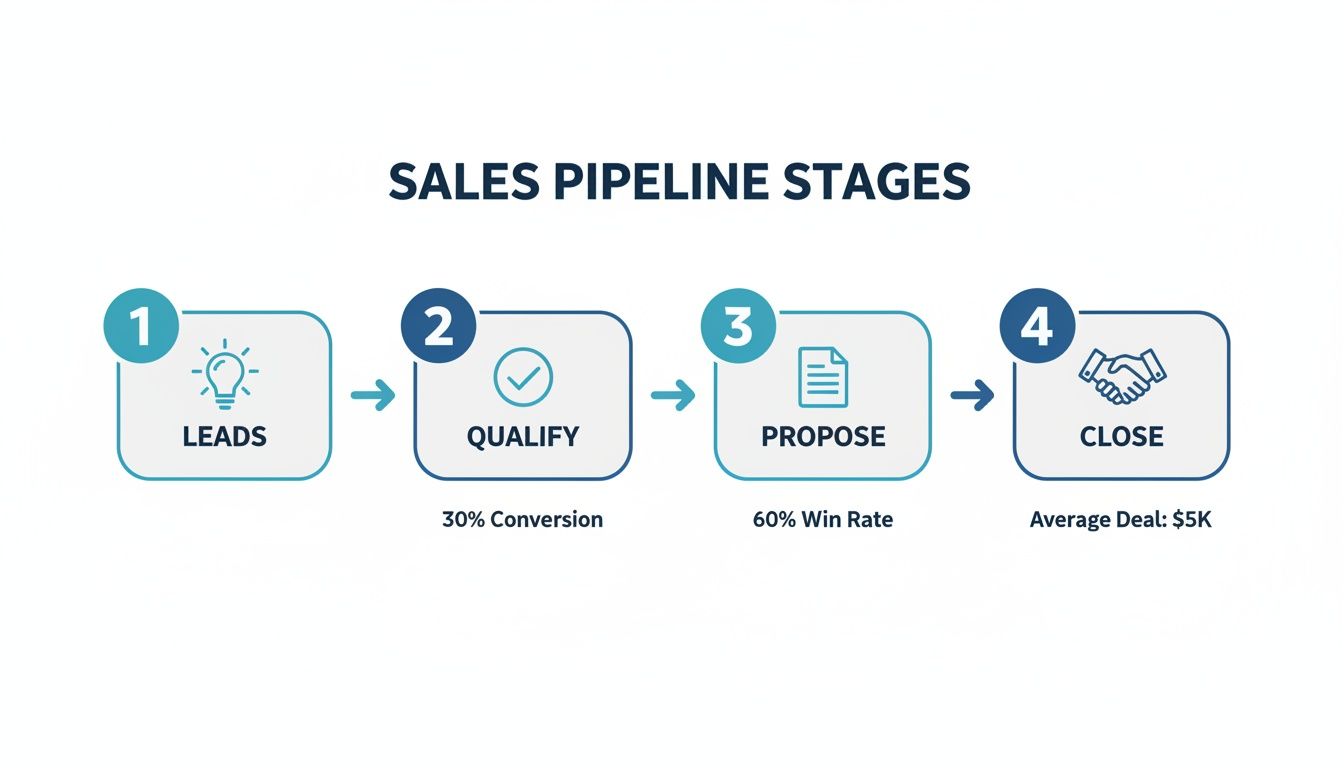
It’s pretty clear how conversion rates at each step snowball. A healthy pipeline isn't just about stuffing tons of leads in at the top; it needs to be strong all the way through.
Key Pipeline Health Metrics And Their Meaning
You could track a million different data points, but a handful of core metrics will give you the clearest picture of what's really going on. Focus on these, and you'll get 80% of the insights with just 20% of the effort. They’re your go-to diagnostic tools.
Here’s a breakdown of the crucial KPIs every sales leader should have their eyes on.
| Metric | What It Measures | How To Calculate It | What It Tells You |
|---|---|---|---|
| Number of Qualified Opportunities | The volume of real, potential deals entering your pipeline. | Total leads that meet your defined qualification criteria (e.g., BANT, MEDDIC) per period. | Are your marketing and prospecting efforts bringing in the right kind of leads? |
| Average Deal Size | The typical revenue value of a successfully closed deal. | Total Revenue from Won Deals / Number of Won Deals. | Are you attracting high-value clients, or is your team closing smaller, less ideal deals? |
| Stage-by-Stage Conversion Rate | The percentage of deals that advance from one pipeline stage to the next. | (Deals in Stage X+1 / Deals in Stage X) * 100. | Where are the leaks? This pinpoints specific stages where deals are getting stuck or dropping off. |
| Sales Velocity | The speed at which a deal moves through your pipeline from first contact to close. | (# of Opportunities x Avg. Deal Size x Win Rate) / Length of Sales Cycle (in days). | How efficient is your sales process? A faster velocity means a shorter path to revenue. |
These metrics move you from just looking at a list of deals to actually diagnosing the health of your entire sales process. You can pinpoint exactly where things are slowing down and where your team is knocking it out of the park.
Interpreting The Story Behind The Numbers
The real magic happens when you start connecting the dots. A single number doesn’t tell you much, but when you look at them together, they paint a very clear picture.
Let's walk through a few common scenarios:
-
Lots of Leads, But Few Qualified Deals: You're filling the top of the funnel like crazy, but your conversion rate from "Lead" to "Qualified" is in the gutter. This screams lead quality issues. Either marketing is casting too wide a net, or your sales team's qualification process is too loose.
-
Deals Dying in the Proposal Stage: If opportunities are flying through the initial stages but grinding to a halt after you send a proposal, something’s wrong with how you're communicating value. Is your pricing a shock? Is the proposal failing to connect your solution directly to their biggest pain points?
-
Average Deal Size is Shrinking: A slow dip in your average deal size is a dangerous sign. It could mean your team is leaning too heavily on discounts to get deals over the line, or you're attracting smaller, less profitable customers. Time to look at your pricing strategy or your ideal customer profile.
By keeping a close eye on these health indicators, you can stop reacting to problems and start preventing them. This data-driven approach lets you make smart, targeted fixes—like beefing up your qualification criteria or creating better proposal templates—that directly boost your bottom line.
Proven Strategies To Optimize Your Pipeline
Knowing your pipeline's health is one thing. Actually improving it is where the top teams find their edge.
Managing a sales pipeline isn't a passive sport. It's about building real systems that turn a simple reporting tool into an engine that actually drives revenue.
Think of your pipeline like a garden. You don't just throw some seeds in the ground and hope for the best. You've got to water them, pull the weeds, and give them the right nutrients if you want a decent harvest. Same deal here. You need to put in the work to nurture deals from that first "hello" to a signed contract.
Let's get into the practical stuff that turns a good pipeline into a great one.
Standardize Your Sales Process
If every rep on your team is running their own playbook, you don't have a sales process—you have chaos. Standardization is the bedrock of a pipeline you can actually scale and predict. It makes sure every single opportunity gets the same level of attention and rigor, no matter who's running the deal.
This means setting clear, non-negotiable rules for each stage. For instance, a deal can't move from "Discovery" to "Proposal" until the rep has confirmed the budget, knows exactly who the decision-maker is, and has the prospect's main problems documented in the CRM. Simple as that.
A standardized process creates a shared language for your entire team. It kills the guesswork, makes coaching way more effective, and gives you a solid baseline for figuring out what works and what doesn't.
When everyone is on the same page, you can finally compare performance accurately, see what your top reps are doing differently, and start cloning their success across the team.
Practice Regular Pipeline Hygiene
A cluttered pipeline is a dangerous pipeline. It’s a breeding ground for "zombie deals"—those opportunities that stalled out weeks ago but are still hanging around, making your forecast look a lot better than it really is. Cleaning this up is just like pulling weeds.
Here's what that looks like:
- Kill Stale Deals: Get ruthless. If a prospect has gone dark for 30 days despite your follow-ups, it's time to move them out of the active pipeline.
- Update Deal Info: Make sure every deal value, close date, and contact is current. One outdated close date can throw your whole forecast into a tailspin.
- Review Next Steps: Every single opportunity needs a clear next action with a due date. If it doesn't have one, it's not a real opportunity.
A clean pipeline gives you a clear view of reality. It lets you focus your energy on the deals that actually have a shot at closing.
Leverage Automation And AI
Manual admin work is a killer. It sucks up time your salespeople should be spending on, well, selling. Modern tools can handle the repetitive stuff, freeing up your team to do what you hired them for. This is where technology really changes the game.
By 2025, a whopping 95% of businesses will be using or planning to use AI in their sales and marketing. The teams that get on board are 7 times more likely to hit their targets because these tools are incredible at scoring leads, automating outreach, and making forecasts more accurate. You can read more about how AI is boosting B2B revenue here.
You can use tech to:
- Automate Follow-Ups: Set up email sequences that kick in when a deal goes quiet. No more leads slipping through the cracks.
- Implement Lead Scoring: Let AI analyze lead data to automatically score and prioritize the hottest prospects for your team to chase.
- Streamline Scheduling: Use calendar tools that let prospects book meetings with one click. It eliminates that painful back-and-forth email chain.
Align Sales And Marketing Efforts
Your pipeline doesn't live in a bubble. The quality of leads coming from marketing directly impacts your sales results. When sales and marketing are on different planets, the pipeline gets clogged with junk leads and mixed messages.
Real alignment means both teams agree on what a "qualified lead" actually is (MQL vs. SQL). It means they work together on content that helps buyers at every single stage. For a deeper look at this, check out our guide on sales and marketing alignment best practices. When they're in sync, your sales team has the right ammo to move deals forward, fast.
Common Pipeline Management Mistakes To Avoid
Knowing what to do is one thing. Knowing what not to do is what separates the teams hitting quota consistently from the ones who always seem to be scrambling at the end of the quarter.
Even the best-laid pipelines get sabotaged by a few classic, recurring bad habits. These mistakes feel small in the moment, but they add up, leaving you with a clogged pipeline, wildly inaccurate forecasts, and a burnt-out sales team. Let's walk through the big ones so you can sidestep them.
Letting Unqualified Leads Clog The System
This is probably the most common trap. Sales reps treat every single inquiry like it’s a golden ticket, afraid to disqualify anyone. What happens? They end up with a pipeline absolutely stuffed with "maybes" that are actually hard "nevers." All this does is burn through time and energy that should be focused on people who are actually ready to buy.
A pipeline full of junk leads creates a false sense of security. The forecast looks healthy, but it's built on a foundation of pure hope. This inevitably leads to missed targets and a last-minute panic when those deals, predictably, go nowhere.
The real goal of qualification isn't just to find reasons to keep a lead in the pipeline. It’s to find reasons to get them out, fast. A clean pipeline with a handful of high-quality deals is always better than a cluttered one.
Stop this by setting up rock-solid qualification criteria. A simple framework like BANT (Budget, Authority, Need, Timeline) is a great start. More importantly, empower your team to be ruthless about it. It’s far better to have a smaller, realistic pipeline than a huge, imaginary one.
Relying On Gut Feelings Over Data
Here's another classic mistake: managing the pipeline based on "good vibes" instead of cold, hard data. You ask a rep for an update, and you get answers like, "This one feels really good," or "I'm pretty sure they'll sign next week."
This is a recipe for disaster. You can't measure a gut feeling. You can't build a predictable revenue model on it. Without data, you’re flying blind. You have no real clue about the health of your pipeline or where the actual bottlenecks are. In fact, a staggering 63% of sales managers admit their company does a poor job managing its pipeline, usually because they aren't using data.
To fix this, get obsessive about objective numbers:
- Stage-by-Stage Conversion Rates: Where are deals actually falling apart?
- Sales Velocity: How long does it really take to get a deal from discovery to close?
- Deal Engagement: Did they open your last three emails, or have you been ghosted for two weeks?
Failing To Conduct Consistent Reviews
Your sales pipeline isn't a crockpot. You can't just "set it and forget it." It needs constant attention, yet so many teams fail to set up a regular, structured cadence for pipeline reviews. The result is a mess of stale deals and outdated notes.
When you don't do reviews, deals that stalled out weeks ago just sit there, bloating your forecast. Reps forget crucial next steps, and you, as a manager, completely lose sight of what's happening on the ground. Your pipeline stops being a strategic tool and becomes a useless historical document.
Make weekly or bi-weekly pipeline reviews a non-negotiable ritual. These meetings shouldn't feel like an interrogation. They should be collaborative sessions to spot risks, figure out what to do next, and make sure every single deal is either moving forward or getting moved out.
A Step-By-Step Pipeline Implementation Plan
Theory is great, but execution is what puts money in the bank. Knowing the concepts is one thing; actually building a functional, data-driven sales process is what separates the top performers from everyone else. This plan is your roadmap to get there.

Think of this as the blueprint. Follow these five phases, and you’ll ditch the messy, reactive sales approach for a structured operation that delivers predictable results. This isn’t about a one-time setup—it’s about creating a living system you can fine-tune over time.
Phase 1: Define Your Sales Stages
You can't manage what you haven't defined. Your sales stages are the specific, non-negotiable steps a deal must pass through, from the first "hello" to a closed-won contract. If your stages are vague, your pipeline will be a mess of bad data and wishful thinking.
Start by mapping out how deals actually move through your business right now, even if it's informal. What are the key milestones? Get your sales team in a room for this one—their buy-in is crucial, and they know the ground truth.
Every stage needs crystal-clear entry and exit rules. No exceptions. For example:
- Stage Name: Qualification
- Entry Criteria: We've made contact, and they've agreed to a discovery call.
- Exit Criteria: We've confirmed BANT (Budget, Authority, Need, Timeline) and it’s logged in the CRM.
This kind of clarity kills the guesswork. A deal only moves forward when specific actions are complete. It forces your pipeline to reflect reality. If you want a deeper look at this, our full guide on how to build a sales pipeline has more detailed frameworks you can borrow.
Phase 2: Identify Key Performance Metrics
With your stages locked in, you need a way to keep score. Don't fall into the trap of tracking every metric under the sun—you'll just drown in data. Focus on a few core numbers that give you a real pulse on your pipeline's health.
These metrics are your diagnostic tools. They pinpoint where your process is humming and where it’s leaking cash.
Start with the "big four": Number of Qualified Opportunities, Stage-by-Stage Conversion Rates, Average Deal Size, and Sales Velocity. Together, these KPIs give you a 360-degree view of your pipeline's volume, efficiency, value, and speed.
First thing's first: establish your baseline. You can't know if you're getting better if you don't know where you started. This data will be the bedrock for every strategic move you make from here on out.
Phase 3: Select The Right CRM And Tools
Trying to run a sales pipeline from a spreadsheet is like trying to build a house with only a hammer. It's slow, painful, and eventually, the whole thing will collapse. A Customer Relationship Management (CRM) system is non-negotiable if you're serious about growing.
Your CRM needs to be the single source of truth for everything sales-related. It's where your stages and metrics come to life. When you're shopping for a platform, make sure it has the features to back up solid sales pipeline management.
Here's what to look for:
- Customizable Pipeline Stages: The tool must bend to your process, not the other way around.
- Visual Deal Tracking: You need a clean, drag-and-drop view to see where every deal is at a glance.
- Automated Activity Logging: It should automatically capture emails, calls, and meetings. Your team is here to sell, not do data entry.
- Robust Reporting and Dashboards: You need real-time visibility into your key metrics without having to export anything.
The right tool removes friction and gives you the clarity you need to steer the ship.
Phase 4: Train Your Team On The Process
A world-class process is worthless if your team ignores it. The next critical step is getting 100% buy-in from your reps. This isn't a one-and-done email—it requires proper, dedicated training.
Start with the "why." Explain how this new structure isn't just more admin work; it's a system designed to help them close more deals and make more money. Then, show them exactly how to use the CRM to manage their opportunities based on the new rules.
Good training always includes:
- A simple playbook that defines each stage and its criteria.
- Live walkthroughs of the CRM and any other new tools.
- Role-playing to practice the new workflow until it becomes muscle memory.
And it doesn't stop there. Reinforce the process constantly in your one-on-ones and team meetings. Make it part of your sales culture.
Phase 5: Establish A Consistent Review Cadence
Finally, a pipeline isn't a crockpot. You can't just "set it and forget it." It needs regular attention to stay clean, accurate, and powerful. The single most important ritual for a high-performing sales team is the pipeline review meeting.
Hold these meetings weekly or bi-weekly. The goal isn't to micromanage your reps; it's to work together to solve problems, spot deals that are at risk, and make sure your forecast is actually based in reality.
Keep the reviews forward-looking. Instead of just asking, "What did you close?" shift the focus. Ask, "What's the very next step for this deal?" and "What do we need to do to push this opportunity to the next stage?" This proactive rhythm keeps momentum high and turns your pipeline into a true engine for growth.
Got Questions? We've Got Answers
Let's tackle some of the common questions that pop up when teams start getting serious about managing their sales pipeline.
Sales Pipeline vs. Sales Funnel: What's The Real Difference?
It’s easy to get these two mixed up, but the distinction is actually pretty simple.
Think of the sales pipeline as your team's playbook. It’s the set of concrete steps you take to push a deal from "new lead" to "closed won." It's all about your internal process, from the seller's point of view.
A sales funnel, on the other hand, is all about the customer's journey. It tracks how a massive pool of potential buyers gets smaller and smaller as they move from being vaguely aware of you to becoming a paying customer. It’s their experience, their perspective.
How Often Should We Be Reviewing Our Pipeline?
There's no single right answer, but cadence is king.
If you have a quick sales cycle (we're talking under a month), you absolutely need to be doing weekly reviews. Things move fast, and a week is a long time. These regular check-ins keep the momentum going and let you pivot quickly.
For businesses with longer, more complex deals, a bi-weekly review usually does the trick. The most important thing is picking a rhythm and sticking to it. It builds accountability and keeps your sales forecasts from becoming pure guesswork.
Can I Get By Without a CRM?
Look, you could try to run this all on a spreadsheet. If you’re a one-person show with a handful of deals, maybe you can make it work for a little while.
But let's be honest—that's going to fall apart the second you start to grow. It’s messy, a nightmare to update, and a magnet for human error.
For any team that’s serious about growth, a real CRM isn't a "nice-to-have." It’s the engine. It automates the grunt work, gives everyone a single source of truth, and pulls reports that actually mean something. It’s a non-negotiable tool for building a scalable sales machine.
Building a predictable B2B pipeline is what we live and breathe. Growlancer combines authority-building content with laser-focused outreach on LinkedIn to drop qualified meetings right into your team's calendar. Discover how we can build your revenue engine.