

In a market saturated with outreach, a generic sales cadence is worse than useless; it's a brand-killer. Prospects have become adept at spotting automated, low-value sequences from a mile away. To break through this noise, sales teams must move beyond simply stringing together emails and LinkedIn messages. The new standard requires a strategic, multi-layered approach that builds authority, delivers genuine value, and personalizes at scale. It's about architecting a conversion system, not just a linear sequence.
This guide moves past the theoretical and provides a tactical playbook of the most critical sales cadence best practices that modern B2B teams are using to book meetings with their ideal customers consistently. We're not just talking about what to do; we're detailing how to do it.
You will learn how to implement specific, actionable frameworks designed to build a predictable pipeline and drive measurable revenue. We will cover everything from coordinating executive outreach and leveraging behavioral triggers to diversifying channels and optimizing the timing of every touchpoint. Each practice is a building block for creating a sophisticated, high-performance outreach engine that respects your prospect's intelligence and time. These are the strategies that separate top-performing sales organizations from the rest, transforming outreach from a game of numbers into a science of engagement. Get ready to architect cadences that don't just get opened, but actually convert.
1. Multi-Touch Attribution Cadence (5-7 Touch Points)
A Multi-Touch Attribution Cadence is a structured outreach sequence that strategically combines 5-7 different touchpoints across multiple channels. This approach, typically spread over 2-4 weeks, recognizes a core truth in modern B2B sales: buyers rarely convert after a single interaction. Instead, this method builds familiarity and trust through repeated, value-driven exposures, dramatically increasing response rates.
This methodology is one of the most effective sales cadence best practices because it mirrors the non-linear B2B buyer’s journey. By integrating channels like LinkedIn content engagement, direct messages, emails, and phone calls, you create a cohesive and persistent presence. For example, platforms like Outreach.io report that clients using structured 5-touch cadences achieve connect rates between 12-15%, while HubSpot’s recommended sequences can convert at rates of 15-30%.
How to Implement a Multi-Touch Cadence
To build an effective sequence, focus on a strategic blend of timing, value, and channel diversity. The goal isn't to bombard prospects but to build a narrative that culminates in a conversation.
- Stagger Your Touchpoints: Space interactions 3-5 days apart. This prevents overwhelming the prospect and gives them time to see and consider your previous message or engagement.
- Warm Up the Relationship: Begin with a low-friction interaction on LinkedIn, such as liking or commenting on a prospect’s post, before sending a direct connection request or message.
- Prioritize Value Over Pitching: Use the first three touchpoints to deliver value. Share a relevant article, offer a unique insight from their company's recent announcement, or provide a helpful resource.
- Save the "Ask" for Later: Reserve your direct pitch or meeting request for touchpoints 5-7, once you have established a baseline of rapport and credibility.
- Track and Optimize: Monitor engagement rates for each touchpoint and channel. If emails are underperforming but LinkedIn messages get replies, adjust your sequence accordingly.
2. Executive Coordinated Outreach (Team-Based Cadence)
Executive Coordinated Outreach is a team-based cadence where multiple leaders from the same company synchronize their content and outreach efforts toward a specific Ideal Customer Profile (ICP). Instead of a single salesperson doing all the work, this strategy leverages the authority of CEOs, founders, and other executives. They post complementary content and orchestrate touchpoints, presenting the entire organization as a unified and credible authority.
This approach is one of the most powerful sales cadence best practices for high-value B2B deals because it replaces cold outreach with warm, authority-led conversations. The collective presence of multiple executives builds immense trust and credibility that a lone sales rep cannot replicate. For example, Growlancer's Foundation to Executive Suite programs have generated over 800 attributed deals for B2B clients using this model, while some SaaS scale-ups report conversion rates of 15-30% from coordinated leadership outreach.
How to Implement a Team-Based Cadence
Building a successful executive cadence requires tight alignment, a shared content strategy, and clear role definitions. The goal is to create an omnipresent effect where prospects see and hear from multiple leaders, all reinforcing the same core message.
- Create a Shared Content Calendar: Map out each executive's posting schedule and content themes. This ensures a consistent and complementary message across all leadership profiles, preventing overlap and maximizing impact.
- Assign Outreach Targets: Match executive seniority with prospect seniority. Your CEO might reach out to their counterpart, while the VP of Sales connects with other revenue leaders, making the interaction feel peer-to-peer.
- Develop Role-Specific Scripts: Tailor outreach templates to each executive's unique voice and expertise. The CTO's message should sound different from the CMO's, reflecting their specific value proposition.
- Establish Weekly Syncs: Hold brief weekly meetings to review engagement data, discuss warm prospects, and adjust the cadence based on what's working. Who is getting replies? Which content is resonating most?
- Use Social Listening: Track when prospects engage with any team member’s content. This provides a perfect trigger for another executive to follow up with a relevant, timely message. For more tips, check out this guide on how to build executive presence.
3. Content-First Outreach Cadence (Authority-Driven Engagement)
A Content-First Outreach Cadence flips the traditional sales model by prioritizing value delivery through authority content before any direct outreach. This approach leverages channels like LinkedIn to build familiarity and trust organically. Prospects engage with your expert content first, effectively warming themselves up, so when you finally reach out, it’s a welcomed conversation rather than a cold interruption.
This method stands out as one of the top sales cadence best practices because it aligns with modern buyer behavior, where prospects prefer to research independently. Instead of pushing a sale, you pull prospects in with expertise. For example, B2B SaaS leaders like HubSpot and Notion generate 30-40% of their pipeline through thought leadership. Similarly, professional services firms that consistently share executive insights have reported a 50%+ increase in inbound inquiries, validating the power of an authority-driven approach.
How to Implement a Content-First Cadence
Building this cadence requires a strategic commitment to content creation and systematic engagement tracking. The goal is to become a recognized authority in your niche, making outreach feel like a natural next step.
- Establish Your Content Pillars: Identify 5-7 core themes that deeply resonate with your Ideal Customer Profile (ICP). This ensures your content is consistently relevant and builds topical authority.
- Mix Your Content Formats: Create a balanced content mix to maintain audience interest. A good starting point is 40% tips/frameworks, 30% data/insights, 20% thought leadership, and 10% company culture.
- Tag and Track Engagement: Monitor who likes, comments on, and shares your content. Tag these engaged prospects in your CRM for a targeted follow-up sequence 3-5 days after their interaction.
- Reference Their Engagement: When you reach out, make the connection explicit. For example, "Saw you liked our post on scaling engineering teams. I thought you'd find our detailed framework on that topic useful."
- Create Content Series: Develop a multi-part content series around a key pain point. This builds anticipation and establishes deep expertise over several weeks, priming prospects for a conversation. You can learn more about building a thought leadership content strategy on growlancer.ai.
4. Personalization At Scale (Dynamic Cadence Framework)
A Dynamic Cadence Framework is a sophisticated approach that delivers highly personalized messaging to hundreds of prospects simultaneously without sacrificing relevance. This system uses data about a prospect's company, industry, role, and pain points to automatically guide them through a unique outreach path built from a templated, variable-driven framework.
This methodology stands out as one of the most powerful sales cadence best practices because it solves the core conflict between scalability and customization. By using modern tools to inject variable content and trigger sequences based on behavior, each prospect feels individually targeted. For example, SalesLoft and Outreach.io clients often report 20-25% higher response rates with dynamic personalization, while some enterprise SaaS companies have deployed this at a scale of 5,000+ prospects with impressive 12-18% reply rates.
How to Implement a Dynamic Cadence Framework
To execute personalization at scale, you must build a system that combines intelligent data segmentation with modular content. The goal is to create a "choose your own adventure" experience for each prospect, guided by their specific attributes.
- Start with Key Variables: Begin with 3-5 core personalization tokens, such as company size, industry, job title, a recent company announcement, or a known pain point from your ICP research.
- Build Cadence Branches: Instead of one giant, complex sequence, create separate cadence branches for different ICP segments. For instance, have one track for VPs of Marketing in SaaS and another for Directors of Operations in logistics.
- Use Company News Triggers: Automate triggers based on news like new funding rounds, executive hires, or earnings reports. A message referencing a recent Series B funding is far more relevant and effective.
- Layer Your Personalization: Use "light" personalization (e.g.,
{{first_name}},{{company_name}}) in early, low-effort touchpoints. Reserve "deep" personalization (e.g., referencing a specific pain point from their 10-K report) for touchpoints 4-6, where it will have the most impact. - Validate Your Data: Before launching, ensure all your data is clean and accurate. A poorly executed personalization token (e.g., "Hi FNAME") is worse than no personalization at all and immediately erodes trust.
5. Channel Diversification Cadence (Omnichannel Sequencing)
A Channel Diversification Cadence, also known as Omnichannel Sequencing, is an outreach strategy that spreads touchpoints across multiple communication channels like LinkedIn, email, phone, and even video or direct mail. This approach acknowledges that prospects have different communication preferences and are active on various platforms. By orchestrating a cohesive sequence across these channels, you significantly increase the chances of cutting through the noise and connecting with your ideal customer.
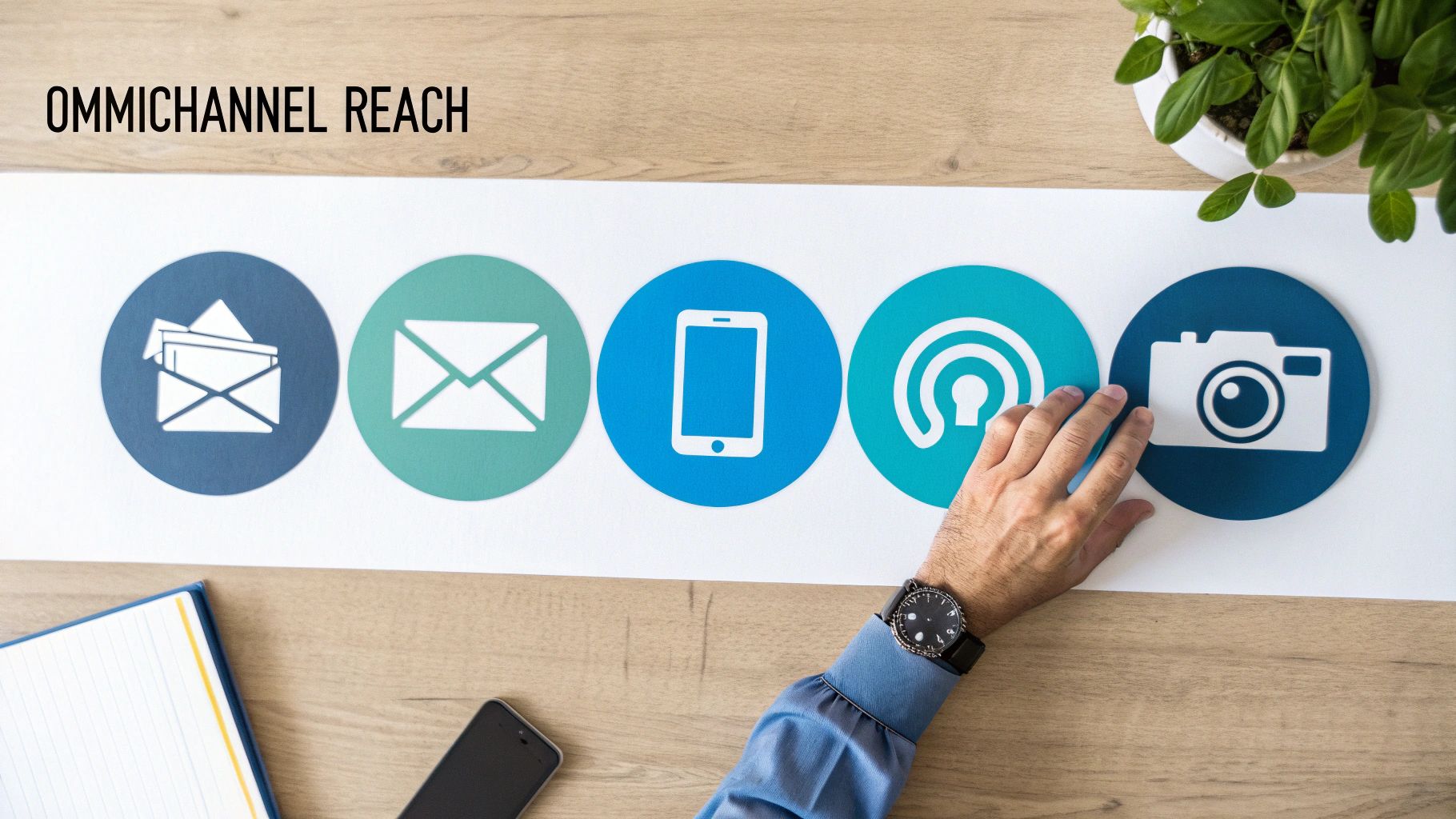
This method is one of the most powerful sales cadence best practices because it surrounds the prospect in a way that feels persistent yet not intrusive. Instead of relying on a single, easily ignored channel, it creates a unified brand presence. For instance, enterprise SaaS companies that combine LinkedIn, email, and phone calls in their cadences often report meeting conversion rates of 25% or higher, showcasing the impact of a well-coordinated, multi-channel approach popularized by platforms like SalesLoft and Outreach.
How to Implement a Channel Diversification Cadence
The goal is to use each channel for its unique strengths, creating a sequence where each touchpoint builds on the last. This requires careful planning and coordination.
- Map Channels to Your ICP: Align your channel selection with your prospect's role and industry. Executives often respond best to LinkedIn and phone calls, while individual contributors may be more accessible via email.
- Escalate Your Efforts: Start with lower-friction, higher-reach channels like a LinkedIn view or comment. Escalate to higher-touch channels like a phone call or a personalized video message only after a prospect shows some form of engagement.
- Assign a Purpose to Each Channel: Use email for delivering in-depth value like case studies or articles. Leverage LinkedIn for conversational starters and relationship building. Reserve phone calls for high-intent follow-ups.
- Reference Previous Touchpoints: Make your outreach feel connected and intentional. A message like, "Following up on the LinkedIn message I sent Tuesday…" shows you are organized and persistent, not just spamming.
- Track Channel Performance: Monitor which channels generate the highest response rates for your specific audience. If LinkedIn DMs outperform cold emails by a wide margin, adjust your cadence to prioritize that channel.
6. Behavioral Trigger-Based Cadence (Intent-Driven Engagement)
A Behavioral Trigger-Based Cadence is a dynamic and responsive outreach sequence activated by specific prospect actions rather than a rigid, time-based schedule. This intent-driven approach launches automated workflows when a prospect shows buying signals, such as visiting your pricing page, downloading a case study, or engaging with an ad. By aligning outreach with a prospect’s real-time interest, this method prioritizes the warmest leads and customizes engagement to match their buying momentum.
This method is one of the most powerful sales cadence best practices because it focuses sales efforts where they have the highest probability of success. Companies using intent data from platforms like 6sense or Demandbase can trigger high-priority sequences the moment an account shows interest, leading to dramatically higher conversion rates. For instance, SaaS companies have reported achieving 40-50% meeting booking rates from high-intent trigger-based cadences because the outreach is perfectly timed and contextually relevant.
How to Implement a Behavioral Trigger-Based Cadence
Building an effective trigger-based cadence requires a clear definition of intent signals and a well-integrated tech stack. The goal is to act on buying intent with speed and precision, providing a seamless and relevant experience for the prospect.
- Define Your Intent Signal Hierarchy: Not all actions are equal. Classify triggers by interest level: a pricing page visit is high-intent, a blog view is medium, and a social media follow is low. This dictates the urgency and personalization of your response.
- Create Tiered Cadence Tracks: Develop separate outreach sequences for each engagement level. A high-intent lead might receive an immediate phone call and personalized email, while a low-intent lead is added to a longer, more nurturing sequence.
- Integrate Website Visitor Identification: Use tools like Clearbit or Apollo.io to de-anonymize website traffic. This allows you to identify which target accounts are browsing your site and trigger cadences even if they don't fill out a form.
- Set Up Immediate Sales Notifications: Configure your CRM to send instant alerts to the assigned sales rep for high-intent actions. A prospect submitting a demo request should trigger a call within 15 minutes to capitalize on peak interest.
- Track Conversion by Trigger: Analyze which signals consistently lead to meetings and closed deals. This data will validate your intent hierarchy and help you refine which behaviors to prioritize in your sales process.
7. Account-Based Sales Cadence (ABM Framework)
An Account-Based Sales Cadence is a highly coordinated outreach strategy that targets entire organizations as a single "account" rather than focusing on individual leads. This framework recognizes that complex B2B purchases involve a buying committee, not just one decision-maker. The cadence synchronizes multi-channel touchpoints across various stakeholders, such as the CEO, CFO, and Head of Procurement, to build consensus and drive deals forward.
This methodology is one of the most powerful sales cadence best practices for high-value, complex sales cycles. Instead of a one-to-one approach, it’s a many-to-many engagement model. For example, enterprise SaaS companies deploying targeted ABM cadences often achieve first-meeting conversion rates of 30-40% and deal closure rates over 25%. Similarly, professional services firms using this model have seen win rates on targeted accounts exceed 50%, compared to 20-25% for non-ABM efforts.
How to Implement an Account-Based Cadence
Success with an ABM cadence requires meticulous planning, internal coordination, and deep personalization for each stakeholder within the target account.
- Select High-Value Accounts: Identify target accounts using clear criteria like company size, strategic fit with your product, and growth potential. Focus your resources where they will have the greatest impact.
- Map the Buying Committee: Create detailed account plans that document each stakeholder's role, priorities, pain points, and reporting structure. This map guides your entire outreach strategy.
- Develop Role-Specific Messaging: Tailor your content and messaging for each individual. A CEO cares about revenue impact and ROI, while a CTO is focused on technical integration and security. Your outreach must reflect their unique concerns.
- Coordinate Cross-Functional Outreach: Assign a primary account owner to orchestrate efforts across sales, marketing, and leadership. Use a dedicated Slack channel or internal group to ensure messaging is consistent and synchronized.
- Stagger Your Touchpoints Strategically: Avoid contacting the entire buying committee on day one. Start by building rapport with a key champion or engaging with senior executives on LinkedIn before initiating a broader, multi-threaded outreach.
8. Cadence Velocity & Spacing Optimization (Timing Science)
Cadence Velocity and Spacing Optimization is a data-driven approach that moves beyond arbitrary timing to scientifically determine the ideal frequency and spacing of touchpoints. Instead of a one-size-fits-all "every 3 days" rule, this method uses engagement patterns, prospect personas, and industry data to dictate when to send emails, make calls, or engage on social media. The goal is to maximize opens, replies, and conversions by contacting prospects at the most opportune moments.
This dynamic strategy is one of the most crucial sales cadence best practices because timing is as important as the message itself. By adjusting the velocity, or speed, of the cadence based on prospect engagement, you can accelerate outreach for interested leads and give colder prospects more space. For instance, data from Outreach.io shows that optimal spacing of 4 days between touches in B2B SaaS can achieve response rates over 20%, while HubSpot research consistently finds that sending emails between Tuesday and Thursday at 10 AM yields 10-15% higher open rates.
How to Implement Cadence Velocity & Spacing
Effective implementation requires a shift from fixed schedules to a flexible, data-informed system. The key is to let prospect behavior and analytics guide your outreach rhythm, creating a more responsive and effective sales process.
- Start with Industry Benchmarks: Don't start from scratch. Use established data as a baseline, such as 4-day spacing for B2B SaaS or 5-7 day spacing for slower-moving enterprise sales cycles.
- Test Day and Time Variables: While Tuesday at 10 AM is a common recommendation, test different windows for your specific ICP. A/B test morning vs. afternoon sends to see what works for your audience.
- Use Engagement to Adjust Velocity: Implement rules that automatically adjust spacing based on actions. If a prospect opens an email or clicks a link, compress the next touchpoint from 4 days to 2. This capitalizes on their momentary interest. For a deeper dive, explore how this fits into your broader sales process optimization on growlancer.ai.
- Implement Lead Scoring Triggers: Connect cadence velocity to your lead scoring system. A high-score prospect (e.g., visited the pricing page) should trigger an accelerated, high-touch sequence.
- Track Spacing-Specific Metrics: Monitor key metrics like reply rate, unsubscribe rate, and conversion rate per touch interval. If you find that 4-day spacing consistently outperforms 3-day spacing by 15%, standardize this learning across the team.
9. Value-First Cadence (Educational Engagement Model)
A Value-First Cadence flips the traditional sales model by prioritizing genuine, educational value before asking for anything in return. This engagement model focuses on building trust and establishing authority through a sequence of touchpoints designed to help, not sell. Each interaction delivers relevant research, unique insights, or useful resources tailored to a prospect's specific challenges, positioning you as a trusted advisor rather than just another vendor.
This methodology is one of the most powerful sales cadence best practices because it aligns with how modern executives buy. Instead of a direct pitch, you lead with generosity, which generates reciprocity and opens doors to higher-quality conversations. Companies like HubSpot and Drift built their empires on this principle, using educational content to fuel their sales funnels. Similarly, professional services firms often generate over 40% of new business by sharing thought leadership and building educational relationships long before a contract is ever discussed.
How to Implement a Value-First Cadence
Building a value-first sequence requires a genuine commitment to understanding and helping your prospect. The primary goal is to establish credibility and make your eventual "ask" a natural next step in a mutually beneficial relationship.
- Lead with Unexpected Insights: Invest time researching the prospect's company, industry, and competitors. Open with a specific, helpful observation, like "I saw your competitor [Company Name] just launched a new feature that might impact your Q4 strategy. Here’s a quick analysis."
- Share Resources Without Expectation: Provide valuable content such as articles, white papers, or case studies with no strings attached. A simple "Found this research on [topic] and thought of you" builds goodwill.
- Build a 'Value Bank': Proactively collect and organize shareable assets like industry reports, frameworks, templates, and helpful articles. This allows your team to consistently provide value without creating new content for every interaction.
- Delay the "Ask": Reserve your direct meeting request for touchpoints 4 or 5 at a minimum. By then, you have established a foundation of trust, making the prospect far more receptive to a conversation.
- Reference Previous Value: When you finally make your ask, connect it to the value you’ve already provided. For example, "Following up on the insight I shared about [topic], would a conversation to explore it further be useful?"
10. Cadence Win-Back & Re-engagement Sequences (Prospect Resurrection)
A Win-Back or Re-engagement Cadence is a specialized outreach sequence designed to revive communication with prospects who have gone dormant or previously declined. Instead of permanently archiving these leads, this strategy acknowledges the prior relationship and attempts to restart the conversation by introducing a new angle, updated value proposition, or relevant trigger event. This approach is one of the most resource-efficient sales cadence best practices because it targets an audience that is already familiar with your brand.
These sequences are effective because circumstances change. A prospect who said "no" six months ago due to budget constraints, timing issues, or a competing priority might now be in a perfect position to buy. A well-executed re-engagement cadence respects their previous decision while gently probing to see if their situation has evolved. By providing a clear and respectful exit ramp, you maintain relationship hygiene and avoid damaging your brand's reputation.
How to Implement a Re-engagement Sequence
The key to a successful win-back is to lead with new information, not a rehashed pitch. Your goal is to provide a compelling reason for the prospect to reconsider their initial stance.
- Acknowledge the Past: Start your outreach by referencing your previous interaction. A simple line like, "We spoke briefly last quarter about [topic]," shows you remember them and aren't just sending a generic blast.
- Lead with a Trigger Event: The most powerful re-engagement messages are tied to a specific trigger. This could be their company's new funding round, a recent promotion you saw on LinkedIn, or a major industry shift.
- Introduce "What's New": Frame your outreach around a new value proposition. Examples include a new product feature, a recent case study from a similar company, or an upcoming webinar on a topic you know they care about.
- Keep it Short and Respectful: These sequences should be shorter than a standard prospecting cadence, typically 3-4 touches over a few weeks. Always include a soft opt-out, such as, "If this is no longer a priority, just let me know, and I'll be sure not to bother you again."
- Segment Your "Lost" Leads: Don't treat all dormant prospects the same. Create different re-engagement cadences for leads lost to a competitor versus those who simply went silent.
10-Point Sales Cadence Best Practices Comparison
| Strategy | 🔄 Implementation Complexity | 💡 Resource Requirements | ⭐ Effectiveness | 📊 Expected Outcomes & Key Advantages | ⚡ Ideal Use Cases / Speed |
|---|---|---|---|---|---|
| Multi-Touch Attribution Cadence (5–7 Touch Points) | Medium–High — cross-channel coordination and sequencing | Moderate — LinkedIn, email, phone + CRM/automation; personalization effort | ⭐⭐⭐⭐ | Increases responses 40–60%; builds familiarity and pipeline velocity | Best for B2B SaaS / mid-market → longer cycles (2–4 weeks) |
| Executive Coordinated Outreach (Team-Based Cadence) | High — requires executive alignment and governance | High — executive time, content calendar, coordination tools | ⭐⭐⭐⭐⭐ | Greatly increases credibility and reach (3–5x); compresses cycle (14–21 days) | Strategic enterprise deals; fast impact if execs engaged |
| Content-First Outreach Cadence (Authority-Driven) | Medium — content production + engagement tracking | High — sustained content cadence (5 posts/week per exec) and analytics | ⭐⭐⭐⭐ | Drives inbound, warms prospects; improves lead quality and authority | Brand-building / long-term pipeline; slower ramp to scale |
| Personalization At Scale (Dynamic Cadence) | High — template rules, data integrations, behavior branching | High — clean firmographic/technographic data + automation tools | ⭐⭐⭐⭐ | Scalable personalized replies (15–30% conv.); efficient high-volume outreach | High-volume outbound for mid-market/enterprise; medium speed |
| Channel Diversification Cadence (Omnichannel) | High — multi-channel tracking and message coordination | High — phone numbers, video/direct mail, LinkedIn + CRM sync | ⭐⭐⭐⭐ | Raises response 30–50% vs single-channel; differentiates top prospects | When prospect prefs vary; effective but costlier and more complex |
| Behavioral Trigger-Based Cadence (Intent-Driven) | High — real-time triggers, lead scoring, CRM flows | Medium–High — intent providers + automation + analytics | ⭐⭐⭐⭐⭐ | Contacts prospects at peak intent; increases meetings, shortens cycle 30–50% | Best for intent-led, high-velocity opportunities; very fast response |
| Account-Based Sales Cadence (ABM Framework) | Very High — multi-stakeholder mapping and cross-team orchestration | Very High — account intelligence, executive involvement, tailored assets | ⭐⭐⭐⭐⭐ | Engages buying committee; higher win rates, shortens cycle 20–30%, larger deals | Enterprise & strategic accounts; resource-intensive, high ROI |
| Cadence Velocity & Spacing Optimization (Timing Science) | Medium — requires historical analysis and testing | Medium — analytics, A/B testing, lead scoring | ⭐⭐⭐⭐ | Improves response 20–30%; reduces fatigue/unsubscribe; better deliverability | Universal playbook optimization; speeds engaged deals, slows cold nurture |
| Value-First Cadence (Educational Engagement) | Medium — research-driven touches and discipline to delay ask | Medium–High — bespoke insights, content library, time per prospect | ⭐⭐⭐⭐ | Builds trust; higher-quality conversations; higher close rates but longer cycles | Consultative sales / professional services; slower initial conversion |
| Cadence Win-Back & Re-engagement Sequences | Low–Medium — triggered replays with refreshed messaging | Low–Medium — reactivation content + automation triggers | ⭐⭐⭐ | Recovers ~10–20% dormant prospects at low cost; preserves hygiene | Lapsed prospects or declined leads; low-cost, timing-sensitive re-engagement |
From Theory to Revenue: Implementing Your Cadence System
We have journeyed through ten distinct frameworks designed to transform your outreach from a speculative art into a data-driven science. From the precision of Behavioral Trigger-Based Cadences to the collaborative power of Executive Coordinated Outreach, the central theme is clear: success in modern B2B sales hinges on a strategic, multi-channel, and value-centric approach. A well-designed sales cadence is far more than a simple sequence of emails and calls; it is a meticulously choreographed conversation that guides a prospect from awareness to decision.
The most critical takeaway is that implementing these sales cadence best practices is not a one-time project but a continuous cycle of refinement. Your ideal customer profile (ICP) evolves, market dynamics shift, and new communication channels emerge. The cadences that generate breakthrough results today will require adaptation tomorrow. The true masters of this discipline embrace an iterative mindset, constantly analyzing performance data to optimize every touchpoint.
Turning Insights into Actionable Strategy
Moving from theory to tangible results requires a deliberate and focused implementation plan. The sheer volume of strategies can feel overwhelming, but progress is made through incremental, measurable steps. The goal is not to overhaul your entire sales process overnight but to build a robust, repeatable system brick by brick.
Here are your immediate next steps to translate these concepts into pipeline:
- Audit and Diagnose: Before building anything new, evaluate your current outreach efforts. Where are the leaks? Are you overly reliant on a single channel? Are your messages generic? Use the frameworks in this article as a benchmark to identify your biggest opportunities for improvement.
- Select a Pilot Program: Choose one or two cadences that align most closely with your immediate business goals. If you are launching a new ABM initiative, start with the Account-Based Sales Cadence. If your executive team has a strong presence on LinkedIn, the Content-First Outreach Cadence is a natural fit.
- Define Success Metrics: Establish clear KPIs for your pilot. Go beyond open and reply rates. Track crucial business metrics like meetings booked, sales-qualified leads (SQLs) generated, and ultimately, pipeline velocity and closed-won revenue attributed to the cadence.
- Document and Systematize: Create a playbook for your chosen cadence. Document the exact sequence, timing, templates, and personalization tokens. This documentation is essential for training new hires and ensuring consistent execution across the entire sales team.
The True Value of a Mastered Cadence
Ultimately, mastering these sales cadence best practices is about more than just booking more meetings. It is about building a predictable revenue engine that scales with your business. It is about empowering your sales team with a system that enables them to spend less time on manual, repetitive tasks and more time on high-value conversations with qualified buyers.
A sophisticated cadence system transforms your go-to-market strategy from reactive to proactive. It creates a powerful feedback loop where every interaction provides data to make the next one smarter. By embedding value, personalization, and strategic timing into the core of your outreach, you build trust and establish authority long before a prospect ever speaks to a sales representative. This is how you win in a crowded market: not by shouting the loudest, but by communicating the smartest.
Ready to install a complete go-to-market system that combines executive authority content with targeted, multi-channel outreach? Growlancer builds and manages the entire engine for you, implementing these advanced sales cadence best practices to deliver a predictable stream of qualified B2B sales meetings. Stop guessing and start growing by visiting Growlancer to see how we build your pipeline.