

A thought leadership content strategy isn't just about sharing opinions online and hoping for the best. It's a systematic plan for turning your executives' deep expertise into measurable brand authority—the kind that actually generates business opportunities.
It's about moving from random acts of content to a deliberate process of establishing your leaders as the go-to experts in their specific corner of the market. This approach uses truly insightful content to build trust, attract the right customers, and ultimately, drive revenue.
What Is a Real Thought Leadership Content Strategy
Let's cut through the buzzwords. A genuine thought leadership strategy is the operational system that transforms your team's unique knowledge into a consistent, pipeline-driving engine, especially on a platform like LinkedIn.
Think of it as the bridge between what your executives know inside and out and what your ideal customers desperately need to hear. So many companies spin their wheels here. They lack a repeatable process, which leads to sporadic, disconnected posts that never build any real momentum.
This guide is the complete playbook to fix that. The goal isn't just to generate "content"—it's to build a system that creates a powerful brand presence, allowing you to lead the conversations in your industry. A solid strategy makes sure every effort is focused, consistent, and tied directly to business goals.
The Core Pillars of This Approach
A winning strategy is a multi-faceted system, not just a writing exercise. There are a few foundational elements that are absolutely critical for turning raw expertise into real influence.
- Niche Positioning: You have to define a unique, defensible angle for each executive. What’s the one thing they can own?
- Consistent Cadence: This means establishing a reliable publishing and engagement schedule that your audience can count on.
- Integrated Outreach: Content is the starting point. The real magic happens when you activate it to start conversations and book meetings.
- Clear ROI Measurement: If you can't measure it, you can't improve it. You need to track the metrics that prove the financial return on your efforts.
To put it simply, here’s a quick overview of the essential components that form the backbone of the framework we'll be building in this guide.
Core Components of a Modern Thought Leadership Strategy
| Component | Objective | Key Activity |
|---|---|---|
| Market & ICP Mapping | Pinpoint the exact audience and their most pressing challenges. | Deep-dive customer interviews, competitor analysis, and social listening. |
| Executive Niche | Establish a unique, defensible "authority zone" for each leader. | Identify the intersection of executive expertise and audience pain points. |
| Content Pillars & Formats | Create a repeatable system for generating valuable content. | Define 3-5 core topics and a mix of formats (text, video, etc.). |
| Cadence & Governance | Ensure consistent output and brand alignment. | Develop a content calendar and a clear review/approval process. |
| Integrated Outreach | Turn content engagement into direct business conversations. | Proactively engage with commenters and build targeted outreach sequences. |
| Measurement & ROI | Prove the financial impact of the thought leadership program. | Track key metrics like profile views, connection requests, and pipeline influence. |
These pillars work together to create a powerful, self-sustaining system.
The progression is simple but incredibly powerful: you consistently share expertise, which builds authority, and that authority is what ultimately drives tangible business growth.
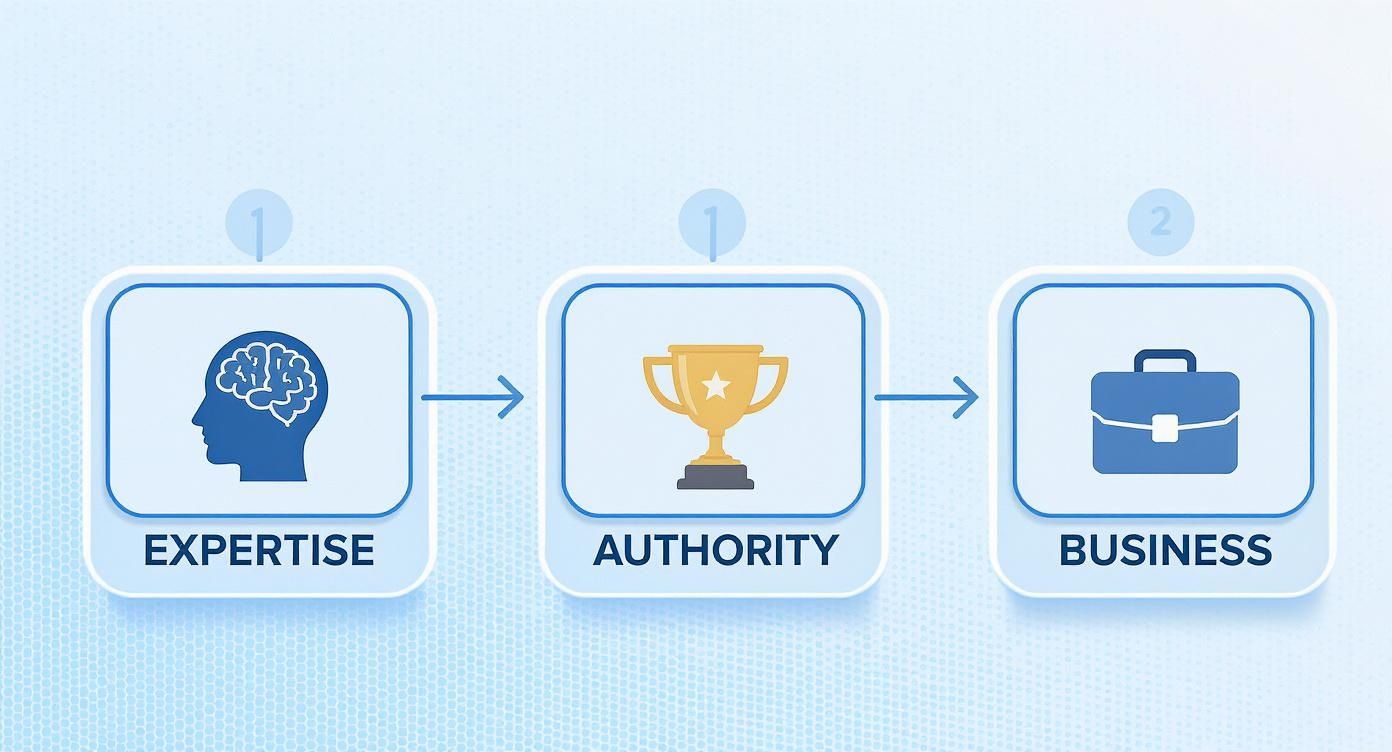
This visual just hammers the point home: real business results are the direct outcome of systematically building authority. It’s not an accident; it’s by design.
Why Invest in Thought Leadership Now
Look, this isn't just another marketing trend—it's a fundamental shift in how B2B companies win. In today's crowded markets, expertise is the only true differentiator left.
The data backs this up completely. According to recent reports, 52% of B2B marketers plan to increase their investment in thought leadership content in 2025.
Why the surge? Because it works. A 2025 study revealed that 89% of business decision-makers said high-quality thought leadership improved their perception of a company. You can dig into more of the latest content marketing statistics to see the full picture.
An effective thought leadership content strategy is your system for turning abstract knowledge into a consistent content engine that attracts your ideal customers and proves its financial return.
Find Your Niche in a Crowded Market

Before anyone on your team even thinks about writing a post, your thought leadership content strategy needs a laser-focused direction. Just adding more noise to LinkedIn is a surefire way to get ignored. It all starts with understanding who’s already out there, what they’re missing, and who you’re really trying to talk to.
This isn’t about chiming in on broad industry trends. It’s about methodically carving out a specific, defensible niche for each executive.
The sweet spot is found at the intersection of two things: what your competitors are constantly talking about, and what your Ideal Customer Profile (ICP) is secretly desperate to hear. When you analyze the market this way, you start to see the "blue ocean" topics—the valuable conversations that nobody else is leading.
This groundwork is what separates shouting into the void from starting a meaningful dialogue in a room full of your perfect customers. It ensures your strategy has teeth from day one.
Map the Competitive Content Landscape
First things first: you need to become a student of your market's conversation. Who are the established thought leaders? More importantly, what specific angles do they own? We’re not looking to copy them; we're looking for the open lanes.
Start by pulling a list of 5-10 key competitors or the most influential voices in your industry. Then, it's time to do some recon. Go through their content on LinkedIn.
- Dominant Themes: What are their go-to topics? Are they all about tactical "how-to" content, high-level strategy, or just commenting on the news?
- Content Gaps: What are they not saying? Look for the overlooked sub-topics, the ignored perspectives, or the tough questions nobody is asking.
- Audience Engagement: Which posts are getting real, meaningful engagement? I'm talking about comments that spark discussion, not just "great post!" That's a direct signal of what the audience actually cares about.
Let’s use cybersecurity as an example. Everyone and their dog is posting about "the latest threats." But after digging, you might realize nobody is talking about the messy reality of getting budget approval for a new security tool from a non-technical CFO. That specific, painful gap? That’s your potential niche.
A crowded market doesn't mean there's no room for you. It just means you have to be more specific. Your unique point of view is your greatest competitive advantage.
Define Your Unique Point of View
Once you've spotted the gaps in the market, it's time to layer in your executive's unique expertise. This is where you connect the market opportunity to personal authority. A killer thought leadership strategy doesn't just fill a void; it fills it with an authentic, credible perspective that no one else has.
Sit down with each leader and dig for their gold. Ask them questions like:
- Contrarian Beliefs: What's a commonly held belief in our industry that you think is completely wrong?
- Hard-Won Lessons: Tell me about a mistake you made that taught you something crucial your peers could learn from.
- Future Predictions: Based on everything you’ve seen, where is the industry really going in the next 3-5 years that most people are missing?
Imagine you’re a sales leader. The market is drowning in content about "closing techniques." But your contrarian take is: "Stop 'closing' and start co-building a business case with your champion. The deal will close itself." See the difference? You’ve just shifted from a generic topic to a specific, memorable philosophy.
This is how you turn an expert into a thought leader. You stop just sharing information and start shaping how people think. That's how you build a following that doesn't just read your content but becomes an advocate for your ideas.
Develop Your Executive Content Pillars
Alright, you've locked in the niche for each executive. Now it’s time to turn that focus into a real, repeatable system for creating content. We're moving past abstract ideas and into the nitty-gritty of what they’ll actually talk about day in and day out.
This isn’t about just brainstorming a list of posts. We're building a framework of content pillars—just two or three core themes that each leader will completely own.
Think of these pillars as the guardrails for your content strategy. They keep every single post focused, relevant, and consistently hammering home each executive’s specific authority. This is what separates people who just post stuff from those who build a true content engine.
From Expertise to Pillar Selection
The best content pillars live at the intersection of three things: what the executive genuinely loves talking about, what the audience is desperate to know, and what aligns with the company's goals. Miss one of these, and the whole thing feels off.
Content based only on passion might fall on deaf ears. Content focused only on business goals often comes across as a sales pitch. You have to find that sweet spot.
Here’s how to drill down and find it for each leader:
- Executive Passion: What topics can they riff on for hours with zero prep? Where does their deepest, most authentic knowledge live?
- Audience Need: Look back at your market mapping. What are the most urgent, nagging questions your ICP has? What problems are really keeping them up at night?
- Business Alignment: Which topics naturally steer the conversation toward your product or service? What conversations position your company as the obvious solution?
Let’s say you have a CTO at a SaaS company who’s an expert in both "Cloud Infrastructure" and "Building High-Performing Engineering Teams." Both are solid. But if your ICP research shows that prospects are struggling more with retaining top talent than with cloud migration, the choice is obvious.
"Building High-Performing Engineering Teams" becomes the knockout pillar. It hits a major audience pain point directly while perfectly showcasing the CTO’s hands-on experience.
The real goal here is topic ownership. You want your executive to be the first person your audience thinks of when a specific challenge pops into their head. You achieve that by going deep on a few topics, not wide on many.
This focused approach is a huge differentiator. The best thought leaders are no longer chasing every trend. They're planting a flag and owning one or two major conversations. If you want to dig deeper, check out these evolving trends in thought leadership that show how much authenticity and focus matter now.
Choosing the Right LinkedIn Content Formats
Once your pillars are set, you have to figure out how to bring them to life. On LinkedIn, the package is just as important as the present inside. A good mix of formats is key to keeping things fresh and engaging your audience in different ways.
Here’s a quick rundown of formats that consistently get results:
- Text-Only Posts: Absolutely perfect for sharing a contrarian take, a personal story, or a question that makes people stop scrolling. They’re super scannable and fantastic for starting conversations.
- Carousels (PDFs): The go-to for breaking down a complex idea, visualizing data, or repurposing a few killer slides from a webinar. They're visually sticky and keep people on your post longer.
- Short-Form Video: Nothing beats video for showing the human behind the title. Use it for a quick off-the-cuff insight, a lesson learned the hard way, or a peek behind the curtain. Authenticity wins over high production value every time.
- Polls: Deceptively simple but incredibly powerful. Polls are an amazing way to take the temperature of your audience, validate a hunch, or kick off a debate around a common problem.
Imagine a VP of Sales whose pillar is "Strategic Account Planning." They could share a text-only post about a huge mistake they see everyone making, follow up with a carousel detailing their 5-step framework for avoiding it, and then drop a short video with a story about a massive deal they saved using that exact plan.
Simple Governance for Quality and Consistency
Finally, you need a lightweight process to keep the content machine running without driving everyone crazy. This isn't about micromanagement; it's about setting clear expectations and a predictable workflow so there are no frustrating bottlenecks.
Your framework should clearly answer three questions:
- Insight Capture: How are you getting ideas out of the executive's head? A standing 30-minute weekly brainstorm? A shared Slack or voice note channel? Pick something easy and stick to it.
- Drafting & Creation: Who takes the raw insight and turns it into a polished post and any needed visuals? This is usually where a content manager or marketing partner steps in.
- Review & Approval: How quickly can the executive review a draft? The goal is a quick once-over for tone and accuracy, not a line-by-line rewrite.
This simple system ensures a smooth flow from an idea in your leader's brain to a live post on their LinkedIn profile, keeping both quality and cadence on track.
Turn Your Content Into Conversations and Pipeline
Putting a great piece of content out there isn't the finish line—it’s the starting pistol.
The real money in a thought leadership content strategy is made when you use that content to spark actual conversations that lead to real business. This is where the fuzzy concept of "brand building" gets very real, very fast.
Too many teams publish and pray, hoping for some inbound magic. But the pros take a different approach. They know that every comment, like, and share is a potential doorway to a new opportunity. This is the connective tissue between sharing what you know and actually growing your revenue.
The Art of Comment Engagement
Think of your comment section as your new focus group, talent pool, and lead list all rolled into one. You have to treat it that way. The goal isn't just to fire off replies; it's to create meaningful back-and-forth that builds relationships.
Don't just thank people. That’s the bare minimum. Ask follow-up questions. Respectfully challenge their perspective. Tag other experts who might have a valuable take. This is how you turn a static post into a living, breathing conversation hub.
A simple "Great post!" doesn't need more than a "Thanks for reading!" But when someone drops a thoughtful comment like, "This is an interesting take, but have you considered how it applies to smaller teams?"—that's your cue.
- Acknowledge and Validate: "That's a fantastic question. The dynamics definitely shift for smaller teams…"
- Share a Specific Insight: "In my experience with startups, the key is focusing on one core channel first before trying to do it all…"
- Keep it Going: "What's the biggest hurdle you've seen smaller teams face with this?"
This approach does two things: it deepens the engagement on the post (which the algorithm loves), and it shows you’re a genuine expert who actually listens. More importantly, it helps you spot the most engaged, thoughtful people in your audience. Nine times out of ten, those are your best-fit prospects.
The depth of your engagement is a direct reflection of your authority. Quick, generic replies signal you're just going through the motions. Thoughtful, curious responses prove you're an active leader in the conversation.
Moving from Public Comments to Private DMs
After a few solid back-and-forth comments, the best conversations are ready for a change of scenery. The direct message (DM) is where you graduate from a public thought leader to a trusted one-on-one advisor.
The secret is to make this transition feel completely natural, not like a slick sales move. You’re not pitching anything. You’re just continuing a valuable discussion.
For instance, after a good public exchange, you could send a DM that says: "Really enjoyed our chat on my post about X. Your point about Y was spot on. It actually reminded me of a private case study I have that breaks it down further, mind if I share it?"
This is all about giving, not asking. You're offering something helpful that’s directly related to the conversation you just had. You’re building trust one step at a time, which is the whole game when it comes to figuring out how to generate B2B leads that actually close.
Empowering Sales with Your Content
Your executives' content is pure gold for your sales team. It’s the perfect icebreaker for cold outreach and a brilliant way to nurture prospects who've gone quiet. All it takes is a simple but effective feedback loop.
- Build a Content Hub: Set up a simple, searchable library where sales reps can grab relevant posts. A dedicated Slack channel or a Notion page organized by topic or pain point works perfectly.
- Prep Outreach Snippets: Don't make them guess. For each key piece of content, give the sales team a pre-written snippet they can quickly personalize for their outreach.
- Push the "Content-First" Approach: Train reps to lead with value instead of a meeting request. Something like: "Saw you were hiring for role X, thought you might find this post from our CEO on scaling engineering teams useful."
This system transforms your content from a simple marketing asset into a powerful sales enablement engine. It gives your revenue team relevant, authoritative material that helps them start better conversations, build instant credibility, and book more meetings.
Measure the ROI of Your Content Strategy

Let's be honest. Any thought leadership content strategy that isn't accountable is just a vanity project. If you can't prove its value, you can't justify the investment. And you definitely can't make smart decisions to improve it.
This means we have to move way beyond surface-level metrics like likes and follower counts. Those are nice, but they don't keep the lights on.
The real goal here is to draw a straight line from your content efforts to real business outcomes. A solid measurement framework lets you walk up to any stakeholder and show them exactly how your executives' voices are building the brand, engaging your ideal customers, and, most importantly, filling the sales pipeline.
It’s about telling a complete story with your data. We're talking a clear path from a LinkedIn post all the way to a closed deal. Do that, and your content program shifts from a line item on the expense report to a proven revenue driver.
Moving Beyond Vanity Metrics
First things first: we need to stop focusing on what’s easy to count and start tracking what actually counts. While a post getting a thousand likes feels good, it doesn't pay the bills. The real ROI is buried in metrics that signal genuine audience interest and, crucially, buying intent.
So instead of just high-fiving over a viral post, you need to dig deeper. Who is actually engaging? Are they from your target account list? Are the comments just "great post!" or are they substantive questions that reveal a prospect's pain points?
That distinction is everything. I'd take ten thoughtful comments from C-suite execs at our dream accounts over a thousand likes from a random audience any day of the week. Your measurement has to reflect that reality.
The most effective way to measure thought leadership is to track its influence across the entire buyer's journey, from initial brand awareness to a signed contract. Each stage has its own set of meaningful KPIs.
A Three-Tiered Measurement Framework
To get a full picture of what's working, I like to break measurement down into three distinct buckets. This structure helps you see how top-of-funnel brand building connects to mid-funnel engagement and, ultimately, to bottom-funnel business impact.
-
Brand Impact: Think of these as your top-of-funnel indicators. They show that your executives' authority and reach are growing and, critically, that you're capturing the attention of the right people.
-
Audience Engagement: This is the middle tier, where you measure the quality of your interactions. Is your content just getting seen, or is it actually sparking meaningful conversations and building relationships?
-
Business Results: This is the bottom line. These are the metrics that tie your content directly to pipeline and revenue, proving undeniable financial ROI.
Here’s a look at how we’d set up a simple dashboard to track this.
Thought Leadership ROI Tracking Dashboard
This kind of dashboard is your secret weapon. It translates your team's hard work into a language that finance and sales leaders understand, showing how brand-building activities cascade down to tangible business results.
| Metric Category | Key Performance Indicator (KPI) | Measurement Tool/Method |
|---|---|---|
| Brand Impact | Profile Views (Monthly) | LinkedIn Analytics |
| Follower Growth (ICP only) | LinkedIn Sales Navigator | |
| Inbound Connection Requests | Manual Tracking/CRM | |
| Engagement | Comment Quality & Sentiment | Manual Review |
| DM Conversations Started | Manual Tracking/CRM | |
| Content Share Rate | LinkedIn Analytics | |
| Business Results | Leads Sourced from Content | CRM Campaign Tagging |
| Meetings Booked (Attributed) | CRM Attribution Reporting | |
| Pipeline Influenced ($) | CRM Influence Reporting |
By laying it out this way, you make it incredibly easy for anyone to see how growing brand impact leads to deeper engagement, which in turn drives the business results everyone cares about.
Proving Financial Impact to Stakeholders
Your ultimate job is to connect the dots for the leadership team. The real power of this strategy is its direct line to sales. In fact, some research shows that combining strong thought leadership with an omnichannel approach can bump sales by around 20%.
And it’s not just about getting seen. Nearly 60% of C-suite executives say they now lean on thought leadership when they're vetting potential partners. You can dig into more on how content writing influences executive decisions to see just how critical this has become.
This is the data you use to secure buy-in and bigger budgets.
Imagine walking into your next quarterly review and being able to say, "Our executives' content directly influenced $500k in pipeline last quarter and sourced 15 qualified meetings with our tier-one accounts." That completely changes the conversation.
This isn't about justifying a marketing expense anymore. It’s about proving you've built a predictable, scalable engine for business growth, all powered by the expertise already sitting inside your company.
Answering the Tough Questions on Thought Leadership
Even with the perfect game plan, a few practical questions always pop up when leadership teams get serious about a thought leadership strategy. Let's dig into the most common ones I hear.
Getting these details sorted isn't just about logistics; these are strategic calls that will make or break your long-term success.
How Much Time Does This Really Take for Executives?
This is always the first question, and the answer is way less than most leaders think. A well-oiled system only needs 1-2 hours per week from each executive. The key is that they aren't spending that time staring at a blank screen trying to write.
Their time is focused only on the high-value stuff that only they can do.
- A 30-minute weekly jam session: This is where the magic happens. The executive just talks—about recent client calls, industry frustrations, new ideas. This conversation becomes the raw material for the week’s content.
- 15-20 minutes a day on engagement: This means jumping into the comments on their own posts and adding their two cents to conversations happening elsewhere in their network. It's easily done in the cracks of the day—waiting for a coffee, between meetings.
A solid support team, whether that’s an internal content manager or an agency partner, does all the heavy lifting: drafting posts, creating visuals, and scheduling everything. This setup makes every minute of an executive's time count.
What's the Difference Between Our Corporate Brand and a Personal Brand?
Nailing this distinction is huge. The corporate brand is the "we." It's the official voice of the company, sharing press releases, product news, and high-level market takes. It’s all about building the reputation of the business itself.
An executive’s personal brand, however, is the "I." It’s built on their own unique expertise, experience, and personality. It’s authentic, often a little more candid, and it’s what people actually connect with.
People don't build relationships with logos; they build them with other people. A leader’s personal brand humanizes the corporate one, making the entire company more relatable and trustworthy. Their unfiltered perspective can open doors in a way a polished company page never could.
When you get this right, the two work together perfectly. The corporate brand provides the foundation and credibility, while the executive's personal brand brings it to life.
How Long Until We See Actual Business Results?
I get it. You need to show ROI. While you’ll see early signs of life—more engagement, follower growth—within the first 30-60 days, real business results take a bit longer to kick in.
You can expect a consistent flow of high-quality inbound leads to start trickling in around the 3-6 month mark. That first phase is all about building trust and establishing your execs as the go-to voices in their niche. You're building momentum.
By month four, that momentum starts to convert. You'll see a steady stream of inquiries and conversations that you can trace directly back to the content. This isn't a get-rich-quick scheme; it's a long-term play for sustainable growth.
Should We Just Repurpose Blog Content for LinkedIn?
Yes and no. A simple copy-and-paste job is a waste of time. But your long-form content is an absolute goldmine if you use it correctly.
Your first priority should always be creating content natively for LinkedIn. The platform’s algorithm rewards posts that use its features, like carousels, polls, and documents.
That said, a single 2,000-word blog post can fuel an entire month's worth of killer LinkedIn content.
Here's how to think about it. One deep-dive article can be broken down into:
- 5-7 text posts, each one diving into a single idea or takeaway from the article.
- A carousel post that visually breaks down the core framework or data points.
- A quick video of the executive sharing a personal story that relates to the topic.
This is how you scale content without sacrificing quality, ensuring every piece is perfectly tailored to the platform where your buyers are spending their time.
Ready to build a predictable pipeline without adding more to your executives' plates? Growlancer builds and manages your entire LinkedIn thought leadership and outreach system, turning your team's expertise into qualified meetings. Learn more about how we can help at https://growlancer.ai.