

Before you even think about sending a single connection request, stop. Your LinkedIn profile has a job to do, and it needs to be primed to do the heavy lifting for you.
A smart connection strategy starts with a profile that screams value and gives people a damn good reason to click "Accept." This isn't just about filling in the blanks; it's about turning your profile into a strategic asset that works for you 24/7.
Build a Profile That Invites Connections
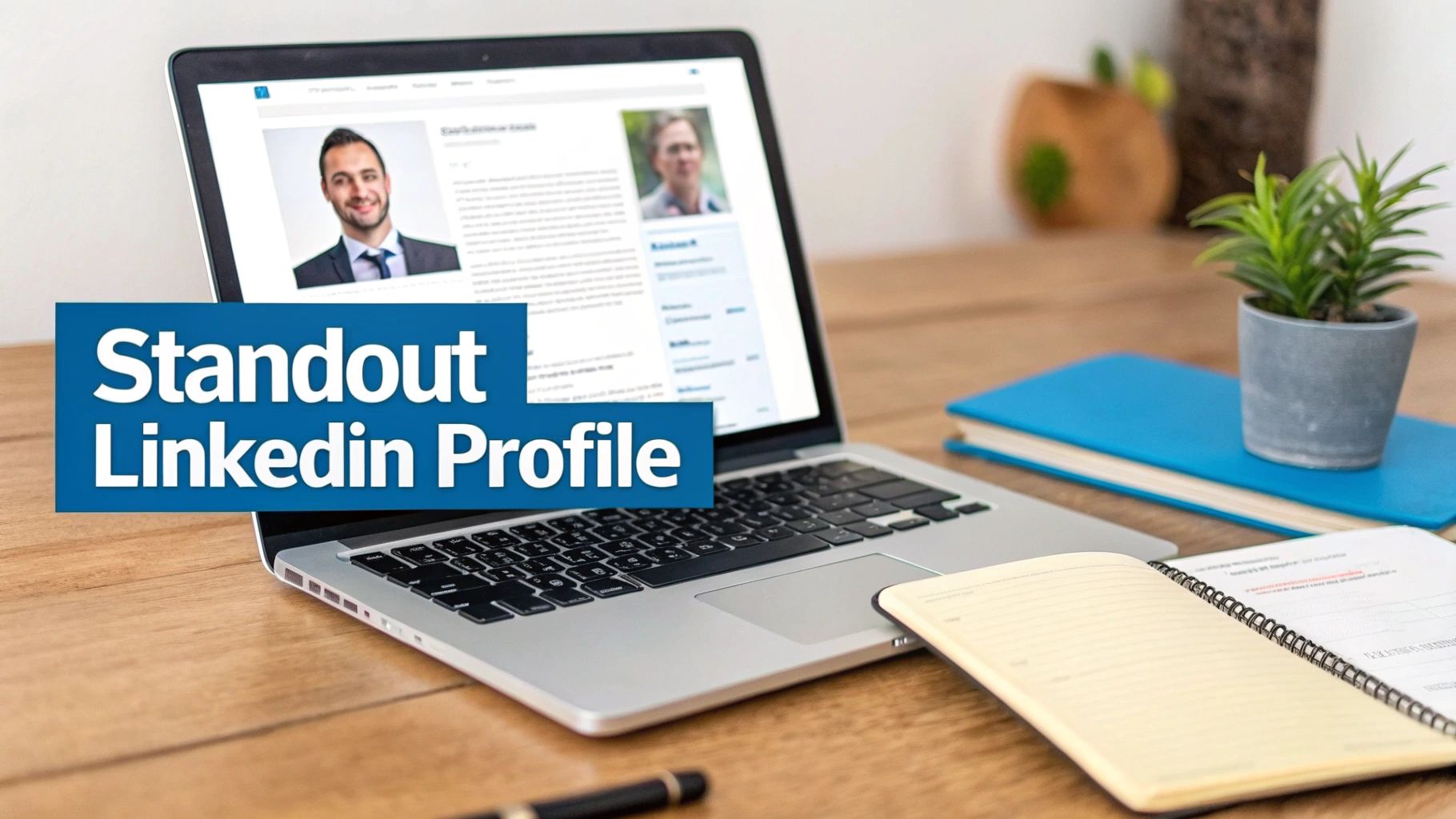
Think of your LinkedIn profile as the digital handshake you make with every potential client, partner, or new hire. Before you can connect effectively, your page has to immediately answer one crucial question for anyone who lands on it: “What’s in it for me?”
If your headline and summary are all about your job title and responsibilities, you're missing the entire point. The goal here is to shift your profile from a dusty old resume into a dynamic landing page—one that pre-sells your expertise and builds trust before you ever slide into their DMs.
Craft a Client-Centric Headline
Your headline is the most valuable real estate on your entire profile. Don't waste it.
Instead of the default "CEO at Company X," flip the script and make it a value proposition. What problem do you solve for your ideal customer?
A generic headline like "VP of Sales at SaaS Inc." is forgettable. A much better one? "Helping B2B Tech Firms Double Their Sales Pipeline with Predictable Outreach Systems." Now that immediately tells your target audience how you can help them and makes them want to know more.
Your headline should act like a magnet, pulling in your ideal prospects while pushing away those who aren't a good fit. It’s your elevator pitch, boiled down to a single, powerful line that follows you everywhere you go on the platform.
Tell a Story in Your About Section
This is your chance to be human. The 'About' section is where you move beyond a dry list of accomplishments and actually connect with people.
Don't just list what you've done. Weave a narrative. Structure it like a mini-story that covers:
- Who you help: Get specific about your target audience.
- What problems you solve: Hit on their biggest pain points.
- How you solve them: Briefly touch on your unique process or methodology.
- What the results look like: Give them a peek at the transformation you deliver.
This approach positions you as a trusted guide who gets their world, not just another salesperson with a quota.
Before diving into outreach, run through this quick checklist. These small tweaks can make a huge difference in how your profile is received and dramatically increase your connection acceptance rate.
Your Pre-Connection Profile Optimization Checklist
| Profile Element | Optimization Goal | Why It Matters |
|---|---|---|
| Profile Photo | Use a clear, professional, high-quality headshot where you look approachable. | This is your first impression. A good photo builds instant trust and credibility. |
| Headline | Make it a client-centric value proposition, not just your job title. | It's the first thing people read and should immediately convey the value you offer them. |
| Banner Image | Customize it to reinforce your headline, show social proof, or add a call-to-action. | This is prime visual real estate. Use it to stand out and communicate your brand at a glance. |
| About Section | Tell a compelling story that addresses your ideal client's pain points and your solution. | It’s your opportunity to build rapport and demonstrate a deep understanding of your audience. |
| Skills Section | Add at least 5 core skills relevant to your expertise and have them endorsed. | Significantly boosts your visibility in searches and reinforces your areas of expertise. |
| Mobile View | Check how your entire profile looks and reads on a smartphone. | With 57% of LinkedIn traffic on mobile, a clean, readable mobile view is non-negotiable. |
Taking a few minutes to tick these boxes ensures you're putting your best foot forward and not leaving connection acceptances to chance.
Optimize Your Profile Essentials
Finally, a few foundational pieces are simply non-negotiable. A high-quality, professional headshot is critical for that initial spark of trust. Your background banner is another missed opportunity for most; customize it to back up your headline's message or flash some social proof like client logos.
And don't sleep on your 'Skills' section. It's a huge driver for discoverability. We've seen that profiles with five or more relevant skills get up to 17 times more views.
Given that 57% of LinkedIn traffic is now mobile, pull up your profile on your phone. Make sure every single element—from your headshot to your summary—is clean, crisp, and easy to read on a small screen. Dig into more LinkedIn marketing statistics to really get a feel for how people use the platform today.
Find High-Value Prospects Worth Connecting With
Alright, your profile is looking sharp. Now for the real work.
Firing off connection requests to anyone and everyone is the fastest way to hit your weekly invitation limit and get precisely zero results. Success on LinkedIn isn't about volume; it’s about precision.
Your real mission is to build a highly curated list of people who can actually move the needle for your business. This is way more than a simple title search. It’s about digging deep to find the perfect fits within your Ideal Customer Profile (ICP).
Quality over quantity. That’s the only rule that matters here.
Use Advanced Search and Sales Navigator
The basic LinkedIn search is fine for finding an old colleague. But for serious B2B prospecting, you need to bring out the big guns: LinkedIn Sales Navigator. It’s an absolute game-changer, unlocking a whole new level of filtering that lets you build laser-focused prospect lists.
Instead of just looking for "Marketing Director," you can get incredibly specific. Filter by:
- Company Size: Zero in on startups, mid-market companies, or enterprise-level organizations.
- Geography: Pinpoint prospects in a specific city, state, or country that you’re targeting.
- Seniority Level: Isolate the real decision-makers, like VPs, Directors, or C-suite execs.
- Recent Activity: Find people who have changed jobs in the last 90 days or have been mentioned in the news—these are powerful conversation starters.
These filters turn your search from a wide, hopeful net into a surgical tool. Every single person on your list becomes a potential high-value connection. This targeted approach is a core piece of the puzzle when learning how to generate B2B leads that have a real shot at converting.
Vet Profiles for Connection Hooks
Once you have a list, don't just start clicking "Connect." The next step is a quick but vital vetting process. Spend 30-60 seconds on each person's profile looking for a genuine "hook"—a real reason to start a conversation.
The best connection requests are never cold. They feel warm because you’ve done your homework and found a specific, relevant reason to reach out. This small investment of time upfront dramatically increases your acceptance rate.
Look for simple, authentic conversation starters. Did they just post an article you found interesting? Did you go to the same university or work at the same company a few years back? Are you both in the same industry group?
Finding that little sliver of common ground is how you craft a personalized message that actually gets read.
Tier Your Prospects for Maximum Impact
Let's be honest: not all prospects are created equal. To spend your time where it counts, I use a simple tiering system.
- Tier 1: Your absolute dream clients. These are the highest-value accounts where you should pour the most time into hyper-personalization. Think custom videos, detailed notes about their recent work—the whole nine yards.
- Tier 2: Strong-fit prospects who are a clear match for your ICP. These folks deserve a well-researched, personalized outreach message that shows you’ve paid attention.
- Tier 3: Good-fit prospects who meet your basic criteria. For this group, a lightly customized template based on their role or industry can work just fine.
This tiered approach ensures your best efforts are aimed where they’ll deliver the biggest return. It’s a strategic way to manage your outreach so you’re connecting for results, not just for the sake of a bigger network.
Write Connection Messages That Actually Get Replies
Let’s be honest. That default LinkedIn connection message—"I'd like to add you to my professional network"—is a digital dead end. Hitting send on that is the fastest way to get your request ignored, deleted, or even marked as spam.
Your connection message is your one shot to make a first impression. It needs to be short, genuine, and most importantly, about them.
This is exactly where all that upfront profile vetting pays off. Your mission is to find one small, specific "hook" and build your entire message around it. This simple shift turns a cold outreach into a warm introduction, sparking curiosity instead of tripping their internal "I'm being sold to" alarm.
The Anatomy of a High-Converting Message
A great connection message isn’t complicated. I've found the most effective ones have three simple parts:
- The Hook: Kick things off by referencing your point of commonality. Did you see their post? Do you know the same person? Did you read an article they were quoted in?
- The "Why": Briefly state why you want to connect, but frame it around their value, not yours. You want to follow their insights, you admire their work, etc.
- The Close: Keep it simple. A low-pressure closing is all you need.
This structure keeps your message well under the character limit and shows you respect their time. You're not asking for a meeting; you're just asking to connect.
Remember, the only goal of the initial message is to get the connection accepted. The real conversation comes later. Trying to sell in the connection request is like proposing on the first date—it's way too much, way too soon, and it almost never works.
Real-World Scenarios and Templates
Theory is great, but let's see how this actually works. Here are a few examples of how this plays out in common B2B scenarios.
Scenario 1: You Admire Their Recent Content
You find a prospect who just posted a killer article about a challenge in their industry.
- Weak Message: "Hi John, saw your post and would love to connect."
- Strong Message: "Hi John, your recent post on scaling engineering teams really resonated. The point you made about prioritizing documentation early was spot-on. Would be great to connect and follow your insights."
See the difference? The strong version is specific, offers genuine praise, and makes it obvious you actually paid attention.
Scenario 2: You Have a Mutual Connection
You notice you both know a respected figure in your industry.
- Weak Message: "Hi Sarah, I see we both know Mark. Let’s connect."
- Strong Message: "Hi Sarah, I see we're both connected with Mark Smith. I've always been impressed with his work at Acme Corp. Seeing your shared connection, I wanted to reach out and connect as well."
This approach taps into social proof without being presumptuous or putting your mutual connection in an awkward spot by asking for an intro.
Why Personalization Is Non-Negotiable
Putting in this tiny bit of effort up front pays off big time. While the average LinkedIn connection request has a respectable 45% acceptance rate, personalized messages blow that out of the water.
In fact, some data shows the average reply rate for personalized messages can hit 85%—that's three times higher than typical email outreach. You can dive deeper into these powerful LinkedIn statistics on The B2B House to see the full picture.
Taking 30 seconds to write a custom note is the difference between being part of the noise and starting a real conversation. This small investment of time is how you learn to connect on LinkedIn in a way that builds a network of valuable relationships, not just a list of random names.
Turn New Connections into Real Conversations
Getting your connection request accepted isn't the finish line. It's the starting pistol.
Too many people fumble the ball right here. They either go completely silent and waste the opportunity, or they immediately jump into a hard pitch, killing any goodwill they just built.
The real goal is to turn that new connection into a meaningful conversation, and that requires a patient, value-first follow-up sequence.
The First Message: Keep It Simple
Once they accept, your first move is a simple, no-strings-attached thank you. Get this into their inbox within 24 hours.
Seriously, don't overthink it. The only goal here is to acknowledge the connection and be a normal human being.
- Example: "Thanks for connecting, John. Really appreciate it. I'm looking forward to following your insights on scaling engineering teams."
This is polite, professional, and puts zero pressure on them. It’s a small step, but it immediately separates you from the army of automated sales bots out there.
This simple workflow—hook, personalize, send—is the core of any successful outreach.
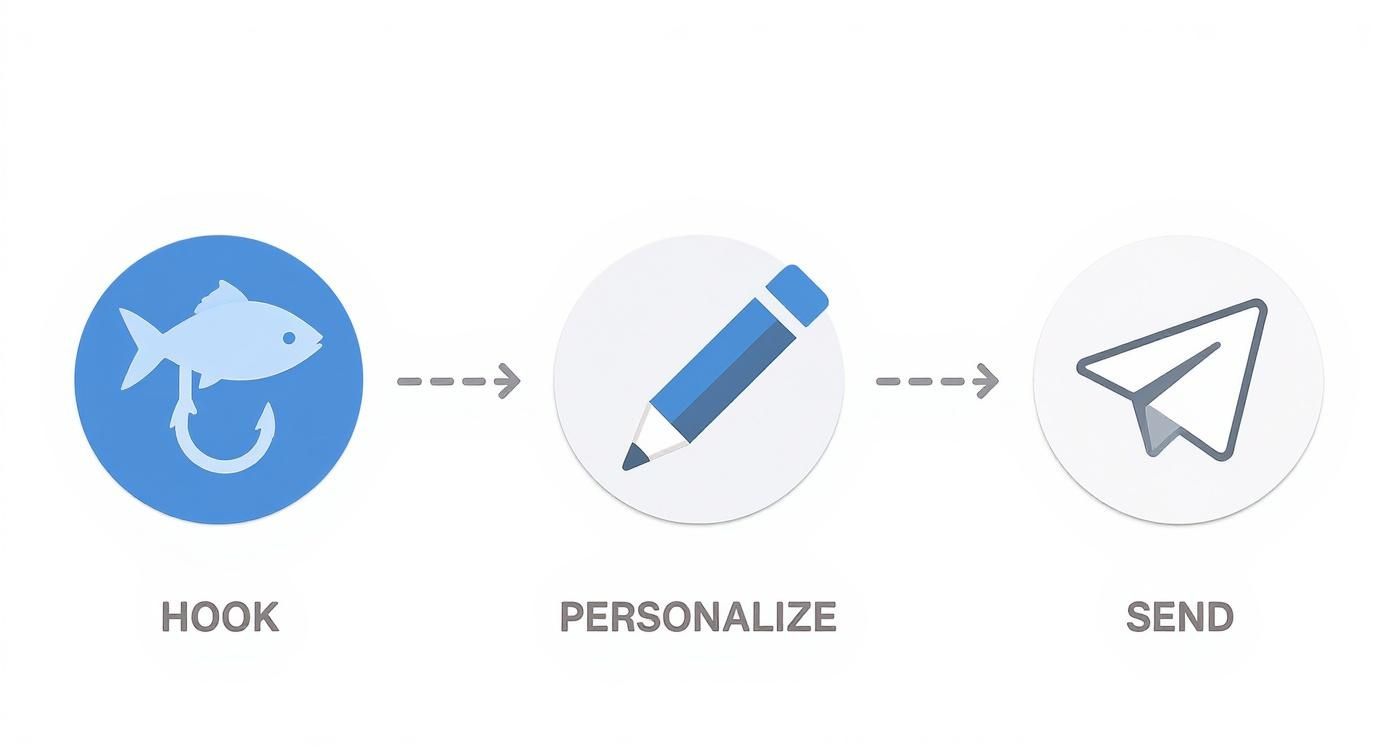
It all starts with a relevant reason to connect, which you then craft into a unique message and deliver promptly.
Nurturing: Play the Long Game with Value
After that first thank-you message, it's time to play the long game. The key is to stay on their radar without spamming their inbox.
This is all about authentic engagement. A "like" is fine, but a thoughtful comment is so much better. When they post something interesting, add your perspective or ask a smart question. Show them you're paying attention and have valuable insights of your own.
Your goal is to become a familiar, respected name in their feed. When you consistently show up with valuable contributions, you build the social capital needed to eventually transition the conversation to business.
A week or two after connecting, look for a chance to provide direct value. Find a high-quality article, report, or case study that speaks directly to their role or something they recently posted about.
- Example: "Hey Sarah, saw your post last week about the challenges with Q3 planning. Came across this industry report on agile forecasting that I thought you might find useful. Hope it helps."
Notice there’s no ask. You're just being helpful. This move positions you as a resourceful expert, not just another salesperson waiting to pounce.
Making the Pivot to a Business Conversation
Once you've built this foundation of value and genuine engagement, you've finally earned the right to pivot. The key is to make it feel natural, not forced.
Look for a trigger. It could be a post about a specific problem they're facing, a new company announcement, or a question they ask their network.
This is your opening.
- Example: "John, your post about the new product launch got me thinking. We've helped a few other SaaS companies in your space navigate that exact scaling challenge by [briefly mention your solution's outcome]. If it's a priority, would you be open to a brief chat next week to see if we could help?"
This works because it's timely, relevant, and tied directly to a business need they’ve already brought up. You've done the work, built the trust, and now you can confidently ask for the meeting. You've learned how to connect on LinkedIn the right way.
Measure What Matters in Your Outreach
Connecting on LinkedIn without tracking your results is like driving blind. You’re putting in the work, but you have no idea if you’re actually getting anywhere. If you want to build a predictable pipeline, you have to stop obsessing over vanity metrics like profile views and focus on the numbers that actually signal B2B success.
What you measure, you can improve. Simple as that. This isn’t about getting lost in complex analytics; it’s about having a straightforward scorecard for your outreach. By homing in on a few key performance indicators (KPIs), you can see what’s working, what's falling flat, and what to do next.
Core Metrics for B2B Success
Forget about likes, shares, or follower counts. For B2B execs and sales leaders, those numbers don't pay the bills. Only a handful of metrics truly matter—the ones that directly tie back to building a sales pipeline and driving revenue.
Your entire focus should boil down to these three data points:
- Connection Acceptance Rate: This is the percentage of your requests that get accepted. A high rate (you should be aiming for 40% or more) is a great sign that your profile is hitting the mark and your personalization is on point.
- Reply Rate: Of all the new connections you make, how many actually reply to your first follow-up message? This tells you if your initial engagement is building real rapport or just adding to the noise in their inbox.
- Qualified Meetings Booked: This is it. The bottom line. How many of these new connections are turning into actual, qualified sales conversations on the calendar?
Tracking these numbers gives you a powerful diagnostic tool. A low acceptance rate? That’s a red flag for your profile or your targeting. A low reply rate? Time to rework those follow-up messages.
Your goal isn’t to collect connections; it’s to start conversations. Every other metric is secondary to the number of qualified meetings that land on your calendar.
Simple Tracking Methods
You don't need a fancy, expensive dashboard to get started. Honestly, a basic spreadsheet will do the trick.
Set up columns for the prospect's name, their title, which message template you used, the date you connected, and whether they replied or booked a meeting. That’s it.
This simple setup is all you need to start spotting patterns. You might find that prospects in one industry respond way better to a certain angle, or that one of your templates is a consistent winner while another is a dud.
This data-driven approach is non-negotiable. LinkedIn, which first launched way back in 2003, is now home to over 1.1 billion members. That's a massive pool of potential clients, and with around 40% of users logging in daily, the platform is incredibly crowded. If you want to cut through that noise, you can't afford to guess what works. You can learn more about the immense activity on LinkedIn at Kinsta.
By measuring what actually matters, you swap guesswork for a predictable, repeatable system for generating leads.
Your Top LinkedIn Connection Questions, Answered
Let's be honest, LinkedIn outreach can feel like navigating a minefield. What works? What gets you ignored? What might even get your account restricted? Everyone's got an opinion, but not everyone has the data.
I get asked about the "rules" of connecting all the time. Here are my straight-shooting answers to the most common questions from B2B leaders.
How Many Connection Requests Should I Really Send Each Day?
Forget the old "spray and pray" method. Blasting out hundreds of generic requests is a fast track to a low acceptance rate and, worse, a flagged account. LinkedIn is cracking down hard on this stuff.
The real number to focus on isn't a vanity metric; it's about quality.
Aim for 10-15 highly personalized connection requests a day. That’s it. This is the sweet spot. It’s a manageable number that gives you enough time to actually look at someone's profile, find a genuine reason to connect, and write a note that doesn't sound like it was written by a robot.
A handful of well-researched, personalized invites will always crush a high volume of generic ones. The goal isn't just a bigger network; it's building the right network.
What Do I Do If My Request Gets Ignored?
First things first: don't take it personally. C-level execs and decision-makers are drowning in notifications. Your request is just one of dozens they see every day. If a high-value prospect doesn't accept right away, it’s not a dead end. It's just a signal to change your approach.
Whatever you do, don't just send the same request again a week later. That's annoying. Instead, play the long game.
- Just Follow Them: Hit the "Follow" button on their profile. You'll see their content in your feed, and they'll get a notification. It's a low-key way to get on their radar without asking for anything.
- Engage with Their Content: Spend a week or two leaving thoughtful, insightful comments on their posts. Not "great post!" but something that adds to the conversation. This builds familiarity and shows you actually know what you're talking about.
- Use InMail (If You Must): Got a Premium or Sales Navigator account? A sharp, value-first InMail can work wonders, but use it sparingly. Tie it directly to a recent post they made, a company announcement, or a shared interest. Make it about them, not you.
This patient, value-driven strategy warms them up. When you do eventually connect, they'll already know who you are.
Should I Bother Withdrawing Old Connection Requests?
Yes, absolutely. Think of it as good account hygiene.
Letting hundreds of pending invitations pile up for weeks or months sends a bad signal to LinkedIn's algorithm. It can look like you're spamming people who don't want to connect with you, which can hurt your account's standing and even limit your ability to send new invites.
Make it a habit to review your pending requests once a month. My rule of thumb? Withdraw anything older than 3-4 weeks. It’s a simple two-minute task that keeps your networking pipeline clean and your account in good shape.
Ready to stop guessing and start building a predictable pipeline? Growlancer is a done-for-you LinkedIn growth partner that turns your leadership team into magnets for your ideal clients. We combine strategy, authority content, and targeted outreach to deliver qualified meetings, not just vanity metrics. Learn more at https://growlancer.ai.