

Let's get one thing straight: outbound lead generation isn't about carpet-bombing inboxes anymore. Forget the 'spray and pray' garbage.
Today, it's a precision-guided system for building predictable revenue. It’s how you cut through the deafening noise of the B2B world and actually connect with people who can buy from you.
Why Outbound Is Still a Revenue-Driving Powerhouse
I hear it all the time—"outbound is dead." That couldn't be more wrong.
Sure, lazy, generic, me-first outreach is dead. Good riddance. But a smart, strategic approach? That’s still one of the fastest and most reliable ways to fill your sales pipeline. It puts you in the driver's seat, letting you proactively hunt down your absolute perfect-fit accounts instead of just waiting around for them to hopefully find you.
The modern philosophy is completely different from the brute-force tactics of the past. Success now hinges on real personalization, picking your channels wisely, and delivering actual value before you ever ask for a 15-minute call. It's about being a helpful expert, not just another sales rep clogging up an inbox.
The Pillars of Modern Outbound Success
If you want to build a machine that consistently books meetings, you have to shift your entire mindset from sheer volume to surgical quality.
This means getting really, really good at three things:
- Deep Customer Understanding: I'm not talking about basic company size and industry. You need to truly get inside your Ideal Customer Profile's (ICP) head—what are their biggest pains, their career goals, the daily headaches they're dealing with?
- Hyper-Personalized Messaging: This is about crafting outreach that feels like it was written for an audience of one. It instantly shows your prospect you've done your homework and you actually understand their world.
- Integrated Multi-Channel Sequences: Don’t just live in email. A modern sequence uses a coordinated mix of channels like LinkedIn, email, and even phone calls to create a conversation that feels natural and persistent, not pushy and annoying.
This is what turns outbound from a frustrating numbers game into a core strategic function. You’re starting valuable conversations with the right people at the right time.
When you focus on relevance and personalization, you stop being a salesperson and start becoming a trusted advisor. That’s the ultimate competitive advantage in any market.
The Speed and Precision Advantage
Look, let’s bust some myths. Yes, a huge percentage of generic cold outreach gets ignored. No kidding. But the data shows that highly personalized and strategic outbound campaigns still crush it.
The real power is in its speed and accuracy. An inbound strategy can take months, sometimes a year, to get traction and start producing. A well-oiled outbound campaign? You can start seeing qualified leads almost immediately. For a deeper dive, check out this piece on the enduring ROI of B2B outbound strategies on demandzen.com.
This guide is your tactical map to make it happen.
Pinpointing Your Ideal Customer Profile
Want to know the real reason most outbound campaigns fail? It’s not the copy, the sequence, or even the offer.
Every failed campaign I've ever diagnosed can be traced back to one single, critical mistake: a blurry, half-baked understanding of the customer.
Before you write a single subject line or dial a single number, you have to know—with almost painful clarity—exactly who you're targeting. This isn't about slapping "SaaS companies" on a spreadsheet. It's about building your one and only source of truth for your entire outbound machine.
Think of your Ideal Customer Profile (ICP) this way: it's a list of the specific companies and people who feel the pain you solve most acutely. They're the ones who will get the most value from your solution and, as a result, are the most likely to actually buy it. A fuzzy ICP means wasted hours, abysmal response rates, and a pipeline choked with leads who were never going to close.
A sharp ICP? That means every email, every call, and every connection request is aimed at a perfect-fit prospect.
Moving Beyond Basic Firmographics
The first layer is always firmographics—the easy-to-find company data. And while it’s a necessary starting point, it's just that: a start. If your targeting stops at "tech companies with 50-200 employees," you've already lost.
You have to get granular. Start asking questions that add real qualification filters:
- Industry & Niche: Are they just in "FinTech," or are they specifically a "payment processing SaaS for e-commerce stores on Shopify"? Big difference.
- Company Size: Is employee count the real story, or is Annual Recurring Revenue (ARR) a much better indicator of their budget and maturity?
- Geography: Are you focused on specific cities or regions where you have a foothold, or is your market truly global?
- Funding Stage: Are you hunting for scrappy bootstrapped businesses or well-funded companies that just closed a Series A and are under pressure to grow?
This exercise alone will slash your total addressable market from a vast ocean into a focused, high-potential pond you can actually dominate.
The Real Secret: Psychographics and Technographics
This is where the pros separate themselves from the amateurs. Most outbound strategies completely miss this.
Knowing a prospect's job title is table stakes. Understanding what they actually care about is the game-changer. That means digging into psychographics (their goals, pains, and internal pressures) and technographics (the software they're already using).
Psychographics get to the human behind the title. What really keeps a VP of Sales up at night? It’s not a generic goal like "hitting quota." It’s the crippling fear of high sales rep turnover, the daily frustration of an inaccurate forecast, or the immense pressure from the board to adopt new sales technology. Your messaging has to hit those nerves.
Technographics are your cheat code. They give you powerful clues about a company's priorities, budget, and pain points. If you sell an integration for Salesforce, knowing a company uses it isn't just a data point—it's a non-negotiable prerequisite for any outreach.
An ICP isn't just some document you create once and file away. It's a living, breathing decision-making filter. If a prospect doesn't tick every box—firmographic, psychographic, and technographic—they don't get your outreach. Period. That discipline is what separates high-performance outbound from spam.
Building Your ICP Definition Matrix
Let's turn these ideas into something you can actually use. A simple matrix forces you to get specific and document your ICP so your whole team is aligned.
Here’s a framework to get you started.
Ideal Customer Profile (ICP) Definition Matrix
| Dimension | Key Questions to Ask | Example Data Point (for a SaaS selling to VPs of Sales) |
|---|---|---|
| Firmographics | What's their annual revenue? How big is the sales team? Are they growing headcount? | SaaS company with $10M-$50M ARR. Sales team of 20-50 reps. Hired 5+ reps in the last 6 months. |
| Psychographics | What are their top 3 business goals for this year? What frustrates them in their daily workflow? What are they measured on? | Goal: Reduce new hire ramp time from 6 months to 3. Frustration: Reps constantly complain they can't find the right content to send prospects. |
| Technographics | What CRM are they built on? What sales engagement or data tools are in their stack? | Uses Salesforce as their CRM. The sales team is active on Outreach. They use ZoomInfo for contact data. |
Once this profile is hammered out, it's time to put it to the test.
Go look at your 10 best customers right now. What do they all have in common? Better yet, get on the phone with a few of them and ask them about their goals and frustrations. This research isn't a "nice-to-have"—it's the single most valuable investment you can make in your outbound success.
Crafting Outreach That Actually Gets a Response
Having a perfect Ideal Customer Profile is a powerful start, but it's only half the battle. The most precise targeting in the world means nothing if your message gets instantly deleted.
This is where all that deep research you did pays off, turning raw data into a real conversation—one a busy executive actually wants to have.
Forget generic, self-serving templates. The secret to effective outbound lead generation isn't about you, your product, or how great your company is. It's about proving, in the first five seconds, that you understand your prospect's world better than anyone else in their inbox.
The Anatomy of a High-Reply Message
Every message, whether it's an email or a LinkedIn DM, has to do three things, and it has to do them fast. If any piece is weak, your reply rate tanks. Think of it as a simple, repeatable framework for earning their attention.
-
The Hyper-Relevant Hook: Your first line must immediately scream, "This is not a mass blast." It has to reference something specific to them—a recent company announcement, a killer LinkedIn post they wrote, a new hire on their team, or maybe even a shared connection.
-
The Pain-Problem Connection: Here's where you bridge your observation from the hook to a common business problem your ICP wrestles with. You're not pitching your solution yet. You're simply putting a name to a challenge they're likely facing right now.
-
The Low-Friction Call-to-Action (CTA): End with a clear, simple, and easy next step. Ditch the high-commitment asks like "Can you hop on a 30-minute demo?" Instead, go for low-friction questions that just ask for their opinion or a simple "yes/no" to start a dialogue.
This structure flips the script from a sales pitch to a peer-level discussion.
From Theory to Practice: Real-World Examples
Let's see how this framework plays out across different channels. Notice how the tone and length change for the platform, but the core principles never do.
Scenario: We're targeting a VP of Marketing at a Series B SaaS company that just announced an expansion into Europe.
-
Weak LinkedIn Connection Request: "Hi Jane, I'd like to connect." (Zero context. Zero value. Instantly ignored.)
-
Strong LinkedIn Connection Request: "Hi Jane, saw the announcement about your expansion into the EU—congrats on the big move! Open to connecting with fellow marketing leaders focused on international growth." (Relevant, complimentary, and totally low-pressure.)
Once they accept, you can follow up with a thoughtful email.
-
Weak Email: "Hi Jane, my company helps businesses like yours with marketing…" (Generic and all about the sender. Delete.)
-
Strong Email:
- Subject: EU Expansion
- Hi Jane,
- Congrats again on the EU expansion. As you scale into new markets, I imagine localizing your go-to-market content without sacrificing brand consistency is a top priority.
- Typically, when we work with marketing leaders taking on this challenge, they're focused on avoiding fragmented messaging across regions.
- Curious, how are you thinking about maintaining a cohesive brand voice as you launch in new countries?
The difference is stark. One feels like spam; the other feels like a relevant conversation started by someone who did their homework. Effective outreach proves you've invested at least 60 seconds into understanding the recipient before asking for 15 minutes of their time.
Achieving Personalization at Scale
Okay, here's the big challenge in outbound lead generation: how do you make every message feel one-to-one without spending your entire day on research?
The answer is "personalization at scale." You do this by systematizing your research around buying triggers—specific events or data points that signal an account is a great fit right now.
These triggers become the fuel for your custom snippets.
- Hiring Triggers: A company is hiring for a specific role (e.g., "Sales Enablement Manager").
- Technology Triggers: They just started using a new tool that integrates perfectly with yours.
- Content Triggers: An executive published a blog post or was quoted on a relevant topic.
- Company News Triggers: They announced a new product, a funding round, or market expansion.
You then build a library of messaging templates around these triggers. The core of the email stays the same, but that critical first line—the hook—is dynamically inserted based on the trigger you found. This lets your team be both incredibly efficient and highly relevant. For more ideas on how to structure these, check out our deep dive on cold email templates for sales.
Let's be clear: modern buyers don't just prefer this; they demand it. The numbers don't lie. 80% of buyers are more likely to make a purchase when they receive personalized content, and a whopping 71% now expect it in every interaction.
On top of that, sales teams using three or more channels in their outreach see 50% more prospect interactions. This data confirms that a thoughtful, multi-channel, and personalized approach isn't just a nice-to-have anymore. It's the only way to win.
Designing a Multi-Channel Outreach Sequence
Let’s be honest. A single cold email blasted into the void isn't a strategy. It's a lottery ticket, and the odds aren't great. Real outbound lead generation isn't about one-off messages; it's about starting a conversation across multiple channels to build familiarity and trust.
Your prospects are everywhere—jumping between their inbox, LinkedIn, and their phone. Your outreach needs to be just as nimble.
The goal is to weave together LinkedIn, email, and even the occasional phone call into a cohesive sequence. Done right, each touchpoint builds on the last, making your follow-up feel natural and expected, not annoying. It’s the difference between being a persistent pest and a welcome professional.
Building Your Campaign Cadence
The sequence—the timing and channel of each touchpoint—is everything. A well-paced cadence keeps you top-of-mind without ever overwhelming your prospect.
I've found a sequence spanning two to three weeks is the sweet spot. It should include a healthy mix of automated and manual steps. This balance is where the magic happens, making your process both efficient and surprisingly effective.
-
Automated Steps: These are your low-effort, high-efficiency plays. Think LinkedIn profile views or automated follow-up emails in a thread. They keep the momentum going without you having to lift a finger for every single action.
-
Manual, Personalized Steps: This is where you earn the reply. We're talking hyper-personalized "first touch" emails, thoughtful comments on a prospect's content, or a well-timed phone call. Save these high-effort touches for your highest-value prospects.
The whole journey should guide a prospect from completely unaware to genuinely interested. It really boils down to three simple stages.
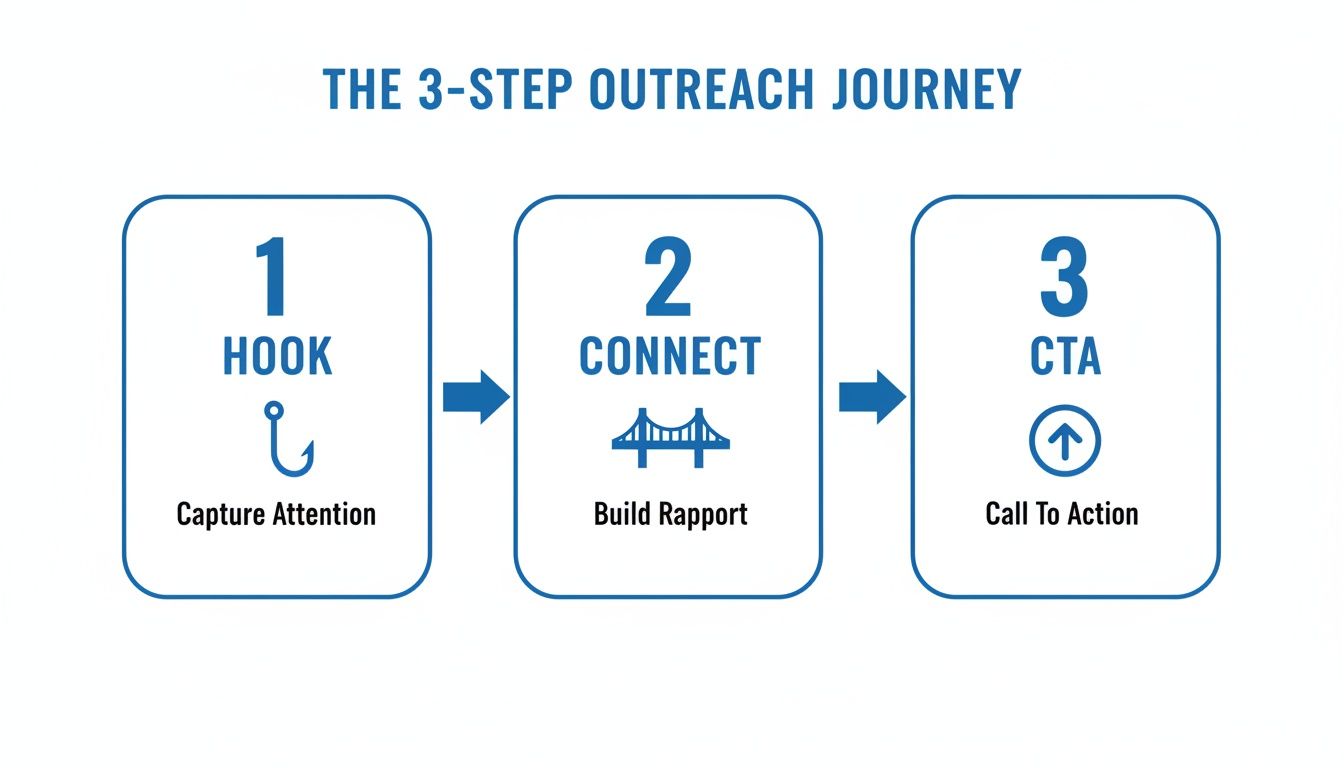
This Hook, Connect, CTA flow is the backbone of every good sequence I've ever built. It ensures every single step has a clear and simple purpose.
A Sample 14-Day Multi-Channel Sequence
Okay, let's get practical. Here’s a battle-tested, 14-day sequence that I've used and refined. It balances different channels to grab attention without being aggressive. Feel free to adapt this to your own industry and ICP.
Day 1: The Subtle Start (LinkedIn)
- Action: View their LinkedIn profile.
- Why it works: It's a zero-pressure notification that puts your name on their radar. Think of it as the digital equivalent of making eye contact across the room before introducing yourself.
Day 3: The Personalized Hook (Email)
- Action: Send a highly personalized email. Find a specific trigger—a new hire, a funding announcement, a recent article they published.
- Why it works: It immediately shows you've done your homework and aren't just spamming a list. You're connecting their world to a problem you can solve.
Day 5: The Social Reinforcement (LinkedIn)
- Action: Send a connection request with a short, contextual note referencing your email.
- Example Note: "Hi [Name], just sent you a note over email about [Trigger]. Thought it made sense to connect here, too."
- Why it works: It reinforces your message on a second channel and makes your name familiar.
Day 7: The Value-Add Follow-Up (Email)
- Action: Reply in the same thread as your first email. Offer something valuable with no strings attached—a case study, a relevant blog post, or a quick insight.
- Why it works: You shift the dynamic from a sales pitch to a helpful conversation. You're giving before you ask. If you need ideas, there are tons of effective drip campaign examples you can model.
Your follow-ups should never be "just bumping this up." Every single touchpoint has to offer new value or a new perspective. If it doesn't, just don't send it.
Day 10: The Direct Approach (Call)
- Action: Make a brief, professional phone call.
- Opening Line: "Hi [Name], this is [Your Name] from [Your Company]. I sent you a couple of emails about [Topic] and just wanted to quickly put a voice to the name."
- Why it works: It cuts through the digital noise. Even if you only get voicemail, it adds another layer to your presence and shows you’re serious.
Day 14: The Breakup Email (Email)
- Action: Send one final, polite closing email. Assume they're not interested and offer to close their file so you don't bother them again.
- Why it works: The "takeaway" often creates a little urgency or at least prompts a courtesy reply. Even getting a "not interested" is a win—it lets you clean your list and focus elsewhere.
This kind of structured approach is the foundation of modern outbound lead generation. It respects the prospect, provides value, and uses a mix of channels to build a persistent, professional presence. It turns a cold shout into a thoughtful dialogue.
Using Authority Content to Warm Up Cold Outreach

Here’s the single biggest mistake I see in outbound lead generation: asking for the meeting way too early. Your prospects are drowning in sales pitches. A premature "can I have 15 minutes of your time?" is the fastest ticket to the trash folder.
The secret to making cold outreach feel warm is shockingly simple. You have to lead with value, not an ask. This is where authority content isn't just nice to have; it's your most powerful weapon.
Instead of just telling prospects you're an expert, you prove it. You completely flip the script from a sales pitch to a genuinely valuable conversation, right from the very first touch.
What I Mean By "Authority Content"
Let’s be clear: authority content is not your standard company blog post. This is a high-value asset built specifically to solve a real, nagging problem for your Ideal Customer Profile. It’s not about your features; it's about their world.
This is the stuff that shows you have deep expertise and builds instant credibility.
- Insightful LinkedIn Posts: Short, punchy takes on industry trends or common pains that make your prospect stop scrolling and think differently.
- Deep-Dive Articles: A meaty, comprehensive guide that tackles a complex topic your ICP is losing sleep over.
- Customer Case Studies: Real-world stories showing exactly how a company just like theirs solved a specific problem and the results they got.
When your reps lead with this kind of material, they stop being salespeople. They become trusted advisors.
The goal is to make your prospect think, "This person actually gets my world." That thought is infinitely more powerful than any sales pitch you could ever write.
This isn't just a theory; the proof is overwhelming. Content marketing is a beast, generating 3x more leads than old-school outbound while costing 62% less. And companies that blog consistently can generate almost 70% more leads than those that don't. The data is clear—this is a foundational piece of any modern growth engine. If you want to dive deeper, you can discover more insights about B2B lead generation statistics that really drive this point home.
Weaving Content Into Your Outreach Sequence
Okay, let's get tactical. Weaving authority content into your outbound sequence is what separates the pros from the amateurs. Instead of just "bumping up" an email, every follow-up becomes a new chance to provide real value. It’s a move that respects your prospect's time and intelligence.
Here are a couple of ways to put this into play.
Example 1: The LinkedIn Follow-Up
A prospect connects with you on LinkedIn. The impulse is to pitch. Don't. Instead, send a message with a relevant resource.
- Message: "Great to connect, [Name]. I noticed on your profile you're focused on scaling the sales team. We just published a case study with [Similar Company] on how they cut new hire ramp time by 40%. Thought you might find it interesting."
Example 2: The Email Follow-Up
Your first email went unanswered. Instead of a generic nudge, use content as the reason for your follow-up.
- Email Body (in the same thread): "Hi [Name], just following up on my last note. I was thinking about your role and remembered this article our team wrote about [Specific Challenge]. The section on [Specific Tip] could be really useful. No need to reply, just thought I'd share."
See the difference? This reframes the entire interaction. You're not pestering them; you're helping them. It’s a core part of building real influence over time, a concept we explore in our guide on thought leadership content marketing.
By consistently sharing useful stuff, you position your team as a resource, not just another vendor. And when your prospect finally does have a need, you'll be the first person they think of. That's the power of warming up your cold outreach with pure, unadulterated value.
Measuring and Optimizing Your Outbound Engine
Look, an outbound lead generation system is only as good as the results it spits out. Firing off sequences is just the starting line. The real work—the stuff that actually builds a pipeline—is in obsessively tracking what’s happening and tweaking your approach based on cold, hard data.
If you aren't dialed into your metrics, you're just flying blind. You might as well be throwing spaghetti at the wall and hoping something sticks.
You can't just fixate on the final number of meetings booked, either. You’ve got to break down the entire funnel, from the very first touchpoint all the way to that "I'm interested" reply. Each stage tells a story. Your job is to listen to it.
Your Core Diagnostic Metrics
Think of your outbound funnel as a series of gates. If prospects keep getting stuck at one of them, you’ve found your bottleneck. That’s where you need to focus all your energy.
Tracking these KPIs isn't optional for any team that's serious about growth.
- Open Rate: This is your first hurdle. It’s a direct reflection of your subject lines and, just as importantly, your email deliverability. Are you even getting into the inbox?
- Reply Rate: This one tells you if your actual message is landing. Are you hitting on a real pain point, or are you just talking about yourself?
- Positive Reply Rate: Let's be honest, not all replies are good news. This metric cuts through the noise of "unsubscribe" and "not interested" to show you who's actually leaning in.
- Meetings Booked Rate: This is the money metric. It tells you how many of those positive conversations are turning into actual calls on the calendar.
When you look at these numbers together, you get a clear picture of your system's health. For example, a sky-high open rate but a rock-bottom reply rate is a dead giveaway. It screams: "Great subject line, terrible, self-serving email copy." You got them to open the door, but your pitch sent them running.
You don't need a dozen complicated dashboards to get started. Just focus on these four core metrics. They’ll tell you 90% of what you need to know to fix a broken outbound campaign.
Making Sense of the Data and Taking Action
Knowing your numbers is one thing. Knowing what to do about them is the real game-changer. Think of your metrics as a diagnostic tool. The data gives you the clues, and you get to play detective to find the root cause of the problem.
Here’s a no-nonsense framework for troubleshooting what's going wrong:
| If This Metric Is Low… | It's Likely a Problem With… | What You Should Do About It |
|---|---|---|
| Open Rate (<40%) | Subject Lines or Deliverability: Your emails are probably landing in spam, or your subject lines are just plain boring. | A/B test new, personalized subject lines. Run your domain through an email warmup tool like Warmbox. Clean your list to remove bounces. |
| Reply Rate (<5%) | Your Core Message or Offer: The copy isn't connecting, or your call-to-action is asking for too much, too soon. | Go back to your ICP research. Rewrite your emails to be 100% about them and their problems. End with a simple, low-friction question. |
| Meetings Booked Rate | Your Follow-Up and Qualification: You're getting good replies, but they're fizzling out. Your process for handling warm interest is leaky. | Map out a clear follow-up plan for positive replies. Make sure your team knows how to qualify interest and make a compelling, direct ask for a meeting. |
This constant feedback loop—measure, interpret, act, repeat—is what separates the outbound lead generation programs that print money from the ones that die a slow death after a few weeks. It’s how you turn guesswork into a predictable, scalable machine.
Common Questions I Hear About Outbound Lead Gen
Look, even with the best playbook in the world, you're going to have questions once you get your hands dirty building an outbound lead generation machine. It's just part of the process.
Let's dive into some of the most common ones I hear from founders and sales leaders. My goal is to give you the clarity you need to push forward with confidence.
"Okay, But How Long Until This Actually Works?"
This is always the first question, and for good reason. The answer is also one of outbound's biggest advantages: speed.
While you might wait six months or more for a content or SEO strategy to really start humming, a sharp outbound campaign can book its first qualified meetings within 2-3 weeks.
You'll really start to feel the momentum and see a measurable impact on your pipeline in the first 60-90 days. By then, your sequences are firing on all cylinders, you've got some initial data to learn from, and your team is finding its rhythm.
The real magic is in the consistency. Outbound isn't a one-off trick; it's a system that builds on itself. The conversations you start in week one lay the groundwork for the deals you close in week four, creating a predictable flow you can count on.
"What Kind of Response Rates Should We Expect?"
Your response rate is your campaign's pulse. It tells you if you're on the right track or way off base. While the numbers can shift depending on your industry and how personal you get with your outreach, there are some solid benchmarks to shoot for.
If you're running a targeted, multi-channel sequence aimed squarely at your ICP, you should be aiming for:
- Positive Response Rate: 5-10% is a healthy target. And I'm not talking about the "no thanks" replies—this is just for the people who show genuine interest or ask for more info.
- LinkedIn Connection Acceptance Rate: On personalized requests, you should be hitting 15-30%. Easy.
If your numbers are dipping way below these, it's a massive red flag. It tells you one of two things: either your prospect list is off (they aren't really your ICP), or your messaging is completely missing the mark on their actual problems.
"Should We Build a Team In-House or Just Outsource It?"
This is a big one. Deciding whether to build your own SDR team or partner with a specialized agency is a strategic call, and it really hinges on your company's resources, internal expertise, and how fast you need to move.
Building an in-house team is a long-term play. It gives you total control, but you're also signing up for a serious upfront investment in hiring, training, management, and the tech stack to support it all.
Outsourcing to a specialist like us, on the other hand, gives you instant access to a team that already has proven processes, seasoned pros, and the right tech. For companies that need to fill their pipeline now without the operational drag, this is almost always the faster path to ROI.
Ready to build a predictable pipeline on LinkedIn without the operational headache? Growlancer is a done-for-you growth partner that combines expert strategy, authority content, and targeted outreach to book qualified meetings for your leadership team. Learn more about how we do it.