

Let's be blunt: if you don't know exactly who you're selling to, you're just burning cash. It's a tough pill to swallow, but I've seen it cripple too many B2B companies. They think a wider net catches more fish, but they end up with a net full of holes, wasted ad spend, and a sales team on the verge of burnout.
The fix isn't about guesswork or wishful thinking. It's about getting surgical and building an Ideal Customer Profile (ICP) based on real data from your best customers.
The Real Cost of a Vague Audience Definition
Let's talk about what happens when your ICP is fuzzy. This isn’t some abstract marketing theory—it’s a silent killer of revenue and morale that ripples through your entire business.
I once worked with a SaaS founder who built an incredible project management tool. His target audience? "Any team that needs to be more organized." He threw a massive budget at broad LinkedIn ad campaigns, hitting professionals in dozens of industries.
The result was a train wreck. Thousands of dollars vanished with almost nothing to show for it, and his sales reps wasted weeks chasing leads who were never, ever going to buy. They were pitching to ghosts.
Symptoms of a Misaligned ICP
This isn't just a one-off story. The warning signs of a weak ICP are all over your business metrics if you know where to look. It usually shows up as:
- Wasted Marketing Spend: You're blowing your ad budget on channels and messages that just don't land. Your Customer Acquisition Cost (CAC) skyrockets while your pipeline stays empty.
- Sales Team Burnout: Your reps are drowning in junk leads, getting shot down on call after call because the prospect has no idea why they should care. This kills quotas, morale, and leads to high churn.
- Generic, Forgettable Messaging: When you try to talk to everyone, you connect with no one. Your content, ads, and outreach become bland background noise.
The difference between a vague audience and a laser-focused ICP is stark. It’s the difference between shouting into the void and having an intimate, profitable conversation.
The High Cost of Poor Audience Targeting
| Metric | Vague Audience Impact | Precise ICP Impact |
|---|---|---|
| Customer Acquisition Cost (CAC) | High and unpredictable; money is wasted on uninterested leads. | Lower and predictable; budget is focused on high-intent buyers. |
| Sales Cycle Length | Long and drawn out; deals stall with unqualified prospects. | Shorter and more efficient; reps engage qualified buyers who get it. |
| Lead Quality | Low; a high volume of MQLs that never convert to SQLs. | High; marketing delivers sales-ready leads that close. |
| Conversion Rates (MQL to SQL) | Dismal; marketing and sales are misaligned and frustrated. | 10-20% or higher; a smooth handoff and shared goals. |
| Sales Team Morale & Quota | Low morale, high burnout, and consistently missed quotas. | High motivation, reps hit their numbers, and team churn is low. |
| Product-Market Fit | Unclear; product roadmap is driven by noise, not signal. | Crystal clear; feedback from ideal customers drives innovation. |
Getting this right isn't just a "nice-to-have." It's the foundation of a predictable growth engine.
The true cost of a vague audience isn't just the money you waste, but the massive revenue opportunities you miss every single day. A precise ICP doesn't limit your market—it focuses your firepower on the deals you're actually built to win.
Ultimately, a poorly defined audience creates a vicious cycle. Marketing can't find good leads, sales can't close deals, and the product team is building in the dark. Nailing your ICP is the first and most critical step to breaking that cycle for good.
Uncovering Your True ICP in Your Best Customers

So many founders make the same mistake when defining their target audience: they start with a blank slate. They guess. They hypothesize.
Forget market reports and theoretical brainstorming for a second. The most valuable data you have is already in your CRM, hiding in plain sight within your happiest, most successful customers.
These are the people who just get what you do. They see massive value, they’re a dream to work with, and they stick around.
Instead of imagining who you should be selling to, let's get real and figure out who you’re already winning with. This flips the whole process on its head, moving from guesswork to data-backed reality. Your Ideal Customer Profile (ICP) shouldn't be a fictional persona; it's a living, breathing profile of these top-tier accounts.
And we need to go deeper than just "mid-market SaaS company." That's not an ICP. It's a starting point, but it's not sharp enough to build a real growth engine on.
Start With Your Top 5-10 Customers
First thing’s first: pull together a small, elite group of your absolute best clients. "Best" isn't just about who pays you the most. You're looking for the all-stars.
Look for a mix of these traits:
- High Customer Lifetime Value (CLV): They spend more with you over the long haul.
- Low Cost of Acquisition: They didn't take a Herculean effort to close. The sales cycle was smooth.
- High Product Adoption/Engagement: They’re power users who are deeply embedded in your solution.
- Raving Fans: They’re the ones giving you referrals, glowing testimonials, and killer case studies.
Got your list? Great. Now your mission is to reverse-engineer their success. Get on a 30-minute call with your main contact at each company. This isn't a sales pitch or an upsell attempt—it’s a genuine discovery session.
Pro Tip: When you reach out, frame it around their success. Try something like this: "Hey [Name], we're doing a bit of an internal study on our most successful partners like you, so we can figure out how to create more wins. Would you be open to a quick chat next week to share a bit about your experience?"
Critical Discovery Questions to Ask
On these calls, your job is to be a journalist. You're trying to uncover the story behind the deal. Go past the what and really dig into the why.
Here are the money questions that will get you the insights you need.
Uncovering the Initial Pain
- "What was going on in your business that first made you think, 'We need to find something for this'?"
- "Before you found us, what were you trying to use? What was the most frustrating part about that?"
- "Was there a specific moment or 'trigger event' that turned this from a 'nice-to-have' into a 'we need this now'?"
Understanding the Buying Process
- "Who else on your team had a say in the final decision? What were their biggest concerns?"
- "When you were looking around, what were the other top 1-2 options you seriously considered? What ultimately tipped the scales in our favor?"
- "What was the single biggest hang-up or hesitation your team had before you decided to pull the trigger?"
Identifying the 'Aha' Moment
- "Can you remember the first time you realized, 'Wow, this is actually working'?"
- "What specific feature or result gave you that first big win right out of the gate?"
- "If you had to describe what we do to a colleague, what would you say?"
These conversations are pure gold. You’ll walk away with the raw material—the exact language, the real pain points, the emotional triggers—to build an ICP that actually works.
This isn't just an exercise. It's the foundation for your messaging, your ad copy, and your entire outbound lead generation strategy. Your customers' words will become your most powerful marketing weapon.
Finding Audience Insights in Unexpected Places
Your CRM and analytics dashboards only tell you part of the story. They're clean, they're neat, but they often miss the real juice.
The most potent data for nailing your ICP isn't in a tidy report. It's buried in the messy, unfiltered conversations your team is already having every single day. This is where you find out what your prospects and customers really think, what keeps them up at night, and the exact words they use to talk about it.
Forget just looking at firmographics. You need to become a data detective. Your job is to connect the dots from all these different places to build a full, three-dimensional picture of your ideal customer. You're not just defining who they are; you're figuring out how they think.
Your customer support system is a straight-up goldmine. Every ticket, chat log, and call recording is a direct line into your users' biggest headaches and desires. What are the recurring problems they can't seem to shake? The language they use to describe their pain points—that’s pure gold. Lift it, and use it in your marketing.
Mine Competitor Reviews for Unbiased Feedback
Here's a secret: your competitors' customers are some of the best free market research you'll ever get. They're your potential customers, and they’re publicly announcing what they love and hate about solutions in your space.
Head over to sites like G2, Capterra, and TrustRadius and start digging. Don't just glance at the star ratings; the real magic is in the written reviews.
Look for these patterns when you're spying on your competition:
- "What I like best": This section tells you what actually resonates with buyers. Is it a specific feature? A slick user interface? Killer customer support? This is what the market values.
- "What I dislike": This is where you find your opening. If you see repeated complaints about missing features, clunky integrations, or a steep learning curve, you've just found a gap in the market you can drive a truck through.
- Reviewer Profiles: Who is leaving these reviews? Pay close attention to their job titles, company size, and industry. This helps you validate if you're targeting the right people and companies who are actively looking for a solution like yours.
By digging into competitor reviews, you’re basically getting a free map of the market. You see what the leader is doing right, but more importantly, you see where they're dropping the ball. That's how you find your wedge.
Decode Your LinkedIn Sales Navigator Data
Most people see LinkedIn Sales Navigator as just a prospecting tool. Big mistake. It's a living, breathing database that gives you a real-time pulse on your target market.
Once you’ve built a lead list based on your initial ICP—say, VPs of Marketing at SaaS companies with 50-200 employees—don't just start blasting messages.
Use the "Posted on LinkedIn" filter. This is a game-changer.
See what these leaders are actually talking about and sharing. Is it all about implementing AI? Slashing budgets? Driving team efficiency? This intel is priceless. It allows you to craft messaging that hits on their current priorities, not what you think their priorities are.
You’re basically listening in on the conversations happening inside your target market, giving you a massive advantage before you ever even send that first connection request.
How to Validate and Segment Your Audience on LinkedIn
Alright, you've done your homework and dug through your internal data. Now you have a hypothesis—a rough sketch of your Ideal Customer Profile (ICP).
It's time to take that sketch into the real world. LinkedIn is where theory gets a reality check.
Think of it less as a social network and more as a living, breathing database where you can pressure-test every assumption you've made. This isn't just about finding a few prospects; it's about validating your entire go-to-market strategy before you burn a single dollar on outreach.
Quantify Your Market with Sales Navigator
First things first: let's see if your target market is actually big enough to support your business. Sales Navigator is your best friend here.
Plug in the criteria from your ICP research—job titles, company size, industry, location, maybe even specific keywords they use in their profiles.
Let's say you're targeting "VPs of Operations in US-based logistics companies with 200-500 employees." If that search spits out a few hundred people, your niche might be a little too niche. But if it returns 50,000? You've got the opposite problem and need to slice that market down further.
This quick exercise takes your ICP from an abstract idea to a concrete number. It’s a simple but critical sniff test for market viability.
Decode Their Priorities by Analyzing Content
Next up, it’s time to stop guessing what your prospects care about and start listening.
Use the "Posted on LinkedIn" filter in Sales Navigator to see what your target execs are actually talking about, sharing, and commenting on. This is a direct pipeline into their current headspace.
Are they sharing articles about AI implementation? Complaining about supply chain costs? Celebrating new employee retention programs? The topics they engage with are huge tells, flagging their current challenges and business priorities. This is pure gold for crafting messaging that actually connects because it’s about what’s already on their mind.
It's all about pulling together the complete picture—combining what your CRM tells you with what you see them doing and saying out in the open.
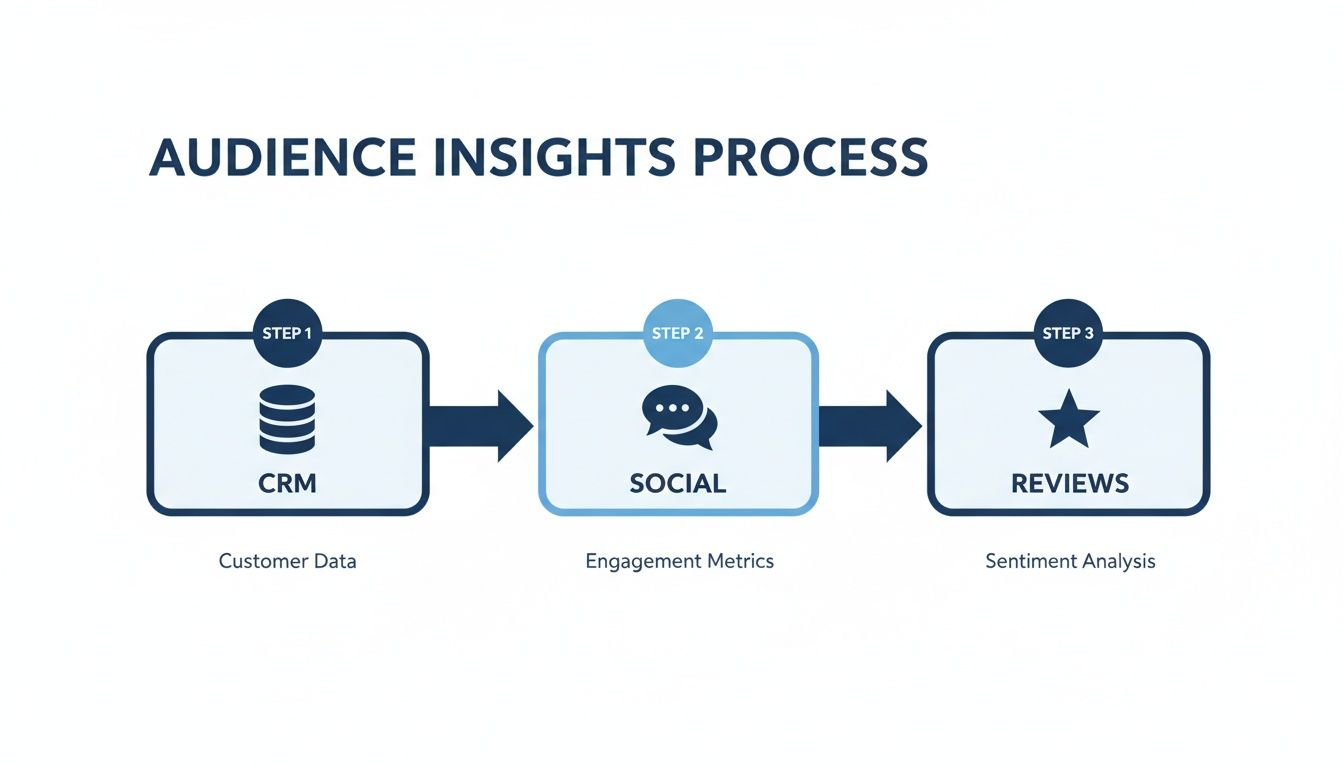
When you blend these different data sources, you move from a flat, one-dimensional profile to a rich, accurate picture of your ideal customer.
Get Precise with Demographic Data
LinkedIn's demographic data is an absolute powerhouse for sharpening your focus. For example, 50.6% of its 1.2 billion+ users are between 25-34. This makes Millennials the key group for most B2B outreach.
When you consider that LinkedIn drives a whopping 80% of all B2B social leads, ignoring these numbers is just leaving money on the table. In fact, marketers who dig into these stats see a 40% higher success rate in lead generation.
It's why our clients at Growlancer often book their first meetings in just 14-21 days—precision targeting beats a spray-and-pray approach every single time. For a deeper dive, check out these LinkedIn demographics on Sprinklr.com.
Validation on LinkedIn isn't a one-and-done task. It's an ongoing pulse check. Markets shift, priorities change. By regularly tuning into these signals, you keep your outreach sharp, relevant, and effective.
This validation stage is non-negotiable if you want to build a predictable pipeline. It confirms you're aiming at the right people and gives you the exact language you need to get their attention. You can learn more about how to put this into practice in our guide to effective B2B LinkedIn marketing.
Turning Audience Insights Into Revenue

Alright, you’ve done the hard work and nailed down your target audience. But let’s be honest, that’s only half the job. Insights are useless until you turn them into cash.
This is where the magic happens. All that data on their pains, goals, and daily headaches becomes the fuel for messaging that actually connects. No more generic, spray-and-pray outreach.
Now, you can craft hooks that speak directly to what keeps your ideal buyer up at night.
Say you found out VPs of Sales are getting hammered by inaccurate forecasting. Your outreach shouldn't drone on about your features. Hit them where it hurts: "Tired of last-minute surprises blowing up your forecast?" That’s how you cut through the noise.
Align Sales and Marketing for Maximum Impact
I see it all the time: sales and marketing teams operating on different planets. It’s a silent pipeline killer.
When both teams work from the same data-backed Ideal Customer Profile (ICP), every single touchpoint—from an ad to a sales call—feels consistent and powerful.
Marketing starts pulling in the right leads because their content speaks the right language. Sales calls become way more effective because the reps already get the prospect's world before they even dial.
This alignment creates a smooth journey for the customer. They feel understood from the first LinkedIn post they see to the final proposal. That consistency builds trust and shrinks the sales cycle. To get this humming, you first have to understand how to build a sales pipeline that’s grounded in a unified ICP.
A validated ICP isn't just a marketing slide deck. It's a strategic weapon for the whole company. It’s the single source of truth that tells you who to target, what to say, and where to show up.
Position Your Leadership to Attract Ideal Buyers
Your company's leaders are your best magnets for attracting the right kind of attention. When you position them as genuine thought leaders on platforms like LinkedIn, high-value prospects start coming to you.
Get your CEO to share real-world insights on the exact challenges your ICP is wrestling with. Have your Head of Product talk about industry trends that actually matter to your target market. Your executive team becomes a beacon for your perfect customers.
And for B2B, LinkedIn is the undisputed king. A staggering 89% of B2B marketers use it to generate leads, and the cost per lead is often 28% lower than Google Ads. Even better, consistent exposure to relevant content on the platform can boost a prospect's purchase intent by 33%.
The numbers don't lie. A smart LinkedIn strategy is non-negotiable for turning audience insights into a healthy sales pipeline. You can dig into more stats on this over at ColumnContent.com.
At the end of the day, it's about translating what you know into what you do. It's about building a revenue engine fueled by a deep, authentic understanding of the people you exist to serve. This is how you go from just knowing your audience to converting them into customers who stick around.
Got Questions About B2B Audience Targeting?
Even with a crystal-clear Ideal Customer Profile (ICP), a few tricky questions always pop up. Let's be real—figuring out how to nail your target audience is never a one-and-done deal. It’s normal to hit some bumps in the road when you start putting your new strategy into play.
I want to tackle a few of the most common challenges I see B2B leaders run into after they’ve put in the hard work of building their initial ICP.
These aren't just hypotheticals. They're the real-world snags that can completely throw off an otherwise killer go-to-market plan if you ignore them.
How Often Should I Actually Review My Target Audience?
Your ICP is not a "set it and forget it" PDF you file away somewhere. Markets change, customer problems evolve, and your own product gets better. You need to treat it like a living, breathing guide, not something carved in stone.
My rule of thumb? Do a full, deep-dive review of your ICP at least annually. But honestly, you should be poking at it a lot more often than that.
- Quarterly Pulse Checks: Take a hard look at your latest customer data. What do your sales win/loss reports really say? What's happening in the industry?
- Big "Oh Sh*t" Moments: If there's a major market shift, a big product update, or you change your company's direction, that’s your cue for an immediate ICP review. Don’t wait.
And if you see your conversion rates tanking or your sales cycle suddenly stretching out for weeks longer than it should? That's a massive red flag. Don't wait for your scheduled review—it’s a clear sign you’re out of sync with your market, and it’s time to rethink who you’re talking to.
What if My Company Targets Multiple Audiences?
First off, this is completely normal. In fact, it's often a sign of a healthy, growing business to have a few different ICPs, especially if you have multiple products or serve very different industries.
The absolute worst thing you can do is try to mush them all together into one generic, watered-down profile. Just don't.
Instead, you need to build a separate, highly detailed ICP for each segment. Your perfect customer in the mid-market tech space has totally different headaches, buying triggers, and ideas of success than an enterprise finance company. Each one needs its own unique messaging, its own content, and its own outreach playbook.
Figure out which segments have the most revenue potential and where you know you can deliver knockout results. Then, prioritize them. This forces you to focus your firepower instead of just spraying and praying across a dozen different groups.
What’s the Difference Between a Target Audience and an ICP, Anyway?
People throw these terms around interchangeably, but in the B2B world, the difference is critical.
A target audience is the big, broad group of people you want to reach. Think of it as the whole ballpark. An Ideal Customer Profile (ICP) is a laser-focused definition of the perfect company you should be selling to. It’s all about the firmographics—industry, company size, annual revenue, tech stack. It's about finding the one seat in the ballpark you know will buy a ticket.
Once you have your ICP, then you can create buyer personas. These are your sketches of the actual people inside those perfect companies who have a say in the buying decision. You always start with the ICP (the company) and then build out personas for the key players within it.
Ready to stop guessing and start building a predictable pipeline? Growlancer combines expert strategy, authority content, and targeted outreach to connect your leadership team with your ideal customers on LinkedIn. See how we can deliver qualified meetings in as little as 14-21 days at https://growlancer.ai.