

Let's be honest, lead nurturing is really just a fancy term for staying in touch with potential customers. The problem is, doing it manually is a nightmare. It’s like having a digital assistant who works 24/7, making sure you’re always talking to the right people at the right time.
This isn't just about sending a few emails. It’s a system that takes those lukewarm “maybe” leads and turns them into genuine, sales-ready conversations. No more missed follow-ups, no more leads going cold because your team got busy.
Why B2B Teams Can't Afford to Ignore Automation
Closing a B2B deal is a marathon, not a sprint. It takes weeks, sometimes months, of building trust and showing your value. But what happens when your sales team is buried under demos, proposals, and putting out fires for existing clients?
Those early-stage leads—the ones with real potential—inevitably fall through the cracks. It's a classic, frustrating problem, and it's exactly what lead nurturing automation is built to fix.
Instead of relying on sticky notes and calendar reminders, an automated system makes sure every prospect gets the right touchpoint at the perfect moment. It takes the guesswork and inconsistency out of follow-up and turns it into a scalable, predictable process.
Stop Chasing Leads and Start Building a Revenue Engine
This is about a fundamental shift in how you work. You move from a reactive, manual scramble to a proactive, automated engine that actually drives growth. The impact isn’t just theoretical; it’s something you can see in the numbers.
A staggering 80% of marketing automation users see a jump in the number of leads they generate. And it's not just a small bump—44% of companies using these platforms actually increased their lead volume. You can dig into more of this data on how automation impacts lead generation at emailvendorselection.com.
Here's what that actually looks like for your team:
- You can build relationships at scale. Suddenly, you can have personalized conversations with hundreds or thousands of leads at once, without it feeling robotic.
- Your sales team gets more efficient. Reps can stop wasting time on cold prospects and focus their energy on high-intent leads who are actually ready to talk.
- You can shorten the sales cycle. By delivering the right information at the right time, you help buyers move through their decision-making process faster.
- Sales and marketing are finally on the same page. It creates a smooth handoff, where marketing warms up leads until they're genuinely qualified for a sales call.
Automation isn't here to replace your sales team. It's here to do the boring, repetitive work so your people can focus on what they do best: having high-value conversations that close deals.
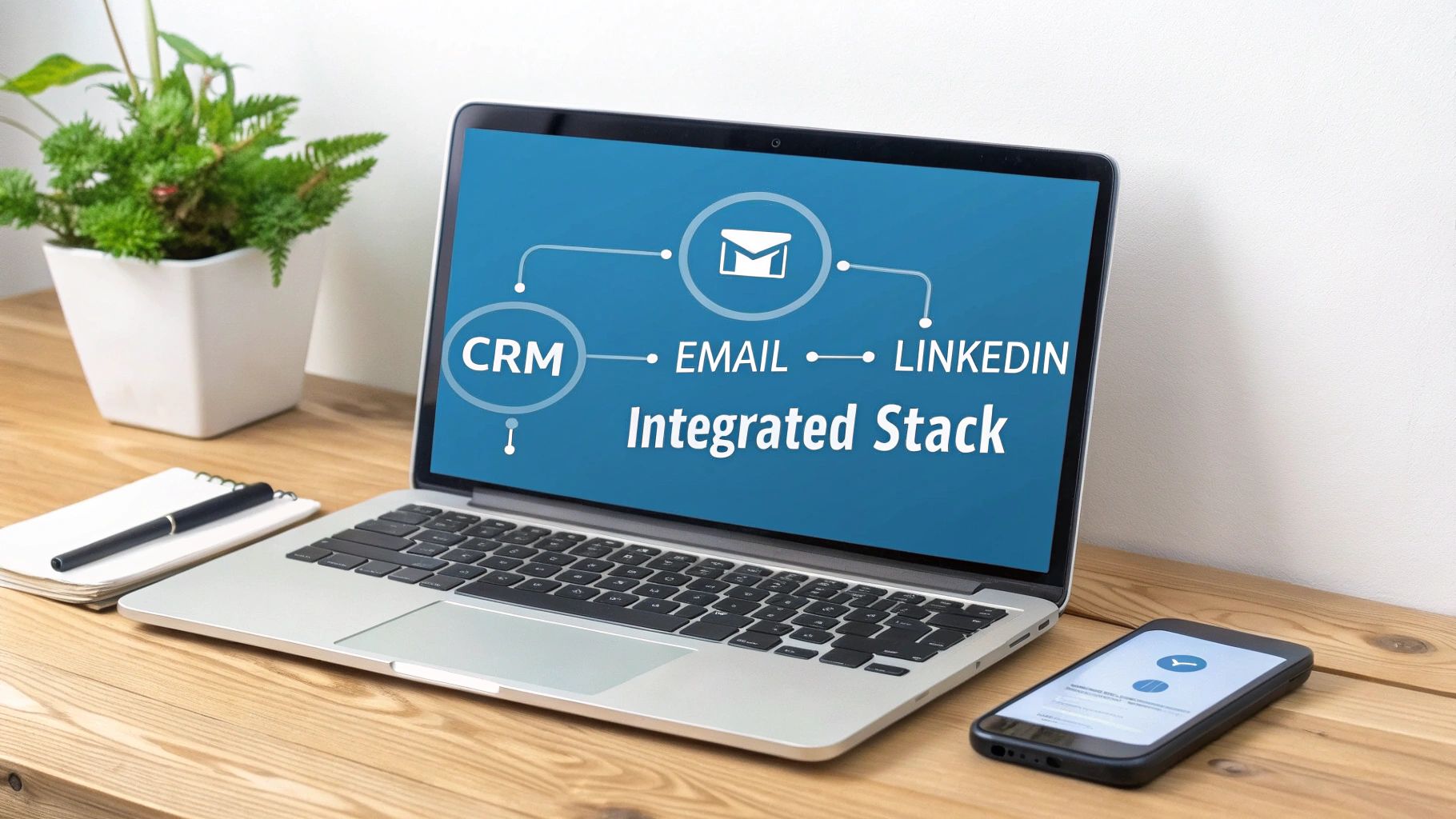
When you connect your CRM, email, and LinkedIn into one smart system, you're building a reliable framework for turning interest into revenue. This playbook is designed to walk you through it all, from mapping your customer's journey to measuring the real-world impact. It's time to build a system that works for you.
Mapping Your B2B Buyer Journey
Let's get one thing straight: killer lead nurturing has very little to do with your software. It starts with empathy.
Before you touch a single workflow or write a single email, you have to climb inside your customer's head. You need to map out the messy, winding path they take from "Hmm, that's interesting" to "Yes, take my money." This isn't about stuffing people into your funnel; it's about understanding their world.
The whole point is to sketch out the questions, the roadblocks, and the key moments your Ideal Customer Profile (ICP) hits along the way. What are they thinking when they first realize something's broken? What are they Googling? What finally makes them pull the trigger? If you haven't nailed down your ICP yet, our guide on what is an ideal customer profile is a great place to start.
Get this right, and your "automated outreach" stops feeling robotic and starts feeling like a genuinely helpful conversation.
This is what we're aiming for—turning a list of faceless leads into real, valuable conversations by using automation as the engine.
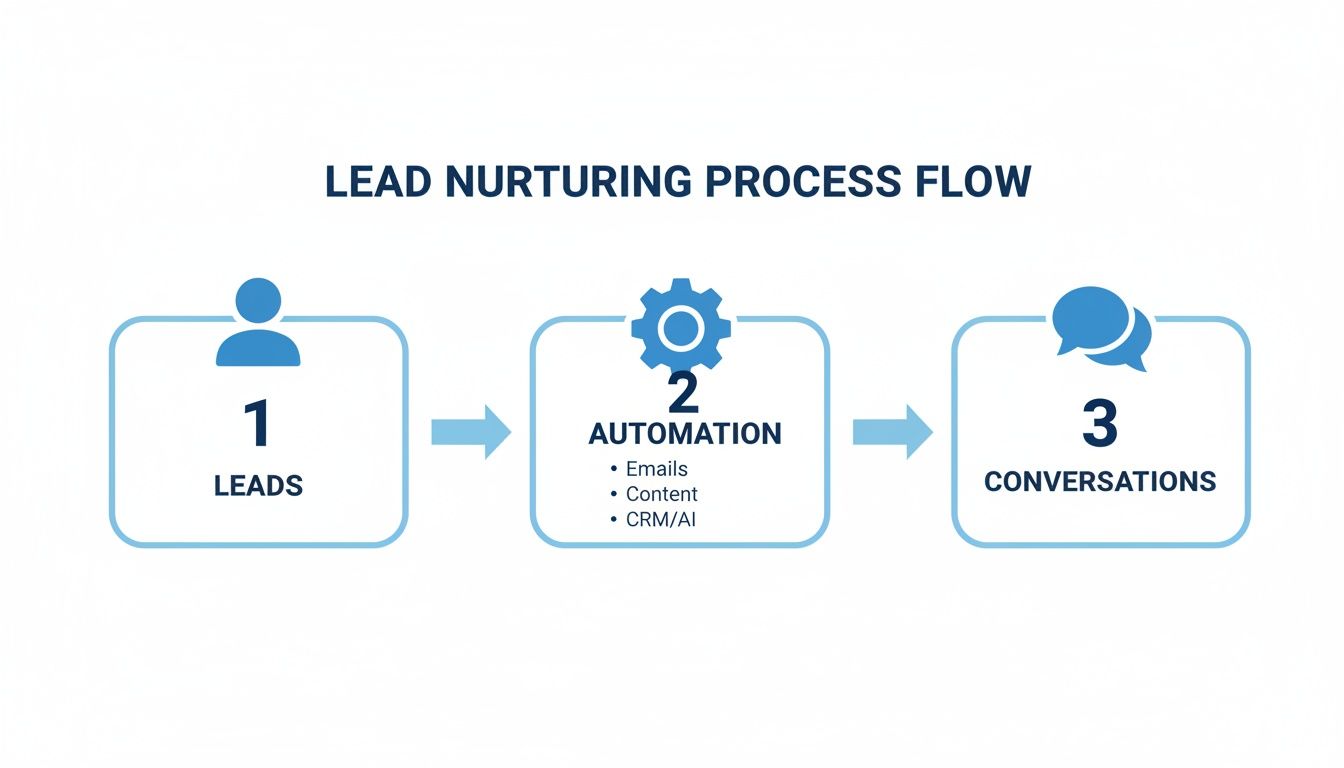
The diagram above shows how a smart system bridges the gap between just getting a lead and actually starting a meaningful sales chat.
Finding the Triggers and Key Moments
Your buyer's journey is full of little signals. Think of them as digital breadcrumbs they drop, telling you exactly where they are in their decision-making process. Nailing these triggers is how you deliver the perfect message at the perfect time.
Here are a few classic markers you'll see in B2B:
- The "Just Looking" Stage (Awareness): They're just starting to poke around. Maybe they download a broad whitepaper on an industry trend, read a blog post, or follow someone important on LinkedIn. Their activity is exploratory, not urgent.
- The "Getting Serious" Stage (Consideration): They've put a name to their problem and are now actively shopping for a fix. You'll see them visit your pricing page, watch a demo video, or sign up for a webinar comparing different solutions. These actions are much more specific.
- The "Ready to Buy" Stage (Decision): They're down to a shortlist and are about to make a call. These are the five-alarm fire signals: requesting a custom quote, binge-watching your case studies, or playing with an ROI calculator on your site.
Your journey map isn't a "set it and forget it" document. It's a living blueprint. I tell my clients to revisit it every quarter. Markets shift, customer problems change, and your map needs to keep up.
Let's Make This Real: A SaaS Company Example
Imagine you're running a B2B SaaS company that sells project management software to marketing agencies. After doing your homework, you build out a journey map for your ICP, a Marketing Director we'll call "Strategic Sarah."
Sarah's Problems and Journey:
- Awareness: Sarah's team is a mess of chaotic workflows and blown deadlines. She's feeling the heat. Her journey starts with a Google search for something like "how to improve marketing team productivity." She finds your blog, and downloads your free "Marketing Project Checklist." Boom. Trigger #1.
- Consideration: A few days later, an automated email sends her a case study about another agency that solved the exact same problem. Her interest is piqued. She clicks back to your site and watches a quick 2-minute video overview of your key features. That's Trigger #2.
- Decision: The video did its job. Sarah immediately clicks over to your pricing page. A lead scoring rule you've set up instantly flags this as a high-intent move. The very next day, a personalized email lands in her inbox from a sales rep—not a generic bot—offering a quick 15-minute chat about her agency's specific workflow challenges.
By mapping this out, the SaaS company built a sequence that perfectly mirrors Sarah's state of mind. The content doesn't feel like a hard sell; it feels like a helping hand. They're building trust and positioning their tool as the obvious solution long before a salesperson ever has to pick up the phone.
Using Lead Scoring And Segmentation For Smarter Outreach
Let's get one thing straight: not all leads are created equal.
If you treat a curious researcher who just downloaded a whitepaper the same way you treat a VP who watched your entire demo video, you're burning through time and leaving money on the table. This is where your lead nurturing automation stops being a simple email blaster and starts getting really, really smart.
By combining segmentation and lead scoring, you can finally stop shouting into the void. Instead, you start having targeted, relevant conversations at scale. This one-two punch is the engine that separates the genuinely interested prospects from the tire-kickers, making sure your sales team only steps in when the iron is hot.
Beyond Basic Demographics
Look, segmenting by company size or industry is fine. It’s a start. But if you want to see real results, you have to go deeper. The real magic happens when you layer that firmographic data with behavioral data—the digital footprints your leads leave all over your website and emails.
This lets you build laser-focused segments. For example:
- High-Intent VPs in Tech: These are folks who fit your ICP like a glove and have recently visited your pricing page or requested a case study. They don't need another blog post; they need a sequence aimed at getting a meeting on the calendar.
- Early-Stage Researchers: Maybe they fit your ICP, but they’ve only downloaded a top-of-funnel industry report. A hard sales pitch will just scare them away. They need more educational content to build trust.
- Competitor Lookalikes: You know these leads are already using a solution like yours—just not yours. Their nurture track should be all about your key differentiators and customer stories that hit on their likely pain points.
This is how you go from generic to genuinely helpful, and it makes a world of difference in how people respond.
Building A Simple Lead Scoring Model
Lead scoring is the automated bouncer for your sales team. It’s a point-based system that constantly evaluates leads based on who they are (demographics) and what they do (behavior), flagging them the second they're ready for a real conversation.
It’s pretty simple in practice. You assign positive points for good signals and negative points for bad ones. A Marketing Director in your target industry? That’s +15 points. Someone visiting your pricing page? That's a strong signal, so give them +25 points. A student with a .edu email? That's probably a -50. The goal is to set a threshold—say, 100 points—that automatically triggers a handoff to sales.
Don't underestimate the impact here. Companies that get this right see incredible results. Marketing automation has been shown to boost qualified leads by a staggering 451%. While only 11% of B2B companies are using automation for lead scoring right now, a much bigger 40% want it, because they know it can deliver 3.5 times more leads to their sales reps. You can see more stats on how automation drives lead generation over at warmly.ai.
A good lead scoring model isn't static. It's a living system. Review it quarterly with your sales team to make sure the actions you're scoring are actually leading to closed deals. If 'webinar attendees' aren't converting, maybe that action is worth fewer points.
To help you get started, I've put together a basic framework. Remember, these point values are just examples. You'll need to sit down with your sales team and figure out what signals truly matter for your business.
Example B2B Lead Scoring Model
This table gives you a simple framework for assigning points based on lead attributes and actions to identify who is sales-ready and who needs more time.
| Category | Attribute or Action | Points Assigned | Rationale |
|---|---|---|---|
| Firmographic | Job Title (VP, Director) | +15 | Indicates decision-making authority. |
| Firmographic | Target Industry (e.g., SaaS) | +10 | Aligns with your Ideal Customer Profile. |
| Behavioral | Visited Pricing Page | +25 | A very strong signal of purchase intent. |
| Behavioral | Downloaded Case Study | +15 | Shows interest in results and solutions. |
| Engagement | Opened 3+ Emails | +5 | Demonstrates consistent engagement. |
| Negative | Unsubscribed from Emails | -100 | Clearly indicates a lack of interest. |
Tweak this model based on what you learn. The goal is to create a system that reliably surfaces your best opportunities.
Putting It All Together For Sales
When a lead finally crosses that score threshold, the automation doesn't just stop. This is the critical handoff, where your system seamlessly passes a genuinely warm opportunity to a human being.
A well-built workflow can instantly:
- Change the lead status in your CRM from "Marketing Qualified" to "Sales Qualified."
- Assign the lead to the right sales rep based on territory, industry, or account size.
- Create a task for that rep with all the context they need, like "Follow up with Jane Doe, who just hit 115 points by viewing the pricing page."
This is how you eliminate cracks in your funnel and ensure no hot lead is ever left behind. It bridges the gap between marketing engagement and sales action, creating a predictable pipeline of real opportunities. For a closer look at perfecting this transition, check out our guide on how to qualify sales leads effectively. By systematically segmenting your audience and scoring their intent, you give your sales team the ultimate gift: the ability to focus their precious time on conversations that actually lead to revenue.
Designing Nurture Sequences That Actually Convert
You've mapped the journey and your scoring model is humming along. Now for the fun part: building the engine. This is where we design the actual communication sequences that guide someone from "just browsing" to a real sales conversation.
Let’s be clear. This isn't about blasting out generic, one-size-fits-all emails. We're aiming for a series of thoughtful, multi-channel touchpoints that feel less like a marketing campaign and more like a helpful, one-to-one dialogue.
A great nurture sequence is a carefully choreographed dance. It blends automated emails with strategic LinkedIn touchpoints and genuinely valuable content. Each piece builds on the last, creating a natural rhythm that keeps you top-of-mind without ever feeling pushy.
Blueprints For Common Nurturing Scenarios
Different leads need different conversations. A brand-new subscriber requires a warm welcome, while a lead who's gone quiet needs a gentle nudge back to life. You wouldn't talk to them the same way, right?
Here are a couple of proven blueprints you can steal and adapt for your own business.
1. The "Welcome and Educate" Sequence (For New Subscribers)
This is your first impression. Make it count. Your only job here is to deliver immediate value and set the stage for a great relationship.
- Touchpoint 1 (Immediate): The welcome email. Confirm their subscription and deliver whatever they signed up for (like that whitepaper or checklist). Simple, direct, and focused.
- Touchpoint 2 (Day 3): Share your greatest hit. Send a link to your most popular blog post or a killer case study. Frame it like, "Since you were interested in X, I thought you might find this useful."
- Touchpoint 3 (Day 5): Time for a LinkedIn connection. Have a relevant person from your team (a founder, sales lead, etc.) send a personalized request. No fluff: "Hi [FirstName], I saw you downloaded our guide on [Topic]. I share similar insights on my profile and thought it'd be great to connect."
- Touchpoint 4 (Day 8): The final welcome email. This one has a soft CTA—maybe an invite to an upcoming webinar or a link to a helpful video tutorial. No hard sells.
2. The "Re-Engagement" Sequence (For Cold Leads)
We all have them. Leads who looked promising but haven't engaged in the last 60-90 days. The goal here is to gently restart the conversation or politely part ways.
- Touchpoint 1 (Day 1): A low-pressure email. Try a subject line like, "Still interested in [Topic]?" and share a brand new piece of content or a recent industry insight. Give them a reason to click.
- Touchpoint 2 (Day 4): Head over to LinkedIn. Find a recent post they've shared or commented on and add a thoughtful reply. It’s a subtle, non-invasive way to pop back onto their radar.
- Touchpoint 3 (Day 7): The "breakup" email. Be direct but friendly. Something like, "It seems like now might not be the right time. I'll be closing out your file for now, but if anything changes, feel free to reach back out." It works surprisingly well.
These frameworks are a solid jumping-off point. For more inspiration, check out our guide packed with drip campaign examples that drive results.
Personalization Beyond The First Name
Look, true personalization is more than just dropping {{FirstName}} into a subject line. Everyone does that. It's about using the data you have to make your automated outreach feel like it was written just for them.
Effective lead nurturing automation uses personalization tokens to reference a lead’s specific actions and attributes. It’s the difference between shouting into a crowd and having a real conversation.
For instance:
- Instead of: "Check out our new case study."
- Try this: "Hi [FirstName], I saw your team at [CompanyName] is in the [Industry] space. We just helped a similar company achieve [Specific Result], and I thought you might find their story interesting."
See the difference? That level of detail shows you’ve done your homework and makes the message instantly relevant.
Finding The Right Cadence
One of the questions I get all the time is, "How often should I reach out?" There's no single magic number, but a good rule of thumb is to start with a delay of 3-5 business days between touchpoints.
The goal isn't to bombard them; it's to maintain a consistent, gentle presence. Spacing out your communications gives leads time to actually digest the information and prevents you from getting marked as spam.
Here’s what a simple five-touch cadence might look like in practice:
| Touchpoint | Channel | Timing | Purpose |
|---|---|---|---|
| 1 | Day 1 | Deliver initial value | |
| 2 | Day 4 | Make a personal connection | |
| 3 | Day 8 | Share a relevant resource | |
| 4 | Day 12 | Engage with their content | |
| 5 | Day 15 | Offer a low-friction next step |
Mixing channels like this is critical. It diversifies your communication and makes your brand feel more present without just flooding a single inbox. By designing these sequences thoughtfully, you turn your automation platform from a simple tool into a sophisticated system for building relationships and, ultimately, converting interest into pipeline.
Integrating Your Tech Stack for Seamless Automation
Let's be honest. A brilliant lead nurturing strategy is completely useless without the tech to back it up. I’ve seen it happen: teams spend weeks crafting the perfect journey maps and clever email sequences, only to have it all fall apart because their tools don’t talk to each other. A clunky, disconnected setup is the fastest way to drop leads and kill your momentum.
The goal here is to build a single, humming ecosystem where your core platforms—your CRM, your email marketing tool, and LinkedIn—work together as one. This integration is the real engine behind lead nurturing automation. It’s what turns your plans on a whiteboard into actual, automated actions. When these systems are properly hooked up, data flows freely, letting you run some seriously sophisticated workflows that feel personal to your prospects but are a breeze for your team.
A Real-World Workflow Example
Theory is nice, but let's walk through a real-world, multi-channel workflow. This is a classic B2B play that ties together lead scoring, email nurturing, and a timely sales touchpoint into one fluid motion.
The Goal: Automatically engage a high-intent lead and ping a sales rep the second they cross the "sales-ready" threshold.
The Trigger: A lead's score inside your CRM (like HubSpot or Salesforce) smashes past 100 points.
Here’s exactly how this plays out, step by step:
- The Score Jumps: A prospect, let's call her Sarah, has been poking around your content. She just watched a product demo video on your website, which bumps her lead score from 80 to 105. That’s our trigger. The automation wakes up.
- The Nurture Kicks In: Instantly, your CRM enrolls Sarah into a short, high-value email nurture sequence built specifically for hot leads. The first email lands in her inbox within minutes, feeling personal and perfectly timed.
- The Sales Handoff: At the exact same time, the system creates a task in the CRM and assigns it to the right sales rep. This isn't just a generic "follow up" task. It's loaded with context: "Connect with Sarah on LinkedIn. She just hit a 105-point lead score after watching the demo video."
- The Rep Makes a Move: The rep gets the notification, glances at Sarah's activity history, and sends a personalized connection request on LinkedIn. It's not a cold pitch. It's a relevant conversation starter.
This entire dance happens automatically. Marketing warms the lead right up to the goal line, and sales gets to swoop in at the perfect moment, armed with all the intel they need to have a real conversation.
You're Dead in the Water Without Clean Data
This kind of slick automation relies on one critical thing: clean data. If your data is a disaster, your automation will be a bigger one. Trust me, nothing torpedoes a good impression faster than addressing someone by the wrong name or sending them an offer for a guide they just downloaded.
A common mistake I see is teams rushing to build workflows without first auditing their data. If your CRM's "Job Title" field is a mess of inconsistent entries ("VP of Sales," "VP Sales," "Sales VP"), your personalization and segmentation efforts are dead on arrival.
Before you build a single workflow, nail down these two things:
- Data Hygiene: Get in the habit of regularly cleaning and standardizing your contact records. Make sure fields like job titles, industries, and company names are consistent.
- Proper Field Mapping: When you connect your tools, be meticulous about mapping the data fields. The "Email" field in your marketing automation platform has to talk perfectly to the "Email" field in your CRM. No excuses.
Getting this right isn't just some boring technical chore; it's a strategic must. The speed and personalization you get from this stuff have completely changed the B2B game. We know that leads contacted within 5 minutes via automation convert 3 times better than those who have to wait just 30 minutes. And with 80% of marketers saying automation generates more leads, it's a no-brainer. A clean, integrated stack is the foundation for a growth engine that actually works. You can find more stats on how automation drives lead generation on monday.com. When your tech execution matches your strategic vision, you build a reliable system that turns interest into revenue.
Measuring Performance and Optimizing Your Nurture Engine
Your lead nurturing engine is not a crockpot. You can't just set it and forget it.
The best B2B teams I’ve worked with treat their nurture flows like a living, breathing system. They're constantly in there, tweaking and refining based on what the data is telling them. This is how you build a real feedback loop—the kind that turns a simple automation tool into a legitimate growth engine.
First things first, we need to get past the vanity metrics. Sure, open and click-through rates are nice to look at, but they don't pay the bills. They don't tell you if your hard work is actually generating pipeline. You have to zero in on the KPIs that prove you're moving leads down the funnel and making a real impact on the business.
Key Performance Indicators That Actually Matter
If you want a true pulse on how your nurture engine is doing, you need to track the metrics that connect your marketing activity directly to sales outcomes.
Here’s what I look at:
- Conversion Rate Between Stages: This is the big one. What percentage of new leads are hitting MQL status? And how many of those MQLs are actually converting into SQLs that sales accepts? If these numbers are low, it's a massive red flag that your content and your audience's needs are out of sync.
- Sales Cycle Length: Is your automation actually making things happen faster? Compare the average time it takes for a nurtured lead to close versus a non-nurtured lead. A shorter cycle for the nurtured cohort is a clear win, proving your content is doing its job educating and prepping prospects.
- Pipeline Velocity: This metric is all about the speed and value of deals moving through your pipeline. Good nurturing keeps leads warm and engaged, which should absolutely increase your pipeline velocity and keep the sales team happy.
Look, the research backs this up. Companies that get lead nurturing right generate 50% more sales-ready leads at a 33% lower cost. This is way more than just sending emails—it's about building an efficient machine that directly pads your bottom line.
A Culture of Constant Testing and Refinement
Once you’ve got your baseline numbers, the real fun begins. It's time to start optimizing. And the only way to do that right is with systematic A/B testing. Stop guessing what might work better. Test it and let the data give you the answer.
I recommend creating a simple testing calendar. The trick is to focus on just one variable at a time so you know exactly what caused the change.
Here are a few high-impact elements you should be testing on a loop:
- Subject Lines: Try a direct, benefit-focused subject line against something more mysterious and curiosity-driven.
- Calls-to-Action (CTAs): Pit a hard "Book a Demo" CTA against a softer "Watch a 2-Minute Tour." You'll quickly learn which offers resonate at different stages of the buying journey.
- Content Offers: Is a deep-dive whitepaper outperforming a quick-read case study for your mid-funnel leads? Test different formats to see what your audience actually wants to consume.
Every test gives you a new insight. If a specific case study is consistently driving demo requests, you'd be crazy not to feature it more prominently. If an email sequence is a ghost town, it's time to rewrite it or swap out the content.
This data-driven approach is what ensures your lead nurturing automation evolves. It stops being a static tool and becomes an increasingly powerful asset for your company.
Common Questions Answered
How Long Until We Actually See Results?
Look, everyone wants to know the timeline. While you'll probably spot some early signs of life—like better engagement—within a few weeks, the real impact on qualified meetings and pipeline usually shows up in about 60-90 days.
Think of it this way: the initial work of mapping the journey and building the workflows is a front-loaded effort. But once it's running, the system's efficiency just keeps building on itself. For really well-dialed-in campaigns, it's not unusual to get those first qualified meetings on the calendar within 14-21 days.
Won't This Automation Feel Robotic to Our Leads?
That's a fair question, and honestly, a common fear. But it's also completely avoidable if you're smart about it. Great lead nurturing automation isn't about spamming people—it’s built on a rock-solid understanding of your customer, sharp segmentation, and real personalization.
When you use behavioral triggers and dynamic content that changes based on what a lead actually does, your messages hit differently. They feel relevant and timely, not like they came off an assembly line.
The goal isn't to fire your sales team and replace them with bots. It's to automate the right touches at the right moments, which frees up your sales reps to do what they do best: have valuable, human-to-human conversations.
The single biggest mistake I see is companies focusing on the tech before the strategy. They buy a shiny, powerful tool and immediately start blasting out generic emails. The programs that kill it? They start with a deep dive into the buyer journey. Always map out the human experience first, then build the automation to make it better.
This way, your outreach feels helpful, not cold. You're delivering actual value at every step, building trust, and guiding prospects toward a sales call naturally. It makes the whole thing smoother and more effective for you and for them.
Ready to build a predictable B2B sales pipeline on LinkedIn? At Growlancer, we mix smart strategy, authority content, and targeted outreach to get your leadership team in front of perfect-fit prospects. Find out how we can deliver qualified meetings in as little as 14 days.