

A solid LinkedIn strategy does more than just get you a few connections—it turns the platform into a predictable pipeline for B2B sales. It's a machine. You define your ideal customer, create content that makes you an authority, and then run targeted outreach to consistently book qualified meetings.
This isn't about random DMs or chasing likes. It’s about building a repeatable system that actually drives revenue.
Your Blueprint for a Predictable LinkedIn Pipeline
Building a high-performing lead gen engine on LinkedIn isn't about luck or striking gold with a viral post. It’s about putting together a deliberate, repeatable process.
Forget the vanity metrics. The only thing that matters is creating a system that reliably books qualified meetings and stuffs your sales pipeline with ideal-fit prospects. This guide gives you that exact blueprint, breaking down how to turn executive profiles into serious revenue drivers.
It all starts with clarity. Not a sales pitch. The first, most critical step is nailing your Ideal Customer Profile (ICP). We're talking hyper-specific here, way beyond just job titles and industries. We need to dig into the exact challenges, goals, and buying triggers of the decision-makers you want to reach. Get this foundation right, and every piece of content, every message, will hit home and position you as the only logical solution.
The Core Components of a Winning Strategy
A truly effective LinkedIn strategy isn't just one thing; it’s a few key activities working in sync to attract, nurture, and convert prospects. These are the pillars of a system you can actually scale:
- Profile Optimization: Your personal profile needs to stop looking like a resume and start acting like a high-converting landing page that speaks directly to your ICP's biggest headaches.
- Authority Content System: This means consistently publishing valuable content that solves your audience's problems, proves you know your stuff, and pulls inbound interest your way.
- Targeted Outreach Engine: Instead of waiting, you proactively find and engage perfect-fit prospects with personalized, value-first messages that start conversations, not just pitch a service.
- System Integration and Measurement: You have to connect your LinkedIn activity to a CRM for clean lead management and track the metrics that actually tell you if you're making money.
This simple flow shows you how the whole process works. It's a three-stage system that starts with defining your target and ends with directly engaging them.
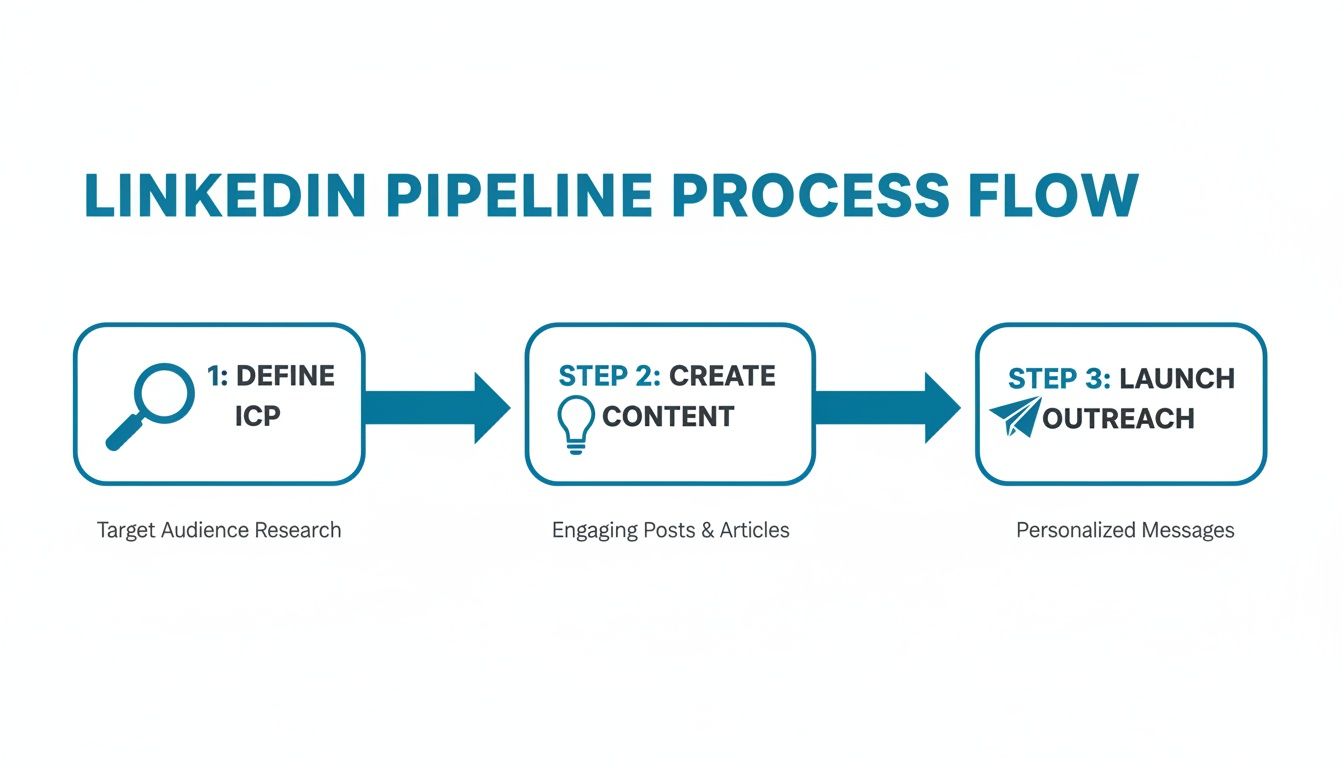
As you can see, each step builds on the last one. This ensures your outreach is always sharp, relevant, and hits the right person with the right message.
The numbers don't lie. LinkedIn is the king of B2B. It’s a staggering 277% more effective for lead generation than Facebook and Twitter combined. A full 40% of B2B marketers point to it as their single best channel for high-quality leads.
This makes perfect sense when you think about it—it's where business gets done. In fact, 89% of B2B marketers are already using LinkedIn for lead generation, and 62% of them confirm it's working. By following the playbook we've laid out, you can join them and turn LinkedIn into a core part of your growth engine.
Turn Your Profile Into a Conversion Tool
Before you even think about sending a single connection request, we need to talk about your LinkedIn profile. Let’s be honest—most profiles read like a dusty, digital resume. They list past jobs, rattle off a few accomplishments, and call it a day.
That’s not going to cut it.
For a modern LinkedIn strategy, your profile needs to act like a high-conversion landing page. It’s the first thing a prospect sees when you pop up in their notifications. They click your name, and in that split second, they decide if you're worth their time or just another spammer. Your profile has to do the heavy lifting, instantly answering their unspoken question: "What's in it for me?"
Let's overhaul the key elements and turn that passive real estate into an active sales asset.
Write a Benefit-Driven Headline
Your headline is the most valuable piece of digital real estate you own on LinkedIn. It follows you everywhere—comments, connection requests, messages, you name it. So please, ditch the generic job titles like "CEO at Company X" or "Sales Director." Nobody cares.
Instead, craft a headline that screams value to your ideal client. A killer headline does three things:
- Names your audience: Who do you help? (e.g., "Helping B2B SaaS Founders…")
- States the outcome: What do they get? (…scale their sales teams…")
- Hints at your method: How do you do it? (…with predictable outbound systems.")
For example, "Account Executive" is a dead end. But "I help fintech companies cut customer acquisition costs by 30% through strategic partnerships"—now that starts a conversation with the right people.
Craft a Compelling About Section
Your "About" section is where you tell your story. And I don’t mean your life story. I mean the story of how you solve your client's biggest problem. Stop listing job duties from 10 years ago and start connecting with your reader.
It needs to be scannable, so use short paragraphs and bullet points. Kick it off with a hook that grabs them by the collar, showing you understand their main frustration. Then, walk them through the problems you solve and the results you deliver.
A great "About" section reads less like a biography and more like the solution-focused copy on a sales page. It builds trust, shows you get their challenges, and makes it obvious why you're the one to solve them.
And for the love of all things holy, end with a clear call to action (CTA). Tell them exactly what to do next. Book a call. Download a resource. Send you a message. Don't leave them hanging.
Optimize Your Visuals for Credibility
People are visual creatures. A blurry, outdated, or unprofessional headshot kills your credibility before you’ve said a word. Get a high-resolution photo. Look at the camera, smile like you mean it, and dress for the clients you want, not the ones you have. It should say "confident and approachable."
Your banner image is just as crucial. That default blue gradient is a wasted opportunity. Think of it as a billboard for your personal brand.
- Consultants: Slap your logo, a killer client testimonial, and your headline up there.
- Founders: Show your product in action or a "logo wall" of impressive clients.
- Sales Leaders: Use a powerful tagline that captures your team's mission.
Don't overthink it, just make it reinforce your value.
Strategically Use the Featured Section
Finally, the "Featured" section is your portfolio. This is where you back up all the claims you just made. You said you get results? Prove it. Pin your best assets here to show you know your stuff.
Good things to feature include:
- Case Studies: Show the before-and-after of how you helped a client achieve real, measurable results.
- Testimonials: Short video clips or screenshots of clients singing your praises are pure gold.
- Lead Magnets: Link out to a valuable whitepaper, webinar, or free tool.
- Your Best Content: Pin your most popular LinkedIn post or a monster article that positions you as a thought leader.
By curating this section, you’re providing instant social proof. You're giving prospects a reason to trust you before you've even had a real conversation.
Build Authority with Strategic Content
Outreach might get your foot in the door, but it’s your authority content that makes prospects actually want to sit down and talk with you. Think of it this way: a consistent content strategy is the fuel for your entire LinkedIn engine. It’s what turns you from just another salesperson into a go-to advisor.
This isn’t about going viral. It’s about consistently solving real, painful problems for your ideal customers, right out in the open.
When you do that, you build trust at scale. Every single post becomes a little sales asset, warming up prospects before you even think about sliding into their DMs. This is how you shift from chasing leads to having them come directly to you.
Find Your Content Cadence and Rhythm
Let’s be real: consistency beats intensity, every single time.
Going all-out with five posts a week sounds great, but if you burn out in a month, what’s the point? It’s far better to start with a manageable two to three high-quality posts per week that you can actually stick with. Find your rhythm, then build from there.
A good content mix keeps your feed from getting stale and boring. Don't be a one-trick pony.
- Text-Only Posts: These are your bread and butter. Perfect for sharing a quick, punchy insight, asking a question that gets people thinking, or telling a short story. They’re super easy to read and often spark the best conversations.
- Carousels (PDFs): I love these for breaking down something complex into a simple, step-by-step guide. They scream "expert," get saved a ton, and are highly shareable.
- Short-Form Video: Nothing builds a personal connection faster. Use a quick video to share an off-the-cuff thought, give a behind-the-scenes look, or just put a face to the name.
Mixing it up like this means you'll connect with everyone—the skimmers, the deep-divers, and the visual learners. You maximize your impact without creating a ton of extra work.
Use Frameworks to Create Better Content Faster
The blank cursor is where good content intentions go to die. Stop reinventing the wheel every single time you post. Instead, lean on proven content frameworks to give your ideas some structure. They’re like creative guardrails that make the whole process faster and way more effective.
The secret to great content isn't being a brilliant writer; it's being a clear thinker. Frameworks help you organize your thoughts into a structure that resonates with your audience and delivers value efficiently.
Here are a few of my go-to frameworks that just plain work on LinkedIn:
- Problem-Agitate-Solve (PAS): Hit them with a problem you know they have. Twist the knife a little by digging into the pain it causes. Then, swoop in with the solution. Simple. Powerful.
- Contrarian View: Take a piece of common industry wisdom and call it out. This "Us vs. Them" angle is an absolute attention-grabber and instantly positions you as a leader who thinks for themselves.
- The "How-To" Mini-Guide: Break down a process into 3-5 dead-simple, actionable steps. This provides immediate value and is a dead-easy way to prove you know your stuff. You can see how this builds trust in our guide to thought leadership content marketing.
Using these frameworks takes the guesswork out of it. You can batch a week's worth of content in an hour just by plugging your core ideas into these structures.
Activate Your Team for Maximum Reach
Your personal content is a great start, but getting your whole team involved? That’s a force multiplier.
Employee advocacy is probably one of the most slept-on tactics for LinkedIn lead gen. When your team shares and engages with company content, your reach explodes. Plus, it just feels more authentic.
Think about it: a post from a company page is marketing. A post from a person on your team is a recommendation. The combined network of your employees dwarfs your brand’s follower count.
Simple Ways to Get Your Team on Board
- Create a Content "Cheat Sheet": Set up a dedicated Slack channel where you drop links to your best content. Make it stupidly easy for them to find and share.
- Give Them a Nudge: Don't just say "share this." Give them a prompt to work with, like "What's one thing you found interesting here?" This gets you genuine engagement, not just robotic reposts.
- Shout Out the Wins: When an employee’s post gets great engagement or even brings in a lead, celebrate it publicly. A little recognition goes a long way in getting others to join in.
When you turn your team into a content distribution engine, you build authority faster, get in front of way more ideal prospects, and create a culture that actually drives business.
Master Targeted Outreach That Starts Conversations
Having great content and a sharp profile is half the battle. But the real pipeline-building magic happens when you start reaching out directly. This is where you flip the switch from passively attracting leads to proactively creating them.
And I’m not talking about those cringey, automated messages we all love to ignore. This is about starting genuine, one-on-one conversations with people who could become your best customers. It's a game of precision, a healthy dose of personalization, and a bit of patience.
When you do it right, it doesn't feel like a sales pitch. It feels like a helpful introduction.

Build Hyper-Specific Prospect Lists with Sales Navigator
Your outreach is only as good as the list you're working from. A generic list means generic messages, which translates to zero replies. This is where LinkedIn Sales Navigator becomes your secret weapon. It lets you get incredibly granular.
Forget broad searches that give you thousands of irrelevant contacts. You need to layer filters that perfectly match your ICP.
Key Sales Navigator Filters I Swear By:
- Job Title & Seniority: Don't just type "CEO." Use Boolean searches like
"VP of Marketing" OR "Head of Marketing"to cast a wider, yet still relevant, net. - Company Headcount & Industry: Make sure you're only talking to companies that are the right size and in the right space for your service.
- Geography: Zero in on the specific regions, cities, or countries you actually do business in.
- "Posted content in the last 30 days": This filter is pure gold. It instantly shows you who is active on the platform, which means they're more likely to see and reply to your message. Plus, it gives you an easy, relevant "in" for personalization.
The goal is to build a list so tight that you could find a legitimate, personal reason to message every single person on it. That level of precision is the cornerstone of any outbound lead generation that actually works.
Craft Connection Requests That Actually Get Accepted
Think of the connection request as the very first domino. A blank request is easy to ignore. One that screams "I'm about to sell you something!" gets rejected instantly.
Your only job here is to be interesting and relevant enough to get a "yes."
Keep it short, sweet, and focused on them. Here's a simple approach that works because it's genuine and references something real.
Example Connection Request:
"Hi [First Name], saw your recent post on [Topic]. Your point about [Specific Insight] really resonated. Would be great to connect and follow your work."
Why does this work? It's not a pitch. It's a simple, peer-to-peer compliment that proves you've done thirty seconds of homework. That tiny bit of effort easily puts you in the top 1% of people sliding into their DMs.
Develop a Multi-Step Follow-Up Sequence
Getting them to accept is just the beginning. The real conversations, and the booked meetings, almost always happen in the follow-ups. A smart sequence lets you build rapport over time without coming across as a pest.
The trick is to make every single touchpoint valuable on its own.
A great follow-up sequence doesn't just ask, ask, ask. It gives, gives, and gives some more before making a small, logical request. This builds trust and makes them want to say yes.
Here’s a simple, non-pushy framework I use to guide my follow-ups.
LinkedIn Outreach Sequence Framework
This multi-touchpoint sequence is all about building rapport and getting a response without being overly aggressive or spammy.
| Touchpoint | Action | Objective |
|---|---|---|
| Day 1 | Send Connection Request | Get accepted and open the line of communication. |
| Day 3 | "Thank You" & Value Add | Thank them for connecting and share a relevant resource (article, case study, tool) with zero ask. |
| Day 7 | Engage with Their Content | Like or leave a thoughtful comment on one of their recent posts. Stay on their radar. |
| Day 10 | The "Soft Ask" | Reference the resource you sent. Ask a simple, low-friction question related to their goals or challenges. |
| Day 14 | The Direct Ask | If they've engaged at all, propose a brief call to discuss a specific, relevant idea you have for them. |
This approach respects their inbox and positions you as a helpful expert, not just another person trying to sell them something.
Transition from Conversation to Discovery Call
The final piece of the puzzle is knowing when and how to gracefully pivot from a casual chat to a scheduled meeting. Once you've built some rapport and they've hinted at a problem you can solve, the transition feels completely natural.
Don't jump the gun. Look for buying signals in their replies—questions about your process, results you've gotten, or even pricing. When you spot one, it's time to make your move.
Example Transition Script:
"That's a great question about [Their Pain Point]. It might be easier to show you rather than just tell you. Would you be open to a quick 15-minute call next week? I can walk you through a couple of examples of how we've helped companies like [Their Company] with this exact issue."
This works because it’s not a generic "can I have 15 minutes of your time?" It’s a specific, value-packed offer to solve a problem they just brought up themselves. The call becomes the next logical step in a conversation you're already having.
Integrate Your CRM to Manage Lead Flow
Getting conversations started on LinkedIn is a huge win. But it’s only half the story.
If all those valuable interactions live and die in your LinkedIn inbox, you’re setting yourself up for failure. This is the exact point where a great LinkedIn strategy either scales into a predictable revenue engine or collapses into a chaotic mess.
Think about it. A hot prospect replied last week, but you got busy. A promised follow-up never happened. A potential deal just vanished. The fix? Building a seamless bridge between your LinkedIn activity and your Customer Relationship Management (CRM) platform.
Connecting LinkedIn to Your Sales Hub
The goal here isn't just to dump a name into a database. It's about transferring context.
You need to know who they are, that they came from LinkedIn, what you talked about, and what the next logical step is. This is how you ensure a smooth handoff from that first message into your actual sales process.
Manually copying and pasting this stuff is a soul-crushing time sink and a recipe for mistakes. Fortunately, most modern CRMs like HubSpot or Salesforce have integrations or can be hooked up with third-party tools. This lets you sync conversation history and create contacts without ever leaving LinkedIn.
Nailing your internal workflows is just as crucial as the outreach itself. If you want to go deeper on this, our guide on sales process optimization lays out some killer frameworks for getting these operations dialed in.
Tracking and Managing Conversation Stages
Once leads are flowing into your CRM, you need a dead-simple way to track where they are in the journey. Don't overcomplicate this. A basic pipeline is all you need to see the progression from a new connection to a booked meeting.
Consider setting up a dedicated "LinkedIn Lead" pipeline with stages that make sense, like:
- New Connection: They've accepted your request but haven't replied yet.
- In Conversation: The back-and-forth has started.
- Meeting Interest: They’ve shown positive intent or agreed to a call.
- Meeting Booked: A discovery call is officially in the calendar.
- Not a Fit / Nurture: Wrong timing, or not a qualified prospect for now.
This kind of visual system gives you instant clarity on the health of your pipeline. Your team knows exactly where every opportunity stands, ensuring no one falls through the cracks.
The best LinkedIn strategies treat the platform as the very top of the funnel, not the entire sales cycle. Your CRM is where the real work of converting that lead happens. A clean handoff is non-negotiable.
Implement a Simple Lead Scoring Framework
Let's be real: not all leads are created equal. Some are ready for a sales call right now, while others need more time. A simple lead scoring model helps your team focus their energy on the hottest opportunities first.
You can assign points based on engagement signals you're already getting from LinkedIn. This doesn't need to be some complex algorithm. A basic framework is more than enough to get started.
| Action | Points |
|---|---|
| Connection Accepted | +5 |
| Replied to a Message | +15 |
| Engaged with Your Content | +10 |
| Asked a Buying Question | +25 |
| Visited Your Website | +20 |
When a lead crosses a certain threshold—let’s say 50 points—it can automatically trigger a task in your CRM for a sales rep to follow up more directly. This data-driven approach means your team is always working on the warmest leads, which will dramatically improve your efficiency and close rates.
Measure and Scale Your LinkedIn Operations
Let's be real. A LinkedIn strategy is just a bunch of busy work unless you can measure it, tweak it, and eventually, scale it. Without the right data, you're just throwing spaghetti at the wall. You might feel productive, but you have no idea if any of it is actually turning into pipeline.
And I'm not talking about vanity metrics. Likes, views, and a ballooning follower count are nice for the ego, but they don't keep the lights on. We need to zero in on the numbers that directly lead to revenue.
The Only KPIs You Need to Watch
Forget drowning in spreadsheets. A few core metrics will tell you everything you need to know about what's working and what's broken. Think of these as the vital signs for your entire LinkedIn system.
Here are the non-negotiables I track with my clients every single week:
- Connection Acceptance Rate: This is your first gate. A strong acceptance rate (we aim for 30% or higher) tells you two things: your profile is resonating and your connection notes are hitting the right nerve with your ideal prospects.
- Reply Rate to Follow-Ups: They connected… now what? This number shows if your follow-up messages are sparking genuine conversations or just getting archived. It’s the ultimate test of your "value-first" approach.
- Positive Reply Rate: Not all replies are good replies. A "not interested" is a data point, but a "tell me more" is a potential deal. You have to separate the polite dismissals from the real buying signals. This is all about lead quality.
- Lead-to-Meeting Conversion Rate: Here’s where the rubber meets the road. Of all the positive chats you're having, how many are actually turning into booked discovery calls? This metric is the purest measure of your ability to generate pipeline.
What gets measured gets managed. If your Connection Acceptance Rate is tanking (under 20%), your profile or your targeting is off. If your Reply Rate is dead, your messaging isn't valuable enough. These numbers aren't just for reporting; they're your diagnostic tools.
Knowing When It's Time to Scale
Once you've got a system that’s proven and repeatable—you're consistently hitting your KPI targets and meetings are landing on the calendar—it's time to pour some fuel on the fire.
But scaling isn't just about "doing more." It’s about strategically cranking up the volume without watering down the quality that got you here in the first place.
This is a classic fork-in-the-road moment for any growing B2B company. The process works, but you've run out of hours in the day. So, how do you amplify the results? You really only have two choices: build a team in-house or bring in a specialized agency.
The Big Decision: In-House vs. Outsourced
Choosing between building your own squad and hiring an outside firm is a major strategic call. There’s no right answer for everyone. It all comes down to your budget, how fast you need to move, and your long-term vision.
Let's break it down.
Building an In-House Team
This means hiring, training, and managing your own Sales or Business Development Reps (SDRs/BDRs) to execute the playbook you’ve built.
- The Upside: You get people who live and breathe your product and are fully baked into your company culture. This gives you ultimate control and helps you build a long-term asset for the business.
- The Downside: It’s a massive commitment of time and cash. You’re on the hook for salaries, benefits, software, and a pretty gnarly learning curve. Realistically, you’re looking at a 6-9 month ramp-up period before you see a solid return, and you always run the risk of turnover.
Partnering with a Specialized Agency
This is where you bring in an external team that does one thing and does it extremely well: LinkedIn lead generation. They come with their own battle-tested systems, expertise, and people.
- The Upside: You get instant access to a team of pros, which slashes your time-to-value. A good agency has proven processes and can start generating results fast—often within the first month. It’s also way more cost-effective than a full-time hire.
- The Downside: You have less direct, day-to-day control. The key is finding a true partner who obsesses over your business, not just a vendor running a generic script.
At Growlancer, we build these predictable LinkedIn pipelines for B2B leadership teams, turning your executives into authority figures who attract and convert ideal customers. If you're ready to scale your pipeline without the overhead of building an in-house team, explore our done-for-you programs.