

Let's be honest, content marketing in B2B isn't about slapping a few blog posts on your website and hoping for the best. It's the strategic art of creating and sharing genuinely useful content that pulls in and educates a very specific business audience.
The real goal? Build authority, generate high-quality leads, and become the trusted guide for complex buying committees navigating a long, winding decision-making process. Think of yourself less as a salesperson and more as the go-to expert in your field.
Why Content Is Your B2B Growth Engine
Nobody in the B2B world makes a snap decision on a major purchase. These are carefully considered, multi-stage evaluations that, on average, involve 11 different stakeholders. Each person on that committee—from the tech lead to the CFO—has their own set of questions, worries, and needs.
This is exactly where a solid content marketing plan stops being a "nice-to-have" and becomes a core part of how you grow the business.
Imagine your ideal customer is standing on one side of a deep canyon, and your solution is on the other. A cold call or a generic ad is like shouting across that chasm. It's loud, easy to ignore, and rarely gets a response. Good content, on the other hand, is the material you use to build a sturdy bridge, piece by piece, guiding them safely over to a confident decision.
Building Trust with Every Asset
Every single piece of high-quality content—whether it's a detailed whitepaper, an insightful webinar, or a data-driven article—is a beam in that bridge. It's not just selling; it's educating, solving real problems, and showing you actually know your stuff. By consistently delivering value, you earn trust long before a sales conversation even has a chance to start.
In B2B, trust isn't built on slick taglines. It's forged by proving your expertise and showing a genuine commitment to helping customers solve their toughest challenges. Content is the most scalable way to do exactly that.
The functions of a B2B content marketing program go way beyond just brand awareness. They're directly wired to revenue and predictable growth. Let’s break down how this works.
Here is a quick look at the core functions a well-oiled B2B content marketing machine should perform.
Core Functions of a B2B Content Marketing Engine
| Function | Description | Key Business Impact |
|---|---|---|
| Educate Buying Committees | Provide targeted content that addresses the unique questions and concerns of various roles, from technical users to financial decision-makers. | Shortens sales cycles by proactively answering questions and overcoming objections before the sales team is even involved. |
| Build Unshakeable Authority | Consistently publish insightful, expert-level content that positions your company as the undeniable leader in your niche. | Creates a strong brand preference, making you the first and often only choice when a prospect is ready to buy. |
| Generate Qualified Leads | Use valuable, gated assets (like e-books or reports) to attract prospects who are actively looking for solutions and willing to share their info. | Fills the sales pipeline with high-intent leads who have already been warmed up by your content, increasing conversion rates. |
This table shows that a strategic content approach isn't just about making noise; it’s about creating tangible business results by systematically addressing the needs of your audience at every stage.
The Economic Case for B2B Content
Not only does this approach work, but it’s also incredibly efficient. The numbers don't lie: content marketing generates three times as many leads as traditional outbound tactics while costing 62% less.
It's a powerful one-two punch of higher lead quality and lower cost. That's precisely why 79% of companies are now leaning on content marketing specifically to generate high-quality leads. If you want to dive deeper, you can explore more statistics on B2B content marketing here and see the full picture.
Ultimately, content isn't a line item on your marketing budget. It's a compounding business asset that works for you 24/7—attracting prospects, nurturing them into leads, and helping your sales team close bigger deals, faster. It's the engine that drives sustainable, long-term growth.
Building Your Foundation with Audience and Strategy
So much B2B content marketing misses the mark. It’s not because the title wasn’t clever or the video wasn’t slick. It’s because it never answered the most important question: who are we actually talking to?
Without a crystal-clear answer, you’re just making noise. The best programs are built on two simple pillars: a deep understanding of your audience and a documented strategy. Think of it like building a house. You wouldn’t just start nailing boards together without a blueprint. Skipping this step is the single biggest reason B2B content just doesn't work.
Defining Your Ideal Customer Profile
Before you write a single word, you have to nail down your Ideal Customer Profile (ICP). This is way more than just industry or company size. A real ICP is a detailed portrait of the company that gets the most value out of what you sell—and in turn, is the most valuable to you.
Your ICP has to answer the tough questions:
- Firmographics: What's their annual revenue? Employee count? Where are they located?
- Technographics: What tech are they already using? What does that tell you about their needs?
- Pain Points: What specific business problems are keeping them up at night? The ones you directly solve.
- Business Goals: What are they trying to hit in the next year? How do you help them get there?
Once you have a sharp ICP, you can stop wasting time and money on companies that were never going to be a good fit anyway.
Mapping the B2B Buying Committee
Okay, so you know the right company. Now, who are the actual people inside who make the decisions? B2B deals are almost never made by one person. It’s a whole committee of stakeholders, and each one cares about something different.
This is where a lot of content strategies completely fall apart. They create everything for a single "Director of IT" persona, but totally forget the CFO who has to approve the budget, or the junior team members who will actually have to use the software every day.
The modern B2B buying group has an average of 11 decision-makers, and they consume a ton of content before they ever talk to sales. In fact, 84% of businesses now outsource content creation just to keep up and create specialized material for each of these different roles. You can explore the full research on B2B content trends to see just how complex this has become.
A documented content strategy stops you from just doing random stuff. It becomes your North Star, making sure every single piece of content has a specific job, for a specific person, at a specific point in their journey.
This is how you should think about it. Every article, video, and post has to ladder up to one of these core business goals. It's about building authority, educating prospects, and generating leads.
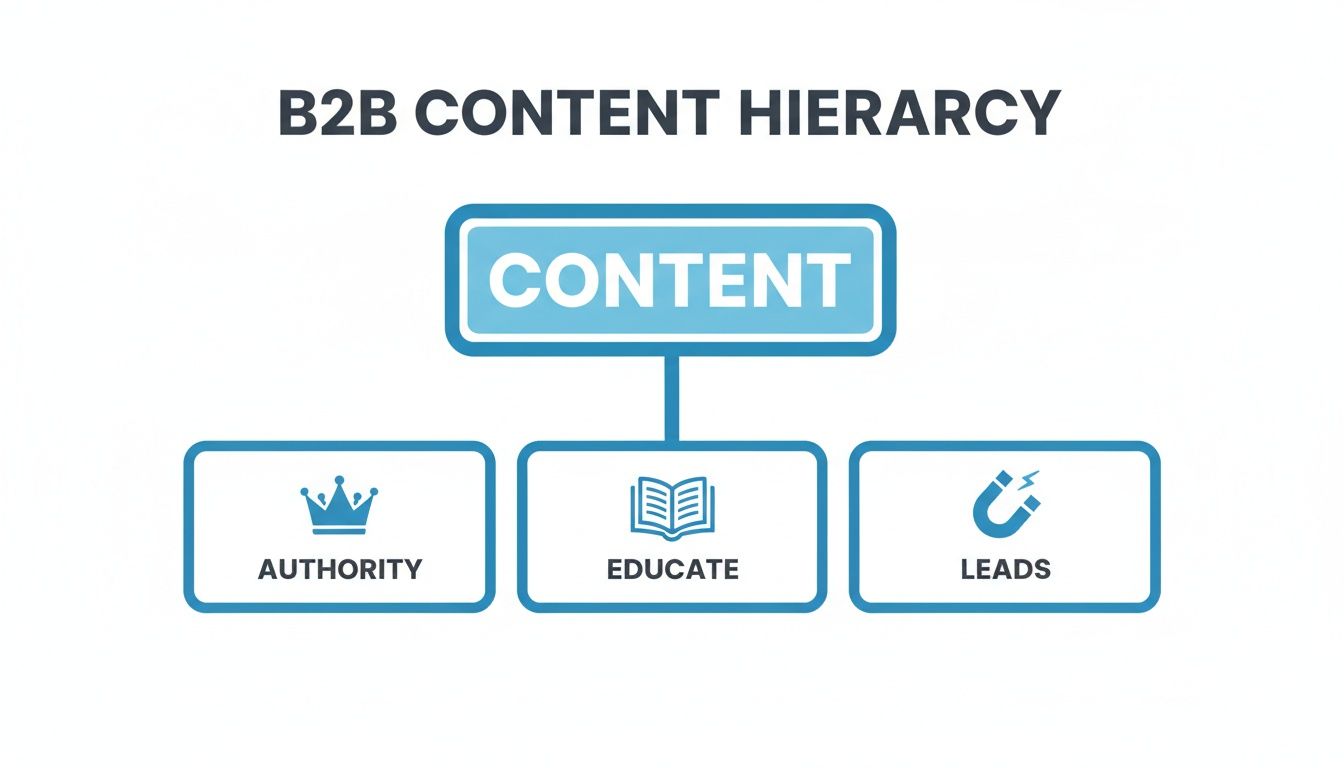
This hierarchy shows that content isn't just about creating more stuff. It’s about driving real outcomes that help the business grow. If an asset doesn't serve one of these goals, you have to ask why you’re making it. Getting this alignment right is how you build a predictable lead machine, not just a content library.
Choosing Content Pillars and Winning Formats

Alright, you’ve got your strategy locked in and you know your audience inside and out. Now for the fun part: deciding what you’re actually going to talk about. This is where so many B2B marketing plans fall apart, dissolving into a random mess of blog posts and one-off videos that go nowhere.
To sidestep that trap, you need to build your content on a solid foundation. We call these content pillars.
Think of them as the handful of massive, overarching topics your company will own. These aren’t just features or product benefits; they're the big-picture conversations, the major headaches, and the game-changing opportunities that keep your ideal customer up at night. Get this right, and every piece of content you create will reinforce the last, building a powerful narrative that screams "expert."
Your pillars live at the intersection of what you know best and what your audience desperately needs to solve. A great pillar is broad enough to sprout hundreds of individual content ideas but focused enough that you can truly dominate the conversation.
Identifying Your Core Content Pillars
So, how do you find them? Start by asking a few simple, but powerful, questions:
- Customer Pains: What are the top 3-5 problems our ideal customers bring up in every single sales call?
- Unique Expertise: Where do we have an opinion or a process that’s different from everyone else in the industry? What’s our unique point of view?
- Business Goals: Which topics naturally lead prospects to the solutions we offer? What conversations do we want to be known for?
For a B2B cybersecurity firm, this might lead to pillars like "Zero Trust Architecture," "Cloud Security Posture Management," and "Incident Response Planning." Every article, webinar, and LinkedIn post will then branch out from these core hubs. This is the bedrock of any serious thought leadership content marketing plan.
Matching Formats to Your Audience and Goals
With your pillars in place, it’s time to think about the delivery. The how is just as important as the what. The right format can make your message stick, while the wrong one can ensure it gets ignored completely. The trick is to build a flexible arsenal of content that meets people wherever they are in their buying journey.
And the data gives us some pretty clear clues. A whopping 92% of B2B marketers are using short articles or posts—no surprise there, as everyone needs quick, digestible answers. Video isn't far behind at 76%, while 75% rely on case studies and customer stories to build trust. You can dig into more B2B content trends to see what's working across the board.
The best format isn't a one-size-fits-all answer. It’s about delivering the perfect message in the perfect package for a specific person at a specific moment. A 60-minute technical webinar is gold for an engineer in the weeds, but a simple, punchy infographic is what will catch a busy executive's eye.
Let's get practical and map out how different formats align with the B2B buyer's journey.
B2B Content Format and Buyer Stage Alignment
Choosing the right tool for the job is critical. Use this table as a quick guide to make sure your content is hitting the mark at every stage of the funnel.
| Content Format | Primary Buyer Stage | Key Objective |
|---|---|---|
| Blog Posts & Articles | Awareness | Attract organic traffic through SEO and answer the high-level questions your audience is typing into Google. |
| Webinars & Live Events | Consideration | Dive deep into a complex topic, educate your audience, and capture leads who are actively looking for solutions. |
| Whitepapers & E-books | Consideration | Offer a detailed, data-backed solution to a major industry problem, cementing your authority on the subject. |
| Case Studies & Testimonials | Decision | Build massive trust by showing, not just telling. Prove you get results for companies just like them. |
| Original Research Reports | Awareness & Consideration | Create your own data to become the source. This is how you earn backlinks, get press, and become a go-to name in your space. |
When you start mixing and matching these formats with intent, your content marketing for B2B companies stops being a collection of assets and becomes a strategic system. You're no longer just creating content; you're building a guided path from a prospect's first flicker of interest to a confident "yes."
Mastering B2B Content Distribution and Amplification
Let’s be honest. Pouring weeks into a brilliant, data-rich whitepaper only to have it sit unseen on your website is a soul-crushing experience. It might as well not exist.
The difference between content that actually generates pipeline and content that just collects digital dust comes down to one thing: a deliberate, multi-channel distribution plan.
The old "publish and pray" approach is dead. You have to actively push your content in front of the right people, where they already hang out, at the right time. This isn’t an afterthought; it’s a critical part of the content process from day one.
Make LinkedIn Your B2B Distribution Hub
For any serious content marketing for b2b companies, LinkedIn is the undisputed king. It's not just another social platform; it's the digital boardroom, the industry conference, and the virtual coffee chat all rolled into one. Decision-makers are there, actively looking for insights.
Ignoring it is like setting up a storefront with no sign on the door. Your strategy here needs to be two-pronged:
- Corporate Page: Think of this as your official broadcast channel. Use it for the big-ticket items—webinars, industry reports, major company announcements. Keep it polished and focused on delivering high-level value.
- Personal Profiles: This is where the real magic happens. Posts from people—especially your company's leaders—get wildly more reach and engagement than posts from a brand page. Why? People trust other people, not logos.
And that brings us to one of the most potent plays in modern B2B.
The Power of Executive-Led Content
When your company's leaders share their unique point of view, they're not just distributing content; they're building trust at scale.
A post from your CEO about a lesson learned or a take on an industry trend feels authentic. It carries a weight that a generic brand update simply can't match. This approach turns your leadership team into trusted voices in your industry, building a following of ideal customers who genuinely want to hear what they have to say.
It's a powerful inbound engine, pulling in high-intent prospects who already see you as an authority. For a deeper look at this, check out our guide on how to generate leads on LinkedIn by building executive presence.
Your executives are the most credible voice your company has. Getting their expertise out there on a platform like LinkedIn is the fastest way to build the trust B2B buyers need before they'll even consider making a decision.
Beyond LinkedIn: Building a Multi-Channel Engine
While LinkedIn is your anchor, a smart distribution strategy doesn't put all its eggs in one basket. The goal is to build a machine with several interlocking parts, reaching buyers wherever they are.
-
Search Engine Optimization (SEO): This is your long game. By optimizing your content around the problems your audience is searching for, you capture high-intent traffic 24/7. Answering their specific questions with in-depth articles is a surefire way to attract qualified people to your website while you sleep.
-
Targeted Email Newsletters: Your email list is gold. Unlike social media, you own this audience. A regular, high-value newsletter is your direct line to prospects and customers, letting you nurture those relationships with exclusive insights and helpful resources.
-
Strategic Partnerships: Find non-competing companies that serve a similar audience. Co-hosting a webinar, co-authoring a research report, or guest posting on their blog can introduce your brand to a whole new, highly relevant group of potential buyers. It’s a win-win.
This multi-channel approach protects you from being too reliant on any single platform. But organic reach has its limits.
Paid promotion is the accelerator. It’s how you ensure your best content actually breaks through the noise. In fact, 71% of the most successful B2B marketers use paid channels to push their content in front of a wider, more targeted audience. You can discover more insights about B2B content marketing statistics to see just how critical a blended strategy really is.
Measuring Success with Meaningful B2B Metrics
Let's be honest. Creating great content is only half the battle. If you can't prove it's actually moving the needle, your entire program is on the chopping block. True content marketing for b2b companies means getting past vanity metrics like social media likes and zeroing in on the numbers that tie directly to business results.
This isn’t about pulling a few random stats. It’s about building a measurement framework that tells the full story—from the first time someone hears about you to the day they sign a contract. The best way to do this? Track performance across the entire sales funnel. This shows you not just what's working, but where it's making the biggest impact.
Top-of-Funnel Awareness Metrics
This is all about getting on your ideal customer's radar. The goal here is simple: attract your target audience and establish yourself as a credible voice in your space. These metrics tell you how well you're capturing attention.
- Organic Traffic: Are people finding you through Google? A steady climb here is a great sign your SEO efforts are paying off.
- Keyword Rankings: When your ideal customer searches for a solution, are you showing up? Tracking your rank for core business terms shows you're winning the visibility war.
- Backlinks: This is a big one. When other reputable sites link to your content, it’s a massive signal of authority to both search engines and actual humans.
Mid-Funnel Consideration Metrics
Okay, you've got their attention. Now what? The next step is to turn that initial spark of interest into a real, tangible lead. These metrics measure how well you’re building trust and getting prospects to raise their hand.
In the middle of the funnel, your content’s job is to turn anonymous lurkers into known contacts. You're trading valuable information for the chance to start a real conversation.
Think about the performance of a specific whitepaper. You shouldn't just track how many people downloaded it. You need to know which companies they're from and what other content they looked at before and after. That's where the real insight is.
Tools like Google Analytics are your command center for tracking this top and mid-funnel activity.
A dashboard like this gives you a clear, at-a-glance view of who’s showing up, what they’re doing, and which content is actually driving valuable actions.
Bottom-of-Funnel Decision Metrics
This is where the rubber meets the road—where your content efforts translate directly into pipeline and revenue. These are the numbers that get the C-suite and your sales team excited because they prove undeniable ROI.
You absolutely have to be tracking:
- Marketing-Qualified Leads (MQLs): How many leads from content downloads or webinar sign-ups actually fit your ideal customer profile?
- Sales-Qualified Leads (SQLs): Of those MQLs, which ones has your sales team accepted as legitimate opportunities worth their time? This handoff is critical.
- Demo Requests or Consultations Booked: This is a high-intent signal. When someone asks for a demo, often influenced by your content, you know you've done something right.
To connect these dots, you need tight integration between your marketing automation platform (like HubSpot or Marketo) and your CRM (like Salesforce). This is non-negotiable for understanding the complete B2B marketing and sales funnel and proving which content campaigns are actually making you money.
The data backs this up, time and time again. Research consistently shows that 58% of B2B marketers see a direct lift in sales and revenue from their content. Even more telling, 77% say it’s a primary driver for generating demand and qualified leads. You can read the full research about these content marketing findings to see just how clear the connection is.
By tracking the right KPIs, you prove that content isn't a cost center—it's one of the most powerful growth engines you have.
Scaling Your Content Engine for Long-Term Success
Let's be honest: a steady stream of high-quality content is the fuel for any B2B marketing program that actually works. But if your plan is to create every single piece from scratch, you're on a fast track to burnout. The real secret isn’t working harder; it’s working smarter by building a system that scales.
This means you have to stop thinking like a project manager hopping from one task to the next and start thinking like an operator building a machine. The goal is to build a content engine that gets the absolute most value out of every ounce of effort you put in. Your most powerful tool to make this happen? Content repurposing.
Think of it like a force multiplier. Instead of one asset for one channel, you create one big "pillar" asset and then strategically break it down into dozens of smaller, purpose-built pieces. This is how you explode your output without needing to explode your budget or your team's sanity.
From One Asset to Many
The big idea here is simple: take one deep-dive piece of content and slice it up for different channels and audiences. This is the cornerstone of efficient content marketing for B2B companies because it respects your team's time and the fact that your audience consumes information in a million different ways.
A single 60-minute webinar, for example, is a content goldmine. With the right plan, you can spin that one event into:
- Four Short Blog Posts: Dive deeper into the key subtopics from the webinar, each optimized for specific search terms.
- Ten LinkedIn Video Clips: Pull out the best 30-60 second soundbites for quick, high-engagement social posts.
- An Infographic: Turn the key stats and takeaways into a visually appealing, super-shareable graphic.
- A Nurture Email Sequence: Break down the main lessons into a multi-part email series for new leads in your pipeline.
- Quote Graphics: Turn the most powerful one-liners into eye-catching visuals for social media.
This isn’t just about creating more stuff; it’s about creating a content ecosystem where every piece works together. You're getting the absolute maximum mileage from your biggest content investments.
Building a Practical Content Calendar
A scalable system needs a command center, and that’s your content calendar. A great calendar is way more than a list of due dates—it's the strategic document that keeps your whole team rowing in the same direction.
Your B2B content calendar should be tracking:
- Pillar Asset: The big-ticket item you’re creating (e.g., Q3 Research Report).
- Derivative Assets: All the smaller pieces being spun off from the pillar.
- Target Persona: Who, specifically, is this piece of content for?
- Distribution Channels: Where is it going? (LinkedIn, blog, email, etc.).
- Owner: Who is responsible for getting it across the finish line?
- Status: Where is it in the process? (e.g., Drafting, In Review, Published).
A well-managed content calendar is the difference between a coordinated, strategic content plan and a series of random acts of marketing. It creates clarity, accountability, and makes sure nothing falls through the cracks.
Establishing Smooth Review Workflows
As you start producing more content, bottlenecks will become your worst enemy. Nothing kills momentum and morale faster than a slow, clunky review process. To keep things moving, you need a clear, documented workflow.
Map out the stages of review, who needs to give input where, and what the turnaround times are. A simple workflow might look like this: Draft > Subject Matter Expert Review > Final Edit > Approval > Schedule.
Using project management tools like Asana or Monday.com can help automate this, making sure you get the quality you need without slowing everything down. This kind of operational discipline is what allows your content engine to run smoothly for the long haul.
Your Top B2B Content Marketing Questions, Answered
Alright, even with the best strategy in place, the real-world questions always pop up. Let's tackle the big ones you're probably thinking about right now.
How Long Until I See Results?
This is the million-dollar question, isn't it? The honest, no-fluff answer is: you need to think in quarters, not weeks. B2B content marketing is a marathon, not a sprint. You're building an asset—trust, authority, and brand recognition—and that just doesn't happen overnight.
You'll likely start seeing early signs of life, like a bump in organic traffic or better keyword rankings, within 3-6 months. But the real payoff—a steady stream of marketing-qualified leads (MQLs) hitting your inbox—usually takes 6-12 months to really get going. That’s when the compounding effect of your growing content library and SEO authority starts to kick in.
What Is a Realistic Budget?
Your budget is going to swing based on your ambitions, how noisy your industry is, and whether you're hiring in-house or bringing in a partner. For a focused program hitting one or two channels hard, you could get started in the low thousands per month.
But if you're aiming for a more dominant position with original research, video series, and paid amplification, you'll obviously need a bigger war chest. The most important shift is to stop seeing it as a "cost" and start seeing it for what it is: an investment in building a predictable pipeline machine.
Here's a pro tip: Don't just budget for making the content. The smartest marketers I know set aside an extra 10-20% of their content budget just for distribution. It's pointless creating a masterpiece if no one ever sees it.
How Can a Small Team Succeed?
Good news: you don't need a massive department to win. For a small team, the game is all about ruthless focus and being incredibly resourceful.
- Own one channel. Before you try to be everywhere, become the undisputed expert on LinkedIn. Master it, then expand.
- Repurpose relentlessly. That one webinar you hosted? It's also ten short video clips, a blog post, a handful of quotes for social media, and a slide deck.
- Tap your internal experts. Your subject matter experts are a goldmine. Use them for raw ideas and outlines to slash your creation time.
- Obsess over distribution. A simple rule of thumb is to spend just as much time promoting your content as you did creating it.
With a tight, focused strategy, even a lean team can build a content engine that punches way above its weight.
Ready to build a predictable B2B sales pipeline without the guesswork? Growlancer combines expert strategy, authority content, and targeted outreach to put your leadership team in front of your ideal customers. Learn how we deliver qualified meetings in as little as 14 days by visiting https://growlancer.ai.