

Qualifying sales leads is really just the process of figuring out if a prospect is a serious buyer or just window shopping. It’s about using a bit of structure and data to separate the hot-to-trot leads from the tire-kickers, making sure your sales team spends their time only on deals that can actually close.
Why You Must Stop Chasing Unqualified Leads
Every minute a sales rep spends chasing a dead-end prospect is a minute they could've spent talking to a future customer. It feels productive, but it’s a killer.
Chasing bad leads doesn't just waste time; it's a massive drain on morale, resources, and your bottom line. A scattergun approach stuffs your pipeline with noise, making forecasting a guessing game and growth unpredictable. The single most powerful thing you can do for your sales engine is to get disciplined about qualification.
The numbers don't lie. Properly qualified leads convert at around 40%, while the unqualified ones? Just 11%. That's a huge difference. On the flip side, a whopping 79% of leads that aren't a good fit will never, ever convert. This means getting good at saying "no" early is just as important as finding the "yes."
The goal isn't just to fill the pipeline; it's to fill it with the right opportunities. Think of qualification as your bouncer, only letting in prospects who have a real need, the power to make a decision, and the cash to back it up.
The Four Pillars of Modern Qualification
To make this practical, let's break down a modern lead qualification system into four core parts. Getting these right will take your team from being reactive order-takers to proactive deal-makers.
Of course, before you can qualify anyone, you need leads coming in the door. If your funnel is looking a bit empty, check out our guide on how to generate B2B leads to get that sorted first.
Once you’ve got a steady stream of prospects, you can apply these four pillars:
- Frameworks: These are your battle plans, like BANT or MEDDPICC. They give you a consistent checklist for sizing up every lead that comes your way.
- Scoring: This is where you get objective. You assign points to leads based on who they are and what they do, so you instantly know who to call first.
- Discovery: This is the human touch. It’s the art of the conversation, asking the right questions to dig deep and uncover the real pain points and buying signals.
- Automation: This is about using your tech stack—mostly your CRM—to move leads from marketing to sales in a flash, so nothing falls through the cracks.
This playbook will walk you through each of these, step-by-step. Let’s get you the tools you need to stop wasting time and start closing more deals.
To keep it simple, think of the entire process like this:
The Four Pillars of Effective Lead Qualification
| Pillar | Core Function | Key Outcome |
|---|---|---|
| Frameworks | Provide a structured model for evaluating prospects. | Consistent and repeatable lead assessment. |
| Scoring | Quantify a lead's fit and intent based on data. | Data-driven prioritization of the hottest leads. |
| Discovery | Uncover deep insights through skilled questioning. | Clear understanding of a prospect's true needs. |
| Automation | Use technology to streamline lead routing and handoffs. | Increased speed-to-lead and operational efficiency. |
Mastering these four areas is the foundation for building a sales process that doesn't just work, but scales.

Choosing Your Foundational Qualification Framework
Before you can build a repeatable sales engine, you need a system. A qualification framework is that system. It's the blueprint your team uses to size up every prospect, making sure they ask the right questions to move a deal forward.
If you don't have one, you're just winging it. Your pipeline will be a mess, and your reps will waste countless hours chasing leads that were never going to close.
These frameworks aren't just scripts. They're strategic lenses. They help your reps turn a simple chat into a proper discovery process, mapping out the path from a "hello" to a qualified opportunity.
Let's break down the three frameworks I see work best in the B2B world.
BANT for High-Velocity Sales
First up is BANT. It’s a classic for a reason. Simple, direct, and killer for fast-moving sales cycles. IBM came up with it decades ago, and it still holds up because it focuses on the four things that make or break a quick deal:
- Budget: Do they actually have the money set aside for something like this?
- Authority: Am I talking to the person who can sign the check, or can they get me to that person?
- Need: Is there a real, painful business problem that we can solve?
- Timeline: How fast are they looking to buy and get started?
BANT is your go-to for transactional sales where you need to qualify (or disqualify) people, fast.
Imagine you're selling a project management SaaS for $100/user/month. A good rep can rip through the BANT questions in a single 15-minute call and know instantly if the lead is worth another minute of their time.
BANT is all about speed. It’s built to filter a high volume of leads so your team isn't chasing ghosts who can't buy.
CHAMP for Consultative Selling
Look, BANT is great, but its directness can feel a bit old-school, especially in more complex, relationship-heavy sales. That's where CHAMP comes in. It flips the script and leads with the prospect's problems, making the whole conversation feel more like a consultation.
CHAMP stands for:
- Challenges: What specific headaches or roadblocks are they dealing with right now?
- Authority: Who’s involved in the decision to fix these problems?
- Money: What’s the financial fallout from these challenges, and what kind of budget is there for a fix?
- Prioritization: How high up on their to-do list is solving this specific problem?
By kicking off with their challenges, your rep instantly becomes a problem-solver, not just another vendor pushing a product. This is the way to go when you're selling something more complex, where you have to truly get their pain to show your value. It changes the entire dynamic from "Can you afford us?" to "How can I help you fix this?"
MEDDPICC for Enterprise Deals
Now, if you're in the big leagues—chasing massive enterprise deals with a dozen stakeholders and a six-month (or longer) sales cycle—BANT and CHAMP just won't cut it. You need a much bigger toolkit.
Enter MEDDPICC. This is the gold standard for qualifying complex, high-stakes enterprise deals. It's an exhaustive deep-dive that leaves no stone unturned.
- Metrics: What are the hard numbers they need to hit? Think revenue growth, cost savings, or efficiency gains.
- Economic Buyer: Who holds the purse strings? This is the person with final P&L responsibility who can greenlight the whole project.
- Decision Criteria: What's on their checklist? The specific technical, business, and vendor requirements they'll use to judge you.
- Decision Process: What are the exact steps, approvals, and hoops you have to jump through to get a signature?
- Paper Process: What legal and procurement nightmares are waiting for you after they say yes?
- Identify Pain: What's the critical, make-or-break business pain that's forcing them to act now?
- Champion: Who’s your inside person? The one who loves you, has influence, and will fight for you in meetings you're not invited to.
- Competition: Who are you up against? And what are their strengths and weaknesses compared to yours?
MEDDPICC forces your sales team to stop acting like reps and start thinking like strategic consultants. If you’re selling a cybersecurity platform to a major bank, you need to know the exact metrics for risk reduction, who the CISO (the economic buyer) is, and the entire procurement gauntlet you’ll have to run.
It's a lot of work, but it's absolutely essential for closing those six or seven-figure deals.
The right framework comes down to your business. A high-volume SaaS can crush it with BANT. A firm selling custom enterprise software would go bust without the rigor of MEDDPICC. Pick the one that fits your sales cycle, drill your team on it, and build it right into your CRM so it gets used every single time.
Building a Predictive Lead Scoring Model

While qualification frameworks give you the right questions to ask, a lead scoring model gives you an objective, data-backed way to prioritize who you talk to first. It’s a system that automatically assigns points to leads based on who they are and how they engage with you.
Think of it as a quality filter for your entire pipeline. Instead of your reps starting their day with a massive, unfiltered list, they see a ranked list of the hottest prospects. This turns the handoff from marketing to sales from a "good luck" pass into a surgical strike.
The real power here comes from blending two very different types of data.
Differentiating Explicit and Implicit Data
A solid model scores leads based on both what they tell you and what they show you. This means you’re tracking two things: explicit data and implicit data.
Explicit data is the stuff people give you directly. It’s the firmographic and demographic info that tells you if they’re a good fit for your business—your Ideal Customer Profile (ICP).
- Job Title: Is this a VP of Sales or an intern? A decision-maker or just a researcher?
- Company Size: Are they a 50-person startup or a 5,000-person enterprise?
- Industry: Do they operate in one of your key verticals, like SaaS or Healthcare?
- Location: Are they based in a market you actually serve?
Implicit data, on the other hand, is all about their behavior. These are the digital breadcrumbs they leave behind that scream, "I'm interested!"
- Website Visits: Did they just hit the homepage, or have they been living on your pricing page for the last ten minutes?
- Content Downloads: Did they grab a fluffy top-of-funnel eBook or a serious bottom-of-funnel case study?
- Webinar Attendance: Did they register and actually show up for the live product demo?
- Email Engagement: Are they consistently opening your newsletters and clicking links?
A lead who perfectly matches your ICP (explicit) and is obsessively consuming your content (implicit) is pure gold. That’s who you call now.
Assigning Point Values That Actually Work
Next, you need to assign point values to these attributes and actions. The trick is to give more weight to the signals that most often lead to a closed deal. High-value actions and ideal customer profiles should get the big points.
For instance, a "Director of Marketing" at a 200-person tech company might immediately get +25 points just based on who they are. If that same person then attends a live webinar (+15 points) and hits your pricing page twice (+10 points), their score skyrockets. They're not just a good fit; they're showing serious intent.
This isn't just a nice-to-have anymore. By 2025, this kind of data-driven lead scoring is expected to be the main driver for any sales team looking to scale. The sharpest teams have found the sweet spot for a sales-ready lead is often between 41 and 60 points, with very few legitimate leads ever scoring above 80.
A well-calibrated scoring system is the first domino to fall when figuring out how to build a sales pipeline that's both predictable and profitable.
To get you started, here’s a simple B2B lead scoring model you can adapt for your own business.
Sample B2B Lead Scoring Model
| Category | Attribute/Action | Score (+ Points) |
|---|---|---|
| Explicit (Fit) | Job Title is C-Level/VP | +15 |
| Company Size is 100-500 Employees | +10 | |
| Industry is a Target Vertical | +10 | |
| Implicit (Intent) | Requested a Demo or Consultation | +30 |
| Visited Pricing Page (2+ times) | +15 | |
| Attended a Product Webinar | +15 | |
| Downloaded a Case Study | +10 | |
| Subscribed to Newsletter | +5 | |
| Negative Scoring | Visited Careers Page | -10 |
| From a Competitor's Domain | -25 |
This table gives you a clear framework. A demo request is obviously a huge buying signal, so it gets +30 points. A newsletter subscription is nice, but it's a lower-intent action, so it only gets +5.
Pro Tip: Don't forget negative scoring. Someone visiting your careers page is probably looking for a job, not a solution. Slap a -10 on them. A known competitor snooping around? That’s an easy -25. This keeps your model honest.
Once your model is live, you just need to set a threshold. For example, any lead that hits a score of 50 or more becomes a Marketing Qualified Lead (MQL) and gets automatically routed to a sales rep for immediate follow-up.
This system rips the guesswork out of prioritization. Your team stops wasting time on tire-kickers and focuses all their energy on people who are actually ready to talk.
The Discovery Call: Where Data Meets Real Life
Okay, all your frameworks and lead scores have done their job. You've got the right person on the phone. Now what?
This is the moment of truth. The discovery call is where a line on a spreadsheet becomes a living, breathing opportunity. It’s where your rep transitions from analyzing data to having a real conversation, and honestly, it’s where most deals are won or lost.
A great discovery call isn't about ticking boxes on a script. It’s a genuine conversation. You’re there to uncover the real story, to dig into their actual frustrations, figure out how they really make decisions, and get a feel for how badly they need to fix this thing.
Ditch the Lame, Generic Questions
You've got to ask questions that make people talk. Forget anything that can be answered with a "yes" or "no." You're hunting for the "why" behind everything.
Stop asking, "Do you have a budget for this?" It immediately puts people on the defensive. It's a rookie move.
Instead, try framing it around value. Say something like, "Typically, teams we work with who are serious about fixing this set aside around X. How does that sound compared to what you were thinking?" See the difference? Now you're talking about investment and outcomes, not just cost.
And please, stop asking, "What are your pain points?" It's so generic. Show them you've done a tiny bit of homework. Something like, "I saw on [LinkedIn] your team's grown by 20% in the last six months. I've got to imagine your old processes are starting to creak under that pressure?"
That single sentence proves you're not just another clueless sales rep. It opens the door to a much realer conversation.
The goal is to make it feel less like a sales call and more like a free consulting session. You want to understand their world so deeply that connecting it back to your solution becomes the most natural thing in the world.
Use LinkedIn to Build Instant Rapport
Going into a call completely cold is just lazy. It’s a guaranteed way to fail.
A few minutes scrolling through their LinkedIn profile is all it takes to find conversational gold. This isn't about being creepy; it's about being prepared. It's how you qualify leads like a pro in today's world.
Give your reps a dead-simple checklist to run through before every single call.
The Pre-Call LinkedIn Signal Checklist:
- New Gig? Did they or their boss just start a new job? New leaders are always looking to make their mark and are way more open to new ideas. Big buying signal.
- Fresh Funding? If the company just announced a new funding round, they have cash to spend and aggressive targets to hit. It doesn't get much warmer than that.
- What Are They Talking About? Check their recent posts and comments. If they just shared an article about a problem you solve, you have the perfect, non-sleazy way to kick off the call.
- Hiring Sprees: Are they hiring a ton of people in a specific department? A company hiring 15 new SDRs is almost certainly feeling the pain of their current sales software.
Using these little nuggets of info shows you see them as a person, not just a lead. It changes your opener from "Hi, I'm calling from…" to a relevant, personalized conversation starter.
The Art of Shutting Up and Listening
Sometimes, the most important clues are in what they don't say.
Active listening isn't just about waiting for your turn to talk. It's about catching the hesitation, the tone, the real meaning behind the corporate jargon. This is a massively underrated skill.
A rookie hears, "Oh, we already have a solution for that," and immediately disqualifies the lead.
An expert hears an opening.
They follow up with genuine curiosity: "That's great. What do you love about it? And if you could wave a magic wand, what's the one thing you'd change?"
That little follow-up can crack open a treasure chest of hidden frustrations and workarounds. A long pause before they answer tells you everything you need to know—things aren't as rosy as they pretend.
Combine smart questions, a bit of social homework, and a real desire to listen, and your discovery calls will stop being qualification chores. They become the foundation of a real customer relationship.
Automating Your Lead Handoff Process
A perfectly qualified lead is useless if it gets dropped in a sloppy handoff between marketing and sales. I’ve seen it happen a thousand times—this is where deals go to die. They land in the dead zone between a lead hitting a score threshold and a rep actually picking up the phone.
Fixing this isn't just about yelling at people to move faster. It’s about building an automated, airtight system in your CRM that makes speed-to-lead the default.
The second a prospect crosses your scoring threshold and becomes a Marketing Qualified Lead (MQL), the clock starts ticking. Loudly. That transition from MQL to a Sales Qualified Lead (SQL) has to be instant, and it has to come packed with context. Your CRM is the engine for this.
The goal here is simple: eliminate all manual work. When a lead's score hits your target—say, 50 points—it should set off a chain reaction in your CRM.
Defining Your Automated Handoff Workflow
Think of this as the operational glue holding your pipeline together. A solid workflow means every qualified lead gets to the right person, with the right information, at the right time. No more guessing games.
Here’s what that automated sequence looks like in practice:
- Trigger: The lead score flies past your MQL threshold.
- Action 1: The lead’s status automatically flips from "Marketing Engaged" to "MQL – Ready for Sales."
- Action 2: The lead is assigned to a sales rep based on your routing rules (territory, industry, company size—whatever makes sense for you).
- Action 3: An instant notification hits the assigned rep's email or Slack, with a direct link to the lead's CRM record.
This simple bit of automation closes the black hole where hot leads so often disappear. It creates accountability and paves the way for a crazy-fast response.
The Critical Importance of Speed
Let's be blunt: how fast you respond to a new lead basically determines if you ever get to speak with them at all. The data on this is overwhelming.
Research aggregated through 2025 shows that contacting a lead within one hour increases the odds of qualifying them by 7x. Some analyses even show that reaching out in the first five minutes makes a prospect up to 9x more likely to convert. Speed is everything.
The handoff isn't just an admin task; it's a competitive advantage. The first salesperson to have a real conversation with a prospect usually wins the deal. Period.
Once that automated notification fires, the rep needs to jump on it. The flow below shows the simple, powerful process they should follow to turn that lead into a real conversation.
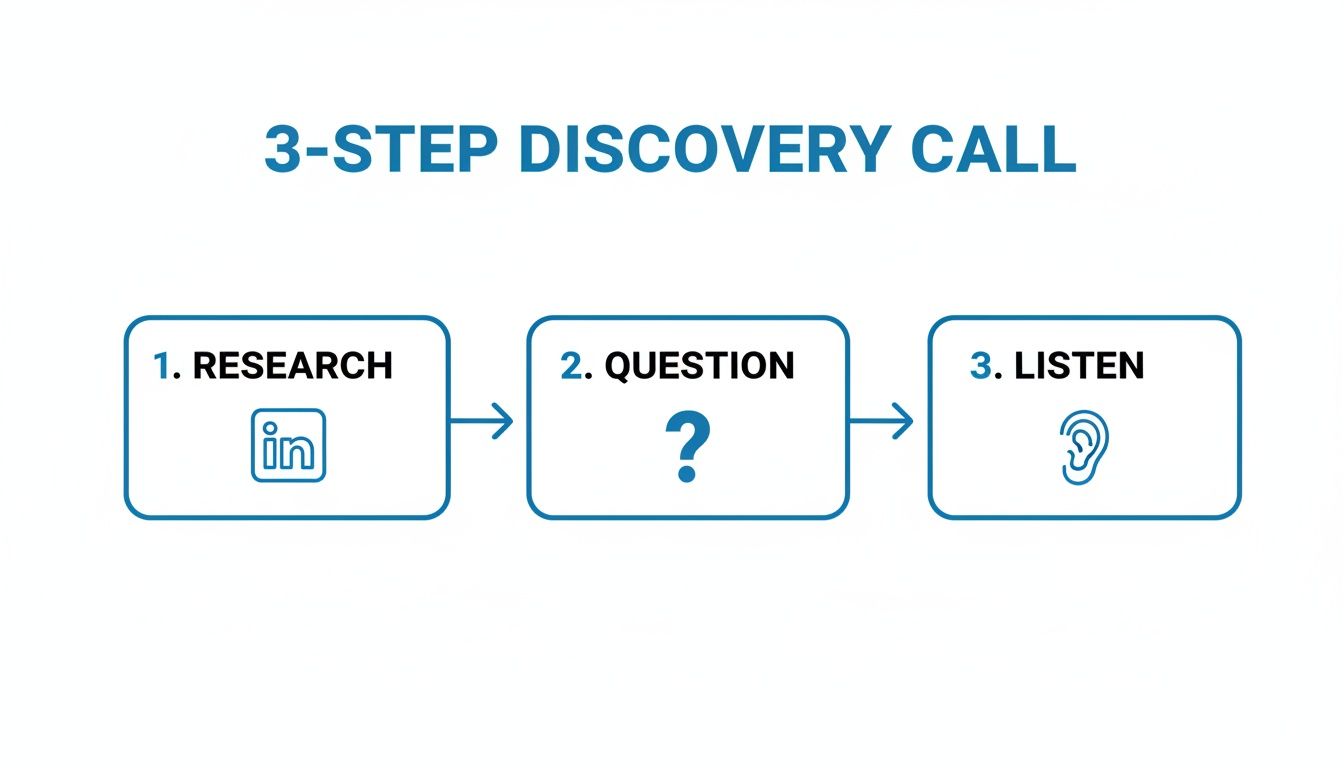
This just hammers home the point that even with slick automation, it's the human touch—the research, the smart questions, the actual listening—that turns a name in a CRM into a genuine opportunity.
Creating an SLA That Sticks
To make any of this work, you need a formal Service Level Agreement (SLA) between marketing and sales. This isn't a suggestion; it's a non-negotiable pact that defines exactly who does what, and when.
This is the key to a truly seamless handoff. Our guide on sales and marketing alignment best practices dives deeper into building this bridge.
Your SLA needs to clearly state two things:
- Marketing's Commitment: Marketing promises to deliver a specific number of MQLs each month that meet the agreed-upon criteria. They also own providing all the necessary context so sales isn't flying blind.
- Sales' Commitment: Sales promises to follow up on every single MQL within a specific timeframe—ideally, under 15 minutes. They also have to update the lead status in the CRM after each attempt.
This agreement stops marketing from just tossing leads over the wall and prevents sales from letting them sit and rot. It creates a closed-loop system where both teams are on the hook for the health of the pipeline. The automation runs the machine, but the SLA makes sure everyone actually does their part.
Common Questions About Qualifying Leads
Even with the slickest frameworks and automation, you're always going to hit a few snags when dialing in your qualification process. It's the small, nagging questions that often make the difference between a system that hums along and one that just creates more work.
Let's clear the air on a few of the most common hurdles I see teams stumble over.
Getting everyone on the same page here is critical. Otherwise, you're just lighting marketing budget on fire.
What’s the Real Difference Between an MQL and an SQL?
This is ground zero for the classic sales vs. marketing war. It’s easily the biggest point of friction.
If you don’t have a crystal-clear, universally agreed-upon definition, marketing will keep celebrating MQL vanity metrics while sales complains about a pipeline full of duds. The line needs to be sharp.
A Marketing Qualified Lead (MQL) has simply shown some interest. They downloaded an ebook or watched a webinar. They fit some basic criteria. Think of it as someone raising their hand in a crowded room. They’re curious, but they are absolutely not ready for a hard sell.
A Sales Qualified Lead (SQL) is an entirely different beast. This is an MQL that an SDR or AE has personally vetted and confirmed is legit. They've moved past idle curiosity into active evaluation. This person didn't just grab a whitepaper; they've requested a demo and confirmed they have a budget and a real timeline.
An MQL says, "I have a problem and I'm learning about it."
An SQL says, "I have a problem, I need to solve it soon, and I'm ready to talk about how."
The handoff happens at that exact moment. Not before.
How Often Should We Recalibrate Our Lead Scoring Model?
Your lead scoring model isn't a crockpot. You can't just set it and forget it. Markets shift, your ideal customer evolves, and your product changes. If your scoring model doesn't keep up, it becomes useless. Fast.
You'll start prioritizing the wrong actions and your sales team will quickly lose faith in the system.
A good rule of thumb? Do a full-blown review every quarter.
Here's what to dig into during that review:
- Conversion Rates: Are your highest-scoring leads actually closing? If you have a pile of 100-point leads going nowhere, you’re overvaluing certain actions. It's that simple.
- Sales Feedback: Get on a call with your reps. Are the leads hot, lukewarm, or ice-cold? They're on the front lines and their gut feelings are worth more than you think.
- New Campaigns & Content: Did you just launch a killer ROI calculator or a major industry report? Those are high-intent actions and need to be scored accordingly.
A quarterly check-in is the sweet spot. It's frequent enough to catch problems before they blow up your pipeline but not so often that it becomes a chore. This keeps your scoring model sharp and predictive.
What Are the Essential Tools for Qualifying Leads Today?
Look, strategy and process are king. But technology is what makes it all work without hiring an army of people. A modern qualification stack really boils down to three core pieces that have to work together.
- A CRM (Customer Relationship Management): This is your command center. Everything lives here. Tools like HubSpot or Salesforce are your single source of truth for all lead data, interactions, and the automation that gets the right lead to the right rep.
- Marketing Automation Platform: Think Marketo or Pardot. This is the engine that tracks a lead’s "digital body language"—every email open, site visit, and content download. It’s what powers the lead scoring we just talked about.
- Third-Party Intent Data: This is the secret weapon. Platforms like Bombora or 6sense show you what topics and keywords target accounts are researching across the entire web. It’s like getting a heads-up that a prospect is in the market before they ever visit your site.
When you combine these, you get the full picture. Your CRM tells you who they are. Marketing automation tells you how they've engaged with you. And intent data tells you what they're obsessed with right now. That’s a powerful combo.