

Ever felt like there's an invisible "it" factor that separates leaders who get noticed from those who get passed over? That's executive presence. It’s not some mystical quality you're born with—it's a skill you can build, and it all comes down to mastering three key areas: how you act (Gravitas), how you speak (Communication), and how you show up (Appearance).
Think of it as a strategic mix of behaviors that tells everyone in the room you’re credible, confident, and in command.
Defining The Three Pillars Of Executive Presence
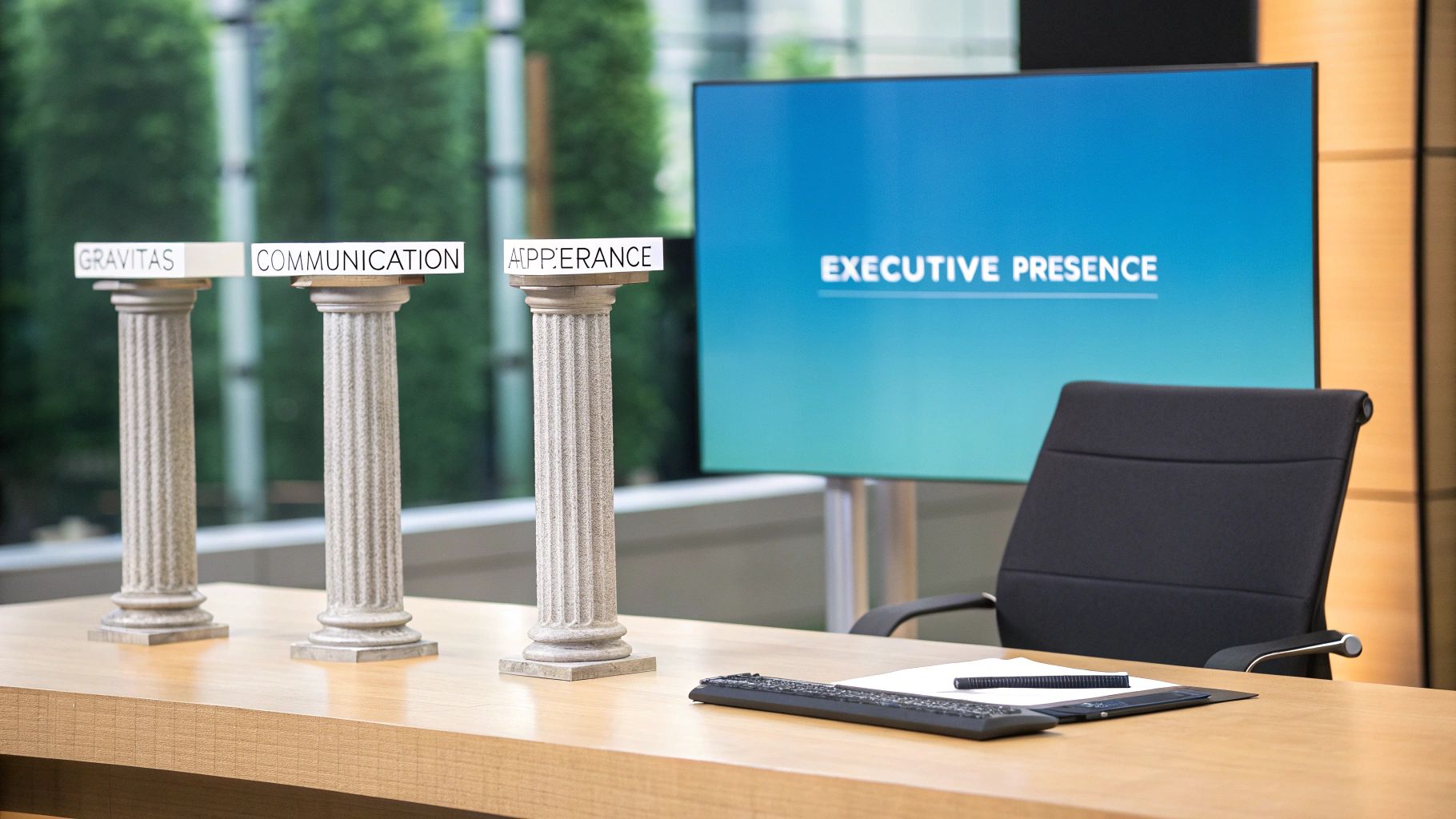
Too many talented professionals get stuck because they see executive presence as this vague, "I'll know it when I see it" concept. That’s a myth that holds people back. In reality, it's a concrete set of skills you can practice and perfect.
And it’s not just a soft skill; it has a hard impact on your career. Research shows that executive presence can account for a massive 26% of the factors that decide whether a leader gets a promotion. That makes it one of the single biggest non-technical reasons people advance. If you're curious, you can dig into the full research on these findings and see just how critical it is.
So, how do we get practical about it? We break it down. The most useful framework, popularized by economist Sylvia Ann Hewlett, organizes it into three distinct pillars.
Gravitas, Communication, and Appearance
-
Gravitas: This is the bedrock. It's the "weight" you have in a room—your confidence, your decisiveness, and your composure. Leaders with gravitas stay cool under fire, make the tough calls without flinching, and project an aura of calm competence that makes others feel secure.
-
Communication: This is all about how you articulate your ideas. Can you be clear, compelling, and concise? It’s not just about what you say, but how you say it through storytelling, active listening, and commanding a room. Strong communication is the engine behind any real thought leadership content marketing.
-
Appearance: Don't mistake this for just being about your clothes. Appearance is how you carry yourself—your posture, grooming, and body language. It’s a non-verbal signal that you respect yourself, the situation, and the people you’re with. It’s about looking the part.
"Executive presence is the ability to connect, influence, and stay composed, no matter the room or the moment."
These pillars don't work in isolation; they reinforce each other. World-class communication skills fall flat without the substance of gravitas. A brilliant idea can be completely ignored if the delivery and appearance don't project confidence.
To help you get a quick read on where you stand, I've put together a simple diagnostic table.
Quick Guide to the Pillars of Executive Presence
This table breaks down the contrast between low and high presence behaviors for each pillar. Use it to quickly spot areas where you’re already strong and where you might need to focus your efforts.
| Pillar | Low Presence Indicator | High Presence Behavior |
|---|---|---|
| Gravitas | Indecisive, easily flustered, avoids tough questions | Confident, calm under pressure, acts with conviction |
| Communication | Rambles, uses filler words, avoids eye contact | Articulate, concise, speaks with clarity and impact |
| Appearance | Slumped posture, unprofessional attire, distracted | Polished, professional, displays confident body language |
By honestly assessing yourself against these behaviors, you can stop guessing and start building a tangible plan for improvement.
Crafting Your Authentic Leadership Narrative
Before you can project executive presence, you need to know what you're projecting.
So many people get this wrong. They think presence is an act, a persona you slip on for big meetings. It's not. Real presence is the outward expression of your internal clarity. It all starts by defining and owning your leadership narrative.
Think of it as the story of your value. It’s the "why" behind your decisions, the philosophy that guides your actions, and the unique angle you bring to the table. Without this core story, any attempt to build presence just feels hollow. Inconsistent.
Uncovering Your Core Leadership Philosophy
Here's the thing: your leadership narrative isn't something you invent out of thin air. It's something you uncover.
It’s already there, woven into your experiences—your biggest wins and, yes, even your toughest failures. The job is to dig it up and put it into words.
Start by asking yourself a few sharp questions. And don't just think about the answers. Grab a pen and actually write them down.
- What are the 2-3 professional moments you are most proud of? Go deeper than the accomplishment itself. Why were you proud? What specific skills or values did you lean on to make it happen?
- Think about a time you faced a massive professional challenge. How did you handle it? What did that pressure teach you about yourself, your team, and your industry?
- What is a common piece of advice people ask you for? This is a huge tell. It often points directly to your perceived strengths and the unique value others already see in you.
This isn't a fluffy, feel-good exercise. The patterns you'll find in your answers point straight to your core values, your unique way of solving problems, and the principles that actually define you as a leader. This is the raw material for your story.
Your leadership narrative is the thread that connects your past actions, current decisions, and future vision. It gives others a clear, compelling reason to trust and follow you.
A technical expert I worked with thought his narrative was just "building great products." After digging in, he realized his real story was about "translating complex technical possibilities into tangible business growth." That one shift completely changes how he's perceived—from a doer to a genuine strategist.
Structuring Your Story for Impact
Once you have the raw material, it’s time to shape it. You need a story that's clear, compelling, and sticks with people. This isn't your life story; it's a strategic summary of your value proposition.
A powerful framework I use with my clients is the Vision-Values-Voice model.
- Vision: Where are you taking people? This is your perspective on where your industry, team, or company is headed. It should be ambitious but rooted in reality.
- Values: What principles guide how you get there? These are your non-negotiables. Are you all about relentless innovation? Unshakeable integrity? Fanatical customer-centricity? Pick two or three that are truly core to who you are.
- Voice: How do you show up? Is your style analytical and data-driven, or are you more empathetic and story-based? Your voice is the personality that makes your narrative yours and not some generic corporate script.
This simple structure becomes the blueprint for every single professional interaction. When you give a presentation, your vision sets the stage. When you make a tough call, your values should be obvious. When you write a LinkedIn post, your voice needs to be unmistakable. It's this consistency that builds a rock-solid executive presence.
Connecting Narrative to Personal Branding
Your leadership narrative is the engine that drives your personal brand.
It’s the difference between a generic resume and a powerful professional identity that attracts opportunities. A well-defined story informs everything—from the words you choose for your LinkedIn summary to how you introduce yourself in a high-stakes meeting.
This is the foundational work for building a true executive identity. By defining your story first, you make sure every piece of content you create and every connection you make reinforces your core message. For a much deeper dive, our guide on personal branding for executives is a full playbook for turning that narrative into a commanding presence in your market.
When you invest the time to get this story right, you're building a strategic asset. You’re no longer just a title on an org chart; you're a leader with a point of view worth listening to.
Building Your Digital Presence on LinkedIn and Beyond
Your leadership narrative can’t just live in boardrooms and team meetings. It needs to be the engine driving your authority online. Let's be honest, your LinkedIn profile is often the first handshake you make, so translating your story into a consistent, powerful digital presence isn't just a nice-to-have anymore. It’s essential.
This is how you move from simply having a profile to building a genuine platform. It's about shaping how people see you long before you ever walk into a room. A strong digital presence doesn't just show off your expertise; it actively builds your influence, pulling in opportunities and cementing you as a go-to voice in your field.
From Static Profile to Dynamic Platform
Most professionals treat their LinkedIn profile like a dusty, digital resume they might glance at once a year. That’s a massive missed opportunity. If you want to build real executive presence, you need to start treating it like your own personal media channel—a place where you regularly share what you think.
The goal is to become a reliable, must-read source of insight for your network. Shifting your mindset from "resume" to "platform" changes the entire game. You stop being a passive networker and become an active thought leader, which is the absolute foundation of a powerful digital footprint.
- Tweak Your Profile: Your headline, summary, and experience sections should scream your leadership narrative. Ditch the generic job titles and write value-driven statements. Instead of "VP of Sales," try something like "Revenue Leader Driving Predictable Pipeline Growth for B2B SaaS." See the difference?
- Create Consistent Content: High-quality, regular content is the lifeblood of your digital presence. It’s how you prove your expertise, reinforce your vision, and actually connect with the people you want to reach.
- Engage Strategically: Presence isn't a monologue. You build it by jumping into relevant conversations, leaving insightful comments that add value, and connecting with other leaders in your space.
The process of turning your internal knowledge into external communication isn't complicated. It really boils down to this:
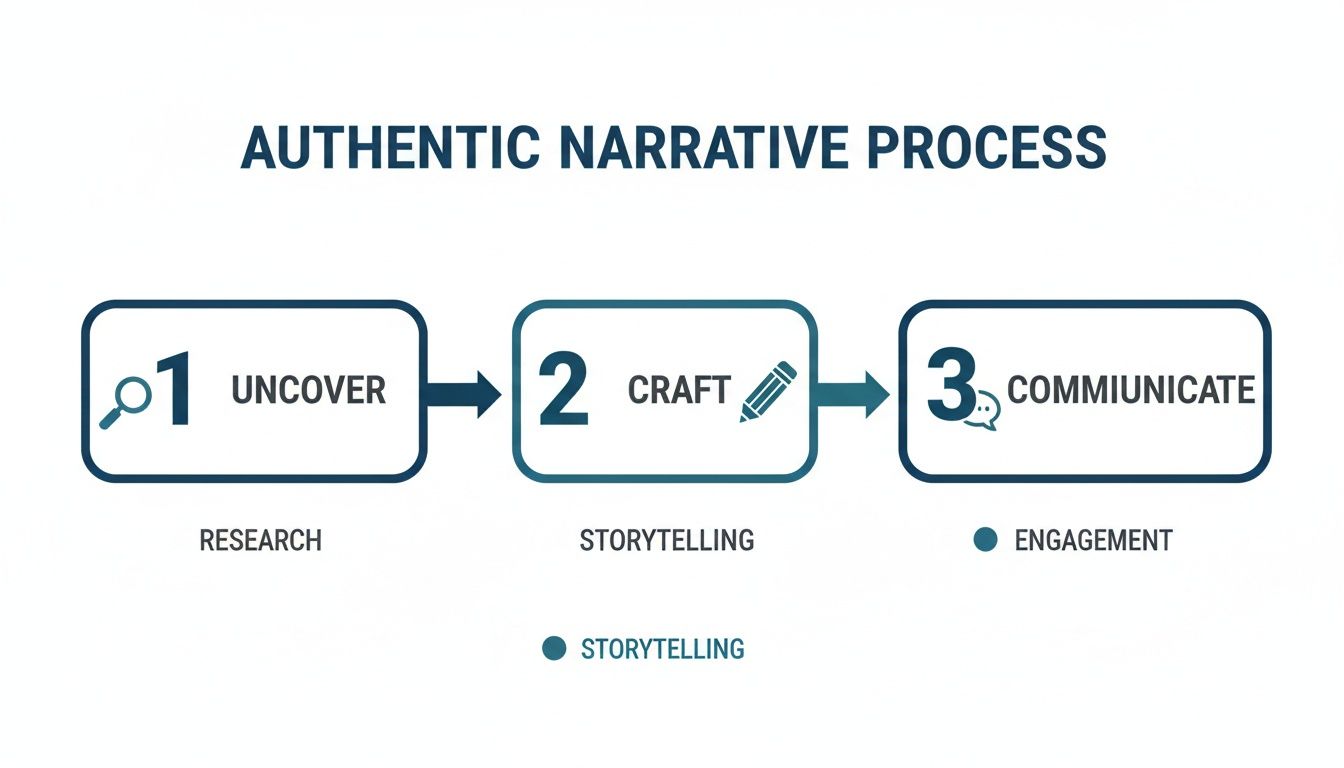
This simple flow—Uncover, Craft, Communicate—is the repeatable system you can use to turn your core ideas into influential content that builds real presence.
Developing Your Thought Leadership Content Strategy
"Post more" is terrible advice because it’s not a strategy. An effective content plan is born from your leadership narrative and is designed to hit specific goals, whether that's attracting top talent, warming up sales leads, or shifting opinions in your industry.
You don't need to invent something new here. The best approach is to rely on proven content formats that let you consistently share your unique point of view. For a full playbook on turning professional networking into tangible results, check out our deep dive on how to use LinkedIn for business.
Here are three battle-tested post formats that immediately signal executive presence:
- The Contrarian Take: Challenge a popular industry belief. This shows you’re a critical thinker and have the confidence to go against the grain. For example, instead of just agreeing that AI will replace all sales jobs, you could argue it will create a new class of "augmented" sales pros, and then explain why.
- The Data-Backed Insight: Find a complex report, a surprising statistic, or some market research and translate it into a simple, actionable takeaway for your audience. This positions you as someone who can cut through the noise and find the signal.
- The Personal Story with a Business Lesson: Share a real-world experience—a project that failed spectacularly, a tough call you had to make, a lesson from a mentor—and tie it to a universal business principle. This builds authenticity and makes your advice feel real and relatable.
Your goal with every single post isn't just to inform, but to spark a conversation. Ask questions. Tag people who should be in the conversation. Make your content an invitation for others to share their own thoughts.
A Practical Routine for Consistent Engagement
Consistency beats intensity every single time. A scattered, "post when I feel like it" approach will never build momentum. The secret is a simple, repeatable weekly routine that turns building your digital presence into a sustainable habit, not a chore.
Here’s a practical weekly action plan you can steal and adapt.
This simple schedule is designed to get you in the habit of creating and engaging without it taking over your entire week.
LinkedIn Weekly Action Plan for Building Presence
| Day | Primary Action | Time Commitment | Goal |
|---|---|---|---|
| Monday | Share a "Contrarian Take" post based on weekend industry reading. | 20 minutes | Set the tone for the week with a strong, insightful point of view. |
| Tuesday | Engage with 5 posts from industry leaders or target accounts. | 15 minutes | Build relationships and increase your visibility within key networks. |
| Wednesday | Post a "Data-Backed Insight" from recent company or industry data. | 20 minutes | Reinforce your credibility and provide tangible value to your audience. |
| Thursday | Share a "Personal Story with a Business Lesson." | 25 minutes | Build authenticity and connect with your audience on a human level. |
| Friday | Engage with comments on your posts and send 3-5 connection requests. | 15 minutes | Nurture your community and strategically expand your network. |
This kind of structured approach ensures you’re not just shouting into the void. You’re actively building a community around your expertise. By dedicating these small, focused blocks of time, you can create a powerful digital presence that amplifies your leadership and extends your influence far beyond your immediate circle.
Commanding Attention in Meetings and Presentations

If your leadership narrative is the engine, meetings and presentations are the proving ground. It's where all the prep work, confidence, and communication skills you’ve honed are put to the test. Let’s be clear: commanding a room isn't about being the loudest person. It’s about being the most impactful.
The modern workplace threw a wrench in the works. Now, your presence has to translate seamlessly from a physical boardroom to a virtual call. It's a huge shift. Recent workforce studies show that while 59% of global employees were back in the office full-time, only 19% actually wanted to be. You can dig into the data in Korn Ferry’s synthesis of workforce data. The bottom line? Your ability to project gravitas has to work just as well through a webcam as it does across a table.
Beyond the Slide Deck Preparation
Real preparation isn't about memorizing your talking points or having the slickest slides. Leaders with true executive presence prepare for the conversation around the presentation, not just the delivery of it.
This means you’re anticipating the dynamics of the room long before you walk in. Who are the key players? What drives them? What are their biggest concerns and potential roadblocks? A truly prepared leader shows up with a mental map of everyone's perspective.
- Pre-Mortem Your Toughest Questions: Before any big meeting, take 15 minutes. Brainstorm the nastiest, most challenging questions you could possibly get. Channel the skeptical CFO or the cautious head of legal.
- Structure for Persuasion, Not Just Information: Don't just dump facts. Build an argument that leads your audience to an inevitable conclusion. Hook them early, back it up with solid evidence, and close with a clear, decisive call to action.
- Know Your "One Thing": If the room forgets everything else, what’s the one single idea you need them to remember? Every story, stat, and slide should hammer that core message home.
Preparation is the ultimate source of confidence. When you’ve done the work to anticipate challenges and refine your message, you radiate a sense of calm control that is the essence of gravitas.
Mastering Verbal and Non-Verbal Cues
How you say something often matters more than what you say. Your verbal and non-verbal cues are the tools that give your words weight. Getting this right is a non-negotiable step in building executive presence.
Think of your voice as an instrument. Playing with your pace, volume, and tone can turn a dry update into a story people lean in to hear. When you get to your most important points, slow down. Speak clearly.
One of the most powerful, and most underused, tools is the strategic pause. A brief moment of silence right before or after a key statement forces everyone to pay attention and actually absorb what you said. It signals confidence and gives your words the space they need to land.
Dominating the Digital and Hybrid Space
Virtual and hybrid meetings are a different beast entirely. You don't have the same physical cues to rely on, which means you have to be much more intentional about how you show up.
On camera, your body language gets amplified. Sit up straight. Lean in slightly to show you're engaged. And here’s the pro-tip: maintain eye contact with the camera lens itself, not just the faces on your screen. That’s how you create a direct connection.
In hybrid meetings, your biggest job is to bridge the gap between the people in the room and the ones dialing in.
- Acknowledge Both Audiences: Call people out by name, whether they’re remote or in person. "Sarah, I see your question in the chat, and John, I see you have your hand up in the room."
- Use Visuals for Everyone: Make sure anything on a physical whiteboard is perfectly visible to remote folks. Better yet, use digital whiteboarding tools so everyone can play on the same field.
- Designate a "Virtual Advocate": Ask someone in the physical room to be the champion for the virtual attendees. Their job is to make sure remote questions get heard and that they don't get talked over.
By consciously managing how you prepare, deliver, and engage across every format, you make sure your message isn't just heard—it gets felt. This is how you stop just presenting information and start truly commanding attention, no matter where you are.
Overcoming Common Barriers to Executive Presence
Let's get one thing straight: building real executive presence isn't an overnight flip of a switch. It’s a process, and like any worthwhile journey, it comes with its fair share of roadblocks.
You’re going to run into things that feel… well, daunting. Some of these hurdles will be external, but many of the toughest ones are internal. We're talking about those moments of crippling self-doubt, the anxiety that bubbles up before a big presentation, or the sting of harsh feedback.
These challenges aren't unique to you; they’re universal. The difference is that leaders with strong presence have figured out how to push through them instead of letting them derail everything. Recognizing these barriers is the first real step to blowing past them.
Addressing Internal Mindset Blocks
So often, the biggest walls we have to climb are the ones we build inside our own heads.
Take imposter syndrome, for example. It’s that nagging voice whispering that you’re a fraud, that your wins are just dumb luck, and that any minute now, you’ll be found out. It’s a direct assault on the very confidence you’re trying to build.
A brutally effective way to shut that voice down? Start keeping a "win file." Seriously. Make a running list of your successes, screenshots of positive feedback, and notes on times you truly made a difference. When that doubt starts creeping in, you’ll have a dossier of hard evidence to prove it wrong.
Then there's the classic fear of public speaking. For many, the thought of fumbling over words or completely blanking in front of a room is paralyzing.
- Change the objective. Stop trying to deliver a perfect, flawless speech. Instead, focus on landing just one powerful, valuable idea with your audience. That’s it.
- Practice for chaos. Don't just run through your script. Get a colleague to grill you with the toughest, most out-of-left-field questions they can think of. This builds your ability to think on your feet and makes the real thing feel like a cakewalk.
These aren't just tricks; they're about reframing the entire experience. You're turning raw, nervous energy into focused, effective communication.
Navigating Systemic and Behavioral Hurdles
It’s not all in your head, though. You also have to contend with how others perceive you, and that’s often filtered through a lens of systemic bias. What one person sees as "confident," another might label "abrasive," depending on their preconceived notions about gender, race, or background.
The data backs this up. Large-scale surveys show that leaders rank specific behaviors as the most damaging to one's presence. Being seen as “indecisive” (about 88%), “timid” (85%), and “lacking confidence” (84%) were rated as the most undermining traits. You can dig into more of these behavioral statistics to see the full picture.
This is where it gets tricky. How do you project confidence without tripping over someone else's bias?
The key is not to contort yourself into some character you think people want to see. It’s about finding a way to demonstrate confidence and decisiveness that feels authentic to you.
For instance, if you’re a naturally collaborative leader, you don’t have to start barking orders to seem decisive.
Instead, you can frame a firm decision like this: "After hearing everyone's perspective, I've made the call to go with Option A. Here's why I believe it's the best path forward for the team."
See what that does? It’s clear, it’s decisive, but it also honors your inclusive style. You’re not faking confidence; you’re just adapting how you express it. Once you understand these barriers—both internal and external—you can start building smart, targeted strategies to work around them.
Of course, as you start putting these ideas into practice, you're going to have questions. Everyone does. This is where the rubber meets the road, so let's tackle some of the most common things people ask when they're serious about building their executive presence.
Can Introverts Develop Strong Executive Presence?
Let's clear this up right now: Absolutely. It's a huge myth that executive presence belongs to the loudest person in the room. It’s not about being a classic extrovert; it’s about projecting confidence, clarity, and credibility.
Frankly, introverts have a few secret weapons here.
- Deep Preparation: They’re often masters of doing the homework. That thorough, quiet preparation is what builds the kind of unshakeable confidence you need before walking into a high-stakes meeting.
- Active Listening: An introvert’s tendency to listen more than they speak is a superpower. It allows them to read the room, pick up on what’s not being said, and respond with insights that actually hit the mark.
- Thoughtful Communication: They tend to choose their words with care. This translates into concise, powerful arguments—both in person and on LinkedIn—that cut through the noise.
Presence is about substance, not volume. A calm, prepared, and clear-thinking introvert will command more respect than an extrovert running on charisma alone.
How Can I Get Honest Feedback on My Presence?
Here’s the thing about feedback: if you ask vague questions, you'll get vague, useless answers. "How's my presence?" is a dead-end. People will just say "it's good!" to be nice.
You need to get specific. And you need to ask people you trust who have actually seen you in action.
Pinpoint a mentor, your manager, or even a sharp peer who was in that meeting or saw your last presentation. Then, instead of a general query, ask about specific behaviors.
Try questions like these:
- "In the client call this morning, what was the impact when I presented the Q3 data? Where did I look most and least confident?"
- "During our team debate yesterday, was my core argument clear? What's one thing I could have done to be more persuasive?"
- "When you read my latest LinkedIn post on industry trends, what was your single biggest takeaway?"
Asking for feedback on a specific moment forces the other person to recall and analyze a real event. That's how you get actionable advice instead of polite fluff.
How Long Does It Take to Build Executive Presence?
It's a marathon, not a sprint, but you can get quick wins almost immediately.
Things like fixing your posture, consciously cutting out filler words ("um," "like," "you know"), or just preparing more strategically for meetings… you can start doing that today. These small tweaks create a noticeable shift in how people perceive you right away.
But developing the real pillars—that deep-seated gravitas and an authentic leadership narrative—is an ongoing game. It takes consistent practice and self-awareness.
Think of it in stages:
- First 30 Days: Go for the low-hanging fruit. Nail your body language, get your meeting prep down to a science, and start a simple, consistent content routine on LinkedIn.
- First 90 Days: You should start feeling a real difference. Colleagues might start coming to you for your opinion more often. Your online posts will be getting more traction.
- 6 Months and Beyond: This is where it all clicks and becomes second nature. Your confidence is no longer forced, your communication is consistently sharp, and your executive presence is just part of who you are.
It’s the consistent effort over a few months that turns these conscious actions into an unconscious, powerful skill.
As you work on this, you'll run into more specific questions tailored to your situation. Here are a few more common ones I hear all the time.
Common Questions About Building Executive Presence
| Question | Answer |
|---|---|
| How do I build presence in virtual meetings? | Double down on the fundamentals. Ensure your lighting and audio are professional. Look directly at the camera to simulate eye contact. And be even more intentional about your contributions—speak clearly and concisely to keep people engaged. |
| What's the biggest mistake people make? | Trying to fake it. People can spot inauthenticity a mile away. Don't try to be someone you're not. Instead, focus on amplifying your own natural strengths—your unique expertise, your communication style, your way of thinking. |
| Can my online presence really affect my real-world presence? | 100%. A strong LinkedIn profile that clearly articulates your value and perspective pre-frames every real-world interaction. People will walk into a meeting with you already seeing you as an authority. |
| I'm not a senior leader. Is it too early to focus on this? | Not at all. Building these skills early is one of the fastest ways to accelerate your career. It signals to leadership that you're ready for more responsibility long before you have the title. |
Hopefully, these answers give you a solid foundation to work from. The key is to just get started.
Ready to stop guessing and start building a predictable pipeline driven by executive authority? Growlancer partners with B2B leadership teams to turn their expertise into a coordinated content and outreach system that delivers qualified meetings and measurable revenue.
Discover how we can build your team's presence and pipeline today.