

Let’s get one thing straight. B2B lead generation on LinkedIn is more than just a buzzword. It's a systematic process for finding, engaging, and turning prospects into real, qualified leads right where they work. This isn't about spamming inboxes; it's about blending a sharp profile, value-driven content, and smart outreach to build a pipeline of high-value decision-makers.
Why LinkedIn Is Ground Zero for B2B Growth
First, stop thinking of LinkedIn as a dusty, digital Rolodex. It's not. It's the de facto town square for B2B commerce. This is where your next enterprise client is scrolling through their feed, looking for solutions and sizing up potential partners. Other social platforms are built for distraction; LinkedIn is built for business. That changes everything.
The sheer density of decision-makers here is insane. We're talking over one billion members, with a huge slice of them being C-suite executives and senior-level folks who actually have purchasing power. You get direct-line access to the people who sign the checks. This is about starting meaningful business conversations where they’re not just expected, but welcomed.
It’s All About the Professional Mindset
People on LinkedIn are in a completely different headspace. They're here to solve problems, learn something new, and grow their careers. This is a huge advantage. When you show up with valuable content and thoughtful outreach, you’re not an interruption—you’re a resource. A well-played strategy shifts your team from just "sellers" into trusted advisors people want to talk to.
This guide is the tactical playbook I wish I had when I started. We're moving past just "having a presence" and into building a predictable revenue engine. The machine has three core parts:
- Building Real Authority: Using targeted content to make your executives the obvious experts in their niche.
- Smart, Scalable Outreach: Crafting personalized messages that actually start conversations instead of just pitching.
- Systematic Lead Capture: Creating a rock-solid process to track and nurture every single interaction, so nothing slips through the cracks.
The mission is to stop the random acts of social selling and start a coordinated, repeatable motion that fills your calendar with qualified meetings.
The data is almost laughably one-sided. Consider this: for every five B2B leads that come from social media, a full four of them are generated on LinkedIn. That's a staggering 80% market share.
And it's not a fluke. LinkedIn consistently outperforms its rivals, converting visitors into leads at a rate nearly three times higher than other major platforms, with a 2.74% visitor-to-lead conversion rate. The numbers don't lie. For any serious B2B team, mastering this platform isn't just a good idea—it's essential for growth. If you want to dive deeper, these LinkedIn B2B marketing stats paint an even clearer picture.
Building Your Foundation for Success on LinkedIn

Before you even think about sending a single connection request, you have to get the groundwork right. So many people skip this part because it isn’t glamorous, but it’s the only way to build a predictable B2B lead generation LinkedIn machine.
Think of it like building a house. A shaky foundation guarantees collapse, no matter how great the rest of the structure looks. It all starts with a brutally honest understanding of who you’re trying to reach. A vague idea of your target audience just won't cut it here.
Defining Your Ideal Customer Profile with Precision
Your Ideal Customer Profile (ICP) is your North Star. Everything you do—your content, your outreach, your entire presence—hinges on it. Without a sharp ICP, you’re just shouting into the void and hoping the right person happens to wander by.
To do this right, you have to get past the surface-level stuff like job titles and company size. You need to dig into the human elements that actually drive business decisions.
What keeps them up at night? What does their boss want from them this quarter? What jargon do they use with their team? Answering these questions turns your targeting from a wide, hopeful net into a surgical strike.
We use a simple matrix to map this out. It forces you to think beyond the obvious and get into your prospect's head.
ICP Definition Matrix
| Attribute | Guiding Questions | Example (Selling to VP of Sales) |
|---|---|---|
| Role & Responsibilities | What does their day actually look like? Who do they manage? Who do they report to? What metrics define their job? | Manages a team of 30 reps. Reports to the CRO. Responsible for hitting a $15M annual revenue target. Spends most of the day in pipeline review meetings. |
| Key Pain Points | What’s the biggest fire they are trying to put out? What blockers are preventing them from hitting their goals? What gets them yelled at? | Forecasting is a nightmare—it's all manual spreadsheet work. Reps aren't hitting quota and ramp time for new hires is over 6 months. |
| Business Objectives | What does a "win" look like for them? What are they trying to achieve in the next 6-12 months? | Needs to increase team quota attainment by 15% this year. Wants to reduce sales cycle length. Needs a predictable way to forecast revenue. |
| Language & Jargon | What specific acronyms, phrases, and slang do they use? How do they talk about their problems? | Talks about "pipeline velocity," "quota attainment," "rep productivity," and "deal slippage." |
Nailing this down is the difference between an outreach message that feels like a genuine solution and one that gets instantly archived. When you know their world inside and out, your offer becomes the exact thing they were already looking for.
Transforming Profiles from Resumes to Resources
Once you know who you're talking to, it's time to fix your team's digital storefront—their LinkedIn profiles. Let’s be honest, most executive profiles read like stale résumés. They’re a laundry list of past jobs and boring duties.
That's a massive missed opportunity.
For B2B lead generation on LinkedIn, every single profile needs to be a lead-generation asset. It should act as a landing page that speaks directly to your ICP's problems and positions your team members as experts who can solve them, not as people looking for their next job.
Profile Optimization Checklist
-
Rewrite Your Headline: Ditch the generic "CEO at Company X." That tells me nothing. Your headline is prime real estate. It needs to scream who you help and the result you deliver. Something like, "Helping SaaS companies cut customer churn by 30% with data-driven retention strategies."
-
Craft a Compelling 'About' Section: Write this in the first person. Start with a hook that grabs your ICP by the collar by mentioning their biggest pain point. Then, explain how you solve it. Use short paragraphs and bullet points to show off real results and build credibility. Our full guide on how to use LinkedIn for business has some great formulas for this.
-
Use the 'Featured' Section Strategically: Think of this as your personal content library. Pin your best stuff here—a killer case study, a webinar replay, a link to a high-value blog post, or a downloadable checklist. This is how you turn passive profile scrollers into engaged leads.
-
Get a Professional Banner Image: A custom banner is a simple way to stand out and reinforce your value proposition. Use it to broadcast your core message or just show off your brand. Anything is better than the default LinkedIn blue-and-gray void.
When you apply these changes across your leadership team, you create a unified, powerful front. Each profile becomes a magnet for inbound interest and a credible launchpad for all your outbound campaigns, making everything else you do on the platform ten times more effective.
How to Create Content That Actually Builds Authority
Let’s be honest, content is the engine that drives this whole LinkedIn lead generation machine. It’s what turns your executive profiles from stale, digital resumes into living, breathing resources that pull your Ideal Customer Profile (ICP) right to your doorstep.
Good content warms up cold prospects before you even reach out. It proves you know what you're talking about and, when done right, generates a steady flow of people asking you for help.
And forget about trying to go viral. That’s a lottery ticket. The real goal here is consistency and relevance. You want to become the go-to expert in your little corner of the world. So when your ICP runs into a problem, your name is the first one that pops into their head. This takes a system, not just random posts whenever inspiration strikes.
The best content strategies I've seen are always built on a few core pillars. Think of them as the guardrails that keep your content focused, on-point, and genuinely valuable.
The Four Pillars of Authority Content
To build a content machine that reliably spits out leads, you really only need to focus on four key areas. Each one plays a specific role in building trust and showing your prospects you can deliver the goods.
- Hit on Critical Pain Points: This is your fastest path to getting an ICP's attention. Create posts that speak directly to their biggest headaches, daily frustrations, and the challenges that keep them up at night. You have to show them you live in their world.
- Share Unique Industry Insights: Stop regurgitating the same old advice everyone else is sharing. Offer a fresh take, challenge a popular belief, or share some proprietary data that people can't get anywhere else. This is what makes you look like a leader, not a follower.
- Tell Compelling Client Stories: Nothing builds trust faster than showing you've already solved this problem for someone else. Showcase how you've helped clients just like your ICP overcome their specific challenges and get real, measurable results. Frame them as mini-case studies, not sales pitches.
- Humanize Your Brand: At the end of the day, people buy from people they know, like, and trust. Share some behind-the-scenes stuff, team wins, personal lessons you've learned, or even a professional struggle. It makes you relatable and builds a real connection.
If you just rotate through these four pillars, you'll have a balanced feed that educates, validates your expertise, and connects with potential customers. For a much deeper dive, we've laid out some actionable frameworks in our guide to building a thought leadership content strategy.
A Simple Framework for High-Impact Posts
Knowing what to post is half the battle. Knowing how to structure it is what actually gets people to stop scrolling and read. Your content needs to be super scannable and easy to digest on a tiny phone screen.
Here’s a simple but stupidly effective structure I use for most text posts.
- The Hook (First 1-2 Lines): This is everything. You have to stop the scroll. Hit them with a bold claim, a relatable problem, or a question they can't ignore.
- The Body (The Meat): This is where you deliver the value you promised in the hook. Use short paragraphs, bullet points, and numbered lists to make it easy to read. No one wants a wall of text.
- The Takeaway (The Punchline): End with a clear summary or one final, memorable insight. What's the one thing you want them to remember from this post?
- The Call to Action (The Next Step): Tell them what to do next. Ask a question to get comments, tell them to follow you for more tips, or point them toward a resource. Don't just leave them hanging.
This structure just plain works because it's designed for how people actually use LinkedIn.
Here's a mind-blowing stat: 89% of B2B marketers are on LinkedIn for lead gen, and a solid 62% say it actually works—that's more than double the next social channel. And for those trying to build a category, get this: 97% of B2B marketers use LinkedIn in their content strategy, with 59% confirming it generates leads. The proof is in the pudding, and you can get more data like this from a great LinkedIn lead generation statistics report.
How to Stay Consistent Without Burning Out
Consistency is the not-so-secret weapon here. Posting once in a blue moon kills your momentum and makes it impossible to build a real audience. You need a sustainable rhythm. I tell my clients to aim for three to five solid posts per executive, per week.
That probably sounds like a ton of work, but it’s totally manageable if you have a system.
Content Cadence Example
| Day | Executive A (CEO) | Executive B (VP of Sales) |
|---|---|---|
| Monday | Insight Post: "The biggest myth about scaling a SaaS startup in 2024 is…" | Pain Point Post: "Your sales team is missing quota for one of these three reasons…" |
| Wednesday | Client Story: "How we helped [Client] cut their sales cycle by 22%." | Humanizing Post: "The toughest lesson I learned managing a remote sales team." |
| Friday | Pain Point Post: "Founders, stop making this hiring mistake." | Insight Post: "Why 'challenger selling' is more important than ever." |
This system lets you consistently publish great content without scrambling for ideas every morning. Just batch-create your posts for the week or even two weeks at a time, focusing on quality, not just quantity.
Remember, a single great post that truly connects with your ICP is worth more than five generic ones that get ignored. A little discipline here turns your team's LinkedIn profiles into a predictable pipeline of inbound leads.
Executing Targeted Outreach That Actually Converts
Okay, your profile is sharp and your content is consistently warming up your audience. Now it's time to switch gears from passively attracting people to proactively building your pipeline.
This is where your B2B lead generation LinkedIn strategy gets surgical. It’s all about finding the exact right people and engaging them with something that feels personal and valuable—something that actually starts a conversation.
Let’s be honest, the old "spray and pray" tactic of blasting generic connection requests and hitting them with an immediate sales pitch? It’s dead. Decision-makers today are drowning in noise. The only way you’re going to cut through is with genuine relevance and a human touch.
Identifying Perfect-Fit Prospects with Precision
Your outreach will only ever be as good as your targeting. Before you even think about sending a message, you need to build a hyper-targeted list of people who are a perfect match for your Ideal Customer Profile (ICP). This is non-negotiable.
For this, LinkedIn Sales Navigator is your best friend. Its advanced filters let you go way beyond just job titles and industries to zero in on prospects based on real-time triggers.
- Job Changes: Pinpoint new executives who are often looking to make a big impact (and buy new solutions) within their first 90 days.
- Company Growth: Filter by headcount growth to find companies that are scaling fast and probably hitting the exact growing pains you can solve.
- Keywords in Profile: Search for specific phrases your prospects use, like "supply chain optimization" or "SaaS revenue," to find ridiculously relevant contacts.
- Posted Content: Find people who just posted about a topic related to your solution. This gives you the perfect, timely "in" to start a chat.
Building these focused lists is the secret to crafting outreach that feels personal, not automated. It's what will get you that positive response.
Crafting Messages That Don't Get Ignored
Once you’ve got your list, the real art begins. That first message sets the entire tone. A generic, self-serving pitch is the fastest way to get ignored or, even worse, blocked.
Remember, the goal isn’t to sell in the first message. It’s simply to start a conversation. To do that, your message has to be about them, not you. Reference something specific—a post they shared, a company announcement, or a mutual connection. Lead with a question or a piece of insight, not a demand for their time.
Here's how to think about aligning your outreach to their journey, from spotting their problems to showing them what success looks like.
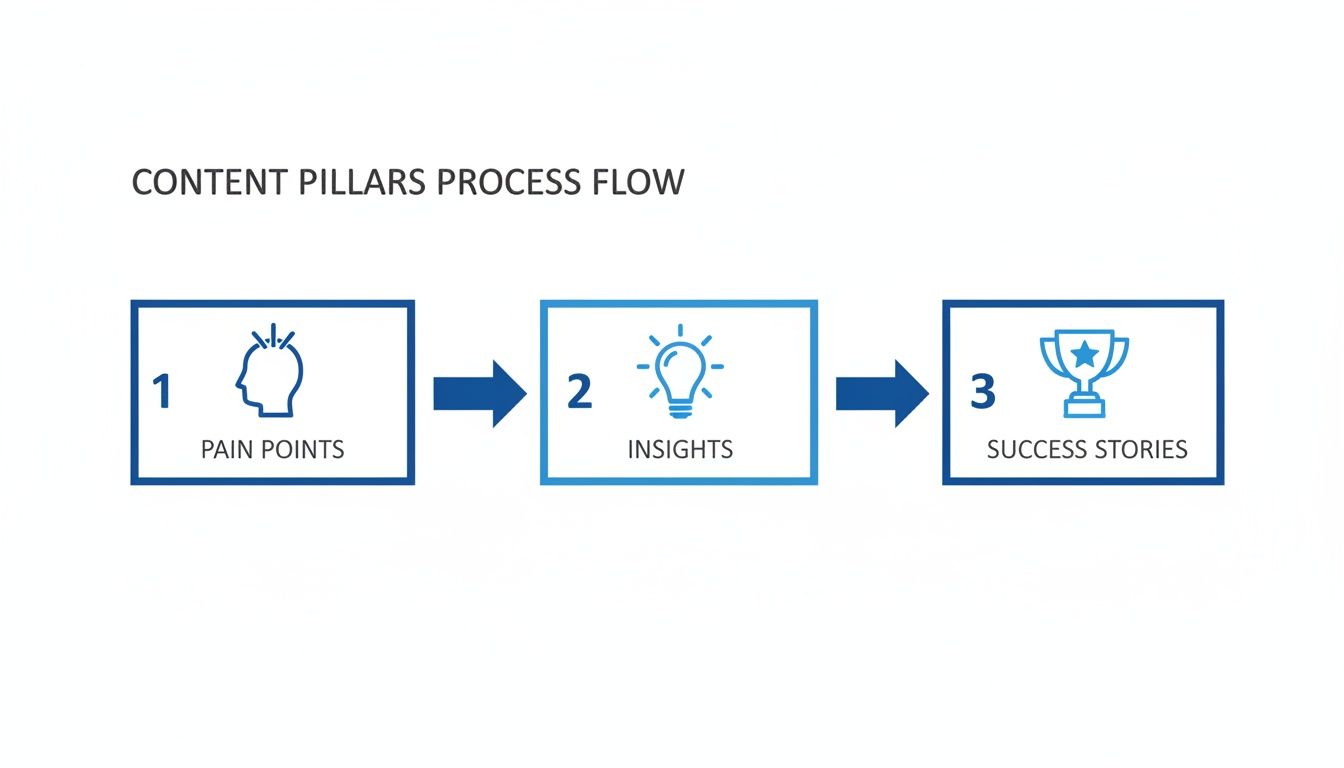
This flow shows how great outreach starts with understanding their pain, offering up valuable insights, and only then validating your solution with proof.
The numbers don't lie. LinkedIn isn't just another social platform; it's a lead-gen powerhouse, proving to be 277% more effective than Facebook and X combined. It's responsible for a whopping 80% of all B2B leads from social media and pulls in 3x more conversions. The results speak for themselves.
Designing a Multi-Touchpoint Outreach Sequence
Look, a single message is almost never enough. You need a persistent, respectful, and value-driven follow-up sequence to turn a cold prospect into a warm conversation. A solid cadence keeps you on their radar without becoming a pest.
And please, don't send those dreaded "just checking in" messages. Every single touchpoint needs to add new value or reframe the conversation from a different angle. We've actually built out an entire playbook on how to send a message on LinkedIn that breaks down proven formulas for this.
4-Step Outreach Sequence Template
Here’s a simple but effective cadence designed to build rapport and book meetings without coming across as aggressive or salesy.
| Step | Action | Sample Script Snippet | Goal |
|---|---|---|---|
| 1. Connect | Send a personalized connection request. | "Hi [Name], saw your post on [Topic] and loved your take. Curious to learn more about your work at [Company]." | Establish a relevant, non-salesy connection. |
| 2. Add Value | Follow up with a helpful resource. | "Thanks for connecting. I thought you might find this article on [Relevant Pain Point] useful. No strings attached." | Build credibility and show you're a resource. |
| 3. Ask an Insightful Question | Engage them with a question related to their role or industry. | "Given your role in [Industry], I'm curious how your team is approaching [Challenge]? We're seeing a big shift." | Spark a conversation and uncover needs. |
| 4. Propose a Meeting | Connect their potential challenges to your solution and ask for a brief chat. | "If you're facing similar challenges, I have a few ideas that helped [Similar Company] achieve [Result]. Worth a quick 15-min chat?" | Convert the conversation into a scheduled meeting. |
This systematic approach respects your prospect’s time and builds real rapport. When you lead with value and show genuine interest in their world, you transform your outreach from a disruptive pitch into a welcome solution.
And that's how you turn your LinkedIn activity into a predictable stream of qualified meetings.
How to Measure and Scale Your LinkedIn Pipeline
Look, a B2B lead generation LinkedIn system that actually works isn't a "set it and forget it" campaign. It's a machine. And like any machine, it needs constant monitoring, fine-tuning, and eventually, scaling.
If you’re not tracking the right data, you’re just guessing. You're flying blind, relying on gut feelings that don't pay the bills. The entire point is to turn your activity into a predictable mathematical equation.
For every 100 connection requests we send, how many meetings do we book? What's the potential revenue from that activity? Answering this is how you turn LinkedIn from a social network into a core part of your go-to-market strategy.
The KPIs That Actually Matter
To get a real pulse on how your system is performing, you need to obsess over a few key metrics. These numbers tell you a story—they pinpoint exactly where your process is humming along and where it's falling apart.
Forget vanity metrics. Here’s what you need on your dashboard:
-
Connection Acceptance Rate: This is your first hurdle. What percentage of your requests get accepted? If this number is low, it’s a red flag. Either your targeting is off (you’re knocking on the wrong doors) or your executive profiles aren't compelling enough to make someone click "Accept."
-
Reply Rate: Okay, they’ve connected. Now what? How many people actually reply to your first message? This metric is a gut check for your opening script. Is it generic and salesy, or does it spark a real conversation?
-
Positive Reply Rate: Not all replies are good replies. This KPI is crucial. It filters out the "no thanks" and "not interested" messages to show you who is genuinely curious or open to a chat. This is the ultimate test of your message's value proposition.
-
Meetings Booked: This is where the rubber meets the road. It's the hard number of qualified sales calls that came directly from all your LinkedIn hustle. Simple as that.
-
Pipeline Generated: This ties everything back to the bottom line. It’s the total dollar value of the sales opportunities created from the meetings you booked. This is the number your CFO actually cares about.
Tracking these numbers is like being a detective. High acceptance rate but a garbage reply rate? Your profile is solid, but your first message is a dud. High reply rate but no meetings? Your follow-up game is weak and isn't pushing the conversation forward.
Setting Benchmarks and Refining Your Approach
Knowing your numbers is half the battle. The other half is knowing what "good" looks like. While performance will always vary a bit by industry, here are some solid benchmarks to shoot for.
| Metric | Weak Performance | Strong Performance | How to Improve |
|---|---|---|---|
| Connection Acceptance Rate | < 20% | > 35% | Get way more specific with your ICP in Sales Navigator. Tweak your profile headline until it screams value. |
| Reply Rate | < 10% | > 20% | Stop sending generic templates. Personalize the first message by mentioning a shared connection or recent company news. |
| Positive Reply Rate | < 5% | > 10% | Lead with value, not a hard pitch. Offer a resource, share a relevant insight, or ask a smart question. |
| Meetings Booked Rate (from positive replies) | < 25% | > 50% | Make it dead simple to book a call. Have a clear, compelling call-to-action and a smooth handoff to your calendar link. |
Your goal isn't just to hit these numbers once. It's about understanding which levers you can pull to consistently improve them. A tiny 2% lift in your positive reply rate might not sound like much, but when you scale it across a team, it can translate to dozens of extra meetings every single quarter.
Scaling the System Across Your Team
Once you've dialed in a proven, data-backed system for one executive, that's when the real fun begins. You can now replicate this success across your entire leadership team.
This is where you document everything—the messaging scripts that work, the content pillars that resonate, and the exact outreach cadences you've perfected. Turn it all into a playbook.
Now, each executive can run the same proven plays, creating a consistent brand voice and a coordinated attack on the market. You cover more ground, engage more prospects, and build a powerful company-wide presence. This is how you transform B2B lead generation on LinkedIn from a solo side project into a full-blown revenue department.
Got Questions? Let's Talk LinkedIn Lead Gen
When you're serious about building a B2B lead generation LinkedIn machine, a few key questions always pop up. Getting these right from the start is the difference between a pipeline full of qualified meetings and a whole lot of wasted effort.
Let's cut through the noise and tackle the ones I hear most often.
What's the Real Cost to Get Started?
This is usually the first question, and it's a good one. You can technically start with a free LinkedIn account, but you'll hit a wall fast.
If you're serious, LinkedIn Sales Navigator isn't a "nice to have," it's non-negotiable. It's the only way to build the hyper-targeted prospect lists you need to make this work. Budget for that, plus a solid CRM to keep track of every conversation. Trying to manage this from a spreadsheet is a recipe for disaster.
Anything else—like content scheduling tools—is extra. The core investment is Sales Navigator and the time it takes to do this right. Think of it as the foundational infrastructure for your sales engine.
Automation: Is It a Cheat Code or a Trap?
Everyone wants to know about automation. Is it the secret sauce or a spam cannon that’ll get your account banned?
Truthfully, it’s a bit of both.
Going full-auto—blasting out hundreds of generic templates—is the fastest way to kill your reputation. Prospects can smell a robot from a mile away, and it's an instant turn-off. Don't do it.
But strategic automation? That's a different story. Using smart tools to handle repetitive tasks like viewing profiles or sending initial connection requests can save you hundreds of hours. It’s about efficiency, not faking a conversation.
The winning formula is a hybrid approach. Let tech do the heavy lifting at the top of the funnel, but the second someone connects, a real human needs to step in with a thoughtful, personalized message. This is how you get scale without sacrificing the authenticity that actually books meetings.
How Long Until I Actually See Results?
The million-dollar question: "How long will this take?"
I'll be straight with you—a predictable pipeline doesn't happen overnight. You're building relationships and authority, and that takes consistency. Anyone promising you a flood of leads in week one is selling you snake oil.
Here's a realistic timeline if you're starting from scratch:
- Months 1-2: The Foundation. This is all about optimizing your profile, building your first prospect lists, and testing your messaging. The goal here isn't volume; it's validation. You should book your first few meetings, proving your targeting and offer are hitting the mark.
- Months 3-4: Gaining Traction. By now, your content should be picking up steam and your outreach process is feeling less clunky. You'll see a steady increase in conversations and meetings as you figure out what really resonates with your audience.
- Months 5+: The Predictable Pipeline. This is where the magic happens. You have a data-backed system. You know your numbers—your reply rates, your meeting book rate—and you can finally start forecasting your pipeline with confidence.
Patience is everything. Trying to rush it is the fastest way to fail. Focus on consistent, value-first activity, and you'll build an unstoppable engine for growth.
Ready to stop guessing and start building a predictable B2B pipeline on LinkedIn? Growlancer provides a done-for-you system that combines expert strategy, authority content, and targeted outreach to deliver qualified meetings for your entire leadership team. See how we can build your revenue engine at https://growlancer.ai.