

Building a buyer persona is pretty straightforward on the surface: you talk to your audience, dig into some data, find the common threads in what they want and what they're struggling with, and then wrap it all up in a neat profile.
But it’s not just about slapping a name on a demographic. It’s about getting inside the head of the human being behind the job title.
Why Generic Personas Are Holding Your Revenue Back
Let's be real for a second—most buyer personas are completely useless.
We've all seen them. Companies go through the motions and produce a glossy document with a stock photo of "Marketing Mary, age 35, who loves yoga and lattes." It feels productive, but it tells you absolutely nothing useful for your go-to-market strategy.
These vague, fluffy personas are more than just a waste of time; they're expensive liabilities. They lead to generic messaging that falls flat, ad budgets burned on the wrong channels, and a sales team walking into calls completely unprepared. When your understanding of the customer is only skin deep, everything you build on top of it—from content to outreach—is destined to crumble.
From Creative Exercise to Strategic Compass
The B2B companies that are actually winning have stopped treating persona development like a creative marketing task. For them, it's a core business function. A deeply researched persona isn't a document; it's a strategic compass that points the entire revenue team in the same direction.
It creates a shared, crystal-clear understanding of who you're selling to, what keeps them up at night, and what makes them finally pull the trigger and buy.
This alignment is everything. When marketing, sales, and product are all singing from the same hymn sheet, the results speak for themselves.
"A great persona is like having a cheat sheet for your customer's brain. It tells you their biggest fears, their career aspirations, and the exact language they use to describe their problems. Stop guessing and start knowing."
The Measurable Impact of Well-Crafted Personas
Making the switch from generic to strategic personas isn't just a "nice-to-have." It delivers cold, hard business results. The top B2B companies know this, which is why 71% of companies that blow past their revenue targets have formally documented personas.
That’s no accident. It’s a direct outcome of being radically customer-centric.
In fact, companies that use properly defined buyer personas see a 72% reduction in lead conversion time. That means prospects fly through the sales pipeline because you're already speaking their language from the very first touchpoint.
This is the kind of insight that underpins all modern growth plays. Your personas are the direct source code for the content and messaging pillars you need for effective B2B demand generation strategies. They give you the "why" behind what your customers do, letting you create outreach and content that feels like a one-on-one conversation, not a megaphone shouting into a void.
Gathering the Raw Intelligence for Your Personas
Powerful personas are built on evidence, not assumptions. This is where the real work begins—trading guesswork for hard data to build a foundation of truth.
Most persona projects fail right here. They're based on vague, internal brainstorming sessions, which leads directly to wasted marketing spend and lost revenue.
Think of yourself as a detective. Your mission is to uncover the patterns, motivations, and frustrations that define your best customers. This means digging into both the quantitative data—the what—and the qualitative insights that tell you why.
The flow below shows exactly what happens when you get this wrong.
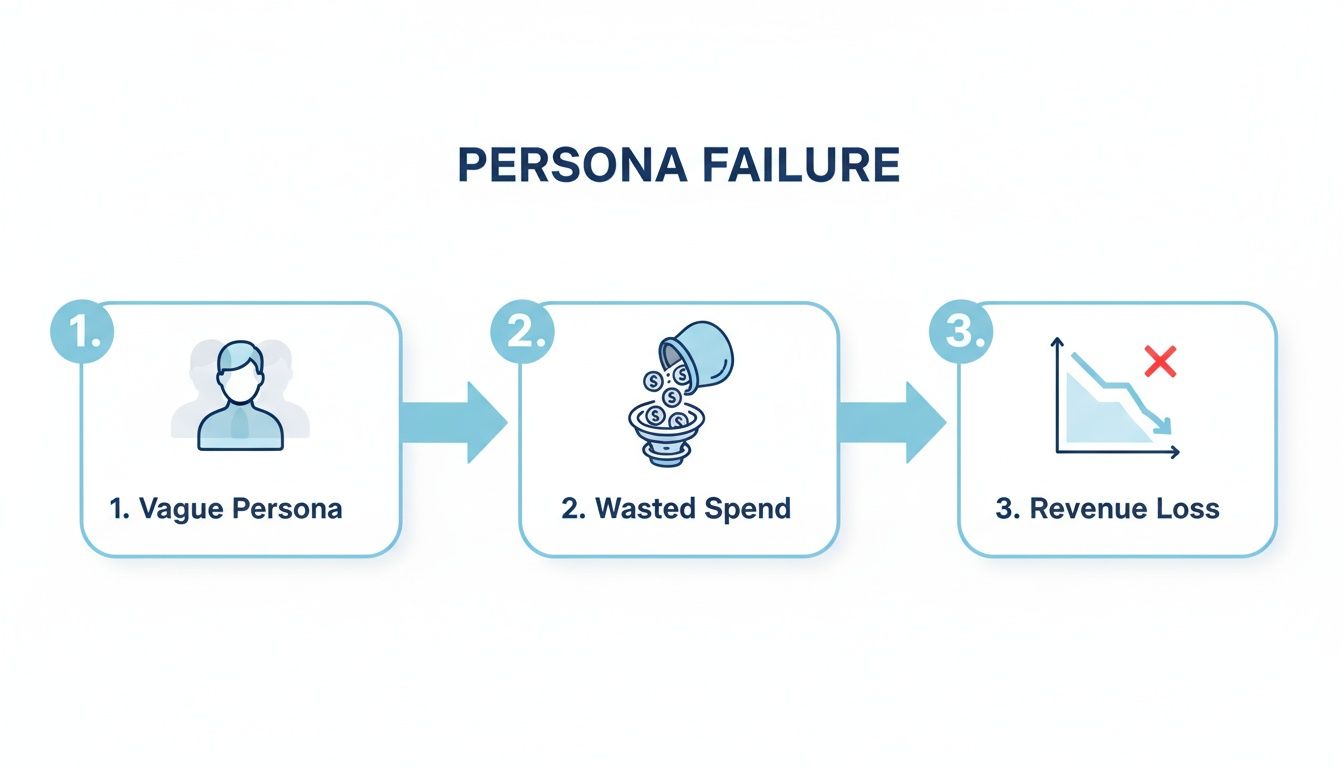
It’s a simple, painful path: a fuzzy persona leads to a budget bonfire. Starting with solid intelligence gathering is your only defense against this all-too-common pitfall.
Start by Mining Your Internal Goldmines
Your company is already sitting on a treasure trove of data. You just need to know where to look and what to ask. Before you ever look outside, you need to look in.
Your Customer Relationship Management (CRM) platform is the obvious first stop. But don't just export a contact list. Filter for your best customers—those with the highest lifetime value, smoothest onboarding, or stickiest retention rates.
Look for the common threads:
- Firmographics: What's the common company size, industry, and location?
- Lead Source: Which channels consistently deliver these ideal clients?
- Sales Cycle Length: Are there patterns in their buying process?
- Product Usage: Which features do they actually use and value most?
This gives you the quantitative skeleton of your Ideal Customer Profile (ICP), the firm-level foundation you'll build your individual personas on.
Now, let's get into the qualitative stuff. Your customer support tickets are a direct line into your users' biggest headaches. What are the recurring questions, feature requests, and complaints? These are unfiltered cries for help, pointing directly to their real-world challenges.
A single recurring complaint in a support ticket can reveal a core pain point that becomes the central theme for an entire persona. These are the problems your marketing should be built to solve.
Sales call recordings are another untapped goldmine. Listen to how your happiest customers talk about their problems in their own words. Pay attention to the specific language they use, the objections they raise, and the goals they're trying to hit. This is raw, unfiltered voice-of-customer data you can lift directly for your persona profiles and, later, your ad copy.
Look at the External Landscape
Once you have a grip on your internal data, it’s time to look outside your own four walls. This gives you the broader market context and validates the patterns you’re starting to see.
LinkedIn Sales Navigator is non-negotiable for B2B persona research. If your CRM data points to VPs of Engineering at Series B SaaS companies, use Sales Nav to map their world. Who do they report to? Who reports to them? Who else is on their team? This helps you understand the entire buying committee and identify other personas you'll need to influence.
Your competitors’ content is another key source of intel. Go through their blogs, case studies, and webinars. What topics are they hammering? Which pain points are they hitting on? This shows you the current industry conversation and helps you spot gaps. If everyone is talking about "reducing costs," but your sales calls tell you customers care more about "implementation risk," you’ve just found your angle.
Finally, go where your audience hangs out. Find the industry-specific forums, Slack communities, or subreddits they use. Just lurk. Observe how they talk to their peers, the jargon they use, and what solutions they recommend to each other. This is where you find the human element that makes a persona feel real.
Data Sources for B2B Persona Research
To pull it all together, here’s a quick-glance table of the data sources we’ve just covered. This should help you organize your intelligence-gathering process and see how each piece of the puzzle fits into the bigger picture.
| Data Source | Type of Insight | Primary Use Case |
|---|---|---|
| CRM Data | Quantitative (Firmographics, LTV) | Building the foundational ICP |
| Sales Call Recordings | Qualitative (VoC, Pain Points) | Capturing exact language and objections |
| Support Tickets | Qualitative (Frustrations, Needs) | Identifying recurring user challenges |
| Customer Surveys | Quantitative & Qualitative | Validating assumptions at scale |
| LinkedIn Sales Navigator | Relational (Org Charts, Titles) | Mapping the buying committee |
| Competitor Content | Qualitative (Topics, Gaps) | Understanding the market conversation |
| Online Communities | Qualitative (Jargon, Behavior) | Observing unfiltered peer-to-peer interactions |
| Industry Reports | Quantitative (Trends, Benchmarks) | Adding broader market context |
Mixing and matching these sources is what separates a truly useful persona from a generic one. You're layering data points to create a multi-dimensional view of your customer, ensuring your marketing doesn't just speak to them, but resonates with them.
Conducting Interviews That Uncover Buying Triggers
Your CRM and analytics can tell you what happened. They can show you the clicks, the form fills, and the deal stages. But they’ll never tell you the full story of why it happened.
That’s where interviews come in. This is your chance to get behind the data and understand the human element—the real-world frustrations, motivations, and "aha!" moments that drive a purchase.
This single step is what separates a generic, useless persona from a true strategic weapon. A good interview doesn't just confirm what you think you know. It reveals the specific "trigger events" that kick off a buying journey.
It’s the difference between saying your customer is a "VP of Sales" and knowing that "VPs of Sales at Series B tech companies are terrified of missing their first board-level forecast." That one emotionally-charged insight is worth a mountain of demographic data.
Who You Absolutely Need to Talk To
To get a complete, 360-degree view, you can’t just talk to your happy customers. That’s an echo chamber. To build personas that are actually robust, you need to talk to three very different groups.
Each one holds a unique and critical piece of the puzzle.
-
Your Best Customers: These are your champions. They just get it. They see the value, use your product to its full potential, and can perfectly articulate the "before and after" story of working with you.
-
Closed-Lost Deals: These people were so close. They took the meetings, saw the demo, but ultimately went with a competitor or decided to stick with the status quo. Their perspective is pure gold for uncovering objections, perceived weaknesses, and the real decision criteria that tipped the scales away from you.
-
Ideal Prospects (Not in Your Funnel): This is your untapped market. They fit your Ideal Customer Profile to a T but haven't engaged with you at all. They offer a completely fresh, unbiased view of the market, their problems, and their priorities—free of any preconceived notions about your brand.
Getting Them on the Phone
Let’s be real: getting 30 minutes from a busy executive isn't easy. But it's far from impossible. The key is making it crystal clear that this is NOT a sales call. You're conducting industry research, and you value their expertise.
For current customers, it's often as simple as asking. Frame it as their chance to help shape the future of a tool they depend on.
For closed-lost opportunities and ideal prospects, you’ll need a little grease for the wheels. A $50-$100 gift card is a tiny price for the kind of intel they can provide. When you reach out, be direct, respect their time, and flatter them a bit by emphasizing you're seeking their expert opinion.
Pro Tip: Always send a calendar invite with a clear, simple agenda. Reiterate that it's a research call, not a sales pitch. This one small step builds a massive amount of trust and drastically cuts down your no-show rate.
The Art of the Interview Question
Think of your script as a compass, not a map. The real magic isn't in the questions you've written down; it's in the follow-ups. Your main goal is to get them telling stories.
People don't reveal their true pain points when answering dry, abstract questions. They reveal them when they're talking about a specific, frustrating situation they had to deal with.
Start broad to get them comfortable.
- "Could you walk me through what a typical week looks like in your role?"
- "What are the big priorities on your plate this quarter?"
- "How do you measure success for your team?"
These questions warm them up. Once they start talking, your job is to listen for threads you can pull on. The most powerful tool in your arsenal is a simple follow-up: "Can you tell me more about that?"
This little phrase encourages them to go deeper and often leads straight to the emotional, specific details you're hunting for. Instead of asking a clinical question like, "What are your pain points?" try asking questions that prompt a story.
Examples of Story-Prompting Questions:
- "Think back to the last time you had a really brutal day at work. What was going on?"
- "Tell me about a project from the last year that you're especially proud of. What made it a home run?"
- "When you first started looking for a way to solve [the problem we solve], what was the specific thing that happened that made you say, 'Okay, we have to fix this now.'?"
That last one is the money question. It’s laser-focused on digging up the exact trigger event. Was it a missed deadline that got them in hot water? A direct order from the CEO? A mind-numbing report they had to build by hand for the tenth time?
That's the moment your persona stops being a document and starts becoming a real person. By the time you're done, you won’t just know who your buyer is; you’ll know their entire story—from the initial spark of frustration to the ultimate goal they're trying to achieve.
Building Your Actionable B2B Persona Profile

You’ve done the hard yards. You’ve dug through the data, survived hours of interviews, and now you’re staring at a mountain of raw notes. This is where most people drop the ball.
The real magic is turning that mess of information into a sharp, usable asset that your entire team can actually get behind. We’re not just filling in a template here; we’re building a story that makes your buyer feel like a real person.
A good persona is a story built on facts. It pushes past the fluffy demographics to paint a vivid picture of someone’s professional life—their daily pressures, what gets them a promotion, and the headaches they can’t shake.
The goal is a document your sales and marketing folks will have pinned to their wall, not one that gets buried in a forgotten Google Drive folder. This becomes your playbook for every message, piece of content, and outreach campaign you run.
Moving Beyond Demographics To Business Realities
Giving your persona a name and a stock photo is fine, but for B2B, the money is in the business details. Forget vague descriptors like "tech-savvy" or "enjoys industry blogs." They're useless.
You need to nail down the specific professional context that drives their every move.
Sift through your interview notes and CRM data to lock down these core elements:
-
Primary Job Responsibilities: What do they actually do all day? List their top 3-5 core duties. A VP of Engineering isn't just "managing tech." They’re "managing sprint velocity," "hiring and retaining top talent," and "overseeing the tech stack budget."
-
Key Success Metrics (KPIs): How does their boss grade their performance? What numbers are on their dashboard? This could be anything from "reducing customer churn by 5%" to "maintaining 99.9% system uptime."
-
Reporting Structure: Who do they answer to? And who answers to them? Knowing the org chart is your secret weapon for navigating the buying committee and sidestepping internal politics.
When you know their KPIs, you know exactly how to position your product as the shortcut to their next win.
Crafting The Persona's Narrative
Okay, you've got the business skeleton. Now it's time to add the flesh and blood that makes the persona click. This is where you bring their story to life with direct quotes and real observations from your research.
Structure your qualitative gold into sections that tell their story.
A Day In Their Life
Write a quick paragraph that walks you through their typical day. What’s the first thing they check when they log on? Which meetings are slowly killing their soul? What’s the one fire they’re always putting out? This gives your team a real sense of empathy for their daily grind.
Primary Pain Points & Frustrations
List their top three professional nightmares, using their own words. Pulling actual quotes from your interviews is an absolute game-changer.
"I spend at least 10 hours a week manually pulling data from three different systems to build a report for my CEO. It’s tedious, and by the time I’m done, the data is already out of date."
See the difference? That quote hits so much harder than a sterile bullet point like "inefficient reporting." It literally gives your team the exact words to use in their emails and ad copy.
Trusted Information Sources
Where do they actually go to get smarter? Be brutally specific. Don't just write "blogs." Name the exact publications, podcasts, influencers, or private Slack communities they hang out in. This is a ready-made roadmap for your content distribution and PR. If you want more ideas on how to use this intel, check out our guide on how to generate B2B leads with sniper-precise content.
When you structure your profile like this, you create a living document that’s both data-backed and deeply human. Your buyer stops being a line on a spreadsheet and becomes a real person. Suddenly, it’s a hell of a lot easier for your team to understand their world and write copy that actually connects.
Turning Persona Insights Into LinkedIn Pipeline

Let's be honest. A perfectly built buyer persona is useless if it just collects dust in a shared drive. It might look good, but it won't generate a single dollar in revenue.
This is where the rubber meets the road. We’re taking those hard-won insights and turning them into a real, tangible pipeline. And our playground for this is the single most powerful B2B platform on the planet: LinkedIn.
Think of your persona document as your new go-to-market playbook. Every single pain point, goal, and KPI you uncovered is now a hook for your content, a reason to connect, and a direct line to a qualified sales meeting. It’s time to stop guessing and start executing with military precision.
Building Hyper-Targeted Prospect Lists
The days of blasting out generic connection requests are over. Your persona gives you the exact filters to build sniper-precise prospect lists using LinkedIn Sales Navigator. We're moving way beyond basic job titles and layering in the rich context you worked so hard to find.
Instead of just searching for "VP of Sales," you can now build a list that’s a mirror image of your ideal customer.
- Geography: Target the exact regions your research pointed to.
- Company Headcount: Filter for that 50-200 employee sweet spot you identified.
- Industry: Focus exclusively on "Computer Software" and "IT Services."
- Keywords: Use terms straight from your persona's profile, like "SaaS," "revenue operations," or "sales enablement."
This isn’t just about finding people with the right title. It's about finding people who operate in the exact environment where your solution makes the biggest splash.
A well-built persona allows you to create a prospect list so targeted that every outreach message feels like it was written for an audience of one. This is the foundation of breaking through the noise.
Translating Pain Points Into Content Pillars
Your persona's biggest headaches are your content goldmine. Forget about brainstorming random blog topics. Now, you can systematically create content that speaks directly to their most pressing professional fears.
This simple shift instantly positions you as a trusted advisor, not just another salesperson.
Let’s grab a single insight from our "VP of Sales" persona: "Fears a messy software implementation will disrupt the team and hurt quota attainment."
Just from that one line, you can map out an entire week of authority-building content on LinkedIn.
- Monday: A text-only post on "3 red flags to spot in a vendor's implementation plan."
- Tuesday: A simple poll: "Biggest fear with new sales tech? A) Low adoption, B) Messy data migration, C) Wasted budget."
- Wednesday: A quick talking-head video on "How to de-risk your next software rollout in 5 simple steps."
- Thursday: A carousel breaking down a successful implementation timeline.
- Friday: A quick story about how a client navigated implementation without missing a beat.
Every piece of content hits their fear head-on, builds your credibility, and acts as a magnet for other VPs of Sales dealing with the exact same anxiety.
Crafting Outreach That Actually Gets Replies
When you genuinely understand your persona, cold outreach suddenly feels a lot warmer. You can ditch the generic templates and lead with empathy, which is the secret to getting replies.
Your persona profile gives you the exact words to use. If you know they are measured on "reducing sales cycle length," you've already got your hook.
The Generic (Before Persona):
"Hi John, I saw you're the VP of Sales at Acme Corp. I'd love to show you how our platform can help your team."
The Persona-Driven (After Persona):
"Hi John, noticed you're leading the sales team at Acme. Many VPs in the SaaS space are focused on shortening their sales cycle without disrupting Q3 momentum. We recently helped [Similar Company] cut their cycle by 18% with a clear implementation plan. Worth a brief chat?"
The second message lands because it speaks their language. It references their industry, hits on a specific goal (shortening the sales cycle), and neutralizes a known fear (disruption). You can only get this personal when you know who you’re talking to. The real strategy for how to connect on LinkedIn is born from this kind of deep understanding.
Below is a simple framework to translate all your hard work into a repeatable LinkedIn strategy.
Persona-Driven LinkedIn Activation Plan
| Persona Insight (Pain/Goal) | LinkedIn Content Pillar | Example Post Angle | Targeted Outreach Script Hook |
|---|---|---|---|
| Pain: "Struggling to get accurate sales forecasting from my team." | Data-Driven Sales Forecasting | "Is your CRM lying to you? 3 signs your sales forecast is pure fiction." | "Noticed you're scaling the sales team at [Company]. Many leaders I speak with are trying to get more reliable forecasts…" |
| Goal: "Needs to reduce new sales rep ramp-up time from 6 months to 3." | Sales Enablement & Onboarding | "I onboarded 5 new reps in Q2. Here's the 30-day plan that got them quoting in a month." | "Saw you're hiring for a few new AE roles. A common challenge is cutting down ramp time…" |
| Pain: "My top reps are wasting time on non-selling admin tasks." | Sales Productivity & Automation | Poll: "What's the biggest time-sink for your sales team? A) CRM updates B) Prospecting C) Internal meetings" | "Most VPs I talk to are looking for ways to give their top reps more selling time. We helped [Client] reclaim 5 hours per rep/week…" |
| Goal: "Wants to break into a new enterprise market segment." | Enterprise Sales Strategy | "Selling to enterprise is a different game. Here's the one mistake most SMB-focused teams make." | "Congrats on the new enterprise-focused roles. Breaking into that segment often means re-tooling your approach to…" |
This table isn't just a plan; it's a system. By operationalizing your persona this way, you create a powerful, coordinated engine where your targeting, content, and outreach all work together, consistently filling your pipeline with your absolute best-fit customers.
The Questions We All Ask About Buyer Personas
Even with the best instructions in hand, a few questions always pop up when my clients start building out their personas. These are the little hurdles that can make or break whether this whole exercise actually moves the needle on your pipeline.
Let’s get them out of the way right now.
So, How Many Personas Do We Actually Need?
It's tempting to want a persona for every single person you might sell to. Don't fall into that trap.
Quality over quantity. Always.
For most B2B companies, the sweet spot is just one to three core personas. These are the people who represent your most profitable, ideal customer segments. Start there.
If you try to build five or more right out of the gate, you’ll end up with generic, watered-down profiles that are too vague to be useful for anything. Focus on the one persona that drives the most revenue or aligns with your biggest strategic goal. Nail that one first. You can always build more later once your team gets the hang of it.
What's the Real Difference Between a Buyer Persona and an ICP?
This one trips up a lot of teams, but the distinction is critical. Think of it like this:
-
Your Ideal Customer Profile (ICP) is about the company. It’s the firmographic data—industry, company size, revenue, location. Your ICP tells you which companies are a perfect fit for your solution.
-
Your Buyer Persona is about the people inside those companies. It’s a deep dive into their job, their headaches, what they’re trying to achieve, and what makes them tick. Your personas tell you how to talk to them.
You need both. An ICP points you to the right accounts, and your personas give you the playbook for engaging the actual humans you need to win over.
An ICP helps you find the right fishing spots. Personas teach you which bait to use for the fish you want to catch. One without the other is just a guessing game.
How Often Should We Update Our Buyer Personas?
Personas are not a "set it and forget it" project. They're living documents.
Markets change. Your customers’ problems evolve. Your personas have to keep up, or they become useless.
As a rule of thumb, plan a formal review and refresh at least once a year. But you should also be ready to revisit them anytime you hit a major business event, like:
- Launching a new product
- Moving into a new market
- Noticing a big change in your sales cycle
- Hearing new objections over and over from the sales team
Keep an open line to your sales and customer success teams. They’re your canaries in the coal mine. They’ll hear the shifts on the ground first, giving you the cue to update your insights and keep your messaging razor-sharp.
Ready to turn those sharp insights into a predictable B2B pipeline? Growlancer builds and executes a complete LinkedIn growth system for your executive team, combining authority content and targeted outreach to deliver qualified meetings. See how we can fill your pipeline at https://growlancer.ai.