

Look, building a sales pipeline isn't just some abstract business school concept. It's a real-world, step-by-step process for finding people who need your help, getting their attention, and guiding them toward a solution. It all starts by figuring out exactly who you're selling to.
Get Your Foundation Right, or Nothing Else Matters

Before you can dream of building a predictable revenue machine, you need a solid blueprint. I see it all the time: sales teams dive headfirst into outreach, armed with a vague "buyer persona" that's so broad it's useless. It describes everyone and no one.
That shotgun approach is a recipe for disaster. It leads to wasted hours, abysmal response rates, and a pipeline clogged with leads who were never a good fit to begin with.
The most successful pipelines I've ever seen are built on a bedrock of strategic clarity. And that begins with an almost painfully specific Ideal Customer Profile (ICP). Your ICP isn't just a fluffy description; it's a filter. It tells you who to chase and, just as crucially, who to walk away from.
Defining Your Ideal Customer Profile
A proper ICP goes way beyond basic demographics. We’re talking firmographics, technographics, and those all-important behavioral triggers. You're trying to pinpoint the exact DNA of the companies that get insane value from your product, stick around the longest, and are the most profitable to serve.
The best way to do this? Go look at your current best customers. The ones you wish you could clone. What do they have in common?
To get started, you need to collect the right intel. This table breaks down what you should be looking for to create an ICP that actually works.
Defining Your Ideal Customer Profile
| ICP Component | What to Look For | Example Data Point |
|---|---|---|
| Industry & Niche | Don't just say "Tech." Get specific. | "B2B FinTech SaaS" |
| Company Size | Employee count AND annual revenue. | "50-250 employees, $10M-$50M ARR" |
| Geography | Where are your happiest customers located? | "North America, primarily US East Coast" |
| Technology Stack | What tools do they already use? | "Uses HubSpot, Salesforce, and Slack" |
| Pain Points | What specific problems do you solve for them? | "Struggling with lead attribution and sales forecasting" |
| Behavioral Triggers | What event signals they might need you now? | "Just hired a new VP of Sales" |
This kind of detail is what separates the pros from the amateurs.
A well-defined ICP is the most critical asset for your sales strategy. It ensures that every action—from content creation to outreach—is aimed at prospects who are a perfect fit, making your entire sales process more efficient and effective.
Getting this foundation right is a non-negotiable first step. It’s what fuels smarter B2B demand generation strategies, because you’re attracting the right people from the very beginning.
Map the Market and Hunt for Triggers
Once you have your ICP dialed in, it's time to map out your Total Addressable Market (TAM). This means finding every single company that fits your new, specific criteria. Tools like LinkedIn Sales Navigator or ZoomInfo are your best friends here.
But a list of names is just a list. The real magic happens when you understand their "why now." What's happening in their business that would make them actively look for a solution like yours? These are buying signals, and they’re pure gold.
You should be constantly on the lookout for common triggers like:
- New Exec Hires: A new VP of Sales or CMO is almost always brought in to shake things up. They have a mandate for change and, usually, a budget to make it happen.
- Fresh Funding: A big Series A or B funding announcement screams growth, expansion, and a fresh pile of cash for new tools.
- Competitor Missteps: Is one of their main competitors getting slammed with negative reviews? That's your cue to slide in with a better alternative.
- Hiring Sprees: If a company is suddenly hiring 10 new SDRs, you can bet they'll need tools to make that team effective.
Nailing this foundation transforms your sales pipeline from a messy, random collection of leads into a curated list of high-potential opportunities. This focus stops your team from chasing dead ends and empowers them to have real, meaningful conversations with people who actually need what you’re selling.
Establishing Authority on LinkedIn
Once you've nailed down exactly who you're after, the next move is to make them come to you.
Think about it. Buyers today are absolutely drowning in generic sales pitches. They're not looking for another vendor to add to their spreadsheet; they're searching for a trusted advisor who actually gets their problems. This is where you and your team need to become thought leaders on LinkedIn. It’s a total game-changer.
Your ideal customers are already on LinkedIn, scrolling through their feeds, looking for answers. Your job is to be the one giving them those answers—publicly. You build trust and credibility long before you ever think about sending a connection request.
This isn't about blasting company news or product updates. It’s about consistently dropping value and sharing insights that solve the real-world headaches of your ICP.
When you do this right, something powerful happens. Prospects start recognizing your name. They see you as an expert. So when your outreach message finally does land in their inbox, it doesn’t feel cold. It feels like a natural next step in a conversation you already started.
The Shift from Selling to Educating
The secret to building real authority is surprisingly simple: give away your knowledge.
Stop saving your best insights for the sales demo. Share them freely, for everyone to see. When you consistently publish content that genuinely helps your audience, you're not just marketing—you're educating your entire target market at scale.
This completely flips the old sales dynamic on its head.
Instead of chasing down prospects, you start attracting them. They come to you already knowing who you are, what you're about, and pre-sold on your expertise because they've been learning from your content for weeks.
"The fastest way to fill your pipeline today is to stop selling and start teaching. Become the go-to resource in your space, and high-value prospects will literally seek you out. Cold outreach suddenly becomes a warm conversation."
Of course, this doesn't just happen by accident. You need a system. The top-performing teams don't just post whenever they feel inspired. They build a content engine that runs like clockwork, pumping a steady stream of value into the market. A solid first step is getting the fundamentals right, which is why I always recommend my clients master B2B LinkedIn marketing from day one.
A Practical Framework for Authority Content
Building a predictable pipeline demands a repeatable content plan.
Forget about going viral—that’s a lottery ticket. Your goal is to consistently create content that speaks directly to the pain points you uncovered during your ICP research.
Here’s a dead-simple framework that works every time.
- Pinpoint the Pain: First, list out the top 5-7 problems your ideal customer is dealing with right now (the ones your product or service solves). These are now your content pillars.
- Turn Problems into Posts: For each pain point, brainstorm a few different angles. You could tell a story about a past failure, share a tactical tip, point out a common mistake, or even offer a controversial opinion.
- Set a Simple Cadence: Consistency beats intensity. Just aim to post 3-5 times per week. That’s enough to stay top-of-mind without burning yourself out.
Let’s say one of your ICP’s biggest headaches is inaccurate sales forecasting. Here’s what a week of content could look like:
- Monday: A text-only post telling a story about a time a bad forecast blew up in your face and the lesson you learned.
- Wednesday: A quick post with 3 bullet points on the most common forecasting mistakes you see sales leaders make.
- Friday: A post that challenges the old-school thinking around pipeline coverage ratios and offers a fresh way to look at it.
This kind of system takes the guesswork out of content. It stops being a creative chore and becomes a strategic part of your sales process.
When you show up consistently with real value, you build a reputation that walks into the room before you do. Every connection request, every message, every call becomes that much easier. Your prospects won't just know your name; they'll know you're the real deal.
Designing Outreach That Gets a Response
You've done the hard work of building a credible voice on LinkedIn. Now what? It's time to turn that authority into actual conversations.
This is where strategic outreach kicks in. Forget the old "spray and pray" method of sending generic emails and hoping for the best. A predictable sales pipeline relies on a smart, multi-channel system that builds genuine interest over time.
Think of great outreach as a system, not a single event. It’s a carefully orchestrated sequence of automated emails, personal LinkedIn messages, and maybe even a well-timed phone call. The goal isn't to blast your message to the masses; it's to deliver a relevant note that feels like a natural next step after all the value you've been sharing publicly.
Crafting Messages That Don't Get Deleted
So, what separates an outreach message that gets a reply from one that gets instantly deleted?
It's all about personalization rooted in relevance. Let's be honest, your prospect couldn't care less about your product's features. They care about their problems.
Your message has to prove you've done your homework. Reference something specific—a recent company announcement, a LinkedIn post they shared, a new exec hire, or a big funding round. This one small act instantly shows your message isn't some robotic blast sent to thousands.
For example, a generic message is just noise:
"Hi [Name], I saw you’re the VP of Sales at [Company]. We help companies like yours improve sales efficiency. Can we chat?"
Yawn. Now, look at how a personalized message starts a real conversation:
"Hi [Name], I saw your recent post on LinkedIn about the challenges of scaling your SDR team. Your point about forecasting accuracy really resonated. At companies growing as fast as yours, that often becomes a major bottleneck. Have you considered…?"
See the difference? The second one isn't a sales pitch; it's a conversation starter. It adds value right away and connects your solution to a problem they're already thinking about. If you want to go deeper on this, our guide on modern outbound lead generation breaks down exactly how to build these compelling narratives.
Building a Multi-Channel Cadence
Relying on a single channel is a rookie move. People are busy. Their inboxes are a war zone, and their LinkedIn DMs are crammed with spam. A multi-channel cadence is your secret weapon for cutting through all that noise.
This whole process—from sharing content to joining discussions—is what builds the authority that makes your outreach land.
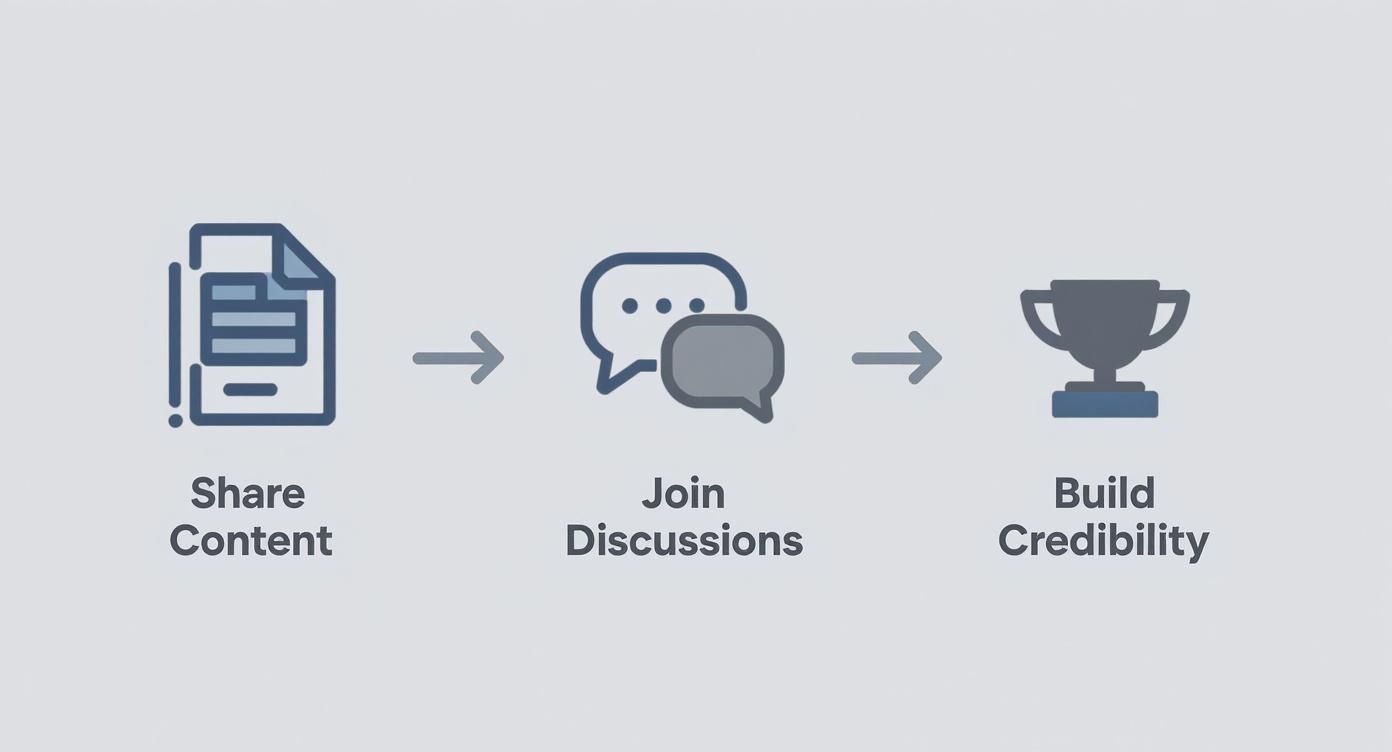
Each touchpoint feels warmer because you're already a familiar, trusted name.
Here’s what a simple 10-day cadence using LinkedIn and email could look like:
- Day 1: LinkedIn connection request (with a personalized note mentioning a shared interest or their recent post).
- Day 2: Email 1 (short, personal, and hits on the "why you, why now" trigger).
- Day 4: LinkedIn message (a quick follow-up, maybe share a relevant article or insight).
- Day 7: Email 2 (come from a different angle—a mini case study or a tactical tip works great here).
- Day 10: Email 3 (the "break-up" email, where you politely close the loop but leave the door open for later).
The Logic of Timing and Follow-Up
The cadence above isn't random. The spacing gives your prospect room to breathe and actually consider your message without feeling hounded.
And let's get one thing straight: following up is not optional. It takes, on average, more than eight touches to even get a response, yet a staggering 44% of salespeople give up after just one try.
A disciplined follow-up process is what separates the top performers from everyone else. The trick is to add new value with every single touchpoint. Don't just send emails saying, "Just bubbling this to the top." Instead, share a new piece of content, reference another company event, or offer a different perspective on their problem.
This persistence really pays off. Companies with accurate, well-structured sales pipelines are 10% more likely to grow their revenue year over year. And the revenue growth difference between companies with a formal sales process versus those without is nearly 30%. It’s a game-changer.
This systematic approach takes the guesswork out of outreach. You stop relying on hope and start building a proactive, predictable system that consistently books meetings with your dream customers.
Let's Talk About Your CRM: The Brains of the Operation
This is where all your hard work pays off. You've mapped your market, nailed your ICP, and crafted outreach that actually gets replies. Now, all that action flows into your CRM—your Salesforce, HubSpot, or whatever tool you use.
Think of it as the command center for your entire sales pipeline. But here’s the rub: if you don’t manage it with ruthless discipline, it becomes a black hole where good leads go to die.
A messy CRM full of stale opportunities and junk data is more than just an eyesore. It makes forecasting a complete guessing game and actively torpedoes your momentum. If you want a predictable pipeline, you have to treat your CRM like a living system, not a data graveyard.
Getting Your CRM Stages Right
First things first: your CRM pipeline stages need to mirror how your buyers actually buy. They should mark real progress, not just be busy-work checkboxes for your reps. Forget vague stages like "Contacted" or "Following Up"—they're totally useless.
You need to define crystal-clear, action-based stages. And each stage must have a non-negotiable exit criterion. A deal can't move forward until a specific, meaningful event has happened.
Here's what that looks like in practice:
- Qualification: The prospect has verbally confirmed they meet your core ICP criteria and have a ballpark budget. Exit Criterion: Confirmed ICP match.
- Discovery Call Completed: A formal call happened. You didn't just chat; you uncovered specific pains and documented them in the CRM. Exit Criterion: Pains documented in CRM notes.
- Demo Scheduled: They've committed to a specific day and time on the calendar to see your product. Exit Criterion: Calendar invite sent and accepted.
This isn't about micromanaging. It's about instilling good habits and ensuring every deal in your pipeline is real. This is how you transform a hopeful wish list into a forecasting tool you can actually bank on.
A disciplined CRM reflects a disciplined sales process. When the data is clean and the stages are clear, your team knows the very next step for every single opportunity. No guesswork, just pure efficiency.
What About the "Not Right Now" Leads?
One of the biggest leaks in any sales pipeline is how we handle interested prospects who aren't ready to pull the trigger today. Too often, a "not now" is treated like a "never." These leads are solid gold, but they get dumped into the CRM and forgotten.
This is where a simple nurture sequence becomes your secret weapon.
Instead of letting those warm leads go cold, use your CRM's automation to stay in touch without annoying them. The goal isn't to blast them with sales pitches. It's to stay top-of-mind by being genuinely helpful.
A simple, low-effort nurture sequence might look something like this:
- Day 3 (Post-Call): Send an email with a link to a case study that speaks directly to the problem they mentioned.
- Day 14: Invite them to a relevant webinar you're hosting or share a third-party industry report they'd find interesting.
- Day 30: A quick, personal check-in from the rep. "Hey, just wanted to see if anything's changed on your end. No pressure."
This simple act of staying relevant ensures that when the timing is finally right, you're the first person they call. You stop wasting the effort you spent generating that lead in the first place.
And this stuff is only getting more powerful. With 95% of businesses planning to adopt AI in sales and marketing by 2025, automation is becoming table stakes. In fact, teams using AI are 7 times more likely to hit their revenue goals. It’s a massive shift, and you can find more details on this trend and other AI insights to see where things are headed.
By combining a clean CRM with smart, automated nurturing, you build a system that doesn't just manage today's deals—it actively cultivates tomorrow's. That's the difference between a good pipeline and a great one.
Using Data to Optimize Pipeline Performance
Building a sales pipeline is one thing. Turning it into a predictable revenue engine is something else entirely. The secret? It's all in the numbers—how you measure, analyze, and optimize performance every single step of the way.
A healthy pipeline isn't just a static list of deals. Think of it as a living, breathing system that needs constant attention.
Too many sales leaders get completely sidetracked by vanity metrics. They’re looking at the total number of leads or calls made, and while those numbers feel productive, they don't tell you the whole story. To really get a grip on what’s working and what’s broken, you have to obsess over the KPIs that show the true health and momentum of your sales engine.
This is what separates the frustrating guesswork from predictable science. When you nail this, you can forecast with real confidence, put your resources where they’ll have the most impact, and scale your sales operation without all the chaos.
Moving Beyond Vanity Metrics
First thing's first: you have to shift your focus to the metrics that actually matter. These are the numbers that track the flow, speed, and efficiency of deals as they move from one stage to the next. They give you a brutally honest look at your pipeline's health.
Instead of just staring at the total pipeline value, you need to dissect the journey. Let’s be real, a $1 million pipeline where deals go to die is worthless compared to a $500,000 pipeline where opportunities are constantly progressing and closing.
Here are the essential KPIs you should have on lock:
- Stage-by-Stage Conversion Rates: What percentage of deals actually move from one stage to the next (e.g., from Discovery to Demo)? A low conversion rate at any specific stage is a massive red flag screaming "bottleneck!"
- Average Sales Cycle Length: On average, how long does it take for a deal to go from that first touchpoint to a signed contract? If your sales cycle is getting longer, it could mean friction in your process or a major shift in the market.
- Pipeline Velocity: This is the big one. It calculates how quickly deals are moving through your pipeline and turning into cash. It’s a formula combining the number of opps, average deal size, and win rate, all divided by the sales cycle length. Higher velocity means more revenue, faster.
Your CRM data is an absolute goldmine, but only if you know where to dig. When you track conversion rates, sales cycle length, and pipeline velocity, you stop reacting to problems and start proactively managing your pipeline for peak performance.
Building a Simple Sales Dashboard
You don't need a crazy-expensive, complex BI tool to get started. A simple, well-organized dashboard right inside your CRM can give you an at-a-glance view of your pipeline's health. This is what empowers you to make faster, smarter decisions.
The key is to keep it visual and laser-focused on the core KPIs we just talked about. The goal is to spot trends and identify problem areas immediately, without having to pour over dense reports.
A killer sales dashboard should clearly show you:
- Pipeline by Stage: A simple bar or funnel chart showing the number of deals and their total value in each stage. This gives you a quick snapshot of your pipeline's overall shape.
- Conversion Rate Funnel: This is a visual representation of the drop-off between stages. If 90% of deals cruise from Qualification to Discovery, but only 30% make it from Demo to Negotiation, you've just found your biggest bottleneck.
- Sales Cycle by Rep: A basic table or chart comparing the average sales cycle for each person on your team. This is great for spotting who needs a bit of coaching or who has a killer technique worth sharing with everyone else.
This kind of visibility changes the game. Research shows that companies that get serious about optimizing their pipeline management grow 28% faster than those that don't. A clear dashboard is your first and most powerful tool for getting there.
Pinpointing and Fixing Bottlenecks
Once your dashboard is up and running, the real work begins. You're now a pipeline detective, using data to diagnose and solve problems. A bottleneck is any stage where your deals consistently stall or fall off a cliff. Without data, finding them is all gut feelings. With data, it's a straightforward, objective exercise.
Let's walk through a real-world scenario. Your dashboard shows a massive drop-off right after the "Demo" stage. Deals look great, the demo seems to go well, but then… crickets.
This single data point forces you to ask some tough questions:
- Are we demoing to the right people? Maybe the technical demo is slick, but we aren't getting the economic buyer who actually holds the purse strings on the call.
- Is our demo failing to connect value? Perhaps we're just rambling on about features instead of clearly tying everything back to the business outcome and ROI for that specific prospect.
- What's our post-demo process? Is there a concrete, agreed-upon next step locked in at the end of the call, or are we just sending a weak "Thanks for your time, let me know if you have questions" email?
By identifying the exact point of failure, you can take surgical action. You might roll out a new rule that an economic buyer must be on every demo. Or maybe you'll revamp your demo deck to lead with a powerful ROI case study.
Then, you go back to your dashboard and watch the numbers. Did the changes work? This continuous loop—measure, diagnose, optimize, repeat—is the hallmark of every high-performing sales organization.
Answering Your Biggest Sales Pipeline Questions
Even with the best playbook, you're going to have questions when you're in the thick of it. That's just part of the game.
Getting the right answers to these common roadblocks can be the difference between a pipeline that’s just… there… and one that actually prints money.
So, let's get straight to it. Here are the most common questions I hear from sales leaders, answered.
How Many Stages Does My Pipeline Really Need?
There's no magic number here, but I've found the sweet spot for most B2B teams is somewhere between 5 and 7 stages.
The golden rule? Each stage has to mean something. It needs to mark a real, tangible step forward in your buyer's journey—not just a box your rep ticked off a list.
A solid, battle-tested structure usually looks something like this:
- Prospecting: Digging for gold and figuring out who's a potential fit.
- Qualification: The gut check. Do they actually meet our ICP criteria?
- Discovery Call: The first real chat where you uncover their actual problems.
- Demo or Proposal: Showcasing your solution, tailored to their pain.
- Negotiation: The back-and-forth on terms, price, and the dotted line.
- Closed-Won/Lost: The final handshake or the lesson learned.
The goal is to keep things simple enough for your team to use without a headache, but detailed enough to give you a true picture of your sales motion. Every stage needs a clear "exit criteria" — a deal can only move forward when a specific, buyer-centric milestone is hit.
What’s a Good Pipeline Coverage Ratio?
The classic rule of thumb everyone throws around is 3x your quota. If you've got a $100,000 quarterly target, you need $300,000 in active, qualified deals in your pipe. Simple.
But let's be real—it's not a one-size-fits-all metric.
If you have a long, winding sales cycle or your conversion rates have been historically shaky, you might need to aim for a 4x or even 5x ratio to sleep at night.
The only way to know for sure is to look at your own numbers. Dive into your historical data. What are your real win rates? How long does it actually take to close a deal? That's how you'll find the ratio that gives you genuine predictability.
My Sales Pipeline Is Stalled. How Do I Fix It?
A pipeline that’s not moving is just a symptom. The real disease is hiding in your CRM data.
First thing you do: run a report. Where are deals going to die? Is everyone getting ghosted after the demo? Are they getting stuck in legal during negotiation? Your CRM will tell you exactly where the bottleneck is.
Once you’ve found the spot, you can figure out the why.
- Bad Qualification: Are you just letting anyone in? A clogged pipeline is often full of leads that never should have been there in the first place.
- Weak Value Prop: Are your reps failing to connect the dots between your solution and cold, hard ROI for the customer?
- No Urgency: Is there a real, compelling reason for them to buy now? If not, you’re just a "nice-to-have."
Time for a ruthless pipeline review. Your mission is simple: either kill the dead deals that are just making your forecast look good or define one concrete next step to get promising-but-stalled deals moving again.
A great way to prevent this from happening again is to build a "deal hygiene" rule into your CRM. Something simple, like automatically flagging any deal that’s been sitting untouched for 30 days. This forces action and keeps your pipeline filled with deals that are actually alive.
At Growlancer, we don’t just talk about building pipelines; we build them for you. Our done-for-you system combines executive positioning, authority content, and targeted outreach to deliver a predictable stream of qualified meetings for your leadership team. Learn how we can build your B2B sales pipeline.