

A B2B marketing sales funnel isn't some rigid slide you shove prospects down. Think of it more as a strategic roadmap—a guided path that maps out the entire journey a company takes, from the first time they hear your name to the day they become a long-term, loyal partner.
Its job is to attract, educate, and ultimately convert your ideal clients by aligning your marketing and sales teams, ensuring they're always delivering the right message at exactly the right time.
Decoding the B2B Buyer Journey
Let's be honest, the B2B world is complicated. In a simple retail sale, the path is short: someone sees a product, likes it, and buys it. Easy. But in B2B, you're dealing with a whole different beast. Decisions often involve multiple stakeholders, months of research, and a significant financial commitment.
Think of your funnel as a sophisticated GPS for navigating this complex relationship. A well-built funnel acknowledges this complexity and breaks the journey down into manageable stages. It gives you a clear roadmap to understand your prospect's mindset at every single step, transforming your outreach from a scattergun blast into a precise, targeted conversation.
Why Every B2B Company Needs a Funnel
Without a defined funnel, your growth efforts feel chaotic and disconnected. Leads get lost in the shuffle, messaging completely misses the mark, and potential deals just fall through the cracks for no good reason. Putting a proper funnel in place brings order and predictability to your entire growth strategy.
- Creates Alignment: It gets marketing and sales speaking the same language. They start working toward the same goals, which creates a seamless, professional experience for the customer.
- Improves Efficiency: By knowing exactly where a prospect is in their journey, you can focus your resources on the leads who are actually ready to talk, saving a ton of time and wasted effort.
- Enables Predictable Growth: A measurable funnel means you can actually start forecasting revenue. You understand your conversion rates at each stage, turning growth from a guessing game into a science.
Ultimately, the goal is to move way beyond just generating a list of names. The funnel is about building real relationships and establishing trust. This is the absolute core of effective B2B inbound marketing, where you attract customers by providing real value long before you ever ask for a sale.
The modern B2B funnel isn't just a sales tool; it's a relationship-building engine. Its primary function is to turn strangers into prospects, prospects into customers, and customers into brand advocates.
To give you a clearer picture, here’s a quick breakdown of what these stages look like.
The B2B Funnel Stages at a Glance
This table offers a quick summary of each stage in the B2B marketing and sales funnel, highlighting the primary goal and the prospect's mindset as they move through it.
| Funnel Stage | Primary Goal | Prospect's Mindset |
|---|---|---|
| Awareness | Introduce your brand and expertise | "I have a problem, but I'm not sure what the solution is." |
| Consideration | Position your solution as the best fit | "I'm researching different options to solve my problem." |
| Decision | Convert the prospect into a customer | "I'm ready to choose a provider and make a purchase." |
| Retention | Turn customers into loyal advocates | "I made the right choice and want to get the most value." |
Think of this as the basic framework.
This guide will walk you through each of these essential stages: Awareness, Consideration, Decision, and Retention. We'll dig into the specific tactics, metrics, and mindset you need to master each phase, helping you build a pipeline that consistently delivers qualified meetings and drives real revenue.
The Awareness Stage: Capturing Initial Attention

This is where it all starts. The Awareness stage—or Top of the Funnel (TOFU)—is the first handshake with a future customer, often happening long before they even know they have a problem you can solve.
Let’s be clear: your goal here isn’t to sell. It's to attract and educate.
Think of yourself as the expert librarian in a massive library, not a salesperson pushing a book. Your ideal customer is just starting to wander the aisles, trying to put a name to their problem. Your job is to be the most helpful, knowledgeable guide they meet, pointing them to the right information without shoving a solution in their face.
Building Authority and Attracting Your ICP
Right now, your Ideal Customer Profile (ICP) is problem-aware, not solution-aware. They’re turning to Google and scrolling through LinkedIn, trying to get a better handle on the challenges they’re facing. They're asking questions and digging into their pain points.
Your content needs to meet them right there, in the middle of their research. The entire point is to establish your brand as the credible voice in your space. You do this by creating content that genuinely helps and offers real insight, not just fluff that promotes your services.
The core principle of the Awareness stage is generosity. You’re giving away valuable expertise for free to build trust. That trust is what earns you the right to talk to them later.
This isn’t just good practice; it's essential. When they finally are ready to look at solutions, you’ll be the first name they think of. It's no surprise that 89% of B2B researchers use the internet to scope things out, so a strong, helpful digital presence is non-negotiable.
Key Tactics for the Awareness Stage
To grab the right kind of attention, you need to focus on high-value, educational content and put it where your ICP hangs out.
- SEO-Optimized Blog Posts: Write articles that directly answer the "what is," "how to," and "why" questions your audience is typing into Google. These become long-term assets, pulling in organic traffic for months or even years.
- LinkedIn Thought Leadership: Get your company's leaders posting consistently. Sharing sharp insights, useful analyses, and quick takes on industry news builds their personal brand and your company's brand at the same time.
- Informational Webinars: Host sessions that teach your audience something useful about a broad industry topic. A webinar on "Boosting Team Productivity" is perfect for this stage. A webinar on "How Our Software Works" is not.
- Engaging Social Media Content: Share things like infographics, short videos, and quick-fire tips. This content is easy to consume and share, widening your reach.
Getting this right isn't about random acts of content. It requires a system. To go deeper, check out our guide on building a powerful thought leadership content strategy that pulls in high-quality prospects like clockwork.
Measuring Success at the Top of the Funnel
Since you aren't trying to make a sale, your KPIs need to reflect that. For the Awareness stage, it's all about reach, engagement, and audience growth. These numbers tell you if you're connecting with the right people.
| Metric | What It Measures | Why It Matters |
|---|---|---|
| Website Traffic | The total number of visitors to your blog and key pages. | A straightforward look at your content's reach and brand visibility. |
| Social Media Engagement | Likes, comments, shares, and new followers. | Shows if your content is actually hitting the mark and sparking conversation. |
| Keyword Rankings | Your SERP position for target search terms. | A direct measure of how well your SEO is working to capture relevant traffic. |
| Brand Mentions | How often your company name pops up online. | A good indicator of your growing authority and share of voice in the industry. |
By nailing these TOFU tactics and keeping an eye on these metrics, you build a rock-solid foundation for your entire b2b marketing sales funnel. You'll start filling your pipeline with people who already see you as a trusted guide—and that initial trust is the fuel for every conversion that comes later.
The Consideration Stage: Guiding Informed Prospects

Alright, so you've captured their attention. They know they have a problem, and they know you exist. Now what?
They’ve officially entered the Consideration stage, or the Middle of the Funnel (MOFU). This is where the real work begins. They're no longer just browsing; they're actively researching, comparing, and shortlisting potential solutions. Your job is to shift from being a helpful educator to a trusted advisor.
The conversation gets more specific here. They're past the "why" and are now asking "how." How does your product actually solve their problem? How is it better than the other options out there? This is your chance to build a real relationship and guide them toward a decision.
Nurturing Leads with High-Value Content
In the Consideration stage, prospects are evaluating their options. You're on their mental shortlist, and they're looking for reasons to either move you to the top or cross you off entirely. Your content needs to do the heavy lifting to build trust and prove your value.
This means you need to go deeper than broad blog posts. It’s time to roll out the solution-oriented, high-impact assets that give them the details they need to justify choosing you.
Here’s the kind of content that works wonders at this stage:
- In-Depth Case Studies: Nothing builds confidence like showing you've done it before. A solid case study with real numbers and tangible results proves you can solve a similar company's problem. It's the ultimate social proof.
- Comparison Guides: Let's be honest—they're already comparing you to your competitors. A transparent, fair comparison guide that highlights your unique strengths builds incredible trust. Don't be afraid to acknowledge where others might be a better fit; it makes you more believable.
- Product Demo Videos: A crisp, clear demo video lets them see your solution in action. It helps them visualize exactly how it would fit into their workflow and tackle their specific pain points.
- Technical Whitepapers: For more complex B2B solutions, a whitepaper is your secret weapon. Diving into the technical specs, research, or methodology behind your product can be the deciding factor for the detail-oriented folks on the buying committee.
The Consideration stage is a masterclass in empathy. You must anticipate your prospect's questions, understand their internal buying process, and provide the exact assets they need to build a business case for your solution.
This nurturing is more critical than ever. Buying cycles are getting longer, with 74% of marketers reporting this trend. Why? Bigger buying committees, tighter budgets, and way more independent research. The quality of your mid-funnel content is what will keep you in the game. You can find more on these trends and discover additional insights on B2B marketing statistics.
Measuring Success in the Middle of the Funnel
At this point, you're not just measuring eyeballs anymore; you're measuring intent. The metrics shift from broad reach to lead quality and engagement. A healthy b2b marketing sales funnel will show clear signs that people are moving from passive interest to active evaluation.
These are the KPIs you should be obsessing over:
| Metric | What It Measures | Why It Matters |
|---|---|---|
| Lead Quality Score | A score assigned to a lead based on their company profile, behavior, and engagement level. | This tells you who's hot and who's not. It lets your sales team prioritize the most promising leads. |
| Demo Requests | The number of people who raise their hand and ask to see your product live. | This is a massive buying signal. It’s one of the most valuable conversions in the entire funnel. |
| Content Downloads | How many people are downloading your gated assets like whitepapers and case studies. | This shows a deeper level of interest. They're willing to trade their contact info for your expertise. |
| Email Click-Through Rates | The percentage of people clicking links in your nurture emails. | High CTRs on solution-focused content mean your messaging is hitting the mark and resonating. |
By focusing on these specific tactics and metrics, you're not just hoping they move forward—you're actively guiding them. You're giving them the confidence and the information they need to take that next crucial step into the Decision stage.
The Decision Stage: Turning Leads into Customers

Alright, you’ve guided your prospect all the way through their research, and now they’re standing at the finish line. This is the Decision stage, what many call the Bottom of the Funnel (BOFU). It's that critical moment where a very qualified lead is weighing their final options, ready to pull the trigger.
This is where the conversation has to change. You’re no longer educating; you're validating. Every interaction, from your content to your sales calls, needs to build unshakable confidence and smooth out any final bumps in the road.
Your goal is to make choosing you feel like the smartest, safest move they could possibly make. This is where the deal is won or lost.
Closing the Deal with High-Intent Tactics
Prospects at this stage have moved past asking "if" they need a solution. Now, they're asking "which" solution is the one for them. Your job is to hand them the final pieces of proof that seal the deal.
This calls for a specific set of high-intent tactics designed to showcase undeniable value and kill any lingering risk.
Here are the key plays for this final push:
- Personalized Demos: Ditch the generic walkthrough. A demo that’s tailored to their specific use case and tackles their exact pain points shows them you’ve actually been listening.
- Free Trials or Pilot Programs: For a lot of solutions, especially SaaS, there’s no better closing tool than letting them get their hands on the product. It vaporizes any doubt about what it can do.
- Transparent Pricing Breakdowns: Give them a clear, simple pricing sheet. Hidden fees and confusing tiers just breed distrust right when you need it the most.
These tactics aren't about pressure; they're about making the final choice feel easy and obvious.
Arming Your Sales Team to Win
The handoff from marketing to sales has to be completely seamless. To make that happen, your sales team needs a toolkit loaded with powerful assets that drive home your value and shut down last-minute objections. We call this sales enablement.
Think of these materials as the closing arguments in a trial. They provide the final, hard evidence your team needs to win over the entire buying committee.
The goal of sales enablement at the Decision stage is to equip your sales reps for decisive, value-driven conversations that leave no room for doubt. It’s about arming them with proof, not just promises.
Effective sales enablement assets usually include:
- ROI Calculators: Let them plug in their own numbers. Interactive tools that show the potential financial upside of your solution are incredibly powerful.
- Competitor Comparison Sheets: Lay it all out there. Honest, detailed comparisons that highlight your unique strengths without trashing the competition build credibility.
- Security and Compliance Docs: For the technical buyers in the room, having detailed documentation on your security protocols can be the single deciding factor.
Getting this alignment right between marketing assets and sales conversations is everything. But it’s still a huge challenge; a massive 45% of businesses admit their teams just aren’t properly aligned. On the flip side, companies that use automated workflows see a 53% higher lead conversion rate, which shows how tech can bridge that gap. You can dive deeper into these sales funnel statistics to see the impact.
Measuring What Matters: Bottom-of-Funnel Success
At the BOFU stage, your metrics get laser-focused on one thing: closing business. You’re no longer tracking interest; you're tracking the direct impact your sales and marketing efforts have on the bottom line.
| Metric | What It Measures | Why It Matters |
|---|---|---|
| Conversion Rate | The percentage of qualified leads that become paying customers. | This is the ultimate test of how well your funnel turns interest into actual revenue. |
| Customer Acquisition Cost (CAC) | The total sales and marketing cost to acquire one new customer. | CAC tells you how efficient your entire closing process is from a financial perspective. |
| Win/Loss Ratio | The ratio of deals you’ve won versus deals you’ve lost. | Digging into this helps you figure out why you’re winning and pinpoint where you need to get better. |
When you master the Decision stage, your b2b marketing sales funnel stops being just a lead generation machine and starts becoming a predictable revenue engine. Arming your sales team for these final conversations is how you start closing more high-value deals. For more on this, check out our guide on effective B2B appointment setting.
The Retention Stage: Creating Lasting Partnerships
That final handshake? The signed contract hitting your inbox? That’s not the end of the line. It's the beginning of what should be the most profitable part of your entire B2B marketing sales funnel. This is the Retention stage, where a simple transaction gets the chance to become a long-term partnership.
This is where you turn brand-new customers into loyal advocates who go out and fuel your growth for you.
Dropping a customer the second they buy is a massive, unforced error. Think about it: acquiring a new customer can cost five times more than keeping one you already have. This final stage is all about delivering on your promises and creating an incredible post-purchase experience that builds unshakable loyalty. It’s about making sure they don’t just stay—they thrive.
The focus has to shift. You're no longer trying to convert a prospect; you're dedicated to customer success. When your clients win using your product, you win. Simple as that.
From New Customer to Raving Fan
A solid, structured onboarding process is your first move. This isn't just about emailing over some login details. It's a guided tour designed to help your new client get their first "win" as quickly as humanly possible. A smooth start sets the tone for the entire relationship.
Proactive support is just as critical. Don't wait for the help tickets to roll in. The best companies anticipate the common roadblocks and provide resources to solve them before they even become problems. That’s how you build real trust and prove you’re a partner, not just a vendor.
To really deepen that partnership, you’ll want to focus on a few key activities:
- A Killer Onboarding Program: Build a step-by-step program with clear milestones, tutorials, and regular check-ins. The goal is immediate value.
- Proactive Customer Support: Use a mix of help-desk articles, scheduled check-in calls, and maybe a dedicated success manager to get ahead of issues.
- Exclusive Educational Content: Give your customers the good stuff. Offer them advanced webinars, best-practice guides, and industry insights that no one else gets. Help them become masters of your solution.
The Retention stage isn't a cost center; it's a revenue multiplier. Happy customers buy more, stay longer, and become your most effective marketing channel.
Activating Advocacy to Fuel the Funnel
Your happiest customers are your greatest untapped marketing asset. Seriously. The ultimate goal here is to turn them into active advocates, creating a powerful feedback loop that feeds the very top of your funnel with high-quality, trusted referrals.
This means you need actual systems in place to capture their enthusiasm and turn it into something tangible.
- Generate Referrals: Set up a referral program that actually rewards clients for sending new business your way. A warm lead from a trusted peer is pure gold.
- Collect Testimonials: Don't just hope for good reviews. Systematically ask for them after your clients hit key success milestones. This is the social proof you need to convince prospects who are on the fence.
- Develop Case Studies: Team up with your top clients to create detailed case studies that show off real-world results. This is absolute dynamite for your mid-funnel marketing.
Measuring Long-Term Success
How do you know if any of this is actually working? You'll need to track a different set of metrics—the post-sale KPIs that reveal the true health and long-term viability of your business.
| Metric | What It Measures | Why It's Crucial |
|---|---|---|
| Customer Lifetime Value (CLV) | The total revenue you can expect from a single customer over the entire relationship. | This number justifies every dollar you spend on customer success. It shows you the true value of keeping clients happy. |
| Churn Rate | The percentage of customers who stop doing business with you in a given period. | A high churn rate is a blaring red siren. It tells you something is broken in your product or post-sale experience. |
| Net Promoter Score (NPS) | A simple score that gauges customer loyalty and how likely they are to recommend you. | NPS is a fantastic leading indicator. It can predict both future churn and your potential for new brand advocates. |
When you master this final stage, your B2B marketing sales funnel stops being a one-way street and becomes a self-sustaining engine for growth.
How to Build and Optimize Your Funnel
Let's be clear: a B2B marketing sales funnel isn't something you "set and forget." It's a living, breathing system that needs a solid plan and constant attention to actually work. Turning the theory of funnel stages into a machine that generates real revenue starts with two things: deeply understanding your customer and having the right tech in place.
It all begins with getting crystal clear on your Ideal Customer Profile (ICP). This goes way beyond just company size or industry. You need to get inside their heads—map out their biggest professional headaches, what their career goals look like, and even the internal company politics they have to deal with just to make a purchase.
Once you know exactly who you're talking to, you can map their buying journey. What questions are they asking at each stage? What information are they desperately searching for? With that map in hand, you can then choose the right technology to support them. We're not just talking about a CRM; we're talking about an integrated tech stack. Your CRM is the brain, your marketing automation platform runs the targeted campaigns, and your analytics tools tell you what's actually working.
Setting Benchmarks and Creating Feedback Loops
With the structure built, you need to set some realistic conversion goals for each stage. What percentage of people visiting your site should turn into a lead? How many of those leads should actually book a demo? These numbers will change depending on your industry, but you absolutely need baseline goals to track progress and spot where your funnel is leaking.
The real magic, though, is the feedback loop between your marketing and sales teams. This is the engine that drives optimization. Marketing has to know which leads are closing and why. Sales has to share the real-world objections and questions they're hearing on calls. This constant back-and-forth is what keeps your messaging sharp and your lead quality high.
A funnel without a feedback loop is just a slide. A funnel with a strong marketing-sales connection becomes an intelligent, self-correcting system that gets smarter with every lead.
This is what you're aiming for—turning a one-time customer into a loyal advocate who sings your praises.
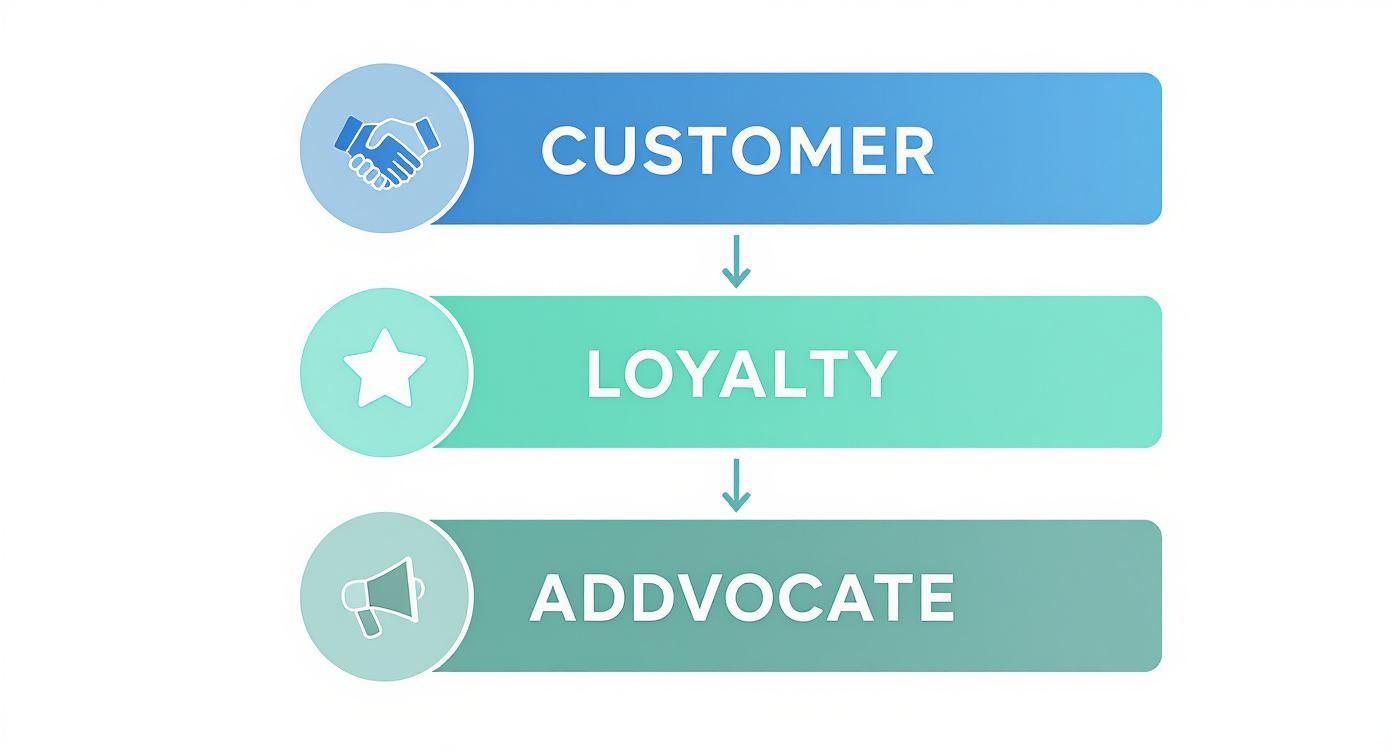
The goal isn't a single sale. It's building a long-term partnership that creates its own growth.
Leveraging AI for Scalable Personalization
Trying to optimize a modern funnel without AI is like trying to build a house with a hand saw. It’s just not practical at scale. AI tools are what let you personalize content for thousands of prospects at once, automate follow-ups based on what people actually do, and even predict which leads are most valuable before they even contact you.
The buyer's journey has completely changed. Today, a staggering 80% of B2B decision-makers prefer to do their own research online, often interacting with a company across 10 or more channels before buying. You can’t manage that complexity manually.
Companies using AI to navigate this see a 37% improvement in lead quality and a 28% reduction in sales cycles. It's not a "nice-to-have" anymore; it's a necessity. You can read the full research about modern B2B funnels to see just how deep this shift goes. By bringing these tools into your process, your funnel stops being a static blueprint and starts becoming an adaptive engine for predictable growth.
Still Have Questions About B2B Funnels? Let’s Clear Things Up.
Even the best roadmaps have tricky turns. If you’re still wrestling with a few questions about making this work, you’re not alone. Here are the most common sticking points I hear about—and the straight answers you need.
What's the Real Difference Between B2B and B2C Funnels?
It all comes down to two things: time and trust.
A B2C funnel is often a sprint. It’s emotional, targets one person, and can be over in minutes. Think about buying a pair of running shoes—it’s a quick, personal decision.
The B2B funnel is a marathon. It’s a long, logic-driven process involving a whole committee of people, a much bigger price tag, and a sales cycle that can easily stretch for months. Your job isn’t to sell to one person; it’s to build bulletproof trust and show a clear return on investment to the entire team.
How Do I Know What Content to Use at Each Stage?
Simple: match your content to the question they're asking themselves right now. You wouldn't pitch a product demo to someone who hasn't even admitted they have a problem, right?
- Awareness Stage (Top of Funnel): They’re problem-aware. Give them education. Think helpful blog posts, insightful webinars, and LinkedIn content that makes them see their challenge in a new light.
- Consideration Stage (Middle of Funnel): They're solution-aware. Give them proof. This is where you bring out the heavy hitters: in-depth case studies, detailed comparison guides, and whitepapers that prove you know how to solve their problem.
- Decision Stage (Bottom of Funnel): They're brand-aware. Make it easy to say yes. Offer personalized demos, free trials, and crystal-clear pricing to eliminate any last-minute friction.
Your content's job is to answer the question the buyer is asking right now. Early on, it’s “What is my problem?” Later, it becomes “Why is your solution the best for me?”
Where Do I Even Start with Measuring Performance?
Before you look at a single metric, you have to define what a "win" looks like at each stage. You can't measure what you haven't defined. Pinpoint the exact action that moves a lead from one step to the next.
For example, a move from Awareness to Consideration could be as simple as a newsletter signup. A move from Consideration to Decision is almost always a demo request.
Once you know what those conversion points are, get them set up in your analytics. This will instantly give you a dashboard showing where your funnel is flowing smoothly and, more importantly, where it’s leaking leads.
Ready to build a predictable B2B pipeline on LinkedIn? Growlancer combines authority content and targeted outreach to deliver qualified meetings for your entire leadership team. See how we do it.