

Effective appointment setting for b2b is a game of precision, not just raw numbers. It’s about strategically finding the right prospects, hitting them with a message that actually resonates, and booking qualified meetings that turn into real pipeline.
Building Your Strategic Foundation

Before a single email is drafted or a single call is made, you need to lay the groundwork. This is where most teams mess up. They jump straight into buying lists and blasting out templates, then get frustrated when their calendars are empty.
The truth is, the best appointment setters are strategists first. They know the real work happens long before they hit "send." This initial phase is all about focus and making smart choices that save you from wasting countless hours chasing ghosts.
It all starts with getting crystal clear on who you're targeting. I'm not talking about a vague description, either. You need a rock-solid Ideal Customer Profile (ICP) that goes beyond the basics to capture the real pain points and buying triggers of your best customers. This ICP becomes your North Star for everything that follows.
Crafting a High-Resolution Ideal Customer Profile
A fuzzy ICP is the number one reason outreach campaigns fall flat. "SaaS companies with 50-200 employees" isn't an ICP—it's barely a starting point. A truly powerful ICP paints a detailed picture of the organization you were born to help.
The framework below breaks down exactly what you need to define. It’s the difference between guessing and knowing.
| Component | Description | Example (SaaS for Logistics) |
|---|---|---|
| Firmographics | The basic company details. | Industry: 3PL/Freight Forwarding, Size: 100-500 employees, Revenue: $50M-$250M ARR. |
| Technographics | The tech they currently use. | Uses a legacy TMS (Transportation Management System), runs on AWS, uses Salesforce as their CRM. |
| Behavioral Triggers | Events that signal a need for you. | Recently hired a "VP of Supply Chain," just announced an expansion into a new region, posted a job for a "Logistics Coordinator." |
| Pain Points & Goals | The specific problems you solve. | "Struggling with high fuel surcharges," "losing shipments due to poor tracking," "wants to reduce delivery times by 15%." |
This table gives you a structured way to think through each layer of your ideal client. Don't just fill it out and forget it; this is a living document.
Key Insight: Your ICP should never be set in stone. Revisit it every quarter. Your best (and worst) customers are a goldmine of data. The patterns you find in closed-won deals are your most valuable clues for refining your targeting.
Prioritizing Accounts with a Tiering System
Look, not all accounts that fit your ICP are created equal. Some are good, and some are game-changers. A tiering system is how you focus your most precious resource—time—on the accounts that matter most.
By slicing your target list into tiers, you can match your outreach intensity to the potential payoff.
- Tier 1: These are your absolute dream clients. They're a perfect ICP match, have a massive potential contract value, and are probably well-known in your space. These accounts get the white-glove treatment: deep research and a highly personalized, multi-channel approach.
- Tier 2: A really strong fit, but maybe missing one or two "perfect" qualities. They still deserve personalized outreach, but you can use more templatized (but still customized) sequences here to be more efficient.
- Tier 3: These companies meet your basic criteria but might have a lower deal size or less obvious urgency. Outreach to this tier can be more automated to cast a wide net without draining your team's energy.
Identifying the Right Decision-Makers
Once you’ve tiered your accounts, the last piece of the foundation is finding the right people inside those companies. A brilliant message sent to the wrong person is just noise.
The game has changed here. Forget just booking any meeting you can get. Recent data shows that campaigns targeting C-level execs deliver much higher downstream revenue, even if it means fewer total meetings. It's about quality, not quantity.
Start by mapping out the buying committee. In any decent-sized B2B deal, you’re not selling to one person. You're selling to a group that often includes:
- The Champion: The person who feels the pain most acutely and will actually use your solution. They'll fight for you internally.
- The Influencer: Someone whose opinion the boss trusts, like a technical expert or senior team lead.
- The Decision-Maker: The one with the budget and final say—usually a VP or C-level executive.
This is where a tool like LinkedIn Sales Navigator becomes indispensable. It helps you pinpoint these roles, check out their backgrounds, and see what they're talking about online. For a deeper dive, check out our guide on using LinkedIn for B2B sales.
Developing Your Outreach Playbook
Okay, so you’ve got your target locked in. Now comes the fun part: building the machine that actually gets their attention.
Let’s be real. Your ideal clients are drowning in generic, automated spam every single day. If your appointment setting for b2b outreach is going to work, it has to be different. It needs to cut through that noise with genuine authority and immediate value.
This isn't about blasting out templates. It's about engineering real conversations.
And it all starts with your unique point of view (POV). What do you believe about your industry that most people don't? What problem do you solve in a completely different way? Your POV is the heart of your entire messaging strategy. It’s what makes you an authority, not just another vendor.
From Point of View to Pillar Content
A strong perspective needs a home. This is where your pillar content comes into play. Think of it as your magnum opus—a seriously in-depth blog post, a detailed webinar, or a data-heavy whitepaper that fully unpacks your unique POV.
This is the asset that proves you understand your ICP's world better than they might understand it themselves.
For instance, a logistics SaaS company could create a pillar piece titled, "The Hidden Costs of Last-Mile Inefficiency and How to Recoup Them." See what that does? It’s not a sales pitch. It’s a resource packed with value, and it becomes the backbone of every single outreach message you send.
Now, you have a powerful reason to connect. Instead of the tired, "Can I have 15 minutes to demo our product?" you can say, "Saw you're hiring a new VP of Supply Chain and thought our latest analysis on last-mile costs might be useful." One is a sales pitch; the other is a helpful gesture from an expert.
A strong point of view turns your outreach from an interruption into an invitation. You stop asking for time and start offering insights, which completely changes the dynamic of your B2B appointment setting efforts.
Architecting a Multi-Touch Sequence
One email is never enough. Neither is one LinkedIn message. Let's be honest, those almost never work on their own. The data I've seen suggests it takes somewhere between 8 to 12 touchpoints to even get a meeting on the calendar.
Success demands a smart, multi-touch sequence that blends different channels over time. The goal is to be persistent without being a pest.
A great sequence feels helpful at every step. You're not just sending the same message over and over. Each touchpoint builds on the last, offering a new insight or a different angle.
Here's a sample framework I've used that gets results:
- Day 1 (Email): A highly personalized email. I'm talking about referencing a specific trigger (like a new job posting or a recent company announcement) and offering your pillar content. The call-to-action is soft—focus on providing value, not booking a meeting.
- Day 1 (LinkedIn): Just view their profile. That's it. No connection request, no message. Just a subtle signal that you're in their orbit.
- Day 3 (LinkedIn): Find a recent post they shared and leave a thoughtful comment. This shows you're actually paying attention.
- Day 5 (Email): Follow up, but with another nugget of value. This could be a quick two-minute video explaining a key idea from your pillar content or a link to a relevant industry article you found.
- Day 7 (LinkedIn): Now you send the connection request. Personalize it by mentioning your previous comment: "Enjoyed your recent post on [Topic]. Would be great to connect and follow your insights here."
- Day 10 (Call): A quick, value-first call. The script isn't a pitch. It’s about referencing the insights you’ve already shared and asking one sharp, qualifying question.
- Day 14 (Email): The "breakup" email. A final, polite message that puts the ball in their court. Let them know you won't keep chasing them unless they see a reason to chat.
Of course, this is just one example. The key is to map out your own sequence based on how your ICP actually behaves. Are they more active on LinkedIn or email? Do they respond better to data or case studies?
Your playbook should be a living document, one you're constantly tweaking based on the results. To dig deeper into this, you can learn more about crafting a successful outbound lead gen system. Building this engine is what separates sporadic wins from a truly predictable pipeline.
Executing High-Impact Outreach Cadences
All that strategy is great, but it means nothing if you can’t execute. This is where the rubber meets the road—where your ICP research and outreach playbook actually start generating real conversations. Think of your outreach cadence as the engine driving your appointment setting for B2B; it’s what turns a list of cold prospects into a calendar full of qualified meetings.
The secret sauce? Finding the right blend of channels. A multi-channel approach isn't just a buzzword for using email, LinkedIn, and calls. It’s about orchestrating them so that each touchpoint builds on the last. Done right, it feels like helpful persistence, not aggressive spam.
This whole process boils down to a simple flow: your content sparks engagement, which then feeds your structured outreach sequence.
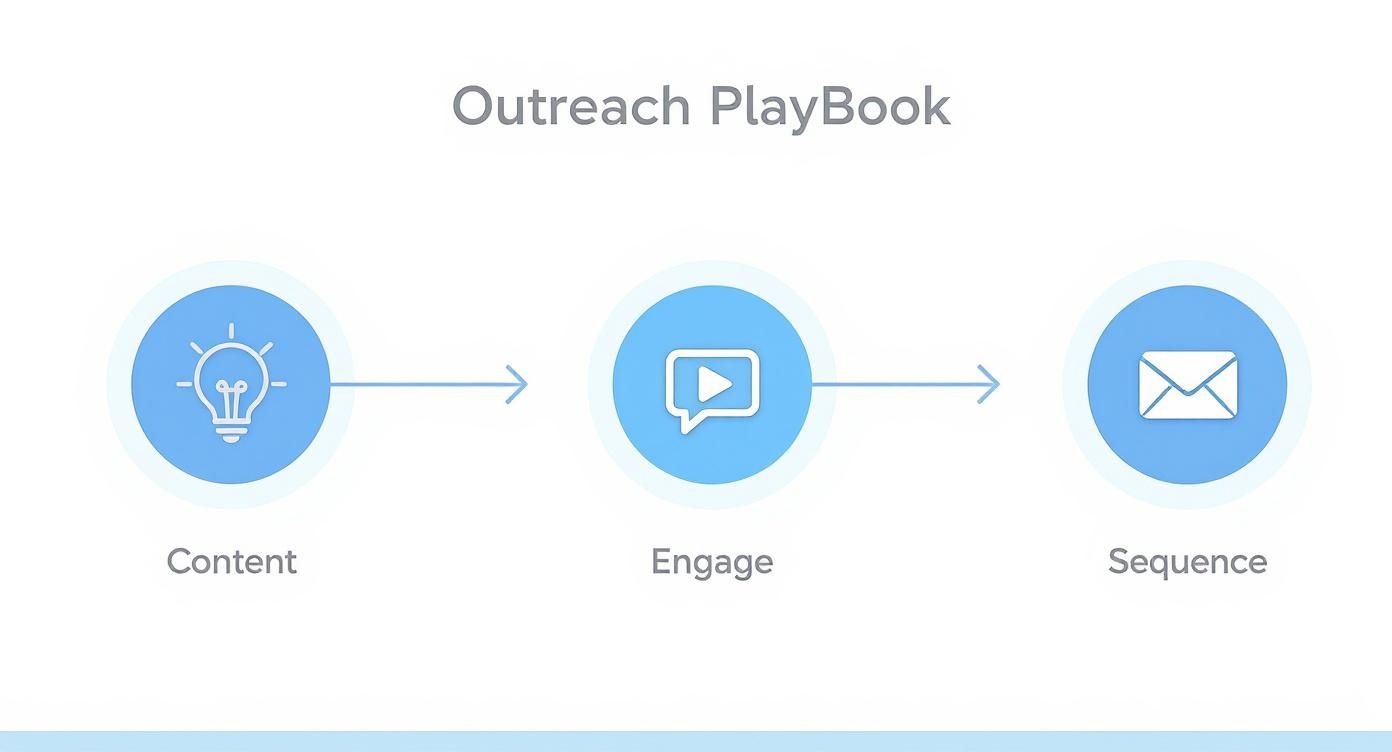
As you can see, great outreach doesn’t start with a cold email. It starts with genuinely valuable content and real social engagement.
Designing a Flexible Cadence Framework
First things first: throw out your rigid templates. The best cadences are flexible frameworks you can adapt on the fly. You have to adjust your approach based on the prospect's role, their industry, and how they’re (or aren't) engaging with you. The real goal is to stay top-of-mind without being an annoyance.
Let’s be honest, the cadence you use for a startup CTO should look nothing like the one for a VP of Marketing at a Fortune 500.
A classic mistake I see all the time is putting 100% of the effort into the first email, then following up with a weak, generic "just checking in." Every single touch needs to add new value.
For a Tier 1 or Tier 2 prospect, here’s a structure I’ve seen work wonders:
- The Hyper-Personalized Email: Kick things off with email. It’s still the best channel for a detailed, personalized message that has a high chance of being seen. Reference a specific trigger event and link to a high-value resource. (If finding the right email is a bottleneck, our guide on how to find someone's email from LinkedIn will save you a ton of time.)
- The LinkedIn Warm-Up: A day or two later, pop up on their LinkedIn. A thoughtful comment on one of their posts is infinitely more powerful than a cold, generic connection request.
- The Value-Add Follow-Up: After a few more days, hit their inbox again, but this time, build on your first message. Maybe it’s a short case study, a relevant statistic, or even just a link to a third-party article that backs up your initial point.
- The Strategic Call: Now that you’ve provided value twice without asking for anything, a phone call feels much less intrusive. The goal isn’t to book the meeting on the spot—it’s just to open a real dialogue and ask a sharp qualifying question.
- The “Breakup” Email: If you still hear crickets after all that, a polite, no-pressure email that closes the loop can be surprisingly effective at getting a response.
This multi-channel approach is crucial for cutting through the noise. Remember, the data shows it can take 8-12 touchpoints to actually land a meeting, so you have to be persistent.
Crafting Scripts That Don't Sound Scripted
Scripts should be guardrails, not a cage. They’re there to make sure you hit your key talking points but still leave plenty of room for a natural conversation to unfold. The best scripts are incredibly concise and focused entirely on the prospect's world, not yours.
Here’s a voicemail script that actually gets callbacks:
Example Voicemail Script
"Hi [Prospect Name], this is [Your Name] over at [Your Company]. I'm calling because I saw your company recently [mention trigger event, e.g., 'announced its expansion into Europe'], and I just sent over a quick email with some data on how other B2B tech firms are navigating that same move. Again, that's [Your Name]. Talk soon."
See? It’s short, it references another touchpoint (the email), it gives immediate context, and it completely avoids a hard sell. It’s a helpful nudge, not a desperate plea.
Pro Tip: Never, ever start a cold call with "Is now a good time?" You’re just inviting a 'no.' Instead, lead with your value. "Hi [Prospect Name], the reason I'm calling is…" This gets straight to the point and shows you respect their time.
At the end of the day, your cadences and scripts are living documents. You have to constantly watch your response rates, open rates, and meeting-booked rates. If a step in your sequence is falling flat, fix it. A/B test your subject lines and calls-to-action to continuously dial in what works. This data-driven mindset is what turns appointment setting from an art into a science.
Mastering Lead Qualification and CRM Workflows
Getting that positive reply is a rush, but it’s not the finish line. Not even close.
I’ve seen it a hundred times: the biggest bottleneck in a sales org isn't generating interest. It’s the failure to separate the merely curious from the genuinely qualified. Booking a meeting with an unqualified lead is one of the most expensive mistakes you can make in appointment setting for b2b. It burns your most precious resource—the time of your Account Executives.
This is where a disciplined approach to lead qualification and a clean CRM workflow become your secret weapon. Without a system, you’re just lobbing meetings over the fence and praying something sticks. A real process ensures every single meeting passed to sales has a legitimate shot at becoming revenue.
Weave Qualification into Every Conversation
Good qualification shouldn't feel like an interrogation. It needs to be a natural part of the conversation, gracefully filtering out the tire-kickers while pulling the high-potential prospects forward. Frameworks like BANT and MEDDIC are great mental checklists to have in your back pocket.
BANT is a classic for a reason—it’s simple and gets the job done for that first-pass qualification. It hits the four essential pillars you need to understand before booking a full discovery call:
- Budget: Do they actually have the money to invest in a solution like yours?
- Authority: Are you talking to the person who signs the checks, or at least someone who has their ear?
- Need: Is there a real, acknowledged pain point that you can solve?
- Timeline: Is this a "hair on fire" problem they need to solve now, or is it a "sometime next year" kind of thing?
You don’t have to ask these questions like a robot reading a script. For instance, instead of the blunt "Do you have the budget for this?" try something smoother, like, "How is your team currently prioritizing investments to tackle challenges like this?"
Your goal in the initial chat isn't to close a deal. It's to open a qualified conversation. Think of yourself as a doctor diagnosing a problem, not a salesperson pushing a product. If there’s no real pain, there’s no need for your prescription.
Build a CRM Workflow That Actually Works
Your CRM is the central nervous system of your sales operation. A messy one leads to dropped leads, forgotten follow-ups, and zero visibility into what’s actually working. A streamlined workflow in a platform like HubSpot or Salesforce is non-negotiable if you want to scale.
The key is to keep it simple. Don’t over-engineer it with dozens of custom fields and confusing stages. That just creates friction. Focus on the core stages that matter for an appointment setter.
A Simple, Effective CRM Workflow:
- New Lead: A prospect is in the system but hasn't been touched yet.
- Engaging: You're actively running a multi-touch sequence.
- Positive Reply: They've responded with interest, but no meeting is set.
- Meeting Booked: A qualified appointment is on the calendar.
- Meeting Held: The AE has completed the discovery call.
- Disqualified: The prospect isn't a fit. (Always, always note why).
This kind of clarity lets you see your pipeline at a glance and guarantees a clean hand-off to the sales team. That transition from "Meeting Booked" to "Meeting Held" is a critical KPI for any serious appointment setter.
This isn’t just about manual data entry anymore, either. AI and automation are changing the game. Smart tools can handle a lot of the initial qualification and follow-up, freeing up your team for the human conversations that matter most. If you want to see where things are headed, check out some of the trends shaping the future of B2B appointment setting.
The point isn't to create busywork; it's to build a system that prevents pipeline clogs and makes every single action count.
How to Measure and Scale Your Success
You can't build a world-class appointment setting for b2b engine on gut feelings. It has to be built on cold, hard data. If you aren't measuring your efforts, you're just guessing. This is the part where you stop being busy and start being effective, turning your outreach into a predictable pipeline machine.
The biggest trap I see teams fall into is obsessing over one single metric: meetings booked. It feels good, but it's a vanity metric. A calendar packed with meetings that go nowhere is actually worse than an empty one. It wastes your sales team's most precious resource—their time—and creates a dangerous illusion of progress.
Key Performance Indicators That Actually Matter
To really understand what's working (and what isn't), you need to look at the entire funnel. Tracking the right KPIs gives you a complete health check on your entire operation.
Here’s what you should be watching like a hawk:
- Positive Reply Rate: This is your first signal. What percentage of prospects are actually responding with some level of interest? If this number is low, your messaging or targeting is off. Simple as that.
- Meeting Booked Rate: Out of those positive replies, how many turn into a real, scheduled meeting? This tells you how good your SDRs are at converting initial interest into a solid commitment.
- Meeting Show Rate: A classic. What percentage of those booked meetings actually happen? If your show rate dips below 80%, something’s wrong. It usually points to a weak qualification process or the prospect just doesn't see enough value to show up.
- Opportunity Conversion Rate: This is the moment of truth. How many of the meetings that happen does your Account Executive (AE) accept as a legitimate, qualified sales opportunity? This number tells you everything about the quality of the appointments being set.
Think of these numbers as your diagnostic toolkit. High reply rate but low booked rate? Your SDRs might need some coaching on how to handle that initial conversation. High show rate but abysmal opportunity conversion? Your SDRs are booking meetings with the wrong people.
The B2B space is also changing. Recent data shows that while it’s getting tougher to get that first response, the prospects who do engage are more likely to show up for the meeting. The takeaway? Blasting out generic messages is dead. A highly-targeted, value-first approach is what cuts through the noise, and it brings more committed buyers to the table. You can find more data in this B2B appointment setting benchmarks report from leadsatscale.com.
Key Appointment Setting Performance Benchmarks
To put your own numbers into perspective, it's helpful to see how you stack up against the rest of the industry. Below is a quick summary of critical KPIs. Use these benchmarks to gauge where you’re at and identify areas for improvement.
| Metric | Industry Benchmark (Average) | Top Performer Benchmark |
|---|---|---|
| Positive Reply Rate | 3-5% | 8%+ |
| Meeting Booked Rate | 25-30% (of positive replies) | 40%+ |
| Meeting Show Rate | 80-85% | 90%+ |
| Opportunity Conversion Rate | 50-60% (of meetings held) | 75%+ |
Remember, these are just benchmarks. Your specific industry, market, and sales cycle will influence your numbers, but if you're falling well short of the industry average, it's a clear sign that something in your process needs a closer look.
Knowing When It’s Time to Scale
Scaling isn’t about hitting some magic revenue number. It’s about reading the signs that your system is humming along at full capacity and can actually support another person. Hire too soon, and you're just burning cash. Wait too long, and you starve your sales team by creating a massive pipeline bottleneck.
Here’s when to start writing the job description for your next SDR:
- Consistent Performance: Your current SDR is predictably hitting their meeting quota month after month.
- Account Saturation: They've worked their way through the best Tier 1 and Tier 2 accounts and are starting to see diminishing returns.
- AEs Are Hungry: Your Account Executives have open slots on their calendars and are asking for more at-bats.
Don't hire another SDR just because your first one is a rockstar. Hire another SDR because your market, your process, and your sales team can handle the output without quality taking a nosedive.
Creating a Seamless Handoff to Sales
The moment a meeting is booked, a new—and equally critical—process starts: the handoff to the AE. A fumbled handoff is one of the easiest ways to kill a deal before it even begins. It forces the prospect to repeat themselves and makes your whole operation look amateur.
A perfect handoff comes down to clear communication and zero guesswork.
- Standardized Discovery Notes: Your SDR must capture key info (like BANT criteria, pain points, and goals) in a consistent format right inside your CRM. No excuses.
- The Internal Huddle: For big, juicy Tier 1 accounts, a quick 10-minute sync between the SDR and AE before the call is a game-changer. It gets everyone on the same page.
- The “Warm Intro” Email: The SDR should send the calendar invite with both the prospect and the AE on it, including a quick summary of the conversation so far. This sets the stage and ensures everyone knows why they’re meeting.
This isn't rocket science, but it’s amazing how many teams skip it. A structured handoff process ensures every single meeting you worked so hard to get has the best possible shot at turning into revenue. It respects the prospect's time and gives your AEs the fuel they need to have a killer first call.
Your B2B Appointment Setting Questions, Answered
When you're deep in the trenches of B2B appointment setting, questions always pop up. Even the sharpest teams I've worked with still debate the finer points of outreach, team structure, and even basic definitions. Let's clear the air on some of the most common ones I hear.
Getting these fundamentals straight is non-negotiable. If you mix up lead generation and appointment setting, for instance, you’ll end up with a messy pipeline and mismatched goals. The same goes for building a team—deciding whether to hire internally or bring in an outside partner can make or break your growth for years to come.
Let's dive in.
How Many Times Do I Need to Follow Up to Get a Meeting?
There’s no magic number here, but both the data and my own experience show the sweet spot is between 8 and 12 touchpoints to book a solid meeting. Sending one email and hoping for the best is a recipe for getting ignored.
But here’s the thing: it’s not just about hitting a number. It's about smart, relentless persistence. Each touchpoint needs to build on the last, adding a bit more value and feeling like a natural conversation, not a robotic sequence.
Anything less than five touches is almost always a waste of time. On the flip side, if you're pushing past 15 without a peep, you risk coming off as spammy and can do real damage to your brand.
A solid cadence could look like this:
- Touch 1-2: Kick things off with a super-personalized email, then check out their LinkedIn profile.
- Touch 3-4: Drop a genuinely insightful comment on one of their posts. A few days later, send a second email with a different, helpful resource.
- Touch 5-7: Send a personalized connection request, make a quick value-first phone call, and leave a non-pushy voicemail.
- Touch 8+: If it's still crickets, send a polite "breakup" email. This often gets a response and puts the ball back in their court.
What's the Real Difference Between Appointment Setting and Lead Generation?
People throw these terms around like they're the same thing, but they’re two completely different beasts. Confusing them creates a leaky sales funnel and a ton of frustration.
Lead generation is the big-picture, top-of-funnel stuff. You're casting a wide net to capture interest and build a list of people who might be a fit. Think:
- Running Google or LinkedIn ads.
- Putting out gated content like whitepapers and eBooks.
- Getting found through SEO and your blog.
Appointment setting is the focused, proactive work of taking that list (or a cold, well-researched list) and turning interest into a conversation. The only goal is to book a qualified meeting with someone who can actually make a decision.
I like to think of it like fishing. Lead generation is throwing a huge net out to see what you can catch. Appointment setting is grabbing a spear and going after the exact, high-value fish you want to take home for dinner.
Should I Outsource This or Build My Own Team?
Ah, the classic question. The answer is a frustrating "it depends," but it really boils down to your company's cash, timeline, and who you have on your team right now. Neither option is flat-out better, but one is definitely a better fit for where you're at today.
Outsourcing is probably your best bet when:
- You need pipeline yesterday: You can't wait the months it takes to hire, train, and ramp up your own SDRs.
- You don't have the expertise in-house: Your leadership team hasn't built and scaled a sales development team before.
- You're testing the waters: An agency lets you validate a new market or service without the heavy commitment of full-time hires.
Building an in-house team is the way to go when:
- Your product is seriously complex: If it takes deep technical know-how, you need people who live and breathe your product every single day.
- Your brand's culture is everything: You want every single prospect interaction to feel 100% like you.
- You're playing the long game: You see sales development as a core part of your company that you want to own and grow internally.
A lot of the smartest companies I've seen actually do both. They'll start with an outsourced partner to get the engine running and bring in revenue, then they use what they learn to build their own powerhouse team over time.
Ready to stop guessing and start building a predictable pipeline? Growlancer offers a done-for-you LinkedIn growth system that combines expert strategy, authority content, and targeted outreach to book qualified meetings with your ideal customers. See how we build B2B sales pipelines at https://growlancer.ai.