

The whole game on LinkedIn boils down to a three-part system: optimizing your profile to pull in your ideal customer, creating content that actually solves their problems, and then reaching out personally to start real conversations. Done right, this turns your profile from a dusty old resume into a machine that brings in leads while you sleep.
Building Your Foundation for LinkedIn Leads

Before you even think about sending a single connection request, you have to build a presence that people want to connect with. So many people get this backward. They jump straight into outreach with a generic, resume-style profile and wonder why nobody responds. It’s like trying to make sales calls from an unlisted number—you just come across as sketchy.
The foundation for everything starts with a laser-focused understanding of your Ideal Customer Profile (ICP). And I don't just mean job titles and company size. You need to get inside their heads.
- What keeps them up at night, professionally speaking?
- What goals are they desperately trying to hit this quarter?
- What lingo and jargon do they use in their day-to-day?
- What kind of content would they actually find useful, not just more noise?
Answering these questions is the key. It lets you flip your profile's entire message from "Here's what I do" to "Here's how I solve your specific problems." That's the secret to making your profile a valuable resource instead of just a list of your past jobs.
Optimizing Your Personal and Company Profiles
Once you're clear on who you're talking to, it's time for a profile makeover. Your personal profile is where the magic happens for B2B. People connect with people, not logos.
Your headline is the most valuable real estate you have. Stop using a generic job title. It tells people nothing. Instead, craft a headline that speaks directly to the outcome you deliver for your ICP.
Bad Headline: Founder & CEO at TechSolutions Inc.
Good Headline: Helping SaaS Founders Scale from $1M to $10M ARR with Predictable Outbound Systems
See the difference? The second one instantly grabs the right person's attention (SaaS Founders) and promises a tangible result. It’s a hook, not just a label.
Next up, your "About" section. Ditch the stuffy, third-person bio. Write it yourself, from your perspective. Tell a story. Show that you get their challenges and lay out exactly how you guide them to their goals. This is your chance to build a connection before you've even spoken.
Showcasing Expertise to Attract Inbound Interest
Finally, don't sleep on your profile's "Featured" section. This is your personal billboard. Use it to pin your absolute best stuff.
- Case Studies: Got a killer case study showing a clear before-and-after? Pin it.
- Helpful Articles: Wrote a guide that solves a nagging problem for your ICP? Pin it.
- Video Testimonials: Nothing builds trust faster than a happy client on camera. Pin that too.
When you set your profile up this way, any prospect who lands there—whether from a post or a connection request—immediately sees you as a credible expert. This does half the selling for you.
Putting in this foundational work is non-negotiable. The numbers don't lie. LinkedIn is a staggering 277% more effective for lead generation than Facebook and X (formerly Twitter). It's responsible for 80% of all B2B leads from social media, making it the undisputed champ for high-value business. You can dig into more of these LinkedIn lead generation statistics, but the takeaway is clear: building a solid foundation here isn't just a good idea; it's a strategic must.
Your LinkedIn Profile Optimization Checklist
Your profile is your digital storefront. Use this checklist to make sure it’s open for business and optimized to attract the right people.
| Profile Element | Optimization Goal | Quick Example |
|---|---|---|
| Profile Photo | Look professional, approachable, and trustworthy. | A clear, high-resolution headshot where you're smiling. No logos, no group shots. |
| Banner Image | Reinforce your value proposition and brand identity. | A custom graphic with your logo, a client quote, or your headline. |
| Headline | Grab your ICP's attention with a result-oriented statement. | "I Help B2B Tech Companies Cut Sales Cycles by 30% Using Intent Data" |
| About Section | Tell a story that connects with your ICP's pain points and goals. | Start with their problem: "Struggling to book meetings with enterprise accounts?" |
| Featured Section | Showcase social proof and your best problem-solving content. | Pin a link to a powerful case study, a video testimonial, or a webinar recording. |
| Experience Section | Describe past roles in terms of achievements, not just responsibilities. | "Grew inbound leads by 200% by implementing a new content marketing strategy." |
| Skills & Endorsements | Highlight your top 3-5 core skills relevant to your ICP. | Pin skills like "Lead Generation," "SaaS," and "Go-to-Market Strategy." |
| Recommendations | Gather testimonials from clients that validate your claims. | Actively request recommendations that speak to specific results you delivered. |
Going through this checklist turns your profile from a passive digital resume into an active, 24/7 lead-generation asset.
Creating Content That Establishes Authority

Alright, your profile is tuned up and ready to go. But what's next? An optimized profile that just sits there is like a beautifully designed storefront with empty shelves—it looks good, but it won’t bring anyone inside.
This is where the real work begins. It’s time to breathe some life into that profile with a smart content plan. This is the step that separates the amateurs from the pros who really know how to pull consistent leads from LinkedIn.
The big secret? It all comes down to a simple but powerful idea: give to get.
Stop selling. Start solving. Your content needs to tackle your Ideal Customer Profile's biggest headaches, and you need to do it for free. When you show up consistently with genuine insights, practical tips, and real stories from the trenches, something magic happens. You stop being another vendor and start becoming a trusted authority.
That shift is everything. Prospects who see you as an expert will come to you when they need help. You're no longer chasing leads—you're attracting them.
What Kind of Content Actually Works on LinkedIn?
Let's be real, not all content gets noticed on LinkedIn. The platform definitely has its favorites. The algorithm—and the people scrolling—tend to reward formats that are easy to consume and spark a conversation. The trick is to find a sustainable mix that you can actually stick with.
Here are a few formats that consistently punch above their weight:
- Text-Only Posts: Never underestimate a great text post. A killer hook, followed by short, punchy paragraphs sharing a unique insight or a controversial take, can absolutely explode with engagement.
- Simple Carousels (PDFs): These things are visual gold. They let you break down a complex idea into 5-10 easy-to-digest slides. Think frameworks, step-by-step guides, or key stats from a report.
- Short-Form Videos: A quick 60-90 second video of you sharing one powerful tip creates a personal connection that text just can't match. It doesn't need to be a Hollywood production—good lighting, clear sound, and a valuable point are all you need.
Don’t try to do it all at once. Pick one or two of these and get really good at them first.
How to Plan Your Content Without Losing Your Mind
Consistency is the name of the game. If you post randomly, you’re sending a signal to both the algorithm and your audience that you’re not a reliable source. A simple content calendar is your best friend here.
Look, this doesn't need to be complicated. A basic spreadsheet with columns for the date, topic, format, and the actual post copy is more than enough. Aim for 2-3 high-quality posts per week instead of burning out trying to post mediocre content every single day.
To keep the ideas flowing, think in terms of "content pillars." These are the core themes that relate directly to your ICP's pain points and your own expertise.
For example, a SaaS founder's content pillars might look like this:
- Pillar 1: Scaling Sales Teams (Hiring, compensation, training tactics)
- Pillar 2: Go-to-Market Strategy (Positioning, pricing models, channel partners)
- Pillar 3: Leadership & Productivity (Mindset, delegation hacks, focus)
This approach keeps your content focused and constantly reinforces why you're the person to listen to. Writing posts that truly connect is an art, and if you want to sharpen your skills, our guide on how to write engaging LinkedIn posts has a ton of actionable advice.
Turn Your Team Into a Content Army
Here’s a force multiplier most companies ignore: the collective brainpower of your entire team. Getting your leadership and sales folks to share their own insights and engage with company content can amplify your reach like crazy.
Start small. Make it dead simple for them. Share the main company posts in a team Slack channel and ask them to drop a comment with their own take or reshare it. This one small action can massively boost a post's visibility and proves your company is filled with active experts.
When you do this, you turn your company's LinkedIn presence from a monologue into a dynamic conversation. And that conversation is what attracts inbound leads and cements your authority in the market.
Firing Up Your Personalized Outreach Engine
Alright, you've done the hard work. Your profile is magnetic, and you're consistently dropping value-packed content that positions you as an authority. Now it’s time to flip the switch from passive attraction to proactive conversation.
This is where your LinkedIn presence stops being a simple branding tool and starts becoming a legitimate lead-generation machine.
But let's be clear: this isn't about spamming inboxes. Forget the generic, spray-and-pray nonsense that everyone hates. We're going to be surgical, thoughtful, and, most importantly, human. This isn’t a numbers game; it’s a relevance game. When you show you've done your homework, you immediately stand out and earn the right to a conversation.
Pinpoint Your Perfect Prospects
Before you even think about writing a message, you need a razor-sharp list of people who fit your Ideal Customer Profile. This is non-negotiable.
For this, LinkedIn Sales Navigator is your best friend. Seriously. The free version of LinkedIn is fine for basic networking, but Sales Nav is where you get the firepower to build hyper-targeted lists with startling accuracy.
You can drill down and find the exact right people by combining filters like:
- Company Headcount: Are you after scrappy startups or established enterprises?
- Industry: Cut out the noise and focus only on the sectors you serve best.
- Job Title & Seniority: Get straight to the decision-makers, like a "VP of Marketing" or "Director of Ops."
- Recent Activity: This one's gold. You can find people who just changed jobs or posted content—perfect, timely hooks for your outreach.
By layering these filters, you're not just building a list; you're creating a high-potential pipeline. This precision is the bedrock of an outreach message that feels personal, because it is personal.
Nailing the Connection Request
Your connection request is your digital first impression. An empty, generic request is a one-way ticket to being ignored. Your only job here is to spark enough curiosity to get that "Accept."
The secret? Be brief, be personal, and make it about them.
Look for a specific detail—a recent post, a comment they made, an article they shared. Referencing it shows you're not a bot.
Bad Connection Request: "Hi John, I'd like to connect. I see we're both in the tech industry and think we could benefit from being in each other's network. Let's connect."
Good Connection Request: "Hi John, saw your post on scaling engineering teams and loved your point about asynchronous communication. As someone focused on productivity tools, I found it insightful. Would love to connect."
See the difference? The second one is a genuine compliment, not a veiled pitch. It acknowledges their expertise and opens the door for a real conversation. This tiny shift will skyrocket your acceptance rate.
Play the Long Game with a Multi-Touch Sequence
Getting the connection is just the first step. The real magic is in the follow-up. You need a multi-touch messaging sequence that builds a relationship by offering value, long before you ever ask for a meeting.
Going for the kill (i.e., the demo request) in your first message is the fastest way to get ghosted. Patience is key.
Here's a simple flow that works:
- The Thank You & Give: Once they accept, thank them for connecting. Then, immediately give them something useful based on their profile or content—a relevant article, a helpful tool, or a case study. No strings attached.
- The Warm Follow-Up: A week or so later, find one of their posts and leave a thoughtful comment. Then, pop into their DMs with a quick note like, "Just saw your post on [topic] and left a comment. Great point about [specific detail]." You're staying on their radar in a non-salesy way.
- The Gentle Pivot: Now you can start bridging the gap. Find a trigger, like a company announcement or a recent win. Your message could be, "Congrats on the new product launch! I was curious how your team is approaching [a related challenge]."
This value-first, patient approach is incredibly effective. Think about it: the average reply rate to LinkedIn messages is around 85%—that's nearly three times higher than cold email. By sending just 30–45 well-researched, personalized connection requests a day, you can realistically hit a 45% acceptance rate and start meaningful conversations. Want more data on this? Check out what the team at Salesbread.com found.
The goal is always rapport first, business second. Once a prospect sees you as someone who understands their world and consistently offers value, they'll be far more receptive when the time is right to talk shop.
If you want to go deeper on this, we've laid out more detailed frameworks and scripts in our guide on building an effective outbound lead gen system.
From Connection to Conversation: Turning Prospects into Pipeline
So, they accepted your connection request. Pop the champagne? Not quite.
That "accept" button isn't the finish line; it’s the starting gun. This is where the real work begins—and frankly, where most people completely fumble the opportunity. A connection is just a vanity metric until you actually turn it into a real conversation.
The game here is building a consistent habit of engagement. It’s about showing up in their world, not with a sales pitch, but with genuine value. The goal is to evolve from "that random person who added me" to "that person who always shares smart stuff."
That little shift in perception? It’s everything. It's what thaws out a cold connection and earns you the right to ask for their time.
Ditch the "Great Post!" Comments
The easiest way to start nurturing is by engaging with what your prospects post. But let’s get one thing straight: a lazy “great post!” or “thanks for sharing!” is a complete waste of your time. It screams, "I didn't actually read this, but I want you to see my name."
You have to do better. Your comments need to add something to the conversation.
- Ask a smart question: "This is a killer point on team alignment. I'm curious, how have you seen this play out for fully remote teams vs. hybrid?"
- Share a relevant data point: "100% agree. We saw a similar trend with our clients, where implementing [specific tactic] actually boosted retention by 15%."
- Bring someone else in: "This is a fantastic framework. Tagging @JaneDoe because this could be really useful for that project we were talking about."
This isn't rocket science, but it works. It shows you’re paying attention and thinking about their world. You become a peer and a resource, not just another vendor lurking in the shadows. Make it a daily ritual: leave five to ten of these high-value comments on posts from your A-list prospects.
Learn to Spot the Buying Signals
As you keep showing up, you need to have your radar on for buying signals. These are the little breadcrumbs people leave that signal they might be looking for a solution or are at least warming up to a chat.
A buying signal is rarely a direct flare gun asking for your help. It's usually a prospect sharing a frustration, asking their network for recommendations, or announcing a new project that lines up perfectly with what you do.
Keep your eyes peeled for these common tells:
| Signal Type | What it Looks Like on LinkedIn | Your Next Move |
|---|---|---|
| Problem Sharing | A prospect posts, "Our current CRM is a reporting nightmare. Open to recommendations for something that doesn't make my eyes bleed." | Drop a helpful comment, then slide into the DMs: "Saw your post about CRM reporting. Have you looked at X? Happy to share a simple reporting template we built, no strings attached." |
| New Initiative | A company announces, "Thrilled to share we're expanding our sales team in Q3!" | Send a direct message: "Huge congrats on the expansion! As you scale, having a rock-solid onboarding process is everything. I have a checklist that might save you some headaches." |
| Direct Engagement | A prospect consistently likes and comments on your content. | Send a DM: "Hey [Name], really appreciate you always engaging with my posts! Seems like [topic] is a big focus for you right now. Would you be open to a quick chat about it sometime?" |
The Right Way to Ask for the Call
Okay, you’ve put in the work. You've built some rapport over a few weeks, provided real value, and you've seen some positive signals. Now it's time to take the conversation offline.
The key is to make it a no-brainer for them. Your ask needs to be low-friction and directly connected to what you’ve already been talking about. Please, for the love of all that is good, avoid the vague, "Can I pick your brain?"
Be specific. Be valuable.
Try something like this: "Based on our chats about [topic], it sounds like solving [problem] is a big priority. I've got a couple of ideas that might help you get there a lot faster. Are you open to a quick 15-minute call next week to run through them?"
This works because it respects their time, offers a clear "what's in it for me," and ties directly back to their stated needs. It’s not a sales pitch. It’s a problem-solving session. This is how you consistently turn those passive LinkedIn connections into your best sales meetings.
Turning LinkedIn Activity into a Scalable System
Let's be honest. A successful LinkedIn strategy isn't just about sending a bunch of connection requests and posting now and then. That's just hoping for the best.
Real success comes from building a system—a repeatable, measurable process that turns your daily grind into a predictable flow of qualified meetings. Without a system, you're basically gambling. With one, you're building a revenue engine.
The very first step? Getting leads off LinkedIn and into a space where you can actually manage them. Your LinkedIn inbox is a terrible place for valuable conversations to live; they just get buried. A lead isn't really a lead until it's logged in your CRM, even if that's just a simple spreadsheet to start.
This discipline is what stops interested prospects from falling through the cracks. It’s the operational backbone that makes getting leads on LinkedIn a consistent outcome, not just a happy accident.
From LinkedIn Inbox to CRM Pipeline
Your workflow doesn’t need to be complicated, but it absolutely needs to be consistent. The second a prospect shows real buying intent—maybe they ask about your services or agree to a call—it's go-time. Move them out of LinkedIn immediately.
Here’s a dead-simple process you can start today:
- Identify the Trigger: The prospect agrees to a meeting, asks for pricing, or wants to see a case study. Boom. That's your signal.
- Create the Contact: Pop open your CRM or tracking sheet and manually add their name, company, LinkedIn URL, and the key context of your chat. Don't skip this.
- Schedule the Follow-Up: Right away, set a task for the very next action. Are you sending a calendar invite? A resource? A reminder? Put it on the board.
This simple habit is what separates the pros from the amateurs. It also gives you the raw data you need to figure out what’s actually working. For a much deeper dive on this, check out our guide on how to build a sales pipeline.
Metrics That Actually Drive Revenue
Profile views and connection counts are vanity metrics. They feel good, but they don't pay the bills. If you want to build a scalable system, you have to track the numbers that directly lead to pipeline and cold, hard cash.
Zero in on these key performance indicators (KPIs):
- Connection Acceptance Rate: What percentage of your personalized requests get accepted? This is your first signal that your targeting and messaging are hitting the mark. You should be aiming for 30% or higher.
- Reply Rate to Follow-Ups: Of all those new connections you message, how many actually write back? This tells you if your opening gambit is compelling or getting ignored.
- Meetings Booked: This is the big one. How many conversations are turning into actual sales calls in the calendar? This is the ultimate proof your system works.
Tracking these numbers weekly gives you a clear dashboard for your system's health. If your acceptance rate is in the gutter, your ICP targeting is probably off. If no one is replying, your opening message needs a rewrite.
This isn't just a numbers game; it's a flow. You're moving people from one stage to the next.
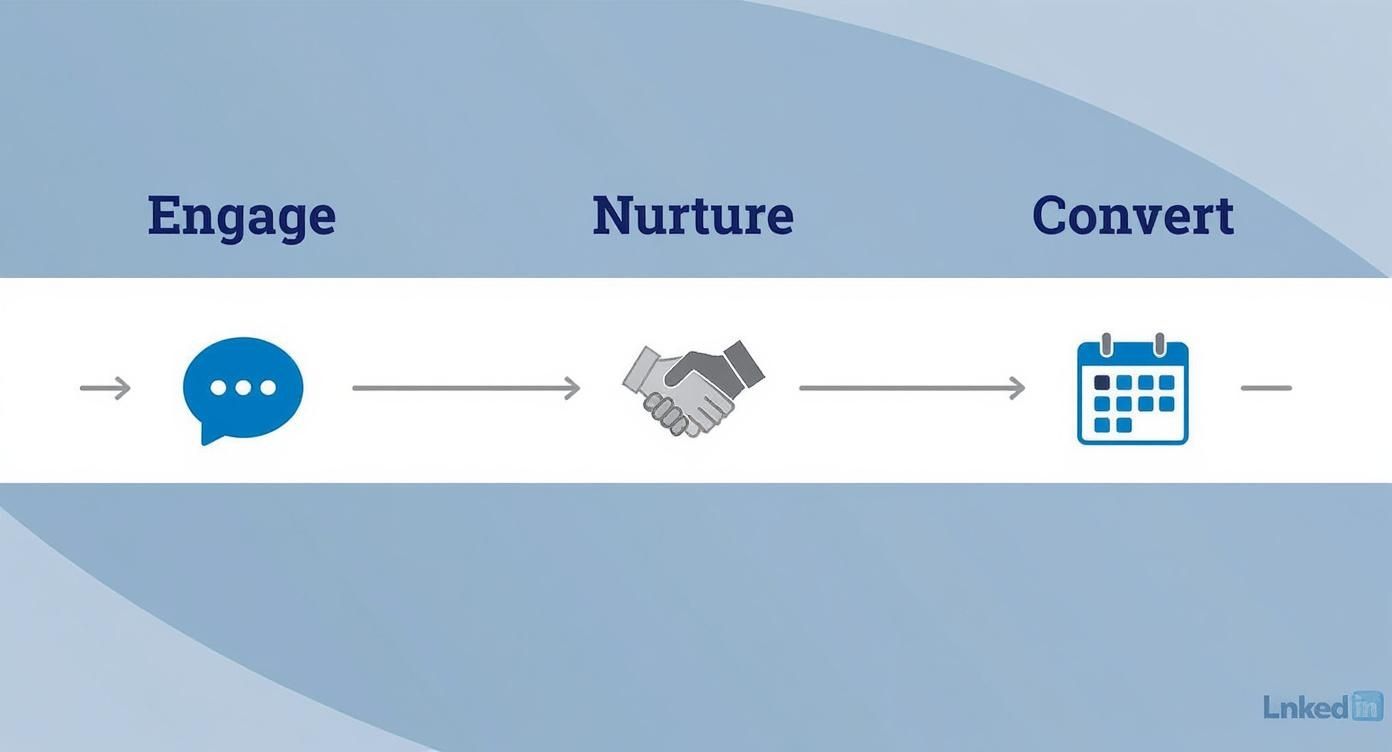
As you can see, engagement is just the first step. The real magic happens in the nurturing phase, which is what builds the trust needed to convert.
Your 30-60-90 Day Action Plan
Building momentum is everything. Don't try to boil the ocean on day one. Instead, break your strategy down into a phased plan. This helps you score early wins and build habits that stick.
First 30 Days: Focus on Foundations & Activity
Your only goal here is consistency. Block out 30-45 minutes every single day for your LinkedIn routine.
- Daily: Send 15-20 personalized connection requests to your ideal clients.
- Daily: Drop 5-10 insightful comments on posts from prospects and industry leaders.
- Weekly: Publish 2 pieces of high-value content.
- Goal: Book your first 1-2 meetings. That's it. Prove the concept.
Days 31-60: Focus on Optimization & Nurturing
You've got some data now. Time to put on your lab coat and analyze what's happening.
- Analyze: Dig into your connection acceptance and reply rates. Which messages are getting responses? Which are falling flat?
- Refine: Tweak your outreach templates and content pillars based on what people are actually engaging with.
- Nurture: Circle back to those connections who liked a post or replied positively but didn't book a call.
- Goal: Build a predictable flow of 3-5 meetings per month.
Days 61-90: Focus on Scaling & Systemization
You've proven the model. Now it's time to pour some fuel on the fire.
- Document: Create simple playbooks and templates for your outreach and content. Make it dummy-proof.
- Empower: Train another person on your team (a sales rep, a founder, a VA) to run the exact same playbook.
- Explore: Look into responsible automation tools—things like profile viewers that can increase your visibility without being spammy.
- Goal: Double your meeting volume by cloning what works.
This structured plan transforms LinkedIn from a messy to-do list into a documented, repeatable system. It’s the difference between a few lucky wins and building a genuine asset for your business that keeps on giving.
Got Questions About LinkedIn Lead Gen? Let's Clear Them Up.
Even with a perfect playbook, questions always pop up once you start getting your hands dirty. Let's tackle some of the most common ones I hear so you can keep moving forward without a hitch.
How Many Connection Requests Should I Be Sending Every Day?
It’s easy to think more is better, but blasting out connection requests is a one-way ticket to getting your account restricted. Trust me, you want to avoid that headache.
The real magic happens with quality over quantity.
Focus on sending 20-30 highly personalized requests a day. When you're only reaching out to people who are a dead ringer for your ideal client, your acceptance rates—and more importantly, your reply rates—go through the roof. It shows you’ve done your homework.
What's More Important: My Personal Profile or My Company Page?
This one’s not even a fair fight. For B2B sales, your personal profile is everything.
Think about it: people buy from people they know, like, and trust. Not from a logo. Your personal profile is where you build relationships, share your insights, and have actual conversations.
Your company page is still important, but it plays a supporting role. It's the digital brochure—a place to park case studies, official announcements, and company-wide content. It’s a credibility checkpoint.
Your profile is the salesperson; your company page is the brochure. Use them that way. Prospects will check both, but the conversation starts with you.
Is LinkedIn Sales Navigator Actually Worth the Money?
Short answer: if you're serious about this, yes. Absolutely. Trying to do scalable prospecting with a free LinkedIn account is like trying to build a house with a screwdriver. You just don't have the right tools for the job.
The advanced search filters in Sales Navigator are the game-changer. You can dial in your targeting with laser precision—filtering by things like company headcount, department size, or even if someone has changed jobs in the last 90 days.
This level of detail is impossible on the free version. It saves you dozens of hours and ensures every person you reach out to is a high-quality fit, making the investment a no-brainer.
How Long Does It Really Take to See Results?
This isn't an overnight thing. Patience and consistency are your best friends here. You’ll see some early wins—like more profile views and connection requests getting accepted—within the first 30 days. That's the initial traction.
But for real, bottom-line results? You should expect to see meaningful conversations and your first qualified meetings landing on the calendar within 60 to 90 days. This system is all about building momentum. The key is to show up and do the work every single day.
Ready to turn your team's LinkedIn presence into a predictable pipeline of qualified meetings? Growlancer builds and executes a complete done-for-you system, combining expert strategy, authority content, and targeted outreach to deliver measurable revenue results. Learn how we can build your sales pipeline on LinkedIn.