

Let's be honest, "B2B sales funnel" sounds like something you'd hear in a stuffy MBA lecture. But forget the jargon for a second.
At its core, a B2B sales funnel is just a map. It's the path a complete stranger takes to become a paying customer. It’s not just a sales process; it's a predictable, repeatable system that gets your marketing and sales teams rowing in the same direction to turn those strangers into long-term clients.
Unpacking the Modern B2B Sales Funnel
The classic image of a funnel—wide at the top, narrow at the bottom—is a decent starting point, but it doesn't really tell the whole story anymore. Today's B2B buying journey is way too complex for that simple model.
Think of it less like a rigid filter and more like a guided tour for smart, self-reliant buyers.
Imagine your ideal prospect is planning a massive, cross-country road trip. Their destination? Solving a huge business problem. They could try to figure it out on their own, using a mess of outdated maps and questionable advice from strangers. They'd probably get lost, frustrated, and maybe even give up.
Your sales funnel is the premium GPS navigation system for that trip.
It doesn’t force them down one specific highway. Instead, it shows them the clearest, most efficient route based on exactly where they want to go. It points out the best rest stops (your valuable content) and even suggests a few scenic detours (webinars and case studies). The goal isn't to control their journey, but to make it so logical and helpful that they arrive at their destination—your solution—feeling confident they made the right choice.
Why This Guided Journey Is No Longer Optional
The game has changed. Your buyers aren't waiting for a sales rep to call them anymore. They're out there doing their own homework long before you even know they exist.
Buyers are now in the driver's seat, completing 70-90% of their research on their own before ever talking to someone on your team. This is happening because an estimated 80% of all B2B sales interactions are now digital.
The proof is in the numbers: companies that build strong, digitally-focused top-of-funnel strategies see up to 18 times greater revenue growth. You can read more about how modern buyer behavior impacts sales funnels.
A well-built sales funnel accepts this new reality. It creates a system to meet buyers where they are, ensuring your marketing and sales efforts are perfectly in sync. For founders and revenue leaders, this isn't just about process. It's the blueprint for predictable growth.
A B2B sales funnel stops your sales process from being a bunch of random, disconnected activities and turns it into a smooth, data-driven machine. It gives you the clarity to find bottlenecks, forecast revenue, and scale your business without the guesswork.
When you master your funnel, you stop leaving deals to chance. You start building an engine that reliably attracts, nurtures, and closes your ideal customers, month after month.
To give you a clearer picture, here's a quick breakdown of how those stages typically look.
Key Stages of the B2B Sales Funnel
| Funnel Stage | Primary Goal | Prospect Mindset |
|---|---|---|
| Top of Funnel (TOFU) | Generate awareness and attract potential leads. | "I have a problem, but I'm not sure what the solution is yet. I'm just exploring." |
| Middle of Funnel (MOFU) | Nurture leads and educate them on potential solutions. | "I understand my problem better now. I'm comparing different approaches and solutions." |
| Bottom of Funnel (BOFU) | Convert qualified leads into paying customers. | "I've decided on a type of solution. Now I need to choose the right provider or partner." |
Each stage requires a different approach, different content, and a different conversation. We'll dive deeper into what that looks like in the sections ahead.
Mapping the Buyer's Journey Stage by Stage
A B2B sales funnel isn’t some rigid, one-size-fits-all flowchart. It’s a map of your buyer’s journey—a path they take from having a vague, nagging problem to confidently signing on the dotted line with you.
Each stage is a checkpoint in their thinking. They go from "Something's not right" to "What are my options?" to "This is the one for me." If you don't know where they are on that map, you’ll just be shouting into the void.
Think of it like being a specialist doctor. You wouldn't prescribe surgery in the first five minutes. You start by diagnosing the symptoms (Awareness), then you walk them through the treatment options (Consideration), and only then do you pick the best one and schedule the procedure (Decision). Your funnel needs to have that same logical, reassuring flow.
Stage 1: Top of Funnel (TOFU) – The Awareness Stage
Let’s be brutally honest: at the top of the funnel, nobody cares about you, your product, or your company. Not yet.
They're completely wrapped up in their own world, dealing with their own problems. They’re feeling the pain, but they haven't diagnosed the illness. They’re googling the symptoms.
Your only job here is to educate, not sell. The goal is to get in front of your Ideal Customer Profile (ICP) by being genuinely helpful. This is where you plant the first seed of trust and start building a reputation as the one who actually gets it.
What’s on their mind: "Our engineering team's productivity is in the tank," or "Our lead gen is a rollercoaster, and the leads are mostly junk."
Your goal: Be the resource they stumble upon during their late-night Googling. Attract the right people by talking about their problems, not your solutions.
What actually works here:
- Helpful Blog Posts & Articles: SEO-focused content that answers the high-level questions they’re asking.
- Real Talk on LinkedIn: Sharp, insightful posts from your leaders that offer a point of view on industry headaches.
- Webinars and Podcasts: Purely educational sessions that dissect a common problem. No heavy sales pitch allowed.
- Infographics and Quick Videos: Content that’s easy to scan and digest, making complex ideas simple and your brand memorable.
Stage 2: Middle of Funnel (MOFU) – The Consideration Stage
Okay, so they've put a name to their problem. They’ve moved from diagnosis to exploring cures. Now, they’re actively researching and comparing different types of solutions. They've gone from, "What's wrong with us?" to "How do we fix this?"
This is where you pivot. You’re no longer just a helpful stranger; you're a potential guide. Your content needs to gently steer them, showing them why your category of solution is the smartest way forward. You're building a case for your methodology.
What’s on their mind: "We definitely need a new project management system," or "Maybe we should just outsource our content creation."
Your goal: Earn their trust and show them the path. Nurture the relationship by educating them on the why behind your approach, making your type of solution seem like the obvious choice.
You're not just selling a product here; you're selling a vision of a less stressful, more profitable future. This is why case studies and deep-dive guides are absolute gold—they let the prospect see that future for themselves.
What actually works here:
- Case Studies and Success Stories: Proof. Hard evidence that you’ve solved this exact problem for a company just like theirs.
- In-depth Guides and Whitepapers: Meaty, comprehensive resources that establish you as the authority on solving this specific problem.
- Product Comparison Pages: Honest, straightforward comparisons that show where you shine against other options or categories.
- Expert-Led Webinars: Sessions that connect their specific challenges to the kinds of features and benefits a solution like yours offers.
Stage 3: Bottom of Funnel (BOFU) – The Decision Stage
This is it. The moment of truth. They’ve done their homework, they know what kind of solution they need, and they've narrowed it down to a shortlist. Now, the final question is simply: "Who do we go with?"
At this point, it’s all about making them feel confident they’re making the right choice. Your sales team is likely in the driver's seat, but your content still plays a huge role in knocking down any final barriers. It’s about justification and removing risk.
What’s on their mind: "Which vendor has the best support for integration?" or "Let's get a demo from Growlancer and see how it stacks up against hiring someone."
Your goal: Close the deal. Prove, beyond a shadow of a doubt, that your solution is the best possible fit for their unique situation.
What actually works here:
- Live Demos and Product Tours: A personalized walkthrough showing them exactly how your solution will make their specific pains go away.
- Free Trials or Pilots: Let them kick the tires. A hands-on experience is the most powerful sales tool you have.
- Custom Proposals and Pricing Pages: Crystal-clear documents that spell out the value, the ROI, and exactly what they're getting.
- Client Testimonials and Reviews: A chorus of happy customers to drown out any last-minute doubts and give them the social proof they need to sign.
Using LinkedIn to Power Every Funnel Stage
A sales funnel is a nice theory. But a theory doesn't pay the bills.
For any modern B2B company, the highest-octane fuel for that funnel is LinkedIn. It’s where over 65 million decision-makers are hanging out, swapping ideas, and looking for solutions. Trying to grow without it is like setting up shop on a street nobody drives down.
You have to meet buyers where they already are.
By being systematic about it, you can turn LinkedIn from a glorified Rolodex into a predictable pipeline machine. The idea is to build trust and authority with the right people long before they even think about asking for a demo.
This flowchart shows how buyers think as they move from just realizing they have a problem to finally signing on the dotted line.
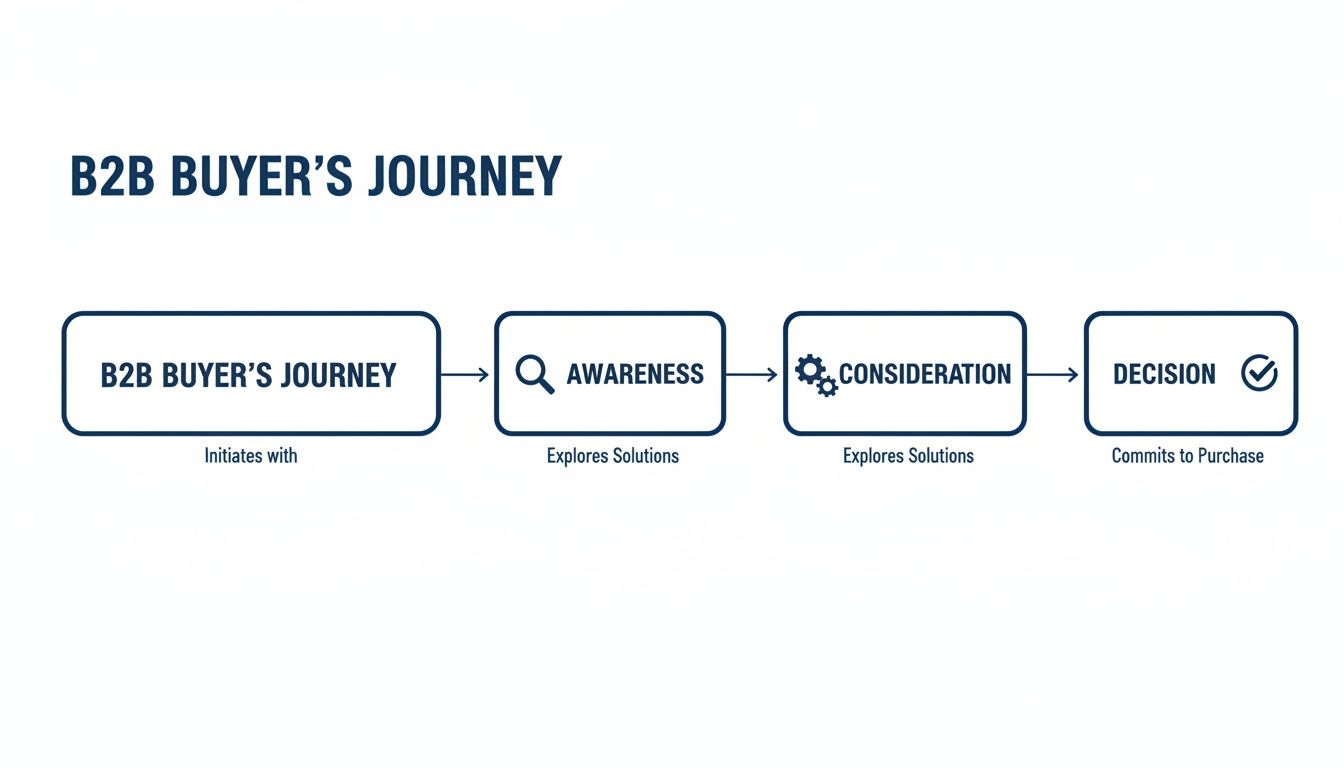
Your LinkedIn game has to change at each step to match their mindset.
Top of Funnel: Plant Your Flag with Authority
At the top, in the Awareness stage, your ideal customer isn't looking for a sales pitch. They’re barely even aware they have a problem you can solve. All they know is something hurts.
Your job on LinkedIn is to become their go-to source for understanding that pain. This isn't about your company page—it’s about your executive team’s personal profiles. People buy from people, not logos. An authentic, expert take from a leader cuts through the corporate noise every time.
Actionable LinkedIn Tactics for Awareness:
- Executive Thought Leadership: Get your key executives posting 3-5 times a week. They should be talking about industry pain points, challenging old assumptions, and sharing their unique point of view.
- Company Page as Amplifier: Use the company page to reshare the best content from your execs, post company news, and show off your team culture. It’s for building brand credibility, not generating leads directly.
- Smart Engagement: Spend 15-20 minutes a day dropping genuinely insightful comments on posts from industry leaders and potential prospects. Add to the conversation. Don't just "like" and run.
This is all about building a magnetic brand. When someone in your target market finally has that "aha!" moment and realizes they have a problem, you want your name to be the first one that pops into their head.
Middle of Funnel: Guide Prospects with Value
Once a prospect knows they have a problem, they start looking for answers. This is the Consideration stage. Your strategy shifts from broad thought leadership to targeted engagement.
Now, the goal is to gently pull them into your world by educating them on why your way of solving the problem is the best way. This is where outreach comes in, but not the spammy kind. Forget the automated connection requests with an immediate pitch attached. You need to lead with value.
Actionable LinkedIn Tactics for Consideration:
- Value-First Outreach: Use Sales Navigator to find perfect-fit prospects. Send them a personalized connection request that mentions something specific—a post they wrote, a shared connection, a common group.
- Content as a Trojan Horse: After connecting, don't pitch. Share something useful. Invite them to a webinar you’re hosting or send over a case study that’s directly relevant to their business.
- Nurture Inbound Interest: Keep an eye on who’s engaging with your posts. If a high-value prospect consistently likes or comments, slide into their DMs. Thank them for the engagement and ask an open-ended question to start a real conversation.
By giving value without asking for anything in return, you instantly stand out from the 90% of other reps who are just racing to book a meeting. You become a trusted advisor, not just another vendor.
Bottom of Funnel: Convert Intent into Conversations
At the Decision stage, your prospects are actively comparing vendors. On LinkedIn, you'll see this as inbound messages asking for info, or comments on your posts like, "This is exactly the problem we have."
Your job is to catch these buying signals and act fast. The only goal here is to move the conversation off LinkedIn and onto a proper sales call. You need a process to make this transition as smooth as possible.
Here's a dead-simple framework for handling an inbound DM:
- Acknowledge & Validate: "Thanks for the message. Sounds like [their problem] is a big priority for you."
- Offer the Path Forward: "We live and breathe this stuff. The easiest way to see if we're a fit is a quick 15-minute chat to hear more about your situation."
- Remove the Friction: "Here’s my calendar link to grab a time that works. Talk soon."
For any founder or sales leader, mastering LinkedIn for B2B sales isn't just a nice-to-have; it's how you build a reliable pipeline. A systematic approach means you're not just throwing content at the wall and hoping it sticks—you're actively building relationships and guiding buyers through your funnel.
LinkedIn Tactics Mapped to Funnel Stages
To pull this all together, think of your LinkedIn activity as a set of tools. You wouldn't use a hammer to turn a screw. Likewise, the tactics you use at the top of the funnel won't work at the bottom.
This table breaks down exactly what to do, what content to use, and how to measure success at each stage.
| Funnel Stage | LinkedIn Tactic | Content Example | Primary KPI |
|---|---|---|---|
| Top (Awareness) | Executive Thought Leadership Posts | A post challenging a common industry myth. | Profile Views, Follower Growth, Post Engagement |
| Middle (Consideration) | Value-Driven Outreach, Targeted Content Sharing | Sharing a relevant case study in a DM. | Connection Acceptance Rate, DM Reply Rate |
| Bottom (Decision) | Handling Inbound Messages, Prompt Follow-up | Sending a Calendly link to a warm prospect. | Sales Qualified Leads (SQLs), Meetings Booked |
Using this map, you can ensure every action you take on LinkedIn serves a specific purpose, systematically moving ideal prospects from stranger to customer.
Measuring What Matters for Funnel Health
A B2B sales funnel without data is just a collection of hopeful guesses.
If you want to build a predictable revenue engine, you have to stop flying blind. It's time to start measuring what actually drives growth. That means getting past surface-level vanity metrics—likes, follows, shares—and zeroing in on the key performance indicators (KPIs) that reveal the true health of your pipeline.
Think of your funnel like a high-performance engine. You wouldn't just check if the paint is shiny; you’d monitor oil pressure, temperature, and RPMs. It's the same deal here. Metrics like conversion rates, lead velocity, and acquisition costs are your dashboard, giving you the insights to diagnose problems before they cause a total breakdown.
Core Funnel Performance Metrics
To get a clear picture of your funnel's efficiency, you only need a handful of core metrics that tell a story. Together, they show how fast you're growing, what that growth is costing you, and how well you’re turning conversations into cash.
Let's break down the vitals every B2B leader should have their eyes on.
-
Stage-by-Stage Conversion Rate: This is simply the percentage of prospects that move from one stage of your funnel to the next. For example, what percentage of Marketing Qualified Leads (MQLs) actually become Sales Qualified Leads (SQLs)? Tracking this shows you exactly where your funnel is "leaking." It helps you pinpoint the biggest bottlenecks in your entire process. If you see a sudden drop-off between the Consideration and Decision stages, it could be a red flag for your demos or proposals.
-
Lead Velocity Rate (LVR): This metric tracks the month-over-month growth in your qualified leads, and it's a powerful crystal ball for future revenue. If your LVR is 10%, it means the number of real, qualified leads you're generating is growing by 10% each month. That’s a damn good predictor of sales growth next quarter.
Your Lead Velocity Rate is the speedometer for your sales engine. It doesn't just tell you how fast you're going right now; it tells you if you're accelerating. A consistently high LVR is one of the clearest signs of a healthy, scalable B2B sales funnel.
- Sales Cycle Length: This is the average time it takes for a lead to go from that first "hello" to a signed contract. A long or, worse, a lengthening sales cycle points to friction. Maybe your pricing is too complicated or your sales team is slow on the follow-up. Shaving even a few days off this cycle can seriously impact cash flow and overall efficiency.
Understanding Your Financial Guardrails
Beyond the operational stuff, you need to know if you're actually making money. These next numbers connect your sales and marketing grind directly to the bottom line, proving your efforts are worth the investment.
Customer Acquisition Cost (CAC): This is the total cost of sales and marketing divided by the number of new customers you brought in over a set period. It answers the big question: "How much are we paying to land one new customer?" A high CAC could mean you're burning cash on inefficient ads or your sales team is wasting time on tire-kickers. For a deeper dive, check out our complete guide on how to measure marketing ROI.
Customer Lifetime Value (LTV): This metric shows you the total revenue you can expect from a single customer over the entire time they do business with you. When you compare LTV to your CAC, you see the long-term profitability of your whole strategy. A healthy B2B business should be aiming for an LTV to CAC ratio of 3:1 or higher. If it costs you $1 to get a customer, you want to make at least $3 back.
By keeping a close eye on these core numbers—both operational and financial—you turn your funnel from a vague concept into a data-driven machine for making smart decisions and hitting predictable growth targets.
Plugging the Leaks in Your B2B Sales Funnel

Even the most buttoned-up B2B sales funnel springs a leak now and then. Prospects ghost you, promising leads go cold, and those revenue forecasts start to feel like wishful thinking.
But here’s the thing: these problems aren't failures. They’re signals. They’re data points telling you exactly where your system needs a wrench.
Think of your funnel like the plumbing in your house. A tiny drip in one pipe can kill the water pressure on the whole second floor. Your goal isn't to build a system that never, ever leaks. It's to know how to spot the drips fast and have the right tools to patch them up.
This is your troubleshooting guide. We'll diagnose the most common leaks and give you practical ways to fix them, turning your funnel from a frustrating liability into a reliable revenue engine.
The Case of the Vanishing Prospect: High Drop-Off Rates
This is the classic one. A ton of prospects pour into a stage, but only a trickle makes it to the next. It’s the definition of a "leaky funnel."
More often than not, a big drop-off signals a mismatch. Your messaging isn’t hitting home for where that prospect is in their journey.
If leads are disappearing right after the first discovery call, your sales team is probably talking features instead of diagnosing pain. If they vanish after you send the proposal, your value prop isn't connecting the dots between your solution and their biggest headache.
How to Fix a Leaky Funnel:
- Nurture, Don't Ditch: Not everyone is ready to sign on the dotted line today. Instead of letting them drift away, drop them into a nurturing sequence. Send them case studies or webinar invites. Keep your name in front of them so when they are ready, you’re the one they call.
- Fix the Handoff: The pass from marketing to sales needs to be seamless. Your sales team needs the full backstory—what pages they visited, what content they downloaded. The first call should feel like the next logical step, not a jarring cold intro.
- Stop Sending Generic Crap: Are your proposals and demo decks one-size-fits-all? Big mistake. They need to be tailored to the exact pain points you uncovered in discovery. Every piece of collateral should scream, "We heard you."
The "Junk Lead" Problem: Low-Quality Inbound
Is your sales team complaining about junk leads? It’s a massive drain on time, money, and morale. A high volume of leads means absolutely nothing if they’re the wrong people.
This problem almost always starts at the very top of your funnel. The root cause? A fuzzy Ideal Customer Profile (ICP).
When you don't have a crystal-clear picture of who you're selling to, your marketing becomes a giant, sloppy net. You'll catch a few good fish, but you'll also drag in a ton of junk you have to sort through.
A vague ICP is the root of most marketing waste. You end up creating content for everyone, which ultimately resonates with no one, filling your B2B sales funnel with prospects who are a poor fit from the start.
How to Get Better Quality Leads:
- Get Granular with Your ICP: Go way past job titles and company size. What specific business pains are they dealing with? What software are they already using? What’s the "trigger event" that sends them looking for a solution like yours? Get specific.
- Sharpen Your ToFu Content: Ditch the broad, generic blog posts. Start creating content that speaks directly to the niche problems of your ICP. The right content naturally repels the time-wasters and acts like a magnet for high-quality prospects.
- Qualify Smarter, Not Harder: Set up lead scoring in your CRM. Automatically rank leads based on who they are and how they’ve engaged with you. This ensures your sales team invests their precious time on people who are actually likely to buy.
By getting proactive and fixing these common issues, you can stop fighting with your funnel. You can turn it into what it's supposed to be: a predictable, scalable system for bringing in revenue.
Your Action Plan for a Predictable Pipeline
All the theory in the world doesn’t matter if you can't put it into action. Knowing how a funnel works is one thing; actually building one that prints money is another. This is the part where we turn all those concepts into a clear, four-step playbook that you can start running with today.
This isn’t about ripping everything out and starting from scratch. It’s about methodically putting the right pieces in place to build a reliable machine that spits out qualified opportunities.
Step 1: Get Obsessed With Your Ideal Customer Profile
Before you write a single line of copy or send one connection request, you need to know exactly who you're talking to. And I mean exactly. A fuzzy Ideal Customer Profile (ICP) is the #1 reason sales efforts fail. It leads to low-quality leads and countless wasted hours.
Forget basic demographics. You need to dig deeper. Pinpoint their biggest headaches, what triggers them to start looking for a solution, and the exact words they use to describe their problems. Nailing this makes every other step ten times easier.
Step 2: Build Your Authority Content Engine
Now it's time to create content that speaks directly to the pains you just identified. The goal isn't to shout about your product from the rooftops. It’s to position your company's leaders as the absolute go-to experts in your space.
Fire up a system that consistently pumps out real value—whether that's through sharp LinkedIn posts, in-depth articles, or practical webinars. You want to be the resource they stumble upon when their research journey is just beginning, building trust long before they're ever ready for a sales call.
Building a predictable pipeline starts with a simple principle: become the most helpful voice in your market. When you consistently educate your ideal customers, they naturally gravitate toward you when they're ready to buy.
Step 3: Launch a Targeted Outreach System
Once you've built that foundation of authority, you can start proactively reaching out to perfect-fit prospects. This isn't about blasting a generic message to a list of 1,000 people. It's a surgical approach to starting real conversations, usually on a platform like LinkedIn where your prospects are already living.
Develop personalized messages that lead with value, not a desperate pitch. The entire point is to gently guide people from your helpful content into a discovery call. It's a natural, seamless transition from the middle of the funnel to the bottom.
Step 4: Nail the CRM Handoff
Finally, don't let a qualified lead slip through the cracks. A clunky handoff from your outreach to your CRM can kill a deal before it even starts. For a deeper dive, check out our guide on how to build a sales pipeline that captures every single opportunity.
This last step ensures your sales team gets the full picture and has all the context they need to walk in and close the deal.
Your Questions, Answered
Alright, we've covered a lot of ground. But theory is one thing, and the real world is another. Let's tackle some of the most common questions that pop up when you start putting this B2B sales funnel stuff into practice.
How Long Is a Typical B2B Sales Cycle, Really?
I wish I could give you a single number, but the honest answer is: it depends. The length of your sales cycle is tied directly to the price tag, the complexity of your solution, and how many people need to sign off on the check.
For a straightforward SaaS tool, you might be looking at a 3-6 month cycle. But if you’re selling a complex, six-figure enterprise platform that needs a dozen approvals from legal, finance, and IT? Buckle up for a 6-12 month journey, sometimes even longer. The real trick isn't to shorten it—it's to have the right plays (content, touchpoints, follow-ups) for every single stage of that marathon.
What’s the Real Difference Between a B2B and B2C Funnel?
It all comes down to the buyer. B2C is about one person making a decision, often driven by emotion. It’s a gut feeling, a quick purchase, a problem solved right now.
B2B is a different beast entirely. You're not selling to a person; you're selling to a committee. They aren't buying on a whim. They're making a calculated, rational decision that has to be justified with ROI, integration specs, and long-term value. This means your funnel needs to be less about impulse and more about education, trust-building, and proving your worth through demos, proposals, and intense negotiations.
Think of it this way: a B2C funnel is a sprint for a single runner. A B2B funnel is a team relay race where every handoff has to be perfect.
How Can We Actually Improve Our Funnel Conversion Rates?
Stop trying to fix everything at once. The key is to find the biggest leak in your funnel—the stage where you lose the most prospects—and plug that hole first.
It's about making small, strategic tweaks, not a massive overhaul.
- Top of Funnel: Is your targeting too broad? Get ridiculously specific with your Ideal Customer Profile (ICP). Attracting the right people from day one is half the battle.
- Middle of Funnel: Are your follow-ups generic? Ditch the "just checking in" emails and send them a case study that mirrors their exact industry and challenges. Make it impossible for them to ignore.
- Bottom of Funnel: Are your demos a feature dump? Wrong move. Your demo should be a direct solution to the specific problems they told you they have. Nothing more, nothing less.
Test these small changes, measure the results, and repeat. That’s how you build a funnel that doesn't just look good on a whiteboard but actually closes deals.
Ready to stop guessing and start building a predictable pipeline? Growlancer builds and manages your entire LinkedIn GTM system—from executive authority content to targeted outreach—delivering qualified meetings directly to your sales team's calendar. Learn how we build predictable revenue on LinkedIn.