

Let's be honest, inbound B2B marketing isn't about creating "valuable content." It's about being so genuinely helpful that your ideal customers feel pulled toward you, not pushed.
Forget generic sales pitches. This is about building trust and positioning your company as the only logical choice when someone is finally ready to buy. You become the go-to authority, attracting buyers who are already looking for what you sell.
Why Inbound Is a Go-to-Market Imperative
The old B2B playbook is officially dead. Cold calls get you sent to voicemail, and mass email blasts are a one-way ticket to the spam folder.
Think about it. Today's B2B buyers are researchers. They’re already 70% of the way through their buying journey before they even think about talking to a salesperson. This isn't a small shift; it's a fundamental change in how people buy. If your go-to-market strategy hasn't adapted, you're already behind. An inbound program isn't just another channel—it's essential for predictable growth.
The Outbound Trap vs. The Inbound Engine
Picture a SaaS company burning through its budget with an outbound sales team. They're grinding it out every day, building lists, making calls, and sending emails that sound like everyone else's. The result? Sky-high customer acquisition costs, a pipeline full of low-intent leads, and a sales team on the verge of burnout. It’s a constant, exhausting hustle for completely unpredictable results.
Now, imagine a competitor playing a different game. They're building an inbound engine. They've positioned their executives as the go-to experts in a specific niche on LinkedIn, and they consistently publish content that speaks directly to their Ideal Customer Profile's biggest headaches.
- They answer the questions their ICP is secretly Googling.
- They share real-world stories and scenarios that make prospects nod and say, "That's us."
- They're building a genuine community of followers who actually trust what they have to say.
This company isn't chasing leads. Their ideal customers are finding them, bingeing their content, and reaching out when they're ready for a real conversation. That’s how you build a sustainable, predictable pipeline of high-intent prospects who already see you as a partner, not a vendor.
The core idea behind inbound is simple but powerful: Be the most helpful and credible voice in your space, and you'll become the only company a prospect seriously considers when it's time to buy.
The Data-Backed Case for Inbound
This isn't just a theory; the numbers don't lie.
Inbound marketing flat-out works for B2B, generating 54% more leads than old-school outbound tactics. It's also way more efficient. Three out of four inbound methods cost less than outbound, and we've seen cost-per-lead drop by as much as 80% after just five months of consistent effort.

This is why sales teams love inbound leads and why 46% of marketers report a better ROI from inbound than outbound. You can dig into more of these inbound marketing statistics on Sender.net.
Ultimately, this isn't just about getting more leads. It's about getting the right ones. It's about building a revenue engine that works around the clock, creating a magnetic brand that pulls in qualified buyers and fuels growth you can actually count on.
Defining Your Ideal Customer Profile with Precision
Let’s get one thing straight: every solid B2B inbound strategy is built on knowing exactly who you're talking to. Get this wrong, and you're just shouting into the void. Your content will be bland, your outreach will feel like spam, and your pipeline will be a guessing game.
This isn't about creating those fluffy "buyer personas" with stock photos and fake hobbies. We're talking about building a razor-sharp, data-backed Ideal Customer Profile (ICP). Think of it as a blueprint for the perfect-fit company for your solution. Without it, you’re making noise. With it, you build a magnet for the exact buyers you want.
Go Deeper Than Just Demographics
Most marketers stop at the basics—company size, industry, maybe geography. That’s a start, but it’s lazy. Firmographics tell you what a company is, not why they’d ever need you.
Real results come from digging into the triggers—the human stuff that actually drives a purchase. We need to move from a wide net to a spear.
A killer ICP doesn't just describe a company. It describes a company with a painful, urgent problem that you are uniquely equipped to solve. You're hunting for the signals that scream, "we need help now."
For instance, "SaaS companies with 50-200 employees" is a category. It's useless.
But "SaaS companies with 50-200 employees that just hired their first VP of Sales and are publicly griping about scaling challenges on LinkedIn"? Now that's a target. You see the difference? One is a datapoint; the other is a story with a clear problem you can step into.
How to Gather Real-World ICP Intel
To get this level of detail, you have to put on your detective hat. This isn't a one-and-done task; it's a constant process of listening and refining. The best intel is usually hiding in plain sight.
You need to be talking to people and digging through data.
- Your Best Customers: Get your happiest clients on the phone. Don't ask them what they like about you. Ask them, "What was the 'oh sh*t' moment that made you realize you had a problem?" or "Before us, what hacks were you using to get by?" The answers are gold.
- Your Sales Team's CRM Notes: Sales reps are on the front lines, hearing the raw, unfiltered truth every day. Dive into your CRM and read the notes from won and lost deals. Look for recurring pain points, objections, and who really had the power to sign the check.
- LinkedIn Sales Navigator: This tool is an absolute beast for this. Filter for your target companies, then stalk the key executives. What are they posting about? What groups are they in? How do they talk about their own challenges? This is market research served on a silver platter.
The goal is to build a rich, multi-dimensional profile of a real business with real problems. This is what makes sure your inbound b2b marketing efforts actually connect with accounts that will turn into revenue. For a more detailed breakdown, our guide on how to generate B2B leads dives even deeper into this.
Essential Components of a High-Impact B2B ICP
To make this practical, you need to document the key data points that will guide your content and outreach. The table below breaks down the must-have components for building an ICP that actually works.
| Component | Description | Example (for a Mid-Market SaaS) |
|---|---|---|
| Firmographics | The basic company stats. The "what" and "where." | Industry: B2B SaaS (Martech). Size: 50-250 employees. Revenue: $10M-$50M ARR. |
| Technographics | The tech stack they currently use. | Uses Salesforce for CRM, HubSpot for Marketing, and is actively hiring for sales roles on LinkedIn. |
| Pain Points | The specific, urgent problems they face. | "Our lead volume is inconsistent," "Sales team complains about lead quality," "Can't track marketing ROI." |
| Buying Triggers | Events that signal an immediate need for a solution. | Just hired a new VP of Sales, recently secured Series B funding, complaining about competitors on social. |
| Key Decision-Makers | The roles involved in the buying process. | Champion: Director of Marketing. Economic Buyer: VP of Sales/CRO. Influencer: Sales Ops Manager. |
| Watering Holes | Where they hang out and get information online. | LinkedIn Groups for SaaS leaders, follow specific industry influencers, listen to podcasts like "SaaS Breakthrough." |
By filling this out, you move from vague ideas to a concrete targeting document that everyone on your team can use.
Putting Your ICP to Work
Once you've built this profile, don't let it gather dust in a Google Doc. It needs to become the filter for everything you do.
Before you write a blog post, create a LinkedIn ad, or approve an outreach sequence, ask one simple question: "Would our ICP actually care about this?"
If the answer isn't a clear "hell yes," then don't do it. This relentless focus is how you stop wasting time and start attracting the customers who will build your business.
Creating Authority Content That Attracts Your ICP
Once you've nailed your ICP, you can finally stop spraying generic content into the void and start building real authority. This is where most inbound programs either take off or fall flat.
The mission is simple: Make your executive team the go-to voice in your niche. The one your ideal customers actually want to hear from.
Forget about random blog posts. We're building a system. A machine that turns your ICP's biggest headaches into content pillars that pull them in. The goal isn't just to be seen—it's to be trusted. Trust is what turns a passive scroller on LinkedIn into a qualified lead in your CRM.
From Pain Points to Content Pillars
Your ICP research is a goldmine. Every single pain point you uncovered is a potential content pillar—a core topic you can own completely.
Let’s say your ICP is constantly battling "unpredictable lead flow." Boom. That’s a pillar. From there, you can splinter off dozens of specific, high-value content pieces.
- Pillar: Unpredictable Lead Flow
- Sub-topics: Common lead quality mistakes, a framework for pipeline forecasting, the right way to calculate customer acquisition cost, why your marketing and sales alignment is broken.
Using this method means every post you publish is hyper-relevant. You’re not guessing what they want to read; you’re directly solving the problems keeping them up at night.
Developing Your Unique Point of View
In a noisy market, just pointing out the problem is table stakes. Real authority comes from having a unique perspective—a strong point of view (POV) that goes against the grain.
Don't just report on what's happening in your industry. Tell people why it's happening and what they should do about it.
An effective thought leader doesn't just say what's happening; they explain why it's happening and what smart leaders should do about it. This is the difference between being a reporter and being an authority.
For example, skip the generic "5 Tips for Better Sales" post. A strong POV sounds more like, "Why Your Sales Team's Demo-First Approach Is Killing Your Pipeline." It’s specific, it’s a little controversial, and it starts a real conversation. That's how you stand out.
If you want to go deeper on this, check out our guide on building a powerful thought leadership content strategy.
High-Performing Content Formats for LinkedIn
LinkedIn is the B2B arena. Your content system needs to be built for it, using formats that grab attention and prove you know your stuff. The key is mixing it up and staying consistent.
Content Types That Just Work:
- Text-Based Insights: Short, punchy posts with a strong opinion or a quick framework. Easy to scan, great for daily engagement.
- Carousels (PDFs): Perfect for breaking down complex ideas into simple, visual steps. A carousel on "The 3-Step Framework for ICP Refinement" will almost always outperform a text-only post on the same topic.
- Personal Stories with a Business Lesson: Tie a real-life experience to a professional challenge. This stuff builds a genuine connection.
- Simple Polls: Ask a sharp question tied to an ICP pain point. It’s a dead-simple way to start conversations and get a pulse on your market.
A steady publishing rhythm turns a static executive profile into a lead-gen asset. This is the momentum that fuels a predictable inbound engine.
Connecting Content to Search Intent
Ultimately, people have to be able to find you. SEO is still the king of B2B inbound channels for a reason—it generates double the revenue compared to others.
Why? Because B2B buyers conduct an average of 12 Google searches before ever talking to a salesperson. And right now, video is the most effective format at 58% effectiveness, beating out even traditional case studies.
With 74% of buyers doing over half their research online, a consistent stream of optimized, authoritative content isn't a "nice-to-have." For leadership teams, a system that consistently publishes can see up to 117% ROI from technical SEO alone. You can see more B2B marketing stats that highlight the power of SEO-driven content on DBS Website.
Building Your Targeted Outreach and Nurturing Engine
Let’s be honest. Creating great content is only half the battle. You could write the most insightful article in the world, but if you just sit back and wait for your perfect prospects to find it, you're playing a slow, unpredictable game.
The real acceleration happens when you bolt a systematic outreach engine onto your authority content. This isn't about spamming connection requests. It's about using the trust you’ve built to start actual conversations and turn cold prospects into warm, qualified meetings for your sales team.
The whole point is to create a predictable flow. You identify a real pain point, address it with content that shows you get it, and then systematically convert the people you help into tangible leads.
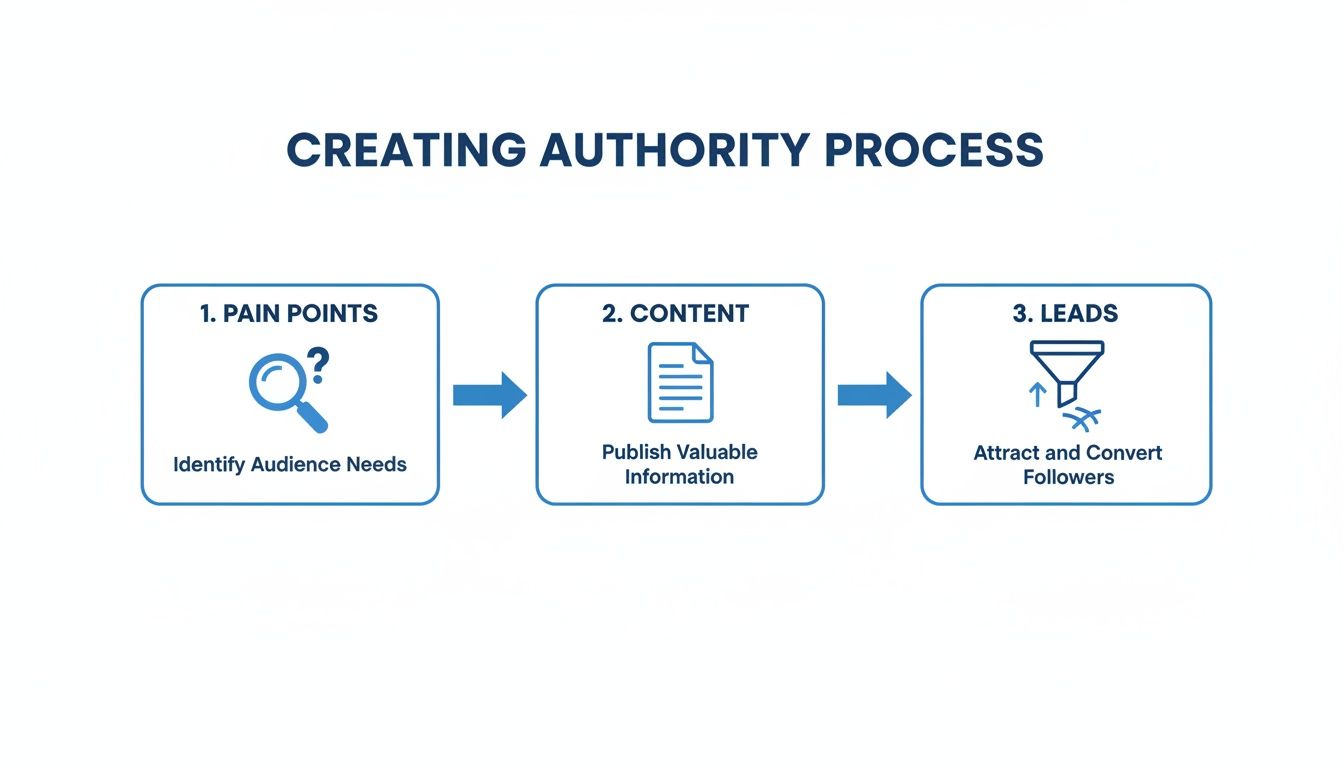
This simple diagram says it all. Your content isn't just an essay; it’s a tool built for one purpose: generating high-intent leads by solving real customer problems.
Crafting Outreach That Doesn't Feel Like Spam
The line between effective outreach and annoying spam is razor-thin, and it all comes down to relevance. All that deep ICP work you did? This is where it pays off, giving you the context to make every message feel personal.
Before you even think about hitting that "connect" button, spend 60 seconds doing your homework on their LinkedIn profile. You're looking for a hook.
- Shared Connections or Groups: Mentioning a mutual contact or a niche industry group is the fastest way to build common ground. It instantly makes you an insider, not an outsider.
- Recent Activity: Did they just share an article or comment on a post about a topic you know well? Reference it. A simple, "Loved your take on scaling sales teams in your post yesterday…" shows you’re actually paying attention.
- Company News: A funding announcement, a new product launch, even a key hire—these are all perfect, timely excuses to reach out and congratulate them.
Your goal is to make the connection request about them, not you. Keep the initial message short, genuine, and give them a reason to connect that has nothing to do with you wanting to sell them something.
The Art of the Follow-Up
Look, almost no B2B deal gets done on the first touch. The real work—and the real money—is in the follow-up. Once a prospect accepts your connection request, your job is to stay on their radar by providing value without being a pest.
A simple, effective nurturing sequence might go something like this:
- The "Thanks for Connecting" Message: A day after they accept, send a quick note. No pitch. Just a simple thank you and maybe a link to a high-value article you wrote that hits on one of their likely pain points.
- The Light Touch: A few days later, find one of their posts and leave a thoughtful comment. This is often way more powerful than another DM because it’s public and adds to their credibility.
- The Soft Ask: After a week or so of warming them up, it's time to connect the dots. You can now transition the conversation towards business, ending with a low-pressure ask like, "Would you be open to a quick chat next week to dig into this a bit more?"
This patient, value-driven approach earns you the right to ask for a meeting.
Your outreach shouldn't feel like a sales sequence. It should feel like a series of helpful conversations. You're trying to earn the right to a meeting, not demand one upfront.
Integrating Channels for a Predictable Pipeline
While LinkedIn is ground zero for B2B, the smartest plays integrate multiple channels. Email is still a monster—50% of B2B marketers say it delivers their highest ROI.
When you pair targeted LinkedIn outreach with automated email nurturing, you build a machine. We've seen this approach deliver 33% more sales-qualified leads at a much lower cost. The key is tracking every interaction in your CRM; teams that do this are 128% more likely to hit their numbers. For more data on this, check out the B2B marketing research from 99firms.com.
From Conversation to Calendar
The final piece of the puzzle is the handoff. How do you get an engaged prospect from a LinkedIn DM onto a sales call without fumbling the ball?
Make it frictionless.
Once they show interest, drop a scheduling link from a tool like Calendly or HubSpot Meetings. Eliminate the annoying back-and-forth of "what time works for you?" and make it dead simple for them to book.
And this is critical: every single one of these interactions gets logged in your CRM. The initial connection, the follow-up messages, the booked meeting—everything. This is the discipline that turns random acts of outreach into a predictable B2B marketing engine that actually grows the business.
Measuring Pipeline Impact and Scaling Your Program
All the authority content and targeted outreach in the world mean nothing if they don’t actually move the needle.
Let's be blunt. An inbound program isn't measured in likes, comments, or how many followers you have. It's measured in what the C-suite actually cares about: pipeline and revenue.
Ditching these vanity metrics is the only way to prove this whole thing is working. It's how you build a rock-solid case to keep the investment coming. You need a dead-simple way to track the numbers that connect directly to the bottom line.
Tracking the KPIs That Actually Matter
To show real business impact, you have to start telling a financial story. The goal is to draw a straight line from your activity on LinkedIn to closed deals in your CRM. That’s how you prove this inbound engine is doing more than just starting conversations.
I tell my clients to obsess over three core metrics:
- Qualified Meetings Booked: This is your primary output. How many legitimate sales calls did your inbound efforts generate this week? This month?
- Pipeline Value Generated: For every meeting that lands on the calendar, what’s the potential deal size? This number translates your work into the language of sales and leadership.
- Customer Acquisition Cost (CAC): How much time and money are you spending to get each new customer through this channel? A low CAC is a powerful sign of an efficient system.
If you want to go deeper on this, our guide on how to measure marketing ROI breaks down the formulas and frameworks we use.
Your dashboard should ultimately answer one question: "For every dollar we put into this inbound program, how many dollars of qualified pipeline do we get back?" When you can answer that, you have a predictable growth engine.
And it’s not just me saying this. Look at HubSpot's State of Marketing report—proving ROI is still the top headache for marketers.
This is exactly why you need to be laser-focused on pipeline-centric KPIs. It's how you justify your budget and get the green light to scale.
Choosing Your Scaling Path
So, you've proven the model. You've got a consistent flow of qualified meetings coming in. The obvious next question is, "How do we pour gas on this?"
You really have two options, each with its own pros and cons: building an in-house team or bringing on a specialized agency.
Building an In-House Team
Taking everything in-house gives you total control. Your team lives and breathes your company culture and your product, which can lead to incredibly authentic content and outreach. No one knows your business better.
The flip side? It’s a serious investment in hiring, training, and management. You need to find people with a rare blend of skills: copywriting, social media chops, sales instincts, and CRM expertise. The ramp-up time can be painfully slow, and the cost of a full-time team adds up quickly.
Partnering with a Specialized Agency
Working with a done-for-you partner (like us at Growlancer) gives you speed and expertise right out of the gate. A good agency brings a proven playbook, battle-tested processes, and a team of specialists who have already scaled programs just like yours.
This route often gets you results faster and can be more cost-effective than hiring, since you get access to an entire team's skillset without the overhead.
The trade-off is giving up some direct control. That's why it's critical to find a partner who feels like a true extension of your team. They have to get your ICP, your value prop, and your voice, or it just won't work.
There's no single right answer here. The best path depends on your company's stage, your resources, and your long-term goals. The important part is to make a conscious choice, knowing the costs, benefits, and timelines for each option.
Still Have Questions? Let's Tackle Them.
Even with the best playbook in hand, I get it. Moving from what you know—like old-school outbound—to building an authority engine can feel like a big leap. It’s a different mindset.
So let's get straight to the questions I hear most often from B2B leaders. No fluff, just real answers based on what we see in the trenches every day.
How Long Until We Actually See Results?
This is always the first question, and it's the right one to ask. You're making an investment, and you need to see a return.
While building true authority is a long game, you shouldn’t have to wait six months to see if the engine is running. When you combine consistent, high-value content with targeted daily outreach, you can start booking qualified meetings in as little as 14 to 21 days.
The trick is momentum. Dabbling here and there gets you nowhere. But a disciplined, daily system that pushes out expertise and connects with the right people builds pipeline velocity faster than most expect. We often see a clear ROI kick in within the first one to three months.
Can a Small Team Really Pull This Off?
Yes. In fact, this approach is a small team’s secret weapon. It’s all about leverage.
Traditional outbound is a brute-force numbers game. You need a small army of reps hitting the phones and sending emails to make a dent. Inbound flips that script.
One sharp piece of content from your CEO can work for you 24/7, attracting hundreds of perfect-fit prospects over months. One smart outreach sequence can warm up dozens of potential buyers while you sleep. The real challenge for a small team isn’t the strategy—it's executing it day in, day out without fail.
This is where having a dialed-in system is non-negotiable. Whether you build an efficient internal workflow or work with a partner, the right system lets a lean team punch way above its weight class.
The power of inbound lies in leverage. A single, well-crafted piece of authority content from a key executive can attract hundreds of ideal prospects over time.
What's the Difference Between Inbound and Content Marketing?
Great question. People throw these terms around interchangeably, but they are not the same thing.
Here’s the simplest way I can put it: Content marketing is the ingredient, but inbound is the entire recipe.
- Content marketing is the stuff you create—the LinkedIn posts, the articles, the videos. It’s the value you put out into the world.
- Inbound marketing is the whole machine. It’s the strategy that uses that content to pull customers in. It includes everything from SEO and social media to the outreach, the follow-up sequences, and the CRM integration that turns a reader into a qualified meeting.
Publishing great content without an inbound system is like shouting into the void. An inbound system with no content is an empty funnel. You need both, working together, to build a predictable pipeline.
How Do You Actually Measure the ROI of Thought Leadership?
You have to look past the vanity metrics. Likes, comments, and follower counts feel good, but they don't pay the bills. They are signals of engagement, not proof of business impact.
To prove this is working, you need to track the metrics that lead directly to revenue.
Here’s what you should be laser-focused on:
- Inbound Demo Requests: How many people are reaching out to you, mentioning they saw your content?
- Lead Source Attribution: Is every single lead from LinkedIn getting tagged in your CRM? You need to track them from the first click all the way to a closed-won deal.
- Outreach to Meeting Rate: Your content warms up your outreach. What percentage of those messages are turning into actual meetings?
- Sales Cycle Velocity: Are leads who’ve seen your content closing faster than ice-cold leads? (Hint: They almost always do).
When you can draw a straight line from your LinkedIn activity to meetings booked and pipeline generated, you've cracked the code. That's how you prove the value of your inbound b2b marketing program.
At Growlancer, we don’t just talk about this stuff—we build these predictable pipeline engines for B2B companies. We take your team's expertise and turn it into a lead generation machine. See how we get it done at https://growlancer.ai.