

If your sales process feels like you're just winging it, you're not alone. But "winging it" doesn't close deals consistently.
Sales process optimization is about taking a hard, honest look at every single step in your sales cycle—from that very first cold email to the final "welcome aboard" call—and making it better. It means swapping guesswork for data. The goal is to find the hidden bottlenecks, smooth out the friction, and give your sales team a clear path to closing more deals, faster.
Tearing Down Your Current Sales Process

Before you can build a high-performance sales engine, you have to pop the hood on the one you've got. Most teams I see are running on autopilot, coasting on assumptions and the classic "this is how we've always done it." That's a surefire way to leave money on the table.
A real audit gets past the assumptions. It’s about mapping every touchpoint a customer has with your team, from first contact to signed contract, and finding the unvarnished truth of what's actually happening. It's not just about finding problems; it's about digging deep to understand the why behind them.
Finding the Friction and Unclogging the Bottlenecks
Your first mission is to pinpoint exactly where deals are slowing down, getting stuck, or just dying altogether. This friction isn't always obvious; it often masquerades as just another part of the daily grind.
You need to look for the clues hiding in your data and listen to what your reps are telling you:
- Deals Stuck in Limbo: Are proposals sitting in the "Sent" stage for weeks on end? That’s a classic sign. It could be a pricing problem, or maybe your reps aren't building enough value before sending the proposal.
- Post-Call Ghosting: Seeing a huge drop-off after the first discovery call? Either your qualification is way off, or your team isn't nailing the value prop right out of the gate.
- The Team is Burnt Out: Pay attention when your reps complain. If they’re constantly griping about clunky software or endless admin tasks, that’s not just noise. It’s a direct signal of friction that's eating up precious selling time.
Don't underestimate the power of a defined system. Studies show that companies with a formal, documented sales process pull in up to 28% more revenue than those just making it up as they go.
An audit without action is just an observation. The real value comes from creating a diagnostic blueprint that guides every subsequent decision you make in your sales process optimization journey.
Sales Motion vs. Customer Journey: Do They Even Match?
Here's where things get interesting. Take your internal sales map—the steps your reps are supposed to follow—and lay it next to the actual path your customers take. You’d be surprised how often they look nothing alike.
You might have "Product Demo" as step two, but your buyer needs to see a solid case study just to feel confident enough to even book that demo. Big disconnect.
This is where you lay the groundwork for a predictable sales pipeline. Once you understand every touchpoint, you finally get a clear picture of what actually moves a deal forward. To go deeper on this, check out our guide on how to build a sales pipeline that actually fuels growth. This audit gives you all the raw materials you need to start redesigning your stages and workflows for real impact.
To help you get started, here’s a quick checklist to guide your initial audit.
Sales Process Audit Checklist
This isn't exhaustive, but it's a solid starting point for poking holes in your current process and finding the low-hanging fruit for improvement.
| Audit Area | Key Questions to Ask | Success Metric |
|---|---|---|
| Lead Generation & Qualification | Where do our best leads come from? Are we qualifying them out too early or too late? What's our MQL-to-SQL conversion rate? | High MQL-to-SQL Conversion Rate |
| Sales Stage Velocity | How long does a deal spend in each stage? Where are the biggest time-sinks? Is there a stage with a high drop-off rate? | Low Average Stage Duration |
| CRM & Tech Stack | Is the CRM a tool for reps or a chore? Is data entry slowing them down? Are we actually using the tools we pay for? | High CRM Adoption/Usage |
| Content & Enablement | Do reps have the right case studies, one-pagers, and battle cards when they need them? Is our content aligned with the buyer's journey? | High Content Utilization Rate |
| Handoffs & Communication | Is the handoff from SDR to AE smooth? What about the handoff to Customer Success post-sale? Where are things falling through the cracks? | Low Customer Churn/Friction |
Use these questions to guide conversations with your team and your deep dive into the data. The answers you find will form the foundation for every optimization you make from here on out.
Designing Sales Stages Around Your Buyer
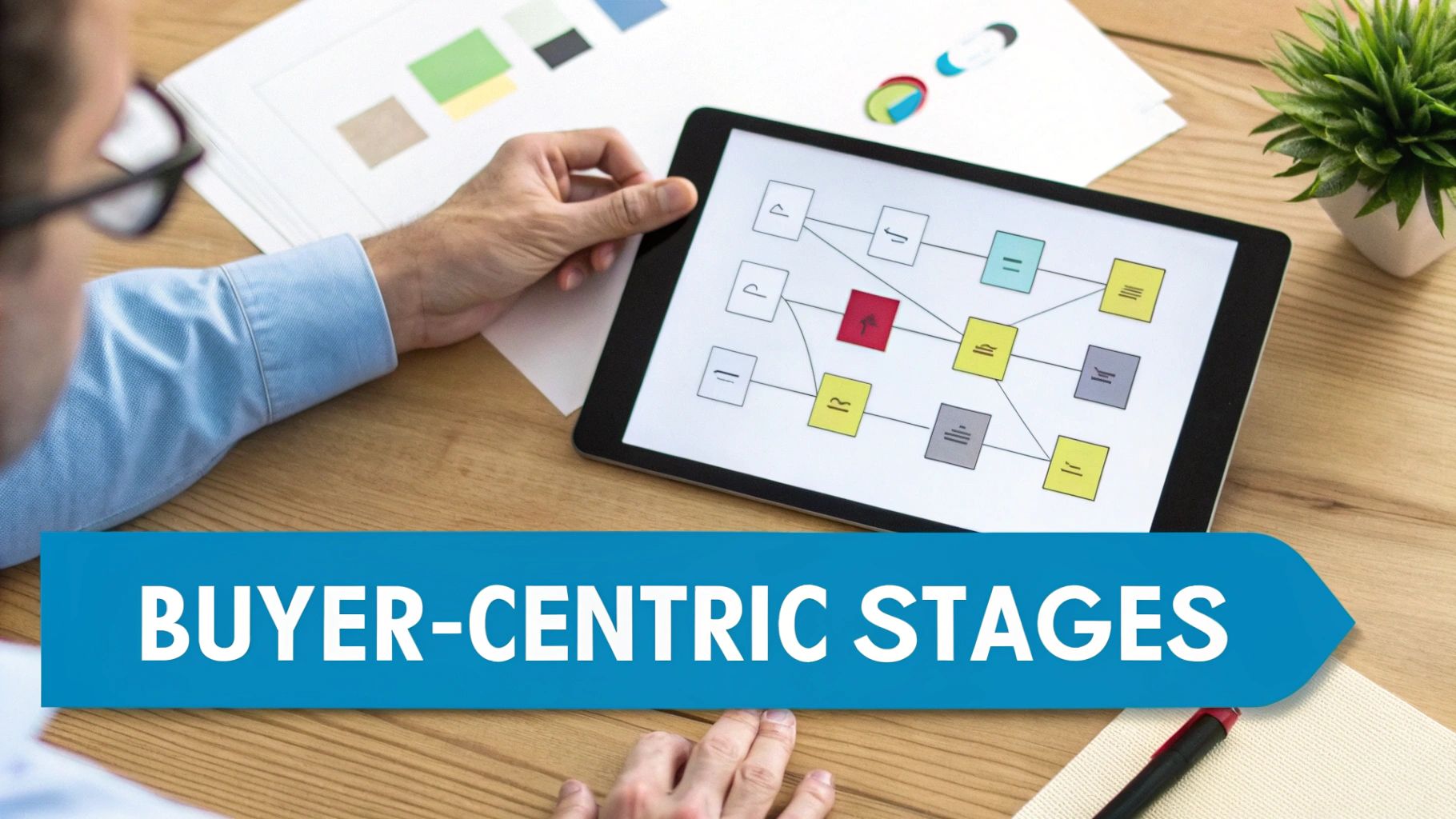
Let’s be honest. Most sales pipelines are a complete mess because they’re built backward. They force buyers into a clunky, unnatural process that just creates friction and kills deals.
Real sales process optimization starts by throwing out your old, internal playbook. You have to rebuild your sales stages to perfectly mirror how your ideal customer actually buys things.
This is a fundamental mindset shift. Stop thinking about what your reps are doing ("Demo Scheduled," "Proposal Sent"). Instead, define every single stage by what your buyer is doing. This buyer-centric view is the only way to ensure a deal moves forward because the prospect took a real, concrete action that shows they're serious.
Establish Concrete Entry and Exit Criteria
This whole approach falls apart without one thing: objective, non-negotiable gates for each stage. These are your entry and exit criteria.
This is how you get rid of the "gut feelings" and happy ears that lead to bloated, wildly inaccurate sales forecasts. If a deal doesn't meet the specific exit criteria for its current stage, it doesn't move. Period.
For example, a deal absolutely cannot leave the "Discovery" stage until the buyer has:
- Verbally confirmed they have a specific, recognized pain your solution actually solves.
- Agreed to pull in the economic buyer or the real decision-maker.
- Given you a clear timeline for when they need a solution implemented.
See the difference? These aren't just tasks for your salesperson to check off a list. They are commitments the buyer has to make. This simple switch turns your pipeline from a sales activity tracker into a true reflection of buyer commitment.
An optimized sales process is defined by buyer actions, not seller activities. When you align your stages with the customer's journey, your forecast becomes a reliable predictor of future revenue, not a wish list.
Implement Stage-Specific KPIs
Once you have clear, buyer-defined stages, you can finally attach meaningful KPIs to each one. This gives you incredible visibility into the health of your pipeline, letting you diagnose problems with surgical precision instead of just staring at a single, lagging win rate.
Here are a few metrics that actually tell you something:
- Stage Conversion Rate: What percentage of opportunities make it from Stage 2 to Stage 3? If that number is low, you know you have a specific breakdown—maybe your discovery calls are weak or the demo isn't hitting the mark.
- Average Time in Stage: Are deals getting stuck in "Negotiation" for 45+ days? That's a huge red flag. It tells you there’s likely a problem with your pricing, the clarity of your proposals, or even your initial qualification process.
Build a Simple Lead Scoring Model
Not all leads are created equal. We all know this, but few teams act on it. A simple lead scoring model is the fastest way to help your team focus their precious time on prospects who are actually signaling intent to buy.
This is a cornerstone of smart sales process optimization. It stops reps from wasting cycles on low-probability leads that were never going to close anyway.
Get started by assigning points across two main categories:
- Demographics/Firmographics: How closely does this person match your Ideal Customer Profile (ICP)? Give points for the right industry, company size, and—most importantly—job title. A VP-level contact might be worth +10 points.
- Behavioral Actions: What have they actually done? A demo request is a massive signal (+25 points), while a simple whitepaper download is far less indicative of immediate need (+5 points).
This system creates a clear threshold. Once a lead hits your target score, they flip to a Marketing Qualified Lead (MQL) and are officially ready for the sales team. This data-driven handoff is what ensures your reps are always working the hottest leads in the pipeline.
Using Technology and Automation for Efficiency
Let’s be honest: your CRM should be your team's secret weapon, not its biggest headache. Too often, it becomes a glorified rolodex that reps spend hours manually updating. The whole point of sales process optimization is to flip that script. We want to turn the CRM into the central command center for your entire sales motion.
The goal is simple: kill the repetitive, mind-numbing tasks that burn out your reps and eat up precious selling time. By building smart workflows, you can automate all the little things that have to get done but don't actually close deals—logging calls, sending follow-up reminders, or nudging a deal stage forward. Every task you hand off to the machine is another minute a rep can spend doing what they do best: building real relationships.
Building Intelligent CRM Workflows
Think about the most common, repeatable steps in your sales cycle. Those are your prime candidates for automation. It's not about replacing people; it's about giving them the leverage to get more done without anything slipping through the cracks.
Here are a few no-brainer automations you can set up today:
- Task Creation: A rep sends a proposal? The CRM automatically creates a task for them to follow up in 24 hours. No more sticky notes.
- Data Enrichment: Instead of having reps Googling company details, use tools that automatically pull in firmographics and contact info.
- Lead Rotation: New inbound lead comes in? It's instantly and fairly assigned to the right person based on territory, industry, or whatever rules you set.
This isn't just about saving time. It's about enforcing the process you've so carefully designed, making sure every single lead gets the right touch at the right time. Our guide on outbound lead generation digs deeper into how this kind of internal structure makes your outreach ten times more effective.
A dashboard like this one from Salesforce is what it’s all about—a single source of truth for your pipeline, activities, and team performance.
When you have this level of visibility, you can spot problems before they blow up and give your team the coaching they actually need.
The Impact of AI in Modern Sales
Now, let's talk about adding AI into the mix. This is where things get really interesting. AI-powered tools can analyze past conversations to predict which deals are likely to close, suggest the very next action a rep should take, or even help personalize outreach emails on a massive scale.
And the numbers don't lie. A whopping 73% of teams using AI in their CRM report a major jump in productivity. Another study found that 90% of knowledge workers feel automation has actually made their jobs better, saving teams about five hours a week. You can get a full rundown of these sales automation statistics over on Kixie.com.
When you thoughtfully connect your tech and embrace smart automation, you’re not just cutting down on manual work or human error. You’re giving your sales team back the one thing they need more than anything else: time to actually sell.
Aligning Content and Outreach with Sales Stages
You can have the most dialed-in internal workflow on the planet, but it all falls apart if your outreach sucks. Seriously. The real magic in sales process optimization happens when you connect those carefully designed sales stages to what you're actually saying to people.
It’s all about giving your team the right message, for the right person, at the right moment.
This isn’t about just blasting more emails. It’s about being a strategic sniper with your content. Think insightful articles, killer case studies, and hard-hitting whitepapers that build authority and trust. Every single piece of content you create needs a job—and that job is tied directly to a stage in your buyer's journey.
A prospect who just realized they have a problem doesn't want your pricing sheet. Give them an article that helps them put a name to their pain. On the flip side, someone deep in the "Decision" stage is craving a case study that shows exactly how a company just like them got a specific ROI. Context is everything.
Crafting Targeted Outreach Sequences
Your outreach cadence needs to feel less like a monologue and more like a conversation. The entire point is to provide value, value, and more value before you ever ask for their time. This means you have to show up in a few different places with a few different angles, all while using that high-value content as your secret weapon.
Here’s what a simple, non-sleazy sequence could look like:
- Touch 1 (Email): A super-personalized email. Maybe you saw they just got a round of funding or hired a new VP. Reference that, then share a relevant blog post that tackles a common growing pain in their industry. No ask, just value.
- Touch 2 (LinkedIn): Send a connection request. The note shouldn't be a sales pitch. Just a quick, "Hey, saw my email about [topic], thought it'd be good to connect here too." The goal is simply to get on their radar in a different context.
- Touch 3 (Email): Follow up a few days later with a different piece of content. A one-page case study that shows a clear solution to the problem you mentioned in email #1 works wonders here.
This is where automation becomes your best friend. By taking the tedious, manual tasks off your reps' plates, you give them the headspace to focus on these high-touch, relationship-building moments.
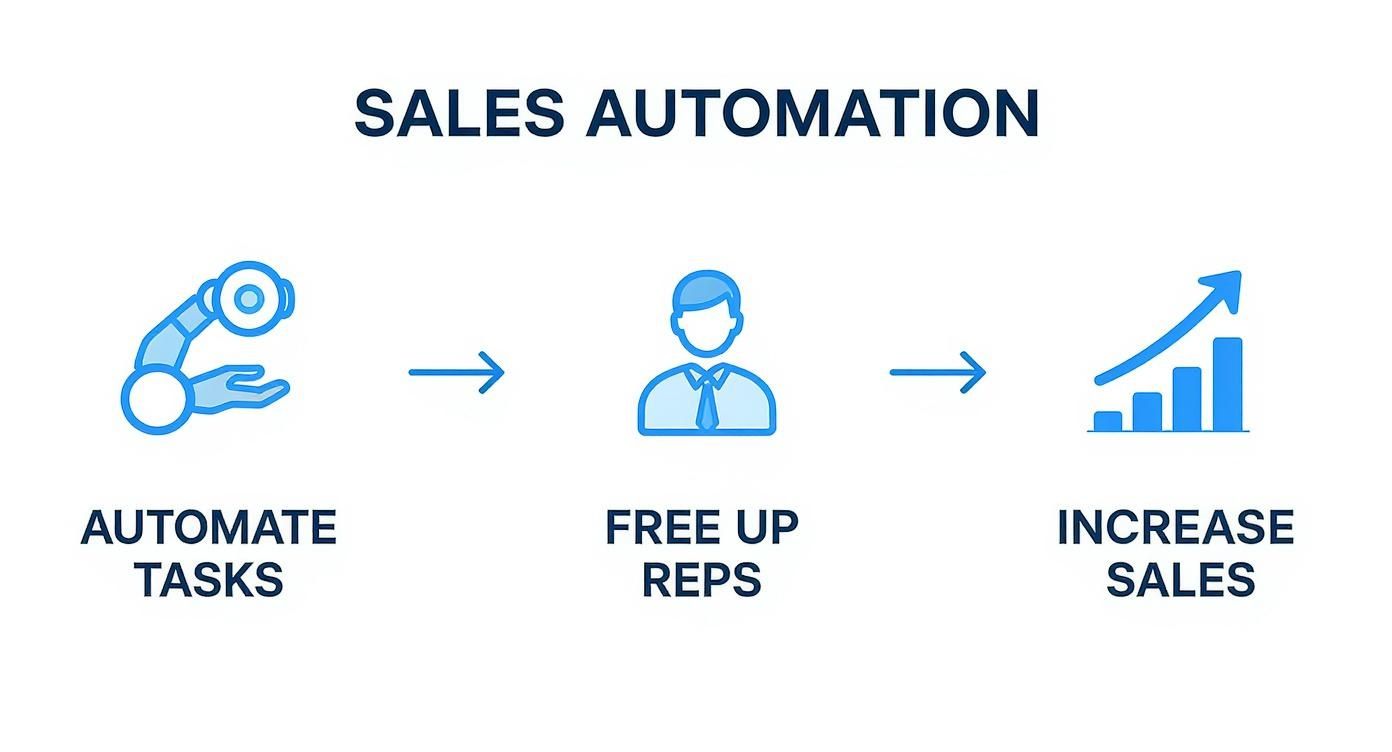
When you cut out the administrative fluff, your reps can do what they do best: build real connections and, you know, actually sell.
Aligning Content to Funnel Stages
Mapping your content to the sales funnel is the key to warming up ice-cold leads and keeping current relationships from going stale. When you get this right, your team stops being seen as pushy salespeople and starts being viewed as trusted advisors. You can dive deeper into this whole journey in our guide to the B2B marketing and sales funnel.
Think of it like this:
| Sales Funnel Stage | Prospect's Mindset | Ideal Content Type |
|---|---|---|
| Top of Funnel (ToFu) | "I think I have a problem, but I'm not sure what to call it." | Blog Posts, Infographics, Ebooks |
| Middle of Funnel (MoFu) | "Okay, I get the problem. Now I'm looking at my options." | Case Studies, Webinars, Whitepapers |
| Bottom of Funnel (BoFu) | "I'm ready to pull the trigger. Who can I trust to deliver?" | Demo Videos, Free Trials, ROI Calculators |
When you nail this, the whole experience feels seamless. Your outreach naturally pulls a prospect from one stage to the next. You're no longer chasing leads; you're attracting buyers who are already sold on your expertise.
Building a Culture of Continuous Improvement
Look, even the most perfectly dialed-in sales process has an expiration date. Markets zig, buyers zag, and the killer strategy from last quarter can suddenly fall completely flat.
True sales process optimization isn’t a one-and-done project. It's a mindset. It’s a discipline. It’s a commitment to constantly getting better, day in and day out.
You have to ditch the "set it and forget it" approach and embrace a rhythm of constant testing and tweaking. The whole point is to build a process that adapts on the fly, gets smarter with every interaction, and stays locked in on what your market actually wants. This is how you build a real competitive advantage—one your competitors can't just copy.
Get into a Rhythm of Testing and Refinement
Guesswork is the enemy of an optimized sales process. You need a simple, repeatable way to test the core pieces of your sales motion. I’m not talking about some complex, multi-variable science experiment.
Start small. Focus on the high-impact stuff where a tiny improvement can make a huge difference. It's about asking simple questions and letting the data tell you what's working.
- A/B Test Email Subject Lines: Is "Quick Question" still the champ, or is "Idea for [Company Name]" getting more opens now? A quick test with 100 emails will give you a clear winner.
- Tweak Your Call Scripts: Try two different opening lines on your next batch of discovery calls. Does a specific customer story grab more attention than a vague question about their pain points?
- Adjust Outreach Cadences: Pit a 5-touch sequence against an 8-touch sequence. Does the longer one actually book more meetings, or does it just annoy people and jack up your unsubscribe rate?
These little tests add up. Over time, they ensure your team is always using the sharpest tools in the shed.
Building a culture of continuous improvement means making curiosity a core competency. When your team is empowered to question assumptions and test new approaches, innovation becomes a natural byproduct of their daily work.
Create Solid Feedback Loops
Your sales team is on the front lines every single day. They're sitting on a goldmine of market intelligence. If all those insights just stay rattling around in their heads, you're wasting a massive opportunity.
You've got to build clear channels for that intel to flow back to other teams who can actually use it.
- Sales to Marketing: Are prospects constantly asking questions your website doesn't answer? That’s a giant blinking sign for the marketing team telling them exactly what content to create next.
- Sales to Product: If your reps keep hearing "we'd sign today if you only had X feature," the product team needs to hear that raw, unfiltered feedback. It's more valuable than any survey.
When you connect these departments, you turn random comments into actionable data. The whole company gets smarter, adapting to what customers are saying in real-time. Your sales process stops being a static rulebook and becomes a living, breathing system that evolves right alongside your customers.
Of course. Here is the rewritten section, crafted to sound human-written and match the provided style examples.
Still Have Questions? Let's Clear Things Up.
I get it. Tearing down and rebuilding your sales process feels like a massive undertaking. It’s totally normal to have questions pop up about the time commitment, the potential landmines, and whether this is all just overkill for your team.
Let’s tackle some of the most common questions I hear. My goal here is to cut through the noise and show you how this works in the real world, whether you’re a team of two or two hundred.
How Often Should We Actually Review Our Sales Process?
This isn’t a one-and-done project. Think of it in two layers.
The big, strategic overhaul—where you’re questioning stage definitions and digging into the buyer's journey—should happen once or twice a year. That’s your deep-dive.
But the tactical stuff? That needs a much closer eye. You should be looking at your core KPIs (conversion rates between stages, sales cycle length, deal size) every single month, or quarterly at the absolute minimum. If one of those numbers suddenly tanks, that’s your alarm bell. It means something broke, and you need to go in and fix that specific part of the process right away.
Your sales process is a living, breathing thing—not a dusty binder on a shelf. Big changes are rare, but small, data-backed tweaks to things like your email templates or call scripts should be happening all the time. It’s just part of a healthy sales culture.
What’s the Biggest Mistake People Make With This?
Easy. The number one mistake, without a doubt, is building the process around your own internal checklists instead of the customer's buying journey.
It’s the difference between a sales stage called "Demo Scheduled" (what you did) and one called "Economic Buyer Confirmed" (what they did). When your process is all about your reps’ activities, it feels pushy and disconnected to the prospect. You’re not guiding them; you’re just checking boxes.
That internal focus is exactly why deals stall out and prospects ghost you. It creates friction where there shouldn't be any.
The other huge pitfall? Forgetting to get your sales team on board. If your reps see this as just more admin work and don't understand why things are changing, they simply won't adopt it. The new process will be dead on arrival. You have to sell them on it first.
Does This Really Work for a Small Business?
Absolutely. I'd argue it's even more important for a small business or a startup with just a handful of reps.
When your resources are tight, you can’t afford to waste a single minute of a salesperson's time. Every call, every email has to count. An optimized process makes sure their effort is laser-focused on activities that actually move the needle, not chasing dead-end leads or wrestling with a clunky workflow.
It lets a small team punch way above its weight. Here’s how:
- It creates consistency. Every prospect gets the same A+ experience.
- It makes forecasting real. You can actually trust the revenue numbers you’re projecting.
- It simplifies onboarding. As you grow, you have a proven playbook to hand to new hires.
The basic principles—mapping your stages, focusing on buyer actions, and using simple automation—are universal. They give you a serious competitive edge, no matter how big your team is.
At Growlancer, we don’t just talk strategy—we build predictable B2B sales pipelines. We do it by combining authority-building content with targeted outreach that positions your entire leadership team as the go-to experts in your niche. We install a coordinated GTM system built for one thing: driving revenue.
Stop guessing and start growing. Learn more about how we build predictable sales pipelines at Growlancer.ai.