

B2B LinkedIn marketing isn’t just about posting updates and hoping for the best. It's the engine you build to generate high-quality leads, connect directly with decision-makers, and drive real revenue.
We're talking about transforming your executive team's presence from a dusty digital resume into a strategic asset—one that creates a predictable, repeatable sales pipeline.
Building Your Foundation for LinkedIn Dominance

Before your team even thinks about sending a connection request or publishing a single post, we need to lay the groundwork. This is the part most companies skip, and it’s why their efforts fall flat.
Too many B2B leaders treat LinkedIn as an afterthought. But in reality, it's the most valuable digital real estate you own for generating pipeline. The goal isn't just to be on LinkedIn; it’s to strategically dominate your specific corner of the market.
This all starts by treating each executive's profile like a high-conversion landing page. Anyone who lands there—whether from a search, a comment, or a direct link—should immediately understand three things:
- Who you are and what problem you solve.
- Who you solve it for.
- Why they should trust you over anyone else.
This foundational work is what separates predictable growth from random acts of marketing. It sets the stage for every piece of content you create and every outreach message you send.
From Digital Resume to Resource Hub
The first step is a mental shift. Your executive's profile needs to stop being a static CV and start acting like a dynamic resource hub that actively pulls in your ideal clients. This means every single element—from the banner to the "About" section—is optimized with your Ideal Customer Profile (ICP) in mind.
A powerful profile doesn't just list jobs and accomplishments; it tells a story. It needs to speak directly to the pain points of your target audience and position the executive as the go-to expert with the solution. This is where your B2B LinkedIn strategy truly begins.
And the data doesn't lie. A staggering 80% of LinkedIn users play a role in business decisions, and 40% of B2B marketers name it their most effective channel for finding high-quality leads. According to Sprout Social's research on LinkedIn, every profile view is a potential sales conversation just waiting to happen.
Key Elements of an Optimized Executive Profile
Optimizing a profile isn't about keyword stuffing; it's about crafting a compelling narrative. Let's break down the must-have components that turn a passive profile into a persuasive one.
The best executive profiles on LinkedIn function like a mini-website. The headline is the H1, the 'About' section is the hero copy, and the 'Featured' section is the portfolio. Treat it with that level of strategic importance.
To get this right, you need a methodical approach. We've put together a quick checklist to help transform each executive profile into a client-attraction machine.
Executive Profile Optimization Checklist
This table is your quick-reference guide for turning a standard LinkedIn profile into a lead-generation asset. Follow it for each member of your leadership team.
| Profile Element | Action Item | Strategic Purpose |
|---|---|---|
| Headline | Craft a search-optimized, value-driven statement (e.g., "Helping SaaS Founders Scale ARR with Predictable Pipeline Systems"). | Instantly communicate your value proposition and attract the right audience through search. |
| Profile Photo | Use a professional, high-resolution headshot where the executive looks approachable and confident. | Build immediate trust and humanize the brand. First impressions are critical. |
| Banner Image | Design a custom banner with a clear tagline, company logo, or a call-to-action (e.g., "Download Our State of the Industry Report"). | Reinforce branding and guide visitors toward a desired next step. |
| About Section | Write a compelling, first-person narrative that outlines the problems you solve, showcases social proof, and ends with a clear CTA. | Create an emotional connection, build authority, and tell visitors exactly what to do next. |
| Featured Section | Pin your most valuable content: case studies, webinar recordings, key articles, or links to your website's resource center. | Provide tangible proof of expertise and offer immediate value to profile visitors. |
Each of these elements works in concert to create a powerful first impression. Neglecting one weakens the entire system. By methodically optimizing these areas for each executive, you create a unified front that consistently communicates authority and expertise.
For more deep dives and resources, you can always check out what the Growlancer team is publishing over on our author page.
Developing Your High-Impact Authority Content System
Alright, you’ve laid the groundwork and your executive profiles are primed. Now comes the fun part: turning those profiles into lead-generating machines. And that all comes down to the content you publish.
Let's be clear—randomly posting company updates or industry news just won't cut it. You need a repeatable system. One that takes your executive's know-how and turns it into content that builds authority, starts real conversations, and pulls your ideal prospects right into your orbit.
This isn’t about just informing people. It’s about building trust and creating demand long before you ever send a connection request.
Establishing a Practical Content Cadence
Consistency is everything on LinkedIn. It trains the algorithm to show your stuff and, more importantly, it trains your audience to look for it. You need a rhythm your team can actually stick to, which for most executives, is about three to five high-quality posts per week.
This frequency keeps you top-of-mind without flooding people's feeds. The secret is mixing it up. A good rule of thumb is the 3-2-1 content mix:
- Three Original Thought Leadership Posts: This is the core of your strategy. Your executive shares a unique take, a contrarian view, or a framework they've developed. It’s their raw expertise on display.
- Two Curated Insight Posts: Find a killer article or industry report and have your executive add their two cents. This positions them as a trusted voice who knows what's important in your space.
- One Personal Story or Behind-the-Scenes Post: This is what makes your executive human. A lesson from a past failure, a shout-out to the team, a key takeaway from a conference. People buy from people they know, like, and trust.
This mix ensures your leaders come across as credible experts who are also relatable and authentic.
Core Content Pillars That Drive Engagement
Every post should tie back to a handful of core themes. We call these content pillars. Think of them as the 2-4 big topics your audience is obsessed with and where your solution solves a real problem. For a cybersecurity firm, these pillars might be "Threat Intelligence," "Compliance & Governance," and "Incident Response."
Once you have your pillars, the "what should I post today?" question disappears. You're no longer staring at a blank screen. Instead, you’re laser-focused on creating content that cements your niche authority. And this matters, because buyers are absolutely using LinkedIn to vet you.
The data doesn't lie: 55% of decision-makers use thought leadership content to evaluate potential vendors. It's not just fluff; it's a critical piece of the buying process. As you can see in the full Edelman x LinkedIn report on thought leadership impact, your content directly signals your company's credibility.
Post Formats That Actually Convert
How you say something is just as important as what you say. Different post formats grab attention in different ways, so your content system needs to have a playbook of templates ready to go.
Your goal on LinkedIn is to stop the scroll. Don't just share information; package it in a way that's impossible to ignore. A simple text post with great formatting can outperform a low-quality video every time.
Here are a few high-impact post templates to get you started:
| Post Type | Description & Purpose | Example Scenario |
|---|---|---|
| The Story-Led Text Post | Uses a hook, a narrative, and a clear takeaway to share a personal lesson or professional insight. It's built for easy reading and high engagement. | A VP of Sales shares a story about losing a huge deal early in their career and the lesson it taught them about asking the right questions. |
| The Simple Image Post | A powerful image (team photo, whiteboard diagram, conference selfie) paired with concise text. This adds a human touch and stops the scroll. | A CEO posts a picture of their team brainstorming, with a caption about the messy but brilliant process of innovation. |
| The Document Carousel (PDF) | A multi-page PDF that breaks down a complex idea into simple, digestible slides. This positions your executive as a teacher and an expert. | A CMO creates a 7-slide carousel titled "5 B2B Content Mistakes to Avoid in Q4," with one actionable tip per slide. |
By building a system around your content pillars and formats, you remove the daily friction of content creation. It becomes a predictable, pipeline-driving asset instead of a chore. For more ideas on building out your strategy, you can check out the various guides on the Growlancer blog.
Engineering a Targeted Outreach and Engagement Engine

Great content pulls people in, no doubt. But sitting back and waiting for leads to fall into your lap isn't a strategy—it's a lottery ticket. A real B2B pipeline pairs that magnetic content with a smart, proactive outreach plan.
This is where the magic happens. You're not just broadcasting; you're actively starting the right conversations with the right people.
We're not talking about spamming inboxes with generic pitches everyone hits "delete" on. We’re building a system that feels human, scales predictably, and, most importantly, gets meetings on the calendar.
Advanced Prospecting Beyond Job Titles
First things first: you have to find the right people. A basic LinkedIn search is okay, but if you're serious about building a pipeline, it's time to graduate. This is where a tool like Sales Navigator becomes your secret weapon, thanks to its deep filtering options.
Stop just searching for "VP of Marketing." That's what everyone else is doing. Instead, we want to find leaders at companies flashing major growth signals. This makes your outreach timely and instantly more relevant.
Here are a few of the Sales Nav filters I use to find absolute gold:
- Company Headcount Growth: I love targeting companies that have beefed up their team by 20% or more in the last year. That’s a massive tell. It screams they have a budget and are desperate for solutions to handle that new scale.
- Recent Funding Events: Find companies that just closed a funding round. They're sitting on fresh cash and have immense pressure from investors to spend it on tools that drive growth.
- Posted Content in Past 30 Days: This filter is a game-changer. It shows you who is actually active on the platform. These are the decision-makers you can easily and authentically engage with before ever sending a connection request.
Layering these filters takes you from a giant, cold list to a highly curated group of prospects who are practically waiting for your message.
Crafting Connection Requests That Start Conversations
That little connection request box is your first real impression. "I'd like to connect with you on LinkedIn" is a total waste of an opportunity. Your message has to be short, personal, and completely non-salesy.
The single biggest mistake I see? Pitching in the request. Just don't. Your only job here is to get them to click "Accept." That's it. The real conversation comes later.
A great connection request answers the prospect's silent question: "Why you, and why now?" It should feel relevant and respectful of their time, not like another automated message cluttering their inbox.
Here’s a simple script framework that just works:
"Hi [First Name], saw your recent post on [Topic]. Your point about [Specific Insight] was spot on. I’ve been following your work at [Company Name] for a bit and would love to connect and keep up with your content."
Why does this work so well?
- It shows you did your homework (by mentioning a specific post).
- It offers a real compliment (validating what they said).
- It gives a clear, low-pressure reason to connect (to follow their stuff).
This simple approach consistently gets us connection acceptance rates of over 40-50%. That’s miles ahead of the generic, salesy templates clogging up everyone's inbox.
The Art of Strategic Engagement
Before you even think about sliding into the DMs, you need to show up on their radar. This is what strategic engagement is all about—warming up a prospect by thoughtfully interacting with their content. It’s how you build familiarity and prove you’re not just another random salesperson.
Make this part of your daily routine. Spend just 15-20 minutes a day engaging with posts from your target accounts.
- Leave insightful comments: "Great post!" is garbage. Add to the conversation. Ask a smart question. Share a related experience. One thoughtful comment is worth more than a hundred likes.
- Share their content with your take: If a prospect drops a brilliant article, share it with your own network. Add your two cents and be sure to tag them. You're giving them exposure while showing your audience you're on top of your game.
Do this consistently, and you'll go from being a total stranger to a familiar face. When your connection request finally hits their inbox, they’ll actually recognize your name. This is the groundwork that makes all the difference in modern B2B LinkedIn marketing.
Funneling LinkedIn Conversations into Your CRM
Let’s be honest. Your executive team is crushing it on LinkedIn. The content is sharp, they’re connecting with the right people, and DMs are buzzing. But what happens next?
If those conversations just sit inside LinkedIn, you’re burning cash. Seriously. All that effort, all those potential deals, just evaporating into the digital ether.
This is the silent killer of most executive-led LinkedIn strategies. When there's no bridge between the platform and your CRM, you’re flying blind. You can't track what's working, you can't see the pipeline you're building, and you sure as hell can't prove ROI.
Fixing this is how you turn random social chatter into a predictable revenue machine.
Nail Down Your Lead Capture Process
First things first: you need a non-negotiable process for getting qualified folks from a LinkedIn DM into your CRM. This isn't about spamming your CRM with every new connection. It's about setting clear "triggers" that tell you someone is a real prospect worth tracking.
Think of it as the official handoff. This process gives your sales team the full story, so they aren't stumbling in blind asking questions that have already been answered. It’s a smooth transition, not an awkward reset.
To get this right, you need to answer a few questions:
- What’s a "LinkedIn Qualified Lead" (LQL) to us? Does a positive reply count? Or do they need to ask a specific question about our service? Define it.
- Who’s on data entry? Is it the executive's assistant? A dedicated VA? The account’s sales rep? Decide who owns it.
- What info is mandatory? At a minimum, you need their LinkedIn profile URL, a quick summary of the conversation, and any pain points they’ve mentioned.
If it's not in the CRM, it didn't happen. Treat your CRM as the absolute source of truth. A great chat on LinkedIn that isn't logged is just a ghost.
Knowing When to Take it Off-Platform
Look, not every friendly back-and-forth on LinkedIn is an invitation to book a demo. Pushing for a sales call too soon is the fastest way to kill the vibe and undo all the great rapport you've built.
The real skill here is learning to read the room. Your team needs to be trained to spot the subtle cues that show a prospect is shifting from just being curious to being genuinely interested.
You’re listening for buying signals. Here’s what to look for:
- They ask specific "how" questions. When someone goes from "Cool post" to "How would your software handle our team's reporting challenges?" they're mentally road-testing your solution. They're picturing it inside their own company.
- They bring up their own problems. If they volunteer something like, "We've been really struggling to get our data organized," or "My boss is looking for a better way to manage projects," they are literally handing you an invitation to solve their pain.
- They tag a colleague in the comments. This is huge. Bringing another person into the conversation means they see the value and want to get a second opinion or internal buy-in. It’s a massive green flag.
Once you spot one of these signals, the next step feels completely natural. You can easily say, "That's a great question. It'd probably be easier to show you on a quick 15-minute screen share than for me to type out a novel here. Open to that?"
For businesses that want this entire system built and managed for them, a done-for-you partner like Growlancer can install the framework and run the playbook to scale these efforts without the headache.
By getting your CRM integration dialed in and training your team to spot these transition moments, you build a rock-solid bridge from your B2B LinkedIn marketing to actual, measurable sales. You stop guessing and start building a real pipeline, one conversation at a time.
Measuring Success with the Right KPIs
If you're going to put this much work into building an executive-led LinkedIn program, you have to measure what actually moves the needle. It's way too easy to get mesmerized by shiny objects like post views and likes. These are pure vanity metrics. They feel good, but they don't pay the bills.
A real B2B LinkedIn strategy is measured by one thing: its impact on the sales pipeline. This means you have to shift your focus from surface-level chatter to the KPIs that tell the true story. Are we starting conversations? Are those conversations turning into meetings? And are those meetings actually creating sales opportunities?
These are the only questions your dashboard needs to answer. Without that clarity, you're just throwing content at the wall and hoping something sticks.
Moving Beyond Vanity Metrics
The first, and maybe most important, step is to actively ignore the metrics that don't matter.
Let's be blunt: a post with 10,000 views and 200 likes that generates zero qualified leads is a failure. On the flip side, a post with just 500 views that sparks two conversations leading to demos is a massive win. Your entire measurement framework has to be built on this reality.
We have to track the whole journey, from that first connection request all the way to a closed deal. This is how you prove the ROI and get the data you need to pour fuel on what's working. And this is especially true on LinkedIn, the undisputed king of B2B social media.
The data is staggering—an incredible 80% of B2B leads generated from social media come directly from LinkedIn. To really let that sink in, X (formerly Twitter) and Facebook combined only account for the remaining 20%. If you want to dive deeper, check out this insightful marketing report that breaks down why LinkedIn completely dominates the B2B world. That stat alone is why getting your KPIs right is so critical; the quality of leads here is just on another level.
Your Core LinkedIn-to-Pipeline KPIs
Your tracking dashboard needs to be simple, clean, and focused on action. Here are the absolute non-negotiables your team should be watching like a hawk every single week.
- Connection Acceptance Rate: This tells you how effective your targeting and messaging really are. A sharp, personalized approach should get you an acceptance rate of 30% or higher. If you're below that, something's off.
- Reply Rate: Of the new folks who accept your request, how many are actually replying to your first message? A healthy rate here is 15-30%. This proves your outreach is sparking genuine curiosity, not just getting ignored.
- Meetings Booked: This is it. This is the big one. It's the most critical leading indicator of success. How many qualified meetings are you setting directly from LinkedIn conversations each week?
- Pipeline Influence: When a new deal pops up in your CRM, can you trace it back to LinkedIn as a key touchpoint? This metric directly connects all your social selling efforts to tangible, closeable revenue.
This simple infographic maps out the ideal journey, from a simple interaction on LinkedIn to a qualified lead logged in your CRM.
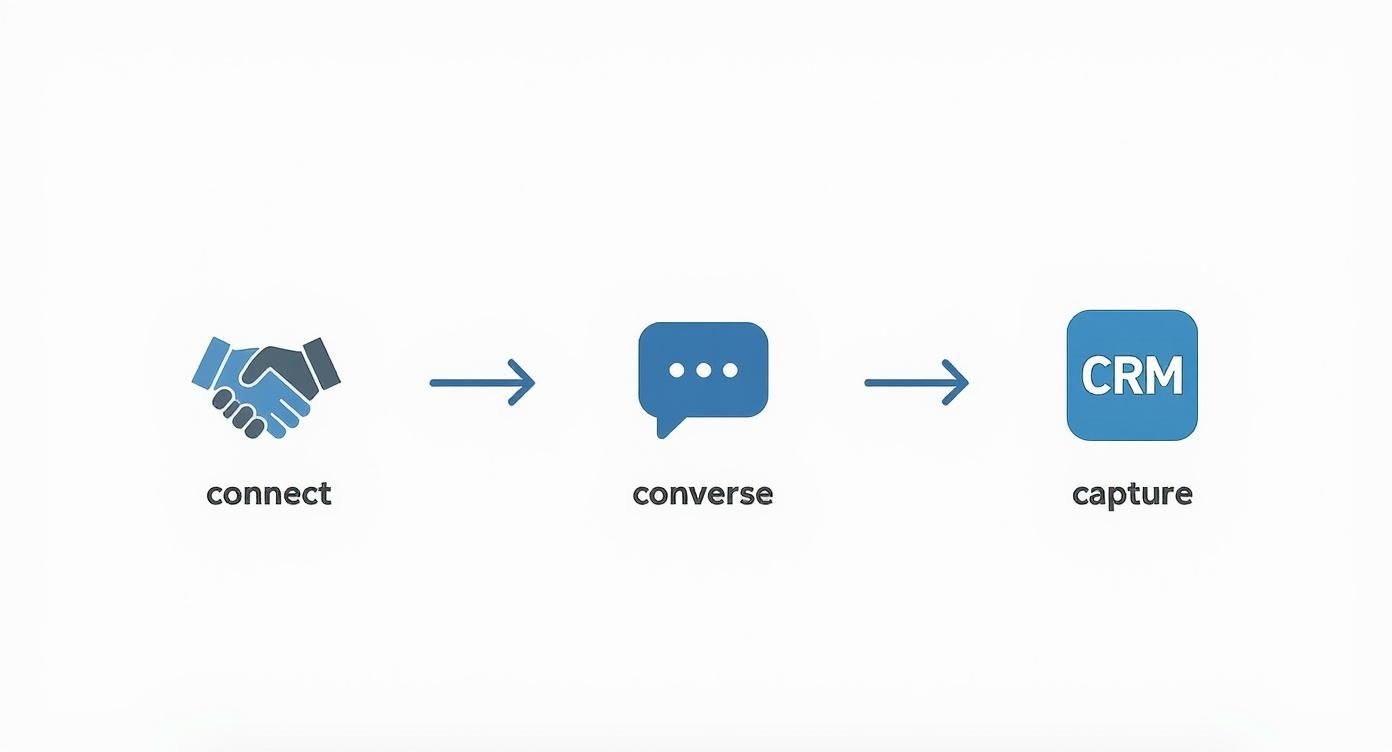
What this visual really drives home is that every single connection and conversation needs a clear path to becoming a qualified opportunity. No dead ends.
A Realistic 90-Day Roadmap
Look, building a legitimate B2B LinkedIn machine takes time. You aren't going to flood the pipeline overnight. Here's a realistic timeline of what to expect and the milestones you should be aiming for.
Don’t get discouraged if meetings aren't pouring in during the first few weeks. The goal here is to build a sustainable system. The consistency you build in the first 30 days is what creates the momentum that pays off over the next 60.
Month 1 (Days 1-30): The Foundation Phase
This month is all about setup and getting the first wheels in motion.
- Milestones: All executive profiles are fully dialed in. You’ve defined your content pillars, and the first few posts have gone live. Your team starts sending out that initial wave of connection requests.
- KPIs to Watch: Connection acceptance rate and the initial engagement on your posts.
Month 2 (Days 31-60): The Engagement Phase
Now it’s all about hitting a rhythm and starting real conversations.
- Milestones: You've established a consistent content cadence. The team is actively working the DMs, and you should see the first handful of meetings start to trickle onto the calendar.
- KPIs to Watch: Reply rate and, most importantly, meetings booked.
Month 3 (Days 61-90): The Pipeline Phase
This is where the engine really starts to hum and produce predictable results.
- Milestones: You have a steady flow of conversations happening every single day. The CRM integration is seamless, and you can clearly point to the pipeline being influenced by your team's LinkedIn activity.
- KPIs to Watch: Meetings booked per week and pipeline influence.
Tracking isn't about creating fancy reports; it's about making smarter decisions. Here’s a quick-glance table of the essential KPIs you should be focused on to measure the true business impact of your LinkedIn strategy.
Key B2B LinkedIn Marketing KPIs
| Metric | What It Measures | Industry Benchmark |
|---|---|---|
| Connection Acceptance Rate | The effectiveness of your audience targeting and outreach copy. | 30%+ |
| Reply Rate | The relevance and conversational quality of your follow-up messages. | 15-30% |
| Meetings Booked | The number of qualified sales appointments set from LinkedIn. | Varies by industry |
| Pipeline Influence ($) | The total value of sales opportunities influenced by LinkedIn. | Varies by industry |
| Content Engagement Rate | How well your content resonates with your target audience. | 2-5% |
These are the numbers that matter. By focusing on these core metrics, you move beyond vanity and start measuring what actually contributes to revenue.
Your Top B2B LinkedIn Questions, Answered
Even with the best playbook, you're going to have questions once you get into the weeds. It's just part of the process.
Here are the straight-up answers to the most common questions we get from leadership teams trying to build a real pipeline on LinkedIn.
How Much Time Do Our Execs Really Need to Spend on LinkedIn Every Day?
This is the big one, right? Every executive is slammed.
Forget blocking out hours. The magic number is 15-20 minutes a day. That’s it.
But it has to be focused time, not just aimless scrolling. This isn't about "being on LinkedIn," it's about executing a very specific mission.
- First 5 minutes: Jump into the comments on your latest post and check your inbox. Handle the low-hanging fruit and see who's talking to you.
- Next 10 minutes: Go engage with your top prospects. Find their latest posts and drop a thoughtful, relevant comment. The goal is to stay top-of-mind.
- Final 5 minutes: Send a handful of highly personalized connection requests. Quality over quantity, always.
A consistent 20-minute daily habit beats a random two-hour binge session once a week. Every single time.
Company Page vs. Personal Profile: Where Should We Focus?
Easy. Your executive's personal profile is infinitely more important.
People don't build relationships with logos. They build them with other people. LinkedIn’s algorithm knows this, which is why it pushes content from personal profiles way harder than it does from company pages.
Think of it like this: The company page is your office building—it needs to look professional and have the lights on. But your executive's profile? That’s the conference room where the deals actually get done.
Your company page is still important, don't get me wrong. Prospects will absolutely click over to it to make sure you're a legitimate operation. But the influence, the conversations, and the leads? They almost always come from the real person behind the profile.
How Do I Reach Out Without Sounding Like a Cheesy Salesperson?
Simple. Stop selling. Your first message should never be a pitch.
The goal isn't to book a demo on the first touch. The goal is to start a conversation. That's it. Lead with value and genuine curiosity.
Here's a dead-simple framework to keep you from sounding "salesy":
- Find a hook: See what they posted about recently. An article, a comment, an achievement.
- Make a connection: Tie what they said to something you know or a shared experience.
- Ask a question: End with a smart, open-ended question that makes them want to reply.
Before you hit send, ask yourself this one question: "Am I asking for anything?" If you're asking for their time, for a click, for anything at all—delete it and start over. Your only job in that first message is to show you're paying attention. Trust me, the sales talks will happen naturally once you've earned the right to have them. This is the foundation of a B2B LinkedIn marketing plan that actually works.
Ready to turn your executive team into a predictable pipeline machine without the daily grind? Growlancer offers a done-for-you service that builds and manages your entire LinkedIn growth system—from strategy and content to outreach and appointment setting. Learn how we build B2B sales pipelines on LinkedIn.