

Want to generate B2B leads? The first step, the only step that matters at the beginning, is knowing exactly who you're selling to.
Forget everything else for a moment. If you don't have a laser-focused Ideal Customer Profile (ICP), every outreach message, every piece of content, every ad dollar is a gamble. It’s like firing a cannon in the fog and hoping you hit something. You’re just burning cash and time on leads that were never going to close anyway.
Defining Who You Actually Sell To

Before you even think about outreach tactics, you have to stop guessing. The biggest mistake I see companies make is casting a ridiculously wide net. They think "everyone" is their customer. This waters down your message until it means nothing to anyone.
The goal here isn't to create some fluffy, generic buyer persona. We're building a data-backed Ideal Customer Profile (ICP). This document becomes your north star. It guides every single thing you do in sales and marketing.
An ICP isn't about the person buying; it's about the perfect-fit company for what you offer. You build it by looking at your best customers—the ones who get massive value, stick around the longest, and tell their friends about you.
Analyzing Your Best Customers
Time to look in the mirror. Pull up a list of your top 5-10 clients and start playing detective. This isn't about gut feelings; it's about hard data. What do these rockstar customers have in common?
Look for patterns in their firmographics:
- Industry/Vertical: Are they all in SaaS? Fintech? Professional services? Get granular. "Technology" is too broad. "B2B SaaS" is better. "Series A MarTech" is best.
- Company Size: Don't just guess. What’s the specific employee count range (e.g., 50-200 employees)? What's their typical annual revenue (e.g., $10M-$50M ARR)?
- Geography: Are they clustered in North America? The UK? Are they remote-first?
- Tech Stack: What tools are they already using? Do they all use HubSpot? Salesforce? Slack? This is a goldmine for finding lookalikes and understanding their technical maturity.
If you discover that 80% of your best clients are Series B SaaS companies with 100-250 employees in the US, congratulations. You've just found your starting block. You now have a concrete, data-driven profile to hunt for.
Key Takeaway: Stop inventing your ideal customer. They already exist in your CRM. The blueprint for your future growth is hidden in the data of your current best customers. Dig it up.
Uncovering Pain Points and Buying Triggers
Okay, you know the what (the firmographics). Now you need the why.
What specific, hair-on-fire problem are you solving for these companies? What finally pushed them over the edge to look for a solution like yours? Vague pain points like "we save them time" or "we increase revenue" are useless. Everyone says that.
The only way to find the real answers is to talk to your best customers. Get them on a quick call and ask some simple, open-ended questions:
- "Before you started working with us, what was the biggest bottleneck you were dealing with when it came to [your solution area]?"
- "Can you remember the 'aha' moment or breaking point that made you think, 'Okay, we need to fix this now?'"
- "What's a specific result or outcome you've been able to achieve since we started?"
Listen closely. Their answers are pure gold for your messaging. You might find out they weren’t just looking to "improve efficiency"—they were dealing with a specific workflow issue that was delaying their product launches by three weeks every quarter. That's a pain point you can build an entire outreach campaign around.
Once you have this foundation, you can start exploring the actual lead gen strategies. My team at Growlancer and I have seen firsthand how getting this step right makes everything that follows 10x easier.
Turning LinkedIn Into a Lead Generation Engine
Once you know exactly who you’re after, you need to show up where they hang out. For pretty much any B2B professional, that place is LinkedIn.
But just having a profile is like having a business card nobody ever sees. It’s collecting digital dust. To actually generate leads, you have to weaponize your presence and turn it into an engine for attracting and engaging your ICP.
This isn't about blasting out connection requests or hitting people with a sales pitch two seconds after they connect. It’s a real system, and it starts by making yourself easy to find for the right people. Your profile is your digital storefront—it needs to instantly scream who you help and what problems you solve.
The proof is in the pudding. LinkedIn is the undisputed king for B2B. Data shows that a whopping 89% of B2B marketers use the platform for lead gen, and 62% say it delivers leads at double the rate of any other social channel. (You can dig into more of those lead generation statistics if you're a data nerd like me).
Optimizing Your Digital Real Estate
Your personal profile and company page are the bedrock of this entire strategy. Most people get this wrong. They treat their headline and summary like a boring old resume, just listing their job title and what they do all day.
That’s a massive missed opportunity.
Your profile needs to talk directly to your ideal client's pain points. Your headline isn't what you are ("CEO at Acme Inc."). It’s what you do for people.
A few headline formulas that just work:
- [Benefit] for [ICP]: "I help B2B SaaS founders build predictable pipeline through LinkedIn."
- [Problem] to [Solution]: "Helping finance teams go from chaotic month-end closes to automated reporting in 60 days."
- [Role] | [Value Proposition]: "VP of Sales | Driving GTM strategy for mid-market tech companies."
This tiny change completely reframes how people see you. A prospect lands on your page, and instead of seeing another suit, they see someone who gets their world. That makes them exponentially more likely to connect or respond. The same goes for your "About" section—tell a story about the problems you solve, don't just list your career milestones.
From Passive Profile to Proactive Prospecting
Once your profile is dialed in, it’s time to hunt. This is where LinkedIn Sales Navigator becomes your best friend. It lets you slice and dice LinkedIn’s entire database with scary precision, way beyond what the free search can do.
You can build hyper-targeted lists based on things like:
- Company Headcount: Zero in on companies in your sweet spot (e.g., 51-200 employees).
- Industry & Keywords: Pinpoint specific verticals like "Financial Services" or "Marketing Technology."
- Job Titles: Target the exact decision-makers, like "VP of Marketing" or "Head of Operations."
- Recent Activity: Find people who just started a new job or posted recently—these are huge buying signals.
Building these lists is the foundation of outreach that doesn't suck. You're not sending a generic blast; you're crafting a message you know will resonate with a specific person's challenges.
Expert Tip: Stop just saving leads. Save accounts. When you track target companies in Sales Nav, you get alerts on new hires, funding announcements, and other company news. These are absolute gold for timing a relevant outreach message.
Attracting Inbound Fish with Valuable Content
Outreach is just one piece of the puzzle. The other is creating content that makes your ideal customers swim to you. This has nothing to do with selling. It’s about being genuinely helpful, sharing your expertise, and establishing yourself as an authority.
When you consistently post content that helps your ICP solve a problem, you build massive trust. You stop being a salesperson and start being the expert they turn to. The entire dynamic flips—they start seeking you out.
A dead-simple content strategy looks like this:
- Share insights from your latest customer calls (keep it anonymous, obviously). What are people struggling with?
- Repurpose gold from your company’s blog posts or case studies. Turn a long article into five short, punchy posts.
- Comment with value on posts from industry leaders and prospects. Don't just say "great post"—add a real insight to get on their radar.
This turns your LinkedIn profile from a static page into a dynamic asset that pulls in opportunities while you sleep. It complements your direct outreach and creates a sustainable flow of the exact leads you want to talk to.
Designing a Multi-Channel Outreach Sequence
Relying on just one channel to drum up B2B leads is a recipe for disaster. Firing off a single email or a lone LinkedIn request is like playing the lottery—you’re hoping for a miracle, but it rarely happens.
Your prospects are drowning in noise. Their inboxes are overflowing, and their attention is split a dozen different ways. To actually cut through, you need a smart, multi-channel outreach sequence that keeps you on their radar without being annoying.
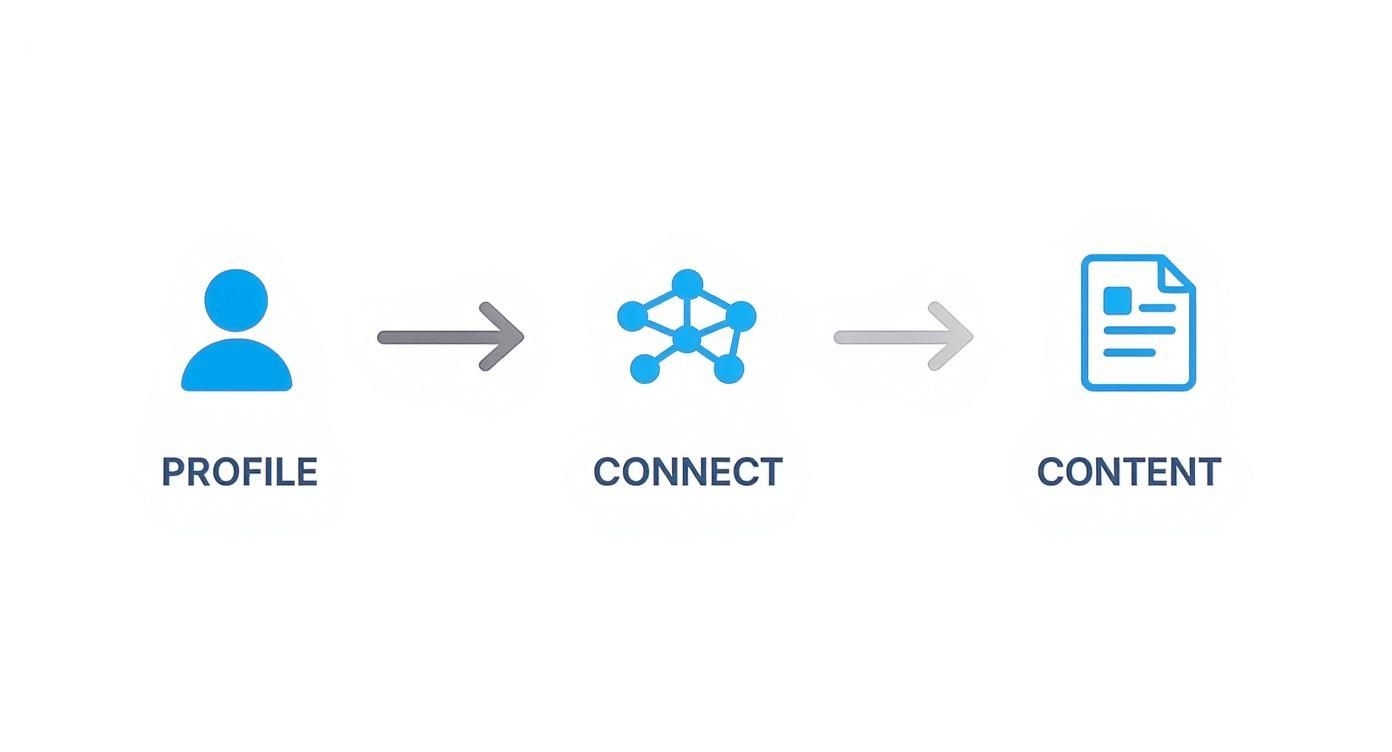
This isn't about spamming people everywhere they look. It’s about orchestrating a series of helpful, value-first touchpoints that build familiarity and trust over time. A solid sequence blends passive moves (like a post-like) with active outreach (a well-crafted email) to create an experience that feels less like a cold pitch and more like a professional hello.
Before you even think about sending a connection request, your own profile and content need to do the heavy lifting, warming up the conversation before it even starts.
The Secret to a Non-Spammy Cadence
Let’s get one thing straight: your goal is not to book a meeting on the first try. It’s to start a real conversation by being genuinely helpful. Every single touchpoint, from a LinkedIn note to an email, has to give value before it ever asks for anything.
Here’s how I think about structuring it:
- LinkedIn First, Always. Start on LinkedIn. It’s way less intrusive than a cold email. Your first move should be to simply engage with their content—like or comment on a post. Just show up on their radar.
- Personalize the Connection Request. Never, ever use the generic default. Reference something specific: a shared connection, a post they wrote, or their company's latest funding announcement. Show you’ve done your homework.
- Bridge to Email. Once you're connected, email becomes the place for deeper conversations. It's a more formal, professional setting where you can share detailed insights or a specific resource that’s too clunky for a DM.
This approach works because people have different preferences. Some live on LinkedIn; others are strictly email. By using both, you’re doubling your chances of actually getting a response.
Key Takeaway: The magic of multi-channel outreach is that it creates the illusion of being "everywhere" without being a pest. A prospect sees your comment, accepts your request, then gets a relevant email. Each touchpoint reinforces the last, building a foundation of credibility.
An Actionable 14-Day Cadence You Can Steal
Theory is nice, but a concrete plan is better. Here’s a proven 14-day sequence that just works. The key is the pacing and the mix of automated and manual, highly personalized touches.
This sample cadence shows how you can blend channels over two weeks to respectfully stay top-of-mind and guide a prospect toward a conversation.
Sample 14-Day Multi-Channel Outreach Cadence
| Day | Channel | Action | Objective |
|---|---|---|---|
| 1 | View profile & engage with a post (like/comment) | Appear in their notifications (low friction) | |
| 2 | Send a personalized connection request | Establish a direct line of communication | |
| 4 | Send first email, referencing the LI connection | Provide immediate, relevant value | |
| 7 | Follow up in DMs with a helpful resource | Nurture the connection with a light touch | |
| 10 | Send follow-up email focused on a key pain point | Connect your solution to a specific result | |
| 14 | Send a polite "break-up" email | Close the loop professionally |
Let's break down the actual scripts for a few of these steps.
Day 2: The Connection Request
- Action: Send a personalized connection request. No pitching.
- Sample Script: "Hi [First Name], saw your recent post on [Topic] and it really resonated. I’m also focused on helping [ICP type] with [Problem]. Would be great to connect and follow your insights."
Day 4: The First Email
- Action: Reference the LinkedIn connection and provide immediate value.
- Sample Script: "Hi [First Name], great to connect on LinkedIn. I noticed your company recently [Company Trigger, e.g., 'announced a new funding round']. Typically when that happens, scaling [Specific Challenge] becomes a top priority. We put together a short guide on [Relevant Topic] that might be helpful. No strings attached."
Day 10: The Follow-Up
- Action: Send a short, direct email focused on a specific pain point or result.
- Sample Script: "Hi [First Name], just following up. We recently helped [Similar Company] achieve [Specific Result, e.g., 'a 30% increase in qualified meetings'] by tackling [Pain Point]. Is this something on your radar at all?"
Day 14: The Break-Up
- Action: The final, polite attempt to close the loop.
- Sample Script: "Hi [First Name], I've reached out a few times without a response, so I'll assume this isn't a priority right now. If that changes, please feel free to reach out. All the best."
This structured approach respects your prospect’s time while allowing you to be persistent in a professional way. By spreading these touchpoints out, you massively increase the odds of starting a real dialogue.
Creating Content That Establishes Authority
Let's be real. A great outreach message might get your foot in the door, but it’s your content that convinces a prospect you're the expert they desperately need.
People buy from people they trust. And in B2B, trust isn’t built with slick sales pitches—it's earned through genuine expertise. Your content is the single best tool you have for building that trust long before you ever ask for a meeting.
The mission isn't just to pump out blog posts. It's to build a library of assets that actually solves your Ideal Customer Profile's most painful problems. When a potential client reads your stuff and walks away smarter, you stop being just another vendor in their inbox. You become a trusted resource, the obvious choice when it's time to buy.
Develop Your Pillar Content First
Before you even think about daily LinkedIn posts, you need to build your foundation. These are the big, meaty, high-value pieces that become the bedrock of your entire content strategy. Think of them as the definitive guides your prospects have been searching for.
These "pillar" pieces should hit on the biggest challenges and questions your ICP is wrestling with.
- In-Depth Guides & Whitepapers: Go deep on a complex topic. A cybersecurity firm, for example, could publish "The Definitive Guide to Securing a Hybrid Workforce." It’s substantial, it's helpful, and it screams authority.
- Case Studies: Nothing sells like proof. Don't just say you get results—show it. Detail the client's problem, the exact solution you brought to the table, and the knockout outcome (e.g., a 40% reduction in support tickets).
- Original Research or Industry Reports: This is a power move. Survey your market and publish the findings. This kind of proprietary data is pure gold. It gets shared everywhere and instantly positions you as a thought leader.
These big assets are perfect for pulling leads from your website. Gating a comprehensive whitepaper behind an email form is a classic B2B move for a reason: it's a fair trade of value.
Key Takeaway: Stop writing about your product. Start writing about your customer's problems. Your content should be so damn valuable that people would consider paying for it. That’s when you know you’re on the right track.
Repurpose Everything for Maximum Reach
A single, well-researched whitepaper is great. But its real power is unlocked when you chop it up into a dozen smaller pieces of content. This is the "create once, distribute forever" model, and it's how you stay consistently visible without burning out. You're simply maximizing the ROI on that initial effort.
Let's say you just finished a 5,000-word guide. That one asset can easily become:
- Five LinkedIn Posts: Each one highlights a key takeaway, a surprising stat, or a single chapter, all linking back to the full guide.
- A Short Explainer Video: Turn the core concepts into a punchy 2-minute animated video. Perfect for capturing attention on social.
- An Infographic: Pull out the most compelling data points and visualize them. Infographics are ridiculously shareable.
- A Webinar Presentation: Host a live session where you walk through the guide's findings and do a Q&A. Instant engagement.
This strategy ensures your core message hits people on different platforms, in whatever format they prefer. By mastering repurposing, a small team can have the impact of a much larger one. You turn one killer asset into an entire month's worth of content.
For more insights on how individuals can build authority, you can also check out the work from our content experts who have helped numerous leaders establish their presence. This is how you move from just sending messages to consistently generating B2B leads by being the recognized expert in your space.
Using SEO for Sustainable Lead Growth

While direct outreach is great for getting meetings on the calendar this week, search engine optimization (SEO) is how you build a real, long-term asset. Think of it as an engine running 24/7 in the background, churning out a steady stream of high-intent inbound leads who are already searching for exactly what you sell.
This completely flips the script. With outreach, you’re starting the conversation. With SEO, your ideal customers find you. Suddenly, you’re not chasing leads anymore; you’re attracting prospects who've already done their homework and are actively looking for a solution.
And the numbers don't lie. The close rate for leads from SEO is a staggering 14.6%. Compare that to the paltry 1.7% from traditional outbound marketing, and the story becomes crystal clear. Leads who find you through organic search are just flat-out more likely to buy. You can dig into more lead generation stats over at databox.com to see for yourself.
Finding Keywords That Signal Purchase Intent
The whole game in B2B SEO starts with figuring out what your best customers are typing into Google when they have a problem they need to solve now. This isn't about getting any traffic; it's about getting the right traffic. You're hunting for high-intent, bottom-of-funnel keywords.
These aren't vague, top-level questions. They’re specific phrases that scream "I'm ready to buy."
Just look at the difference:
- Informational (Top-of-Funnel): "what is sales forecasting"
- Commercial (Bottom-of-Funnel): "sales forecasting software for startups"
That second person is much, much closer to making a decision. Your job is to uncover all of those golden-nugget phrases for your specific niche.
Key Takeaway: Solid B2B SEO isn't about ranking for a million different keywords. It's about owning the search results for the exact terms your best customers use right before they sign a check. Focus on intent, not just search volume.
Optimizing Your Website to Capture Leads
Once you've got your list of money keywords, you need to weave them into the DNA of your website. So many companies get this wrong. They’ll write a blog post and call it a day, completely ignoring the pages that actually do the selling.
Start with your most important pages—your service pages, features pages, and the pricing page. These have to be perfectly tuned for the keywords that are directly tied to what you offer.
Here’s a quick-and-dirty checklist for your on-page SEO:
- URL: Keep it clean and pop your main keyword in there (e.g., yoursite.com/b2b-lead-generation-services).
- Title Tag: This is your biggest lever. Make it compelling and lead with your keyword.
- H1 Heading: The big headline on the page needs to state clearly what it's about and include the keyword.
- Body Content: Sprinkle your target keywords and related phrases throughout the copy naturally. Don’t force it. Focus on being clear and helpful.
With your core pages dialed in, you can then use your blog to go after those broader, "problem-aware" keywords. This is how you catch prospects at every single stage of their journey. For some solid examples on how to structure content that actually converts, check out our guides on the Growlancer blog.
Building Authority with Quality Backlinks
In Google's eyes, not all websites are created equal. When other reputable sites link to you, Google sees it as a vote of confidence. We call these backlinks, and they are absolutely essential for building authority and ranking for anything remotely competitive.
Getting good backlinks is a long game. It’s not about quantity; it’s about earning links from relevant, respected players in your industry. I'd take one link from a major industry publication over a hundred from spammy directories any day of the week.
Here are a few link-building strategies that actually work:
- Guest Posting: Write genuinely helpful articles for other blogs in your space and include a link back to your site.
- Digital PR: Create unique research or data-driven content that news sites and bloggers will be eager to cite.
- Partnerships: Team up with non-competing companies to cross-promote content and link to each other.
Building a strong backlink profile takes serious time and consistent effort. But it’s the one thing that separates the sites that stall out from the ones that dominate the search results and generate a predictable flow of B2B leads for years to come.
Measuring Performance to Refine Your Strategy
Look, a lead gen strategy without metrics is just a shot in the dark. You could have the slickest scripts and a perfectly curated list, but if you aren't tracking what's working and what's bombing, you're just guessing.
This is the part that turns your outreach from a bunch of random activities into a predictable engine for growth. It’s how you go from hoping for leads to building a system that generates them.
The KPIs That Actually Move the Needle
You don't need a crazy-complicated dashboard to get started. Honestly, a simple spreadsheet works just fine when you're kicking things off (though a proper CRM like HubSpot or Pipedrive will give you way more power down the road).
What's important is consistently keeping an eye on the numbers that tell you if your funnel is healthy.
Here are the big ones I watch like a hawk every single week:
- Connection Acceptance Rate: Are people even letting you into their network? This tells you how well your profile and connection note are resonating. A 20-30% acceptance rate on a highly targeted list is a solid starting point.
- Reply Rate (to the first message): This is the acid test for your opening line. Are you interesting enough to get a response? I aim for 5-10% here. If you're hitting higher than that, you're absolutely crushing it.
- Meetings Booked: This is the real money metric. How many chats are actually making it onto your calendar? This is your most important leading indicator of future revenue.
- Lead-to-Opportunity Conversion Rate: Of the meetings you land, how many are actually qualified and get added to your active sales pipeline? This is what connects your LinkedIn hustle directly to your bottom line.
My Two Cents: Don't get hung up on industry benchmarks. The only numbers that truly matter are your own. The game is simple: beat last month's numbers. Even a tiny 1% lift in your reply rate adds up to a massive difference over a year.
Use A/B Testing to Get Better Every Day
Once you know your baseline numbers, it's time to start tinkering.
A/B testing is just a fancy way of saying you test one small change at a time to see if it improves your results. It’s how you stop guessing what your audience wants and start knowing.
The golden rule? Don't test a million things at once. You'll have no idea what actually made the difference. Isolate one variable at a time for clean data.
For instance, you could run a test on:
- Your LinkedIn Connection Note: Pit a note that mentions a shared connection against one that references a recent post they made.
- Your Email Subject Line: Try a question like "Quick question about [Company Name]" versus a benefit-focused line like "Idea to cut your team's onboarding time."
- Your Call-to-Action (CTA): See what works better—asking for a "quick 15-minute chat" or offering a "look at our platform."
This constant cycle of testing and tweaking creates a powerful feedback loop. It's how you go from just "doing outreach" to building a fine-tuned machine that predictably generates high-quality B2B leads.
A Few Common Questions I Get Asked
Alright, so we've covered the playbook. But I know what you're thinking. There are always those lingering questions about what to really expect. Let's get straight to the ones that pop up most often.
How Long Before I Actually See Meetings Pop Up?
This is the big one, right? If you’re focused and follow the multi-channel approach we've laid out, you should start seeing your first meetings land on the calendar within 2-4 weeks. Seriously.
Now, building a truly predictable engine where you know, week in and week out, that X number of conversations will happen? That takes a bit longer. Give it a solid 60-90 days of consistent work. Just remember, things like SEO are a different beast entirely—that’s a long game where you won't see major traction for 4-6 months.
Should I Just Automate All My B2B Outreach?
Look, automation is a game-changer for scaling, but jumping in too fast is a classic mistake. You have to start manually, or at least semi-manually. You need to get your hands dirty to figure out what messaging actually connects with people.
Once you’ve got a script and a cadence that’s proven to work—and by proven, I mean it’s actually starting conversations—then you bring in the tools to handle the grunt work like sending initial connection requests.
My Two Cents: Never, ever sacrifice a personal touch for the sake of volume, especially when you're going after big fish. A small, handcrafted batch of messages will crush a generic blast every single time. The goal isn't to send messages; it's to start conversations. A good reply rate to aim for is somewhere between 5% and 10%. If you're hitting that, you're on the right track.
Ready to stop guessing and start building a predictable pipeline? Growlancer offers a done-for-you LinkedIn growth system that pulls all these levers for you—strategy, authority content, and targeted outreach—to put qualified meetings on your calendar. Learn how we can fill your calendar.