

Let's be blunt: most people get discovery calls completely wrong. They treat it as a thinly veiled sales pitch, and it kills the deal before it even starts.
A discovery call isn't about you. It's a structured conversation designed to figure out if a prospect is a good fit by digging deep into their problems, goals, and how their business actually works. It’s a consultation, not a pitch. The goal is to save everyone's time by finding out if your solution is genuinely the right one for them.
What a Discovery Call Is Actually For

Think of it like this: you wouldn't trust a doctor who hands you a prescription before asking a single question about your symptoms, right? A good doctor diagnoses first. They ask questions to get to the root of the problem, not just throw medicine at the surface-level pain.
That’s exactly what a great discovery call does. It's all diagnosis, zero prescription.
Your job is to listen and learn. You're trying to build a complete picture of the prospect's world—their biggest headaches, what they're trying to achieve, and the real-world financial impact of their challenges. This is the only way to know if you can actually help them.
The Big Shift: From Pitching to Diagnosing
Too many reps jump on the first call and immediately start rattling off product features. It’s the sales equivalent of that doctor handing out pills in the waiting room. It shows you don't care about their specific problem, only about making your sale.
A proper discovery call flips this script entirely.
Instead of talking, you should be asking smart, open-ended questions. Here’s a telling stat: the average sales rep asks about 23 questions during discovery. The top performers? They ask around 32. That 39% increase in questions isn't just for show—it's directly tied to higher win rates because it builds trust and shows you're genuinely trying to understand.
The real goal of discovery isn’t to sell. It's to earn the right to even present a solution later on. You're exploring a potential partnership, and that starts with understanding their reality, not yours.
This distinction is the key to building a predictable sales pipeline. A well-run call acts as a filter, making sure your team only spends time on prospects who are a perfect match. It's the first—and most important—step in seeing if a prospect fits your ideal customer profile.
Let’s break it down even simpler.
Discovery Call vs. Sales Pitch
Too often, these two get confused, but they couldn't be more different. One is a conversation focused on the customer's world; the other is a presentation focused on your product. Thinking you can do both at the same time is a recipe for failure.
Here’s a clear look at the difference:
| Attribute | Discovery Call (Diagnosis) | Sales Pitch (Prescription) |
|---|---|---|
| Primary Goal | Understand the prospect's pain and qualify fit. | Persuade the prospect to buy the product. |
| Talk-to-Listen Ratio | Prospect talks 70%; you talk 30%. | You talk 70%; prospect talks 30%. |
| Focus | Their problems, goals, and challenges. | Your features, benefits, and company. |
| Key Skill | Asking insightful, open-ended questions. | Presenting and handling objections. |
| Desired Outcome | Mutual decision on whether to proceed to a demo. | Closing the deal or getting a commitment. |
| Analogy | A doctor's diagnostic appointment. | A pharmacist explaining a medication. |
Seeing it laid out like this makes the difference obvious. Your first call is for diagnosis—earning trust and gathering information. The prescription, your pitch or demo, only comes after you’ve proven you understand the ailment.
Why Discovery Is Your Most Valuable Sales Asset
Let's get one thing straight. A great discovery call isn't just a box to tick in your sales process—it's the engine that powers your entire pipeline.
Think of it like laying the foundation for a skyscraper. If you rush it, cut corners, or miscalculate, the whole thing will come crashing down later. This is precisely why so many sales teams burn hours chasing deals that were doomed from the start. They skipped the most important part.
The real job of a discovery call is to be a ruthless filter. It's there to separate the real, qualified buyers from the tire-kickers and time-wasters. Getting this right means your team stops pouring energy into dead ends and can focus like a laser on the deals that have a genuine shot at closing.
From Meetings to Predictable Revenue
When you nail discovery, your most important sales metrics start to look a whole lot better. You uncover the real decision-makers, figure out the budget situation, and spot potential deal-killers right at the beginning. This alone can slash your sales cycle time. No more nasty surprises from an unknown VP of Finance in the final hour.
This isn't just about qualification; it's about building momentum. When you can connect your solution directly to a problem they're desperate to solve—a problem you just uncovered—your value becomes crystal clear. It’s how you stop sounding like every other salesperson pitching generic features and start becoming a trusted partner.
A well-run discovery call turns a messy, unpredictable sales motion into a machine that spits out consistent, forecastable revenue. It’s the difference between hoping for deals and engineering them.
Boost Win Rates with Deeper Understanding
Look, buyers are smart. They've done their research. Your only real edge is the value you bring to the conversation, and that starts in discovery. This is your chance to stop being a vendor and start being an advisor. The data doesn't lie.
When reps treat these first calls as a proper investigation—asking sharp questions and then shutting up to let the prospect talk—win rates can jump into the 10–14% range. That's a massive leap from the dismal 2% you see on cold calls that lack any real intent. You can dig into more of these eye-opening cold calling statistics on Cognism.com.
Mastering this one skill is what separates the pros from the amateurs. It’s how you turn a calendar full of random meetings into a predictable pipeline of qualified opportunities and, ultimately, closed-won deals.
The Anatomy of a High-Impact Discovery Call
A great discovery call doesn't just happen by accident—it's engineered. While no two conversations are the same, the best reps follow a structured, repeatable playbook.
Think of it less like a rigid script and more like a flight plan. You have a series of waypoints to hit that guide the conversation from small talk to a clear, mutual decision on what comes next.
This structure is your secret weapon. It stops calls from spiraling into aimless chats and turns them into strategic consultations. We'll break the call down into five distinct phases. By mastering each one, you stay in control, gather the intel you need, and build real momentum toward a qualified opportunity.
1. Setting the Stage
The first two minutes are everything. They set the tone for the entire call. Your only goals here are to build a little rapport and lock in a clear, agreed-upon agenda. This isn't just a formality; it shows you’re a confident guide who respects their time.
Start with a brief, genuine connection point, then pivot straight to the agenda. A solid transition sounds like this: "Thanks for carving out some time today. To make sure this is a great use of your time, I was hoping we could spend a few minutes on your current process, dig into some of the challenges you mentioned, and then, if it makes sense, I can share how we might be able to help. How does that sound?"
2. Exploring the Current State
Agenda set? Good. Now, your job is to become an instant expert on their world. This phase is pure diagnosis. You need to understand their current processes, the tools they’re using, and who’s involved. You have to map out their reality before you can even think about changing it.
Use open-ended questions that get them talking. Think things like, "Can you walk me through what happens today when X occurs?" or "What does your team's current workflow for Y look like right now?" This isn't an interrogation. It’s a collaborative exploration to get the facts on the table.
3. Uncovering the Pain
Once you have a clear picture of their day-to-day, it’s time to find the friction. This is where you shift from understanding what they do to why it's a problem. Your questions need to gently probe for the bottlenecks, frustrations, and things that just don't work.
A killer technique is to follow up a process question with an impact question. For instance, after they describe a clunky workflow, you ask, "And what happens when that process breaks down?" or "What’s the actual business impact of that inefficiency?" This connects a tactical annoyance to a strategic pain point—and that’s the foundation of any real business case.
4. Defining the Future State
After you’ve dug into their challenges, you need to help them see what a better future looks like. This is where you get them to paint the picture. What does success look like on their terms? This part of the conversation shifts the energy from problems to possibilities, directly aligning your solution with their goals.
Ask vision-oriented questions. "If you could wave a magic wand, what would the ideal process look like?" or "In a perfect world, what would your team be able to accomplish?" This gets them to articulate their goals in their own words, which is pure gold you can use to frame your solution later. This approach is a cornerstone of effective sales process optimization, because it ties what you sell directly to their vision of success.
This simple infographic breaks down how a structured discovery process creates real value by saving time, shortening the sales cycle, and boosting your win rates.
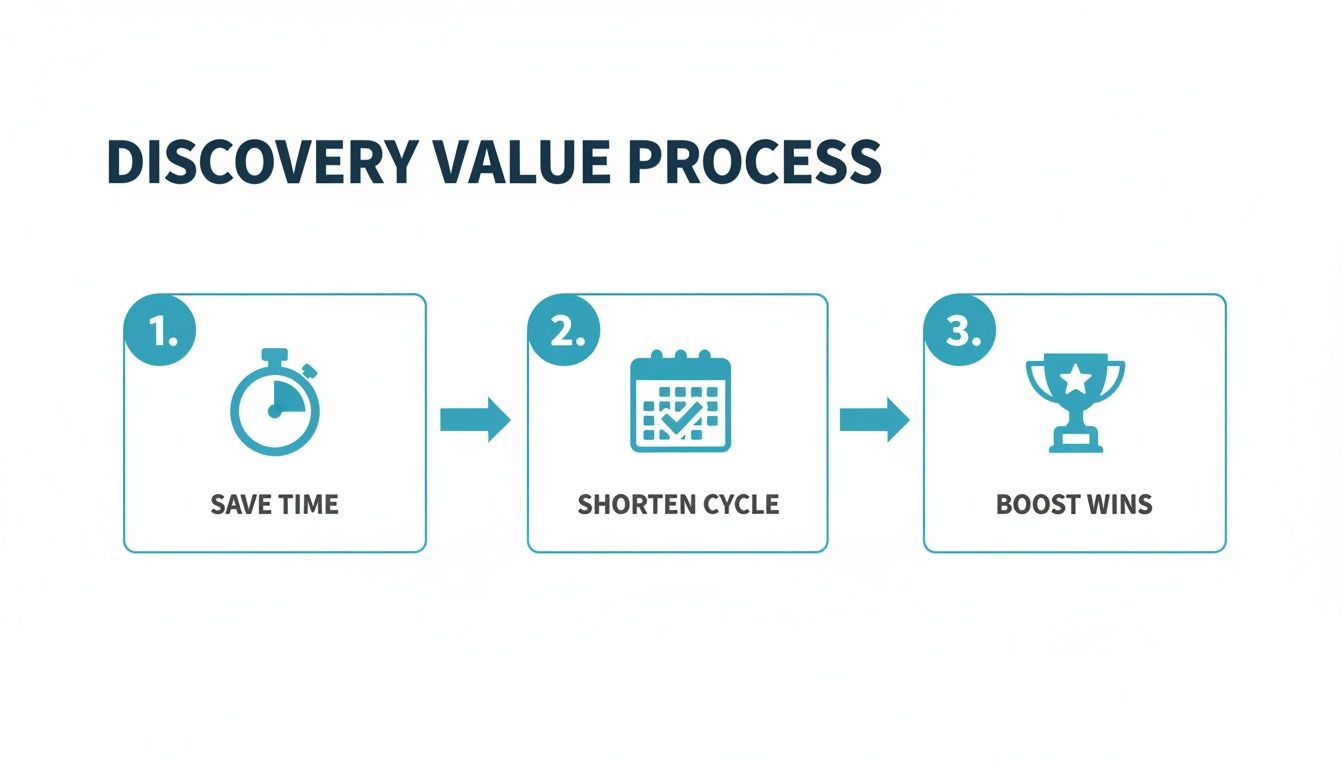
As you can see, a well-run call directly impacts key sales metrics. It's all about focusing on qualification and mutual fit from the very first conversation.
5. Aligning on Next Steps
Finally, every single discovery call must end with a clear, concrete, and mutually agreed-upon next step. If you leave it vague, you kill all momentum. Period. Based on the conversation, you should know whether or not there’s a potential fit.
Summarize their key challenges and what they hope to achieve, then propose a logical next action. For example: "So, it sounds like the main issues are X and Y, and you're looking to achieve Z. Our next step would be a focused demo to show you exactly how we nail those points. Are you free this Thursday to take a look?"
Always, always get that next meeting booked before you hang up.
Questions That Uncover Real Opportunity
Let’s get one thing straight: the quality of your discovery call lives and dies by the quality of your questions.
Anyone can ask, “So, what are your pain points?” and get a bland, rehearsed answer. That’s not discovery; it’s a checklist. To find a real, closeable opportunity, you have to ask questions that make your prospect pause and think about their own business in a new light.
You’re not there to interrogate them. You’re there to guide them. The goal is a strategic conversation where they start connecting the dots between their day-to-day headaches and a much bigger business problem. The best questions are your keys to unlocking what’s really going on—the challenges, the goals, and the messy internal politics.
A small tweak in how you frame a question can change the entire conversation. Instead of asking a generic question, try something like: “If you could wave a magic wand over your current process, what’s the one thing you’d change immediately?”
See the difference? One gets you a grunt. The other invites a story.
Problem Questions That Find the Pain
Before you even think about pitching your solution, you need to understand their problem better than they do. Problem questions are designed to dig past the surface-level symptoms and get right to the root cause of the friction in their workflow.
Your job here is to get them to paint a crystal-clear picture of their current reality, warts and all.
- “Can you walk me through your team's exact workflow for [specific task] from start to finish?” This question is brilliant because it forces them to slow down and actually describe a process they probably do on autopilot, which almost always reveals hidden cracks and holdups.
- “What’s the most manual or time-consuming part of that process right now?” This zooms in on the most concrete source of frustration—the thing their team complains about every single day.
- “When was the last time [the current process] broke down, and what was the immediate result?” This ties the abstract problem to a specific, painful memory.
Impact Questions That Quantify the Cost
Okay, so you’ve found a problem. Now you have to make it matter. Impact questions are where the magic happens because they turn a simple annoyance into a hard-hitting business case. This is how you create urgency and get the attention of the people who sign the checks.
These questions connect the problem to the only three things executives truly care about: revenue, cost, and risk.
An unquantified problem is just an opinion. A quantified problem is a budget-level priority. It's your job to help the prospect do the math and see the true cost of inaction.
- “When that inefficiency happens, what's the downstream effect on other teams?” This uncovers the ripple effect, showing that this isn't just one team's problem—it's an organizational one.
- “Roughly how many hours per week does your team lose to that manual task?” This is the first step in calculating the real dollar cost of wasted time and resources.
- “What opportunity is the business missing out on because your team is stuck dealing with this?” This is the killer question. It reframes the pain from a cost to be managed into lost revenue or missed growth—a much more powerful motivator.
Authority and Vision Questions
Knowing what the problem is isn't enough. You also need to understand the who and the why. Authority questions help you map out the decision-making process without bluntly asking, “Are you the one who can actually buy this?” Vision questions help you align your solution with their biggest goals.
- Authority: “Who, besides yourself, is most impacted by this issue?”
- Authority: “When your team has made similar strategic purchases in the past, what did that approval process look like?”
- Vision: “Let's imagine we solve this perfectly. What does that unlock for your team six months from now?”
- Vision: “What strategic company objective does solving this problem support?”
Having a structured way to think about your questions ensures you're not just winging it. You're strategically uncovering the information needed to qualify—or disqualify—the opportunity.
Strategic Discovery Question Matrix
This table breaks down how to structure your questions to hit on the key qualification criteria you need to uncover.
| Qualification Criteria | Sample Question to Uncover Criteria | Objective of the Question |
|---|---|---|
| Need | "If you didn't solve this problem, what would be the likely consequence in the next 6 months?" | To establish urgency and confirm that the pain is significant enough to warrant a solution. |
| Authority | "Who else on the team usually gets involved in decisions like this?" | To identify all the stakeholders in the buying committee without putting your contact on the spot. |
| Budget | "Have you invested in tools to solve similar challenges in the past? What was that experience like?" | To gauge their willingness to spend and understand their history with budget allocation for this area. |
| Timeline | "What's driving the need to look for a solution now versus three months ago?" | To uncover the trigger event and determine if their timeline is realistic or just a vague "sometime in the future." |
By thoughtfully deploying these different types of questions, you turn the discovery call from a simple qualification exercise into a genuinely valuable consultation for the prospect. They leave the call smarter, and you leave with a real, qualified opportunity.
Common Discovery Call Mistakes to Avoid

Look, even a perfect-fit prospect on a seemingly great discovery call can walk away feeling cold. It usually comes down to a few simple, unforced errors. These slip-ups feel minor in the moment, but they completely kill any trust or momentum you've built.
Knowing what these traps look like is the first step to dodging them. The most lethal habit? Treating discovery like an interrogation. Just peppering someone with question after question makes them feel like they're being audited, not helped. A great call feels like you're exploring a problem together, not just running through a checklist.
Another classic mistake is hearing a single keyword and immediately launching into your pitch. That’s a rookie move. It completely short-circuits the diagnostic process. Your job isn't to find the first excuse to talk about your product; it's to fully grasp their reality before you even think about proposing a solution.
Pitching Before Diagnosing
This is the cardinal sin of discovery. A prospect mentions "inefficient reporting," and the rep dives headfirst into a five-minute monologue about their platform's reporting dashboard. This premature pitch screams, "I care more about my script than your actual problem."
Here’s what it sounds like: A prospect says, "Our team is really struggling to track project progress." The untrained rep immediately jumps in with, "Oh, you'll love our platform! It has a real-time progress tracker with customizable widgets and automated alerts! Let me tell you…"
The prospect has already checked out. You haven't let them explain why it's a struggle—maybe the issue is sloppy data entry, not a lack of fancy charts. You just prescribed medicine without ever diagnosing the illness.
To fix this, make yourself a promise: never mention a product feature until you have uncovered a quantified business pain. Instead of pitching, dig deeper with an impact question like, "And what happens to the business when you can't track that progress effectively?"
Accepting Surface-Level Answers
Good discovery means you have to dig. When a prospect gives you a generic, high-level answer, it's often a test—they're seeing if you're truly listening or just waiting for your turn to talk. If you accept their first response, you leave the real, valuable problem buried.
Here’s how it plays out: You ask, "So, what are your biggest challenges right now?" The prospect shrugs and says, "We just need to improve our workflow efficiency."
An amateur rep will nod, say, "Okay, great," and move on. A pro hears an open invitation to go a level deeper.
A surface-level problem gets a surface-level budget. A deeply understood, quantified business problem gets executive attention and a real budget. Your job is to connect the dots for them.
The fix is simple. Just use clarifying follow-up questions to peel back the onion.
- "That's interesting. When you say 'efficiency,' what does that actually look like for your team?"
- "Can you walk me through a recent example of where that inefficiency really caused a headache?"
- "Who on the team feels the pain from that the most?"
Ending with Ambiguity
This might be the most common mistake of all. You have a great call, and then you end it with a vague, non-committal next step. Phrases like "I'll send over some information" or "Let's connect again soon" are absolute deal-killers. You’re handing all control over to the prospect and letting all the urgency you just built evaporate into thin air.
Here’s the deal-killing finale: The call went well, and the rep wraps up with, "This was a great chat! I'll email you some resources. Feel free to book a demo from my calendar link when you're ready."
That deal is now on life support. The "resources" will sit unopened in their inbox, and that demo is never getting booked.
The solution is to always propose a specific, time-bound next step before you hang up. Summarize the value you uncovered and make the ask crystal clear: "Based on what you told me about [Problem X], it sounds like a logical next step is a 30-minute demo focused specifically on how we solve that. Do you have your calendar open for Tuesday or Thursday afternoon?"
This turns a fuzzy "interest" into a concrete action item.
Turning LinkedIn Leads into Qualified Calls
The secret to a great discovery call doesn't start when you hop on Zoom. It starts way before that.
In B2B sales today, the real work begins on platforms like LinkedIn, where you have to earn the right to even have that conversation in the first place.
The goal isn't to ambush prospects with a calendar link. It's a total mindset shift. Think of your activity on LinkedIn as a "pre-discovery" phase—it’s all about warming up the relationship before you ever ask for a meeting.
This whole process kicks off when you consistently share content that actually helps people and positions you as an expert. When a prospect engages with your post—maybe they leave a comment, a like, or send a thoughtful DM—that's a clear signal. They're raising their hand. This interaction is the perfect green light to take the conversation from public to private.
From Engagement to Scheduled Call
Okay, so someone interacted with your post. What now?
The next move is a personalized, no-pressure message. The aim here isn’t to sell. It's simply to acknowledge their engagement and gently suggest a chat.
Here’s a simple, proven framework that works:
- Acknowledge: "Thanks for your comment on my post about [topic]. Glad it resonated."
- Connect: "I noticed your team is also in the [industry] space, so you're probably dealing with [related challenge]."
- Propose: "I have a few ideas on how you could tackle that. Open to a quick chat next week to walk you through it?"
This approach respects their time and frames the call as a valuable consultation, not another sales pitch. When they say yes, you're walking into that discovery call with a foundation of trust already built.
They aren't a cold lead anymore. They're an engaged person who already sees you as a credible resource. This foundation is everything, and you can get a deeper dive into building it with our guide on how to connect on LinkedIn.
Your Burning Discovery Call Questions, Answered
Even with the perfect game plan, you're going to run into some tricky situations on a discovery call. Let's walk through a few of the most common curveballs so you know exactly how to handle them.
Getting these little details right is often what separates a stalled deal from a closed one.
How Long Should a Discovery Call Be?
Put 30 minutes on the calendar, but don't be a slave to the clock. Your real goal is diagnosis, and sometimes that takes a little longer.
If the conversation is flowing and you're uncovering gold at the 35-minute mark, keep digging. The aim isn't to wrap up on time; it's to get to a clear "yes" or "no" on whether moving forward makes sense for both of you. If you get that in 25 minutes, fantastic. If it takes 45, that's time well spent.
Should You Talk Money on the First Call?
Absolutely, but you have to do it right. Blurting out, "So, what's your budget?" is a great way to make a potential client clam up and kill the great rapport you just built.
Instead, you need to frame it as an investment tied directly to the value you've just uncovered.
Pro Tip: Wait until you've established the pain. Then, try something like this: "For companies we work with to solve this exact problem, the investment is usually in the X to Y range. Does that feel about right for how high a priority this is for you?" It qualifies them without putting them on the spot.
What's the Best Way to End the Call?
The single worst thing you can do is end with a vague "I'll send over some information." You lose all momentum.
Always, always end with a concrete, time-bound next step. Summarize their biggest challenges back to them to show you were listening, then propose the next logical move.
For example: "Okay, so it sounds like the real roadblocks are X and Y. The best next step would be for me to walk you through a quick demo focused specifically on how we solve those two things. How does your calendar look for Tuesday?"
Never leave the call without something firmly booked in both your calendars.
Ready to fill your calendar with genuinely qualified discovery calls? The Growlancer system helps B2B leadership teams build authority on LinkedIn and convert it into a predictable stream of high-value meetings. Stop chasing leads and start attracting your ideal buyers. Learn how we build your pipeline.