

Let's be honest, "personal branding" used to feel like a vanity project. Something for influencers, not serious executives.
But that world is long gone.
Today, a leader's personal brand isn't about looking good online; it's a hard asset that directly impacts the bottom line. It’s the difference between a sluggish pipeline and a predictable one. It's not a rare exception anymore—it's the new standard for anyone in a leadership role.
This isn't just another guide with vague advice. It's a system built for busy executives who need a repeatable process for driving real business outcomes. No fluff, just what works.

The Real Financial Weight of Your Reputation
A strong personal brand isn't a "soft" asset. It has a real, quantifiable value tied directly to your company's health.
Don't just take my word for it. Industry studies have shown a CEO’s reputation can account for up to 43% of a company’s market value. If you want to dig into the numbers, check out the data behind personal branding statistics on dsmn8.com.
That's a staggering figure. It shows exactly why this has shifted from a "nice-to-have" to a core business function. How the market, your customers, and potential hires see you directly influences how they see the entire organization.
Your personal brand is a promise of the value you'll deliver. For an executive, that promise extends to the entire company, influencing everything from sales cycles to recruitment success.
Your LinkedIn Profile: From Digital Resume to Revenue Engine
The goal here is simple: stop treating your LinkedIn profile like a static resume and start running it like a dynamic engine for revenue and market leadership. This demands a system. One that connects your personal expertise directly to your company's growth targets.
When you get this right, you unlock some powerful results:
- You start generating inbound leads. Instead of chasing people down, your ideal customers start seeking you out because they see you as the expert.
- You build unshakeable market authority. You’re no longer just participating in industry conversations—you’re shaping them. Our guide on building a thought leadership content strategy dives deeper into how to do this.
- You become a magnet for A-player talent. The best people want to work for compelling leaders. Your brand showcases your vision and culture, making you the obvious choice.
- You build rock-solid investor confidence. A leader with a clear, public vision and market insight is a much safer bet for stakeholders and new capital.
Ultimately, a deliberate, well-executed personal brand gives you control. Control over your professional story and, more importantly, its impact on the business.
Find Your Angle: Niche Down to Stand Out
Before you even think about writing a single LinkedIn post, we need to lay the foundation. You need a blueprint. Too many executives think building a personal brand is about spraying generic leadership advice all over the internet. It's not.
It's about finding a specific, valuable corner of your industry and absolutely owning it. Without this sharp focus, your content is just noise. It’s a surefire way to get ignored by the very people you’re trying to reach.
The goal here is simple: stop being a generalist executive and become a specialized, go-to authority. Generalists are replaceable. But a specialist with a unique point of view? They become indispensable. This initial work makes sure every post, every comment, and every connection request has a clear purpose.
The Market Mapping Warm-Up
So, how do you find that unique position? First, you have to understand the existing landscape. I call this a "Market Mapping" exercise. It's a quick analysis to show you where the real opportunities for influence are hiding.
Get started by zeroing in on your Ideal Customer Profile (ICP). Who are the decision-makers you absolutely need to get in front of? Get specific. What are their exact titles? What kind of companies do they run? What keeps them up at night, and what conversations are they already having on LinkedIn?
Next, take a look at your competitors and peers—the other executives in your space who are already active. What topics do they talk about constantly? What’s their angle? Pay close attention to the content formats they use and, more importantly, the engagement they get. We're not doing this to copy them. We're doing it to find the gaps they've left wide open.
This leads to the final piece: pinpointing the untapped conversations. What are the nagging problems your ICP is dealing with that nobody is addressing with any real insight? These gaps are gold. They are your entry point to building real authority.
Nail Your Positioning Statement
Once you’ve mapped the terrain, it's time to distill it all into a powerful positioning statement. This isn't some fluffy marketing slogan for your profile. It's your internal compass. It's the filter for everything you'll create and every person you'll reach out to.
A rock-solid positioning statement answers three questions, no exceptions:
- What specific problem do you solve? Ditch the vague stuff like "I help companies grow." Get sharp. Something like, "I help mid-market SaaS companies slash customer churn by redesigning their product onboarding." See the difference?
- Who, exactly, do you solve it for? This comes straight from your ICP work. Maybe it's "VPs of Customer Success at Series B and C startups." That's a target.
- What makes your take on it unique? This is your secret sauce. It's that unique blend of experience, a proprietary method, or a contrarian view that nobody else has. Maybe you have a background in a totally different industry that gives you a fresh perspective. That's it.
A great positioning statement is a declaration of focus. It tells your audience—and reminds you—exactly why you deserve their attention in a sea of noise. It’s the concrete foundation for a brand that people actually remember.
Let’s make this real. Think of a CFO at a manufacturing company. A generic brand is just "CFO." A powerful, niched-down brand is something like, "The CFO who helps legacy manufacturing firms digitize their supply chain financing to unlock millions in hidden cash flow." The second one instantly tells you who they help, what they do, and hints at a massive value proposition.
Getting this focus right changes the entire game. It dictates the topics you write about, the people you connect with, and the opportunities that will start coming to you. And this isn't just theory. Research shows 82% of consumers trust a company more when its senior leaders are active and visible on social media. That trust is built on clarity and relevance, which all starts here.
Without this positioning, you're just another suit adding to the noise. With it, you become a signal your ideal audience can't afford to ignore.
Hammering Out Your Content Cadence
Once your positioning is dialed in, it's time to turn that strategy into a real, sustainable content system. This is where a lot of executives get stuck. They think they need to become a full-time LinkedIn creator overnight, and the whole idea feels overwhelming.
Forget that. The goal isn't to post constantly; it's to create a deliberate rhythm that transforms random posts into a predictable way to build your authority.
This is about shifting from just sharing company news to starting real conversations that matter to your ideal clients. Impact over volume. Every single time.
High-Impact Content Formats That Actually Work for Executives
Your time is your most valuable asset, so your content has to be ruthlessly efficient. Instead of throwing spaghetti at the wall to see what sticks, let's focus on three core formats proven to build expertise and trust.
These are my go-to pillars for any leadership team I work with:
- Provocative Perspectives: This is where you pick a common industry belief and challenge it. Not just to be a contrarian, but to show you're thinking on a deeper level. A COO, for example, could dismantle the idea that remote work always kills company culture, then share a specific framework for how they build genuine connection across distributed teams.
- Behind-the-Curtain Insights: People want to connect with other people, not just a job title on a profile. Pull back the curtain. Share a hard-won lesson from a tough quarter, the real story behind a successful project, or even a mistake you learned from. A VP of Sales could tell the story of a major deal that almost died and the one specific negotiation tactic that brought it back from the brink. This stuff builds massive trust.
- Customer-Centric Stories: Make your clients the hero. Turn their wins into mini case studies. Talk about the problem they were wrestling with before they met you and the transformation they saw after. This is infinitely more powerful than just listing your product's features because it's real-world proof that you deliver results.
The best part? These formats are flexible. A single "Behind-the-Curtain" insight can become a quick text post, a short video, or even a multi-part series. If you need more ideas on how to structure these, check out our guide on how to write engaging LinkedIn posts.
Nailing Your Weekly Rhythm
Consistency is everything. Posting sporadically tells your network you aren't serious and kills any momentum you might build. But this doesn't mean you need to be chained to LinkedIn every day.
A simple, powerful cadence mixes one or two pieces of original thinking with some lighter-touch engagement. This keeps you visible and in the conversation without eating up your entire week.
An executive's content cadence isn't about shouting into the void daily. It's about a strategic, weekly rhythm of value that trains your audience to listen when you speak.
A manageable schedule is the key to sticking with it. Here’s a simple structure I recommend to busy leaders to get started.
Weekly Executive Content Cadence Example
This sample schedule is designed to maximize your impact on LinkedIn without demanding hours of your time. It focuses on one core thought leadership piece and supplements it with strategic engagement to maintain momentum.
| Day | Content Type | Objective | Time Commitment |
|---|---|---|---|
| Tuesday | Thought Leadership Post | Share a 'Provocative Perspective' or 'Behind-the-Curtain' insight. | 45-60 minutes |
| Thursday | Curated Post with Commentary | Share a valuable industry article and add your unique 2-3 sentence take. | 15 minutes |
| Friday | Engagement Focus | Spend time commenting thoughtfully on posts from your ICPs and key partners. | 15 minutes |
This rhythm is doable. The Tuesday post is your anchor, establishing your expertise. The other touchpoints are quick wins that keep the conversation flowing. It’s a system built for a real-world executive calendar.
The Massive Opportunity Hiding in Plain Sight
Here's the kicker: most executives are silent on LinkedIn. This creates a huge opening for anyone willing to be even moderately consistent.
Recent data shows a massive gap between presence and participation. While around 87% of senior executives have a LinkedIn profile, very few are active. A ColumnContent 2025 analysis found that only about 55% of FTSE 100 CEOs post with any kind of regularity.
Think about that. Nearly half of the top leaders are leaving this on the table.
This isn't just a statistic; it's your competitive advantage. By simply showing up with a sustainable content rhythm, you immediately separate yourself from the majority of your peers. You stop being another silent profile and start being an active voice shaping the conversation in your industry. That's how you build a personal brand that actually drives business.
Wiring Your Brand into the Sales Pipeline
This is where the rubber meets the road. A killer personal brand is more than just impressive posts and a climbing follower count. It has to be a strategic asset, directly wired into your sales pipeline to generate real, predictable revenue.
If your content isn't actively helping your team close deals, it’s just noise.
We’re moving beyond just passively sharing thoughts. The goal here is to build a systematic outreach strategy that gives your sales team an unfair advantage. It's about creating a powerful ‘surround sound’ effect around your most important target accounts.
When an executive’s authority and the sales team’s outreach are in lockstep, the entire dynamic shifts. Cold outreach becomes warm. Prospects feel like they already know you. Sales cycles shrink. This is how a personal brand goes from a simple megaphone to a powerful magnet, actively pulling qualified leads into your world.
This flow shows how a consistent content cadence—mixing thought leadership with genuine engagement—lays the groundwork for true pipeline alignment.
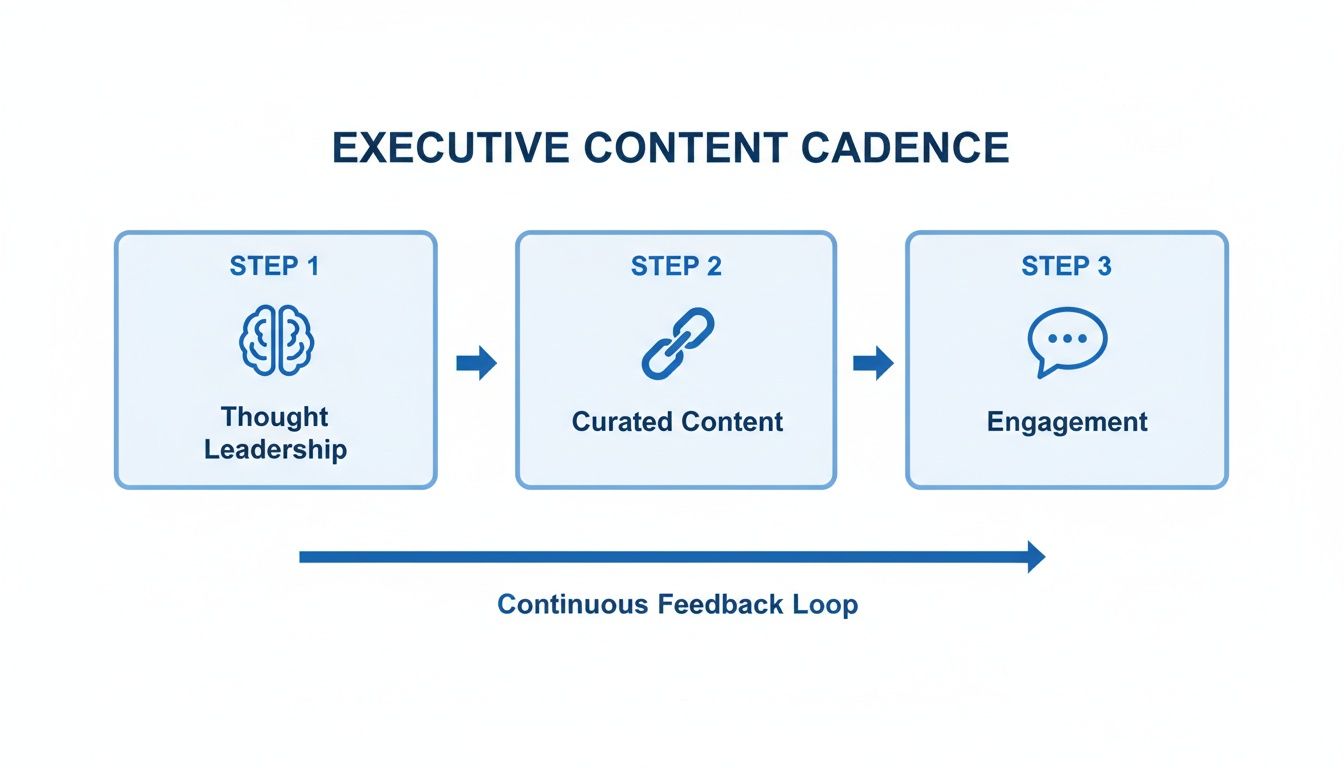
The takeaway here is that a successful executive presence isn't about broadcasting. It’s a cycle: create value, share relevant industry insights, and actively engage with your target audience to build real relationships.
Creating Sales and Content Synergy
Real alignment comes from a practical workflow that bridges the gap between marketing and sales. Your content can't exist in a vacuum; it needs to be a tool your sales team can grab and use every single day.
Picture this: You publish a post on Tuesday morning with a unique take on a key industry problem. By Tuesday afternoon, your sales team has a list of every decision-maker from your target accounts who engaged with that post.
That's a total game-changer. It turns a piece of content into a high-intent lead list, served up on a silver platter.
Here’s how you make that happen:
- Amplify Through the Team: When you post, the entire sales team should be ready to jump in. A like is good, but a thoughtful comment is gold. This massively boosts the post's visibility and signals to the algorithm that a valuable conversation is happening.
- Content as a Conversation Starter: Get your reps using your latest article as their reason to reach out. A message like, "Hi [Prospect Name], saw you’re connected with our CEO, [Your Name]. She just posted some great points on [Topic] that seemed relevant to your work at [Company]." is worlds away from a generic pitch.
- Targeted Account Engagement: Your content calendar needs to be informed by sales priorities. If the team is going after the fintech vertical this quarter, your content needs to be all about the pains and challenges of fintech leaders.
Mining Your Engagement for a Hot List
Your LinkedIn notifications are more than an ego boost—they're a real-time feed of warm leads. The people consistently liking, commenting, and sharing your content are raising their hands and signaling interest. You just need a system to catch it.
Start by watching the engagement on your high-value posts—the ones where you share a strong opinion or deep insight. Pay close attention to the job titles and companies of the people interacting.
Don’t just count the likes. Analyze who is liking. A single engagement from a C-suite executive at a dream account is worth more than a hundred from people outside your ideal customer profile.
From this analysis, build a targeted list. This isn't a cold list; it's a list of prospects who have already shown they're paying attention. This precision approach to LinkedIn for B2B sales turns your profile into a finely-tuned lead machine.
Crafting the Non-Salesy Connection Request
Once you have your warm list, it's time to reach out. But the standard "I'd like to add you to my professional network" is a massive wasted opportunity. You need a request that's personal, relevant, and has zero whiff of a sales pitch.
The key is to reference the interaction you just had. Your content provides the perfect excuse.
Here's a simple but killer template:
"Hi [Prospect Name], thanks for your thoughtful comment on my post about [Topic]. Appreciated your perspective on [Mention something specific they said]. Always keen to connect with other leaders in the [Industry] space. Let's connect."
This works because it’s genuine. You aren’t immediately pushing for a demo. You’re starting a professional relationship on shared intellectual ground. You've already provided value with your content, and now you're simply opening the door for a real conversation.
This is the system: content creates engagement, engagement builds lead lists, and outreach is personalized. This is how an executive’s personal brand becomes a predictable engine for pipeline growth.
How to Measure Your Branding ROI
Let's be blunt: if your personal branding isn't leading to actual business, it’s just a hobby. A time-consuming one at that. To make this a core part of your growth strategy, you have to know what's working. You've got to measure it.
This means looking past the ego-boost metrics. Sure, likes, views, and a growing follower count feel good, but they don't pay the bills. They're clues, not conclusions. The real goal is to draw a straight line from your activity on LinkedIn to your company's pipeline.

Shifting From Vanity to Value
First things first, we need to redefine "winning." Winning isn't a viral post. It's getting the attention of the right people and starting valuable conversations. It’s about tracking the entire journey, from a prospect checking out your profile to your team closing the deal.
So, let's reframe the numbers you should actually be watching. It's about moving from broad, feel-good numbers to sharp, business-focused insights.
Key Metrics for Executive Personal Branding
This table breaks down the crucial shift in mindset. Instead of just counting things, we start weighing their impact. A single view from a target CEO is worth more than a thousand random impressions.
| Metric Category | Vanity Metric (Easy to Track) | Business Metric (Drives Decisions) |
|---|---|---|
| Audience Growth | Total Followers | Followers from Target Accounts (ICPs) |
| Content Reach | Post Impressions & Views | Engagement Rate from Key Verticals |
| Profile Traffic | Total Profile Views | Profile Views from Target Job Titles |
| Lead Generation | Connection Requests | Inbound Connections from Qualified Leads |
| Pipeline Impact | "Brand Awareness" | Demo Requests Attributed to LinkedIn |
Making this switch means you have to go deeper than the surface-level LinkedIn dashboard. You need to start asking who is engaging, not just how many. That's where the real value lies.
Integrating LinkedIn with Your CRM
This is the linchpin. If your LinkedIn efforts don't connect back to your company's CRM, you're just guessing at the ROI. You need a closed-loop system so you can say with confidence, "This customer came from my personal brand."
The most straightforward way to nail this is by creating a dedicated lead source in your CRM.
- Create a New Lead Source: Inside your CRM—whether it's HubSpot, Salesforce, or another platform—create a specific source tag. Something like "ExecLinkedIn-Inbound" or "CEO-Brand-Lead" works perfectly.
- Establish a Workflow: Get your team on board. Any lead that comes from your direct LinkedIn activity gets this tag. This includes inbound DMs, connection requests that spark a conversation, or even someone on a sales call who says, "I saw your post about X."
- Manual Tagging is Key: At the start, this is almost always a manual process. When a great prospect slides into your DMs, you or an assistant need to create that contact in the CRM and apply the tag. This discipline is absolutely essential for accurate tracking.
Your CRM is the source of truth for your business. If your branding efforts don't have a clear, traceable path into that system, their value will always be invisible to the rest of the company.
This simple habit of tagging lets you build reports that show exactly how much pipeline and revenue your personal brand is generating. The conversation shifts from "I feel like this is working" to "My LinkedIn activity generated $150,000 in new pipeline last quarter."
Building a Simple ROI Dashboard
With the data flowing into your CRM, you need a way to see it clearly. A complex spreadsheet nobody understands is useless. The goal is a clean, simple dashboard that tells the story at a glance.
Focus on just a handful of metrics that tie directly to business outcomes.
- Inbound Qualified Connections: The raw number of new connections from people who fit your Ideal Customer Profile.
- Conversations Started: How many back-and-forth chats were initiated with qualified prospects in your LinkedIn inbox.
- Meetings Booked (ExecLinkedIn Source): The number of demos or discovery calls set that carry your unique "ExecLinkedIn" tag.
- Pipeline Influenced (ExecLinkedIn Source): The total dollar amount of all sales opportunities created from this channel.
- Deals Closed (ExecLinkedIn Source): The bottom line. How much actual revenue was won that started with your personal brand.
This dashboard isn't just for you; it’s undeniable proof for the rest of the leadership team. It turns personal branding from a "soft" marketing activity into a hard-hitting, predictable revenue engine.
Scaling the Program Across Your Leadership Team
A single executive with a rock-solid personal brand is a huge asset. I've seen it time and again.
But an entire leadership team? All speaking with coordinated authority? That's how you move markets.
Once you’ve got a system that works for one person, the real magic happens when you scale it. It’s not about turning your leaders into an army of clones all posting the same stuff. Far from it.
It's about empowering each leader to find their own authentic voice within a unified company framework. Think of it as a chorus of expert voices, all reinforcing your company's core message from slightly different angles. This is how you build trust and drive growth at a pace you just can't achieve alone.
Build an Executive Branding Playbook (and Keep It Simple)
To get everyone on the same page without killing their creativity, you need a playbook. This isn’t some 50-page binder that’ll gather dust. It’s a simple, clear set of guidelines to remove the guesswork for busy leaders and keep things consistent.
Your playbook should be practical and get right to the point. Here’s what it needs to cover:
- Core Content Pillars: Outline the 3-5 key themes your company wants to own in the market. This ensures every executive is pulling in the same direction and contributing to the same big-picture story.
- Tone of Voice Guardrails: What's the brand's personality? Are you the insightful teacher? The bold challenger? The helpful guide? Give them a few examples to bring it to life.
- Approval and Compliance Workflows: Make this crystal clear. For most, a quick review by marketing before publishing is plenty. But if you’re in a regulated industry, a legal check might be non-negotiable. The goal is to keep it as lean as humanly possible so you don’t kill momentum.
This playbook is the foundation for your entire personal branding for executives program. It provides just enough structure while giving your leaders the freedom to be themselves.
Get Them the Right Support
Let's be real: your executives are slammed. Expecting every leader to suddenly become a content creator, publisher, and community manager on top of their day job is a recipe for failure.
You have to build a support system around them.
I've seen a few models work really well in practice:
- Fractional Ghostwriter or Agency: This is usually the fastest way to get results. You bring in an external partner who lives and breathes this stuff. They know content strategy, they know LinkedIn, and they can interview each executive to perfectly capture their voice. They turn a few hours of an exec's time each month into a steady flow of killer content.
- Internal Marketing Liaison: Got someone sharp on your marketing team? Designate them as the champion for this program. They can help brainstorm ideas, edit drafts, and handle the posting schedule. It's a cost-effective way to keep everything tightly aligned with your other marketing campaigns.
- Hybrid Approach: Mix and match. Maybe you use an agency to handle the heavy lifting for the CEO's strategy and content, while your internal liaison gives the rest of the leadership team a lighter touch with editing and scheduling support.
A successful scaled program isn't about piling more work onto your leaders. It’s about building a support system that makes their participation almost effortless. This allows their expertise to shine without getting bogged down by the day-to-day operations.
When you get this right, you transform your leadership team from a group of talented individuals into a coordinated intellectual force. By giving them a clear playbook and the right support, you create a powerful, sustainable engine for market authority and pipeline.
This collective voice becomes one of your biggest competitive advantages, hands down.
Ready to scale your leadership team's influence and build a predictable sales pipeline on LinkedIn? Growlancer offers a done-for-you system that combines strategy, authority content, and targeted outreach to turn your executives into industry powerhouses. Learn more and book a call at https://growlancer.ai.