

Tired of shouting into the void?
Imagine your business acting less like a megaphone and more like a powerful magnet. That's the real magic behind inbound lead generation. It's a strategy that’s all about attracting customers by being genuinely helpful, not by interrupting their day. You pull people in instead of pushing your message out.
What Is Inbound Lead Generation

Inbound completely flips the old-school sales script. Forget your team grinding away on cold calls or blasting out generic emails. Instead, you create content and experiences so valuable that your ideal customers find you. This whole game is built on earning trust and credibility right from the start.
Think about the last time you had to make a big purchase for your business. Did you jump on a cold call? Or did you hit Google, read a few articles, and check out your options? I'm betting it was the latter. Inbound marketing simply meets buyers where they already are—smack in the middle of their research.
The core idea is to solve problems, plain and simple. When you publish useful blog posts, host webinars, or create in-depth guides, you're not just selling; you're positioning your company as an expert. People find you through search or social media because you’re the one providing the answers they're desperately looking for.
The Shift from Interruption to Attraction
The real difference between inbound and outbound comes down to one word: permission. Outbound marketing is an interruption. It's a gamble, hoping you stumble upon someone who cares. Inbound, on the other hand, earns attention. And that creates a much warmer, more engaged audience for your sales team to talk to.
The numbers don't lie. Inbound marketing generates three times more leads than traditional outbound marketing, and it costs 62% less. It's a fundamental shift from chasing people down to making your business so valuable that the right customers can't help but find you.
This magnetic pull doesn't just bring in more leads; it brings in better ones. These people actively sought you out. They've read your stuff. They're already convinced you know what you're talking about because you've already helped them solve a small piece of their problem.
It’s all about building a relationship through a series of helpful steps:
- Awareness: A potential customer is struggling with an industry problem and stumbles upon your blog post that breaks it all down.
- Consideration: Impressed, they download one of your guides, trading their contact info for even more of your expertise.
- Decision: After you've followed up with more useful content, they finally book a demo. They trust you before they've even spoken to a salesperson.
This natural journey builds a predictable pipeline of prospects who aren't just leads. They're fans. It's a smarter, more sustainable, and frankly, more human way to grow your business.
The Core Channels of Your Inbound Engine
A great inbound strategy isn't about doing one thing well. It's an engine, a system where several moving parts work together to create something powerful. When each component fires in sync, you get a predictable, self-sustaining flow of high-quality leads.
Let's pop the hood and look at the essential parts of this machine.
Think of these channels less like separate silos and more like gears. One gear turns, which moves the next, and suddenly you have momentum driving your entire inbound lead generation effort forward.
Content Marketing: The Fuel
Content is the fuel. Simple as that. It’s the value you give your audience before you ever ask for anything in return. Without high-quality, genuinely helpful content, your inbound engine will sputter to a halt. There’s nothing to attract, engage, or convert anyone.
This isn’t about just churning out blog posts for the sake of it. Real content marketing is about getting inside your ideal customer's head, understanding their biggest headaches, and creating resources that actually solve those problems.
The data backs this up. Industry reports show that content marketing generates three times more leads than old-school outbound tactics and costs 62% less. You can dig into the numbers in this in-depth analysis of lead generation statistics. It’s proof that providing value first always wins.
Your content arsenal needs to be diverse, hitting people at different stages of their buying journey:
- Blog Posts & Articles: Think of these as your front door. They answer specific questions and attract new visitors from Google and social media.
- Guides & eBooks: These are the deeper dives. They cement your authority and are perfect for capturing lead information.
- Webinars & Videos: Incredibly engaging formats that let you connect with your audience on a more personal level and show off your expertise in real-time.
The goal? Become the go-to resource in your space. When a prospect has a question, your name should be the first one that pops into their head.
Search Engine Optimization: The GPS
If content is your fuel, then Search Engine Optimization (SEO) is the GPS guiding people straight to it. You could create the most brilliant guide in the world, but if no one can find it, it’s worthless. SEO is how you make sure that when your ideal customer types their problem into Google, your solution shows up.
This is the very essence of inbound—you’re connecting with people who are actively searching for what you do. It’s a pull, not a push. You’re not interrupting their day; you’re the helpful answer they were looking for.
SEO isn't a "set it and forget it" task. It's the ongoing work of matching your content to the exact language your audience uses. This ensures your hard work gets discovered at the precise moment of need, turning a curious searcher into a warm lead.
Good SEO boils down to a few key things:
- Keyword Research: Figuring out the exact phrases your audience is typing into search engines.
- On-Page Optimization: Structuring your content with clear headings and meta descriptions so Google understands what it's about.
- Technical SEO: Making sure your website is fast, mobile-friendly, and easy for search engines to crawl.
When you get this right, SEO becomes a compounding asset. A single well-ranked article can keep generating inbound leads for months—or even years—delivering an incredible return on your initial time investment. For more ideas on creating content that gets found, check out the various topics on the Growlancer blog.
Social Media: The Distribution Network
Social media, especially a platform like LinkedIn for B2B, is your distribution network. It's where you amplify your content, build a community, and talk to prospects like a normal human being.
Hitting "publish" on a blog post is just the start. You have to get out there and promote it. Sharing your content on social platforms puts it in front of a much wider audience—people who would never have found you through search alone.
This is also where you build real authority. By consistently sharing insights and jumping into industry conversations, you position your company and its leaders as credible experts. That builds trust, which is the foundation of every single sale you’ll ever make.
Building Your Predictable Lead Pipeline
Knowing the pieces of an inbound engine is one thing. Actually assembling them into a machine that spits out qualified leads like clockwork? That's a whole different ballgame.
The goal here isn't just to "do marketing." It's to build a system. A repeatable process that turns your team's hard-won expertise into a reliable revenue stream. Because let's be honest, random acts of marketing get you random results. A solid framework, on the other hand, delivers predictable growth.
This is exactly where most companies get stuck. They'll drop a killer article, see a little bump in traffic, and then crickets. They're left wondering why it didn't turn into a flood of sales meetings. The secret isn't a content-first mindset; it's a system-first one, where every single piece of content has a job to do inside a bigger strategy.
Let's walk through a practical, five-step framework to get this pipeline built.
This is the basic flow: content creation gets amplified by SEO and social media, which in turn attracts the right people.
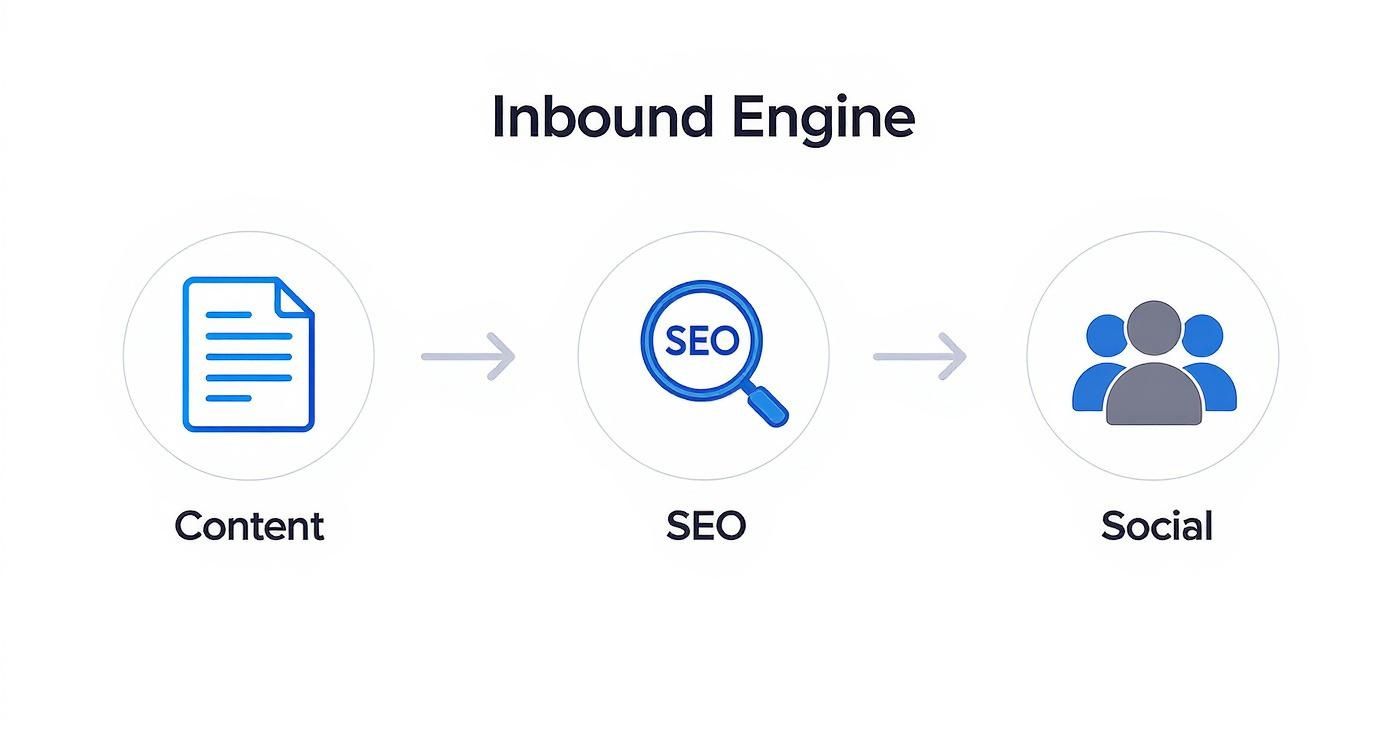
It’s a flywheel. Content, search, and social all feed each other, creating a constant loop that pulls prospects in.
Step 1: Find the Expensive Problems
Your entire inbound lead generation strategy lives or dies right here. Before you even think about writing, you have to get crystal clear on the urgent, expensive, and downright painful problems your ideal customers are trying to solve.
Generic content gets you a generic audience full of tire-kickers. Content that zeroes in on a specific, high-stakes problem? That’s what attracts buyers who are ready to talk.
Get on the phone with your best customers. Sit down with your sales team. What questions are they hearing over and over? What’s the one thing that keeps your ideal client up at night? Your job is to find a problem so painful that someone would gladly give you their email address for a chance at a solution.
Your best content ideas won't come from a brainstorming session; they'll come directly from your customers' mouths. The closer you get to their real-world pain, the more effective your inbound machine will be.
Step 2: Create the Definitive Guide
Once you've locked onto that core problem, it's time to create the ultimate solution. This becomes your pillar resource—a massive, all-encompassing piece of content that covers the topic from A to Z. Think of it as the bible on the subject.
This isn't just another blog post. It's an eBook, a deep-dive webinar, or a comprehensive playbook that establishes you as the go-to expert. If your ideal customer is struggling with "sales team efficiency," your pillar might be an eBook called "The Sales Productivity Playbook: How to Double Your Team's Output." This is the crown jewel of your campaign.
Step 3: Break It Down Into Bait
Look, nobody wakes up in the morning and decides to read a 50-page guide from a company they’ve never heard of. That massive pillar you just created is the destination, not the starting point. You need to "fracture" it into smaller, bite-sized pieces of micro-content designed to catch attention on different channels.
- Blog Posts: Each chapter of your eBook can become its own detailed, SEO-friendly blog post. For that sales productivity guide, you could pull out articles like "5 Must-Have Tools for High-Performing Sales Reps" or "The Secret to Running Sales Meetings That Actually Close Deals."
- LinkedIn Posts: Grab the most compelling stats, punchy quotes, or quick tips from your pillar and turn them into posts for your team to share. These are your social hooks.
- Short Videos: Film a few quick 60-second videos summarizing a key idea from the pillar. Perfect for grabbing attention on social feeds.
Every one of these little pieces acts as a breadcrumb trail leading people back to your main pillar resource. If you want to dive deeper into this, check out our guide on how to improve your B2B content strategy.
Step 4: Promote the Bait, Not the Book
Now that you have your army of micro-content, it's time to get it in front of the right people. This is where you use those core channels we talked about—SEO, social, maybe a little paid advertising—to put your smaller, snackable assets where your ideal customers hang out.
The rule is simple: every piece of micro-content needs a clear call-to-action (CTA) that points back to the main pillar. Your blog post on sales tools should end with something like, "Want the full system for boosting team efficiency? Download our complete playbook here."
Step 5: Convert Visitors into Leads
This is the final step where the magic happens. All that traffic you've generated gets sent to a dedicated landing page built for one thing and one thing only: getting people to download your pillar resource.
Keep the page clean, simple, and laser-focused on the value of what they're about to get. A clear headline, a few compelling bullet points, and a simple form to capture their info. That's it.
Once they fill out that form, boom—they're officially an inbound lead. Now you can start the process of nurturing that relationship and guiding them toward a real sales conversation. This five-step cycle is how you stop guessing and start building a pipeline you can count on.
How to Scale Your Inbound Strategy with Technology
A great inbound strategy built on killer content and solid SEO is a fantastic start. But trying to run it all by hand? That's like trying to fill a swimming pool with a thimble. It's slow, draining, and will absolutely capsize as you grow.
If you really want to scale your inbound lead generation and build a predictable pipeline, you have to bring in technology to do the heavy lifting. This is where you build the operational spine of your inbound machine.
Technology doesn't replace the human touch needed to build relationships. Instead, it supercharges it. It automates the mind-numbing tasks, personalizes communication at scale, and arms your sales team with the intel they need to close deals faster.
Without the right tech, leads will fall through the cracks. It's inevitable. Follow-ups get forgotten, prospect data is a mess, and your sales team wastes precious hours on tire-kickers. Let's fix that.
Automating Nurturing with Marketing Automation
At the core of any inbound system that can scale is a marketing automation platform. Think tools like HubSpot, Marketo, or Pardot. Their main job is to act as your central nervous system, tying all your marketing efforts together and automatically guiding leads through their journey.
The real magic here is the ability to trigger actions based on a lead's behavior. Instead of manually blasting out one-off emails, you build smart workflows that deliver the perfect message at the perfect time.
For instance, let’s say a new lead downloads your "Sales Productivity Playbook." Instead of a single "thanks for downloading" email, they're automatically dropped into a nurture sequence:
- Day 1: They get the playbook and a welcome email. Simple enough.
- Day 4: The system pings them with a link to a related blog post: "5 Must-Have Tools for High-Performing Sales Reps."
- Day 7: If they clicked that link, they get an invite to a webinar on sales efficiency. If they ignored it, maybe they get a different case study instead.
This is a screenshot of a visual workflow builder, which is the heart of most of these platforms.
This visual map lets you plot out every single step of a lead's journey, from the moment they convert to the second they become a sales-ready opportunity. Nobody gets left behind.
Supercharging Your System with AI
AI isn't some far-off concept anymore; it's a practical tool that adds a powerful layer of intelligence right on top of your automation. AI can spot data patterns way better than we can, helping you zero in on your best opportunities with uncanny accuracy.
One of the most obvious examples is the AI-powered chatbot. Instead of forcing a visitor to hunt around your site for answers, a chatbot can engage them instantly, answer their questions 24/7, and even qualify them as a lead before handing them off to a human. This immediate engagement is critical when a prospect's interest is red-hot.
AI is also completely changing how we understand lead quality. Predictive lead scoring uses algorithms to analyze the DNA of your best customers—their traits, their behaviors—to predict which of your current leads are most likely to buy. It goes way beyond simple scores like "opened 3 emails" and gives your sales team a prioritized list of their hottest prospects.
The results speak for themselves. Automation and AI have made inbound lead generation wildly more efficient. By 2025, 44% of companies worldwide are expected to use marketing automation for lead gen, and that number jumps to 55% for B2B. Even better, companies using AI for lead generation often report a 50% spike in sales-ready leads. Dive into these powerful lead generation statistics and trends to see the full picture.
When you build a system that marries robust automation with smart AI, you create a seamless pipeline. It's a machine that not only captures and nurtures leads but makes sure your sales team is only spending their time on conversations that actually turn into revenue. If you're looking to build a system that combines authority content with this kind of targeted outreach, you can learn more about how Growlancer builds predictable B2B pipelines.
Measuring Inbound Success With The Right Metrics

Running an inbound strategy without tracking the right numbers is like driving across the country blindfolded. You're definitely moving, but you have no clue if you're getting any closer to your destination.
To actually prove the value of your inbound lead generation and make smart decisions, you have to look past vanity metrics like social media likes. The real game is focusing on the data that directly impacts your revenue.
It's not about tracking every single data point you can find. It's about building a simple, powerful dashboard that tells a clear story: what’s working, what isn’t, and where your next dollar should go.
Foundational Traffic and Conversion Metrics
Before we even talk about lead quality, we need to know if we're getting people in the door and if they're raising their hands. These early metrics are the pulse check for the very top of your funnel.
The most important one right out of the gate is your Visitor-to-Lead Conversion Rate. Plain and simple, this tells you what percentage of people who land on your site actually take an action—filling out a form for an ebook, a webinar, or a demo.
If this number is low, it’s a massive red flag. It means there's a disconnect. Either your content isn't hitting home, or your landing pages just aren't convincing enough to get someone to hand over their email.
A strong Visitor-to-Lead Conversion Rate is your first real proof that the content is landing. It confirms you’re attracting the right crowd and offering them something they genuinely want.
This single number is your first big lever for improvement. By A/B testing headlines, calls-to-action, or even just the length of your forms, you can nudge this rate up and squeeze so much more value out of the traffic you already have.
Measuring Lead Quality and Funnel Progression
Getting leads is just step one. The real magic happens when you start measuring the quality of those leads and see how they move through your funnel toward an actual sale. This is where marketing’s work starts to look like real money to the sales team.
For this to work, sales and marketing must agree on the definitions. Without that alignment, you get the classic scenario: marketing celebrates hitting their lead goal while sales complains that the leads are all junk.
Here’s what you need to track at this stage:
- Marketing Qualified Leads (MQLs): These are the folks who fit your ideal customer profile and have shown real interest, like downloading multiple guides. Tracking the number of MQLs shows you the volume of high-potential leads your content is pulling in.
- Sales Qualified Leads (SQLs): An MQL becomes an SQL only after the sales team has talked to them and confirmed there’s a real, near-term opportunity. The MQL-to-SQL rate is the ultimate test of how well marketing is setting up sales for success.
Think of it like a relay race. The MQL-to-SQL rate is all about the handoff. A high rate means it was a smooth, perfect exchange.
To give you a clearer picture, here’s a quick breakdown of the core metrics you should have on your radar.
Key Performance Indicators for Inbound Success
This table summarizes the must-track metrics, what they actually measure, and why they’re so critical for B2B growth.
| Metric | What It Measures | Why It's Important |
|---|---|---|
| Visitor-to-Lead Rate | The percentage of website visitors who convert into a lead. | Shows if your content and offers are compelling to your target audience. |
| MQL Volume | The total number of leads that meet marketing's pre-defined qualification criteria. | Indicates the top-of-funnel health and the raw output of your content engine. |
| MQL-to-SQL Rate | The percentage of MQLs that the sales team accepts as qualified opportunities. | A direct measure of lead quality and the alignment between marketing and sales. |
| Cost Per Lead (CPL) | The average cost to acquire a single lead from a specific channel or campaign. | Reveals the efficiency of your marketing spend and helps you allocate budget wisely. |
| Lead-to-Customer Rate | The percentage of total leads that ultimately become paying customers. | The ultimate ROI metric; it measures the effectiveness of your entire funnel. |
Having these numbers at your fingertips transforms your inbound efforts from a "cost center" into a predictable revenue driver.
Tying Inbound Efforts Directly to Revenue
At the end of the day, your inbound program has to pay for itself. This is where you connect all the dots, from that first blog post someone reads all the way to a signed contract.
The two metrics that tell this story best are Cost Per Lead (CPL) and the Lead-to-Customer Rate.
CPL tells you exactly how efficient each of your channels is. You can quickly see which channels are a money pit and which ones are a goldmine, allowing you to double down on what’s actually working.
But the king of all metrics? The Lead-to-Customer Rate. This tells you what percentage of all the leads you generate end up buying something. It is the final report card for your entire inbound machine.
When you can confidently show a predictable conversion rate from lead to customer, you're no longer just running a marketing campaign. You've built a revenue engine.
Common Inbound Pitfalls You Need to Avoid
Let’s be honest. Even the most brilliant inbound lead generation strategies can fall flat. The real gap between a program that delivers a predictable pipeline and one that just burns cash often comes down to dodging a few common, totally avoidable mistakes.
Seeing these traps for what they are is the first step. It's how you build an inbound engine that doesn't just start strong but keeps running for the long haul.
A lot of teams get tripped up by impatience. Inbound is a marathon, not a sprint. You're building authority and trust from the ground up, and that simply takes time. If you're expecting a firehose of qualified leads in the first 30 days, you're setting yourself up for disappointment. Worse, you might pull the plug right before things start to click.
Another classic mistake? Creating content for everyone. Generic blog posts that try to please the entire internet end up connecting with no one. This "spray and pray" content is a massive waste of time and money, and it definitely won't attract the high-value prospects your sales team is dying to talk to.
Creating Without Promoting
I see this one all the time. It’s the old "if you build it, they will come" fantasy. You pour your heart and soul into a killer article, hit publish, and… crickets.
Publishing is only half the job. Without a real plan to get it in front of people, even the best content just gathers digital dust.
Promotion is what breathes life into your content. It’s the engine that turns a static PDF or blog post into an active lead-generating machine. This means you need a mix of plays to make sure your ideal customers actually see your stuff:
- SEO Optimization: This is non-negotiable. You have to make sure your content shows up when people are actively searching for solutions.
- Social Distribution: Don't just post and ghost. Actively share and discuss your content on platforms like LinkedIn, where your buyers are actually hanging out.
- Email Marketing: Your email list is gold. Send your new content to your subscribers to keep them engaged and give them something valuable to share.
Skipping promotion is like building a beautiful new store in the middle of a field with no roads leading to it. Pointless.
The Lead Nurturing Gap
Getting a lead isn’t the finish line—it’s the starting gun. A huge pitfall is capturing someone's email and then just letting them sit there until they go cold. This is what happens when you have no system for lead nurturing, which is really just the simple process of building a relationship and guiding someone toward a real sales conversation.
If you don’t have automated emails or a clear follow-up process, I guarantee you that potential deals are slipping through the cracks every single day.
Think about this: on average, a staggering 80% of converted leads never close. The single biggest thing you can do to beat those odds is to have a rock-solid lead management and nurturing process. It's the difference between collecting contacts and actually generating revenue.
Finally, there’s the age-old disconnect between sales and marketing. If your teams don't have a shared, crystal-clear definition of what a "qualified lead" actually is, you're doomed. Marketing will be high-fiving over vanity metrics while the sales team complains that the leads are garbage.
This misalignment creates constant friction and ensures your inbound machine never finds its groove. Get ahead of these pitfalls, and you'll be on your way to building a powerful inbound strategy that actually works.
Your Top Questions Answered
When you're digging into inbound lead generation, a few questions always pop up. Let's tackle the big ones I hear most often from B2B founders and leaders.
How Long Does This Inbound Thing Actually Take to Work?
Look, inbound is a long game, not a quick fix. If anyone tells you otherwise, they're selling you something.
You might get some early sparks of interest, but you really need three to six months to see real momentum from your content and SEO efforts. Think of it like planting a tree, not flipping a switch. You're building assets that compound over time. A single blog post that hits the right nerve and ranks well can keep bringing in leads for years—something a paid ad that vanishes when you stop paying can never do.
MQL vs. SQL: What’s the Real Difference?
It all comes down to one thing: a lead's readiness to have a sales conversation.
-
Marketing Qualified Lead (MQL): This is someone who's kicking the tires. They've downloaded your ebook or signed up for a webinar. They fit your target profile and are clearly interested, but they aren't ready to buy just yet. Pushing them to sales now would be premature.
-
Sales Qualified Lead (SQL): This is an MQL who has been properly vetted and is now raising their hand. The sales team has confirmed they have a real, pressing need and the authority to make a decision. This is who you want your reps spending their time with.
Getting your marketing and sales teams to agree on a crystal-clear definition of an MQL and an SQL is the single most important thing you can do to stop friction and align everyone on driving revenue.
Can a Small Business Really Do Inbound on a Shoestring Budget?
Absolutely. In fact, it's one of the smartest plays a small business can make.
Instead of burning cash on ads, your main investment is your own time and expertise. Inbound is the great equalizer. You don't need a massive budget if you focus on a tight niche and create genuinely helpful content that solves one specific, painful problem for your audience. That's how you build real authority and attract high-quality leads that your bigger competitors, with their generic content, will miss.
Ready to build a predictable sales pipeline on LinkedIn without all the guesswork? Growlancer combines expert strategy, authority content, and targeted outreach to get your leadership team in front of ideal buyers and book qualified meetings. Discover how Growlancer can build your revenue engine.